Browse by Category
Fiction
- Action & Adventure
- African American
- Anthologies
- Children's Fiction
- Classics
- Comics & Graphic Novels
- Coming of Age
- Contemporary
- Cultural & Regional
- Drama
- Erotica
- Fantasy
- General
- Historical Fiction
- Horror
- Humor & Satire
- Literary Fiction
- Mystery, Thriller & Suspense
- Poetry
- Religious & Inspirational
- Romance
- Science Fiction
- Short Stories
- War & Military
- Westerns
- Women's Fiction
- Young Adult
Non-Fiction
- Antiques & Collectibles
- Arts & Photography
- Biographies & Memoirs
- Business & Money
- Children's Non-Fiction
-
Computers & Technology
- Artificial Intelligence
- Computer Science
- Cybersecurity & Cryptography
- Data Science & Analytics
- Databases & Big Data
- Game Development & Design
- General
- Hardware & DIY
- Mobile App Development
- Networking & Cloud Computing
- Operating Systems
- Programming
- Robotics
- Software
- Software Engineering
- User Experience (UX) & Design
- Web Development & Design
- Cooking, Food & Wine
- Crafts, Hobbies & Home
- Education & Teaching
- Engineering
- General
- Health, Fitness & Dieting
-
History
- African History
- African History - North Africa
- African History - Sub-Saharan Africa
- American History
- American History - 20th Century
- American History - Civil War
- American History - Colonial Period
- Ancient History
- Asian History
- Asian History - China
- Asian History - India
- Asian History - Japan
- Asian History - Southeast Asia
- European History
- European History - Ancient Greece
- European History - Ancient Rome
- European History - Medieval
- European History - Modern
- European History - Renaissance
- General
- Middle Eastern History
- Military History
- Military History - Aviation
- Military History - Naval
- Social & Cultural History
- World History
- Humor & Entertainment
- Industrial Technology
- Language Learning
- Law
- LGBTQ+ Non-Fiction
- Literary Criticism
- Medical Books
- Parenting & Relationships
- Philosophy
- Politics & Social Sciences
- Reference
- Religion & Spirituality
-
Science & Math
- Agricultural Sciences
- Astronomy & Space Science
- Behavioral Sciences
- Biological Sciences
- Botany & Plant Science
- Chemistry
- Earth Sciences
- Engineering - Chemical
- Engineering - Civil
- Engineering - Electrical
- Engineering - Mechanical
- Environment
- General
- Geology
- Mathematics
- Nature & Ecology
- Oceanography
- Paleontology
- Physics
- Statistics
- Self-Help
- Sports & Outdoors
- Study Aids
- Sustainability & Green Living
- Textbooks
- Transportation
- Travel
- True Crime
- Urban Planning & Development
- Veterinary Medicine
- Writing & Publishing
Jump to Section

Want unlimited access to all books published by MixCache.com (plus their audiobooks)? Try MixCache.com Total Access. Look for the MTA badge on book covers to identify included titles.
Access to infinite ebooks: Don't see the book you want? Suggest it and we'll create it (free!) for you from scratch with our powerful AI book writer. Then read it with MTA - besides profiting from any sales it makes!
Trajectories of Tomorrow: Scenarios for Humanity's Expansion into Space
MTA
Plausible roadmaps, risks, and ethical considerations for solar system settlement and beyond
About this book:
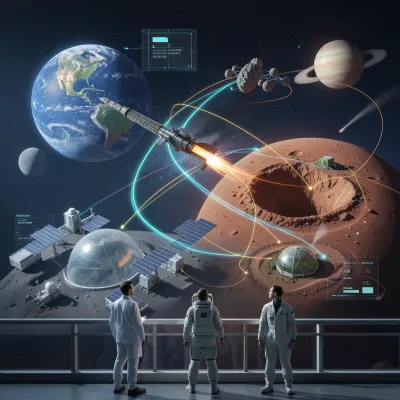
*Trajectories of Tomorrow* provides a comprehensive foresight analysis of humanity’s transition from episodic space exploration to permanent solar system settlement. The book argues that declining launch costs, maturing autonomous systems, and emerging cislunar infrastructure have created a unique window for expansion. However, it emphasizes that this progress is not inevitable; it requires a deliberate integration of technological readiness (TRLs), economic sustainability, and polycentric governance. By utilizing tools like scenario planning and backcasting, the text maps various pathways—including lunar polar industry, Mars colonization, and asteroid mining—not as singular forecasts, but as a portfolio of choices that must be balanced against technical bottlenecks and "tail risks" like debris cascades.
Central to the book’s thesis is the shift from a "flags and footprints" model to a "nodes and links" infrastructure. This involves the development of a solar system internet, orbital propellant depots, and standardized interoperability that allows diverse national and commercial actors to cooperate. The text explores the critical role of In-Situ Resource Utilization (ISRU) and advanced propulsion (chemical, electric, and nuclear) in breaking the "tyranny of the rocket equation." It grounds these technical ambitions in the practical realities of financing, suggesting that government anchor tenancy and blended public-private models are essential to bridge the "valley of death" for long-term frontier investments.
Beyond engineering, the book dedicates significant focus to the biological, ethical, and geopolitical dimensions of spacefaring. It examines the physiological stresses of microgravity and radiation, the psychological challenges of isolation, and the necessity of closed-loop life support systems. Ethically, the authors grapple with the "ethics of extraction," debating how to balance property rights with the concept of space as a global commons and the responsibility of intergenerational justice. The text warns that without established norms and conflict-prevention mechanisms, dual-use technologies and resource competition could turn the high frontier into an arena of instability.
The concluding chapters look toward the 22nd century, discussing interstellar precursor missions and the long-term policy frameworks required for a multi-planetary species. The book argues that the trajectory of 2100 and beyond will be defined by the "pace of expansion" and the governance models chosen today. Ultimately, it serves as a roadmap for decision-makers, advocating for a resilient, transparent, and standards-based approach to ensure that humanity’s expansion is not only technically feasible but also ethically sound and socially enduring.
What You'll Find Inside:
- Comprehensive foresight toolkit including horizon scanning, Delphi studies, scenario planning, and backcasting methods specifically adapted for space expansion planning
- Structured readiness assessment frameworks (TRLs, MRLs, SRLs) with practical examples showing how to identify technological bottlenecks and maturation pathways
- Comparative analysis of economic foundations covering energy systems, launch economics, and emerging in-space markets for propellant, manufacturing, and resource utilization
- Detailed roadmaps for multiple expansion pathways (lunar polar industry, Mars settlement, asteroid logistics, free-space habitats) with explicit trade-offs and decision points
- Integrated treatment of governance, ethics, and risk management including polycentric institutions, intergenerational justice, and resilience engineering for long-term space activities
Who's It For:
This book is designed for space policy planners, systems engineers, and technology managers who need to make long-term investment decisions under deep uncertainty. It will also benefit economists analyzing space markets, ethicists examining the societal implications of expansion, and advanced students in aerospace engineering or space policy who seek integrated frameworks for evaluating humanity's multi-planetary future. Professionals involved in international space cooperation, commercial space ventures, or national space strategy development will find particular value in its comparative roadmaps and decision-making tools.
Author:
Published By:
Date Published:
May 3, 2026
Type:
Nonfiction
Language:
English
Word Count:
64,780 words
Reading Time:
4 hours 32 minutes
Sample:
Order:
Order Trajectories of Tomorrow: Scenarios for Humanity's Expansion into Space (Paperback) on MixCache.com:
Buy NowPrint copy is made to order and ships worldwide. Includes the ebook free, ready to read instantly.
$5 account credit for all new MixCache.com accounts, usable toward any ebook purchase!*