
Browse by Category
Fiction
- Action & Adventure
- African American
- Anthologies
- Children's Fiction
- Classics
- Comics & Graphic Novels
- Coming of Age
- Contemporary
- Cultural & Regional
- Drama
- Erotica
- Fantasy
- General
- Historical Fiction
- Horror
- Humor & Satire
- Literary Fiction
- Mystery, Thriller & Suspense
- Poetry
- Religious & Inspirational
- Romance
- Science Fiction
- Short Stories
- War & Military
- Westerns
- Women's Fiction
- Young Adult
Non-Fiction
- Antiques & Collectibles
- Arts & Photography
- Biographies & Memoirs
- Business & Money
- Children's Non-Fiction
-
Computers & Technology
- Artificial Intelligence
- Computer Science
- Cybersecurity & Cryptography
- Data Science & Analytics
- Databases & Big Data
- Game Development & Design
- General
- Hardware & DIY
- Mobile App Development
- Networking & Cloud Computing
- Operating Systems
- Programming
- Robotics
- Software
- Software Engineering
- User Experience (UX) & Design
- Web Development & Design
- Cooking, Food & Wine
- Crafts, Hobbies & Home
- Education & Teaching
- Engineering
- General
- Health, Fitness & Dieting
-
History
- African History
- African History - North Africa
- African History - Sub-Saharan Africa
- American History
- American History - 20th Century
- American History - Civil War
- American History - Colonial Period
- Ancient History
- Asian History
- Asian History - China
- Asian History - India
- Asian History - Japan
- Asian History - Southeast Asia
- European History
- European History - Ancient Greece
- European History - Ancient Rome
- European History - Medieval
- European History - Modern
- European History - Renaissance
- General
- Middle Eastern History
- Military History
- Military History - Aviation
- Military History - Naval
- Social & Cultural History
- World History
- Humor & Entertainment
- Industrial Technology
- Language Learning
- Law
- LGBTQ+ Non-Fiction
- Literary Criticism
- Medical Books
- Parenting & Relationships
- Philosophy
- Politics & Social Sciences
- Reference
- Religion & Spirituality
-
Science & Math
- Agricultural Sciences
- Astronomy & Space Science
- Behavioral Sciences
- Biological Sciences
- Botany & Plant Science
- Chemistry
- Earth Sciences
- Engineering - Chemical
- Engineering - Civil
- Engineering - Electrical
- Engineering - Mechanical
- Environment
- General
- Geology
- Mathematics
- Nature & Ecology
- Oceanography
- Paleontology
- Physics
- Statistics
- Self-Help
- Sports & Outdoors
- Study Aids
- Sustainability & Green Living
- Textbooks
- Transportation
- Travel
- True Crime
- Urban Planning & Development
- Veterinary Medicine
- Writing & Publishing
Jump to Section
MixCache.com Total Access
Unlimited reading and audiobooks for every book published by MixCache.com.
Included titles carry the MTA badge.
Learn more →
Tehran Unveiled: Urban Life, Architecture, and Social Change
MTA
An urban studies perspective on Tehran's transformation, planning challenges, and popular culture
About this book:
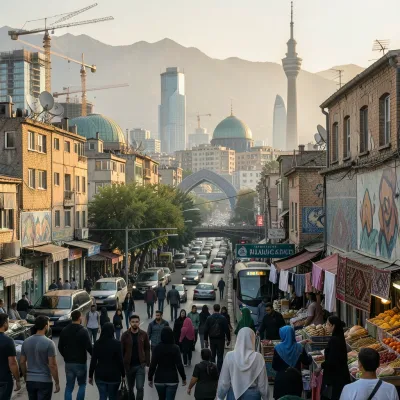
"Tehran Unveiled" offers a comprehensive urban studies perspective on Tehran, dissecting its complex transformation through lenses of urban life, architecture, and social change. The book portrays Tehran as a city of paradoxes, where rapid growth, environmental constraints, and social aspirations constantly collide. It emphasizes that the city is not merely a built environment but a dynamic "urban laboratory" shaped by historical legacies, ecological conditions, political projects, and the everyday experiences of its millions of inhabitants.
The narrative delves into Tehran's historical evolution, from a small settlement to a sprawling metropolis, highlighting how topography, fault lines, and migration waves have sculpted its physical form and demographic profile. Chapters explore critical urban systems such as housing markets, public transit (metro and BRT), and the pervasive challenges of traffic congestion and air pollution. The book reveals how the promise of homeownership confronts speculative markets, while informal settlements emerge as resilient, self-organized communities addressing housing needs where formal planning falls short. Environmental concerns, particularly water scarcity and waste management, are framed as intrinsic to Tehran's "urban metabolism," revealing the high costs of its resource-hungry growth.
Beyond infrastructure and economics, "Tehran Unveiled" examines the city's social and cultural dimensions, exploring the nuanced "choreography of urban space" as experienced by different genders and generations in streets, squares, and commercial hubs like the bazaar and burgeoning malls. It uses case studies, such as the planned cooperative community of Ekbatan and the gridded neighborhood of Narmak, alongside an in-depth analysis of Valiasr Street, to illustrate the interplay between grand master plans and grassroots adaptation. The book concludes by exploring the evolving landscape of "Digital Tehran," analyzing how platforms, data, and smart-city promises are reshaping governance, popular culture, and the very fabric of metropolitan life, often challenging traditional notions of control and public participation.
What You'll Find Inside:
- Examines Tehran's urban history as a palimpsest of planning intentions, migration waves, and environmental constraints that shape its contemporary form.
- Analyzes housing markets, homeownership aspirations, informal settlements, and cooperative models like Ekbatan as lenses for understanding social inequality and the right to the city.
- Explores mobility systems—from sidewalks and bike lanes to metro, BRT, and car dependence—highlighting how topography, policy, and cultural practices produce spatial inequities.
- Investigates Tehran's environmental metabolism: water scarcity, air pollution, waste management, green space, and seismic risk as interwoven challenges of urban resilience.
- Traces the role of culture, media, popular practices, and digital platforms in negotiating identity, public space, and grassroots activism amid rapid urban change.
Who's It For:
This book is suited for urban studies scholars, city planners, policymakers, and graduate students interested in Middle Eastern metropolitan dynamics, as well as practitioners working on housing, transportation, and environmental resilience in rapidly growing cities. It will also appeal to residents of Tehran and urban enthusiasts seeking a nuanced, multidimensional understanding of how the city's physical form, social life, and governance intersect.
Table of Contents:
- Introduction
- Chapter 1 City of Contrasts: A Brief Urban History
- Chapter 2 Topography, Fault Lines, and the City’s Form
- Chapter 3 Migration, Demography, and the Pace of Growth
- Chapter 4 Housing Markets and the Promise of Homeownership
- Chapter 5 Informal Settlements and the Right to the City
- Chapter 6 Mega-Projects, Master Plans, and the Politics of Space
- Chapter 7 Everyday Mobility: From Sidewalk to Superhighway
- Chapter 8 The Metro, BRT, and the Future of Public Transit
- Chapter 9 Traffic, Air, and the Costs of Congestion
- Chapter 10 Water, Waste, and Urban Metabolism
- Chapter 11 Green Space, Mountains, and the Ecologies of Relief
- Chapter 12 Earthquakes, Risk, and Urban Resilience
- Chapter 13 Architectural Typologies: Courtyards to Towers
- Chapter 14 Heritage, Modernism, and Conservation Debates
- Chapter 15 Streets, Squares, and the Making of Public Life
- Chapter 16 The Bazaar, the Mall, and Shifting Economies
- Chapter 17 Gender, Youth, and the Choreography of Urban Space
- Chapter 18 Housing Cooperatives and the Ekbatan Experiment
- Chapter 19 Neighborhood Case Study: Narmak’s 100 Squares
- Chapter 20 Valiasr Street: Axis of Movement and Memory
- Chapter 21 Peri-Urban Tehran: Sprawl, Satellites, and New Towns
- Chapter 22 Municipal Governance and the Political Economy of Planning
- Chapter 23 Finance, Land, and the Speculative City
- Chapter 24 Media, Music, and Popular Culture in the Metropolis
- Chapter 25 Digital Tehran: Platforms, Data, and Smart-City Promises
Author:
Published By:
Date Published:
May 1, 2026
Type:
Nonfiction
Language:
English
Word Count:
79,317 words
Reading Time:
5 hours 33 minutes
Sample:
Order:
Order Tehran Unveiled: Urban Life, Architecture, and Social Change (Paperback) on MixCache.com:
Buy NowPrint copy is made to order and ships worldwide. Includes the ebook free, ready to read instantly.
$5 account credit for all new MixCache.com accounts, usable toward any ebook purchase!*


