
Browse by Category
Fiction
- Action & Adventure
- African American
- Anthologies
- Children's Fiction
- Classics
- Comics & Graphic Novels
- Coming of Age
- Contemporary
- Cultural & Regional
- Drama
- Erotica
- Fantasy
- General
- Historical Fiction
- Horror
- Humor & Satire
- Literary Fiction
- Mystery, Thriller & Suspense
- Poetry
- Religious & Inspirational
- Romance
- Science Fiction
- Short Stories
- War & Military
- Westerns
- Women's Fiction
- Young Adult
Non-Fiction
- Antiques & Collectibles
- Arts & Photography
- Biographies & Memoirs
- Business & Money
- Children's Non-Fiction
-
Computers & Technology
- Artificial Intelligence
- Computer Science
- Cybersecurity & Cryptography
- Data Science & Analytics
- Databases & Big Data
- Game Development & Design
- General
- Hardware & DIY
- Mobile App Development
- Networking & Cloud Computing
- Operating Systems
- Programming
- Robotics
- Software
- Software Engineering
- User Experience (UX) & Design
- Web Development & Design
- Cooking, Food & Wine
- Crafts, Hobbies & Home
- Education & Teaching
- Engineering
- General
- Health, Fitness & Dieting
-
History
- African History
- African History - North Africa
- African History - Sub-Saharan Africa
- American History
- American History - 20th Century
- American History - Civil War
- American History - Colonial Period
- Ancient History
- Asian History
- Asian History - China
- Asian History - India
- Asian History - Japan
- Asian History - Southeast Asia
- European History
- European History - Ancient Greece
- European History - Ancient Rome
- European History - Medieval
- European History - Modern
- European History - Renaissance
- General
- Middle Eastern History
- Military History
- Military History - Aviation
- Military History - Naval
- Social & Cultural History
- World History
- Humor & Entertainment
- Industrial Technology
- Language Learning
- Law
- LGBTQ+ Non-Fiction
- Literary Criticism
- Medical Books
- Parenting & Relationships
- Philosophy
- Politics & Social Sciences
- Reference
- Religion & Spirituality
-
Science & Math
- Agricultural Sciences
- Astronomy & Space Science
- Behavioral Sciences
- Biological Sciences
- Botany & Plant Science
- Chemistry
- Earth Sciences
- Engineering - Chemical
- Engineering - Civil
- Engineering - Electrical
- Engineering - Mechanical
- Environment
- General
- Geology
- Mathematics
- Nature & Ecology
- Oceanography
- Paleontology
- Physics
- Statistics
- Self-Help
- Sports & Outdoors
- Study Aids
- Sustainability & Green Living
- Textbooks
- Transportation
- Travel
- True Crime
- Urban Planning & Development
- Veterinary Medicine
- Writing & Publishing
Jump to Section
MixCache.com Total Access
Unlimited reading and audiobooks for every book published by MixCache.com.
Included titles carry the MTA badge.
Learn more →
Invasion
MTA
The Conquest of the New World
About this book:
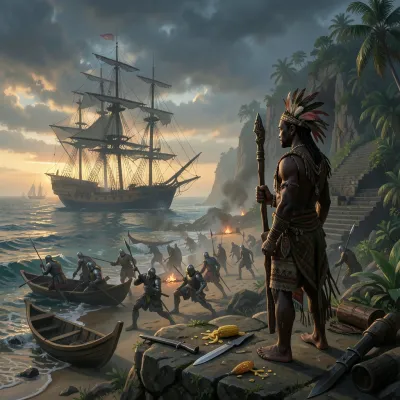
*Invasion: The Conquest of the New World* provides a comprehensive examination of the centuries-long transformation of the Americas following Christopher Columbus’s 1492 landfall. The book moves beyond traditional narratives of discovery to detail the systemic machinery of empire, tracing the transition from initial Caribbean landfalls to the formation of complex, stratified colonial societies. It explores the interplay of military force, legal fictions like the Treaty of Tordesillas, and the institutionalization of labor extraction through systems such as the *encomienda*, which paved the way for the massive wealth generated by Mexican and Andean silver and the brutal Atlantic slave trade.
The text emphasizes that European expansion was never a singular event but a prolonged period of improvisation and contingency. The "Great Dying"—the demographic collapse of Indigenous populations due to novel pathogens—is presented as a pivotal force that facilitated conquest and created the labor vacuums filled by the forced migration of millions of Africans. This biological and cultural "Columbian Exchange" fundamentally reshaped the global landscape, introducing new plants and animals while entrenching a plantation economy that linked the fates of three continents.
Central to the narrative is the theme of Indigenous and African agency. Rather than depicting these groups as passive victims, the book highlights varied forms of resistance, ranging from the open warfare of the Mapuche and the Pueblo Revolt to the subtle preservation of traditions within missions and the creation of maroon communities. The emergence of *mestizaje*—the mixing of European, Indigenous, and African peoples—is shown to have undermined rigid colonial hierarchies, creating fluid identities that defined urban centers like Mexico City, Lima, and Havana.
Ultimately, the work assesses the intellectual and administrative legacies of empire, specifically the Bourbon and Pombaline reforms that sought to modernize and centralize control over the colonies. By the late eighteenth century, the Americas had evolved into a landscape of deep-seated fault lines between law and violence, and between extraction and survival. The book concludes that the conquest did not end with the fall of empires but persists in the social, economic, and cultural structures of the modern Americas, where the legacies of this violent encounter remain powerfully present.
What You'll Find Inside:
- The book traces the earliest European landfalls in the Caribbean and how initial motives shifted from gold to sugar, establishing the plantation economy and reliance on enslaved African labor.
- It analyzes the legal and ideological foundations of conquest, including papal bulls, the Treaty of Tordesillas, and the encomienda system, showing how claims of legitimacy masked exploitation.
- It details the catastrophic impact of Old World diseases on Indigenous populations—the 'Great Dying'—and how this demographic collapse reshaped labor demands and enabled the rise of African slavery.
- It examines the Columbian Exchange, the flow of silver from Potosí, and the global economic integration that linked American mines and plantations to European and Asian markets.
- It highlights diverse forms of Indigenous and African resistance, cultural syncretism (mestizaje), and the enduring legacies of conquest in shaping colonial societies and modern Americas.
Who's It For:
This book is suited for undergraduate and graduate students of history, particularly those focusing on colonial Latin America, Atlantic world studies, or early modern global history. It will also benefit general readers seeking a comprehensive, nuanced understanding of how European conquest, disease, labor systems, and cultural exchange interacted to reshape the Americas. Scholars interested in the interplay of law, economics, and resistance in empire-building will find its detailed analysis valuable.
Table of Contents:
- Introduction
- Chapter 1 First Landfalls, 1492–1493
- Chapter 2 The Papal Divide: Tordesillas and the Right to Conquer
- Chapter 3 Gold, Sugar, and the Birth of the Caribbean Colonies
- Chapter 4 Encomienda and Early Colonial Society
- Chapter 5 Cortés and the Aztec War of Conquest
- Chapter 6 Pizarro and the Inca Cataclysm
- Chapter 7 Disease, Demography, and the Great Dying
- Chapter 8 The Columbian Exchange: Plants, Animals, and Pathogens
- Chapter 9 Potosí and the Silver Empire
- Chapter 10 Brazil: Sugar, Slavery, and the Portuguese Advance
- Chapter 11 The Atlantic Slave Trade and the Making of the Americas
- Chapter 12 Missions and Conversions: Franciscans, Dominicans, Jesuits
- Chapter 13 Resistance and Revolt: Mapuche, Pueblo, and Beyond
- Chapter 14 Women, Families, and Mestizaje
- Chapter 15 Law, Violence, and the Debate over Empire
- Chapter 16 Frontiers and Borderlands: Northern New Spain and Florida
- Chapter 17 France in the St. Lawrence and the Mississippi
- Chapter 18 England and the Chesapeake: Jamestown to Tobacco
- Chapter 19 New England: Puritans, the Pequot War, and Metacom’s Uprising
- Chapter 20 The Dutch Atlantic and New Netherland
- Chapter 21 Pirates, Privateers, and Imperial Rivalries
- Chapter 22 Urban Worlds: Mexico City, Lima, and Havana
- Chapter 23 Mapping, Science, and the Idea of the “New World”
- Chapter 24 Reforming Empire: Bourbon and Pombaline Projects
- Chapter 25 From Conquest to Colonial Societies: Legacies and Fault Lines
Author:
Published By:
Date Published:
April 30, 2026
Type:
Nonfiction
Language:
English
Word Count:
61,913 words
Reading Time:
4 hours 20 minutes
Sample:
MixCache.com Total Access
Get unlimited access to this book + all books published by MixCache.com for $11.99/month
Subscribe to MTAOr purchase this book individually below
Order:
Buy the Invasion ebook on MixCache.com:
Buy Now
Full ebook will be available immediately
- read online or download as a PDF file.
$5 account credit for all new MixCache.com accounts, usable toward any ebook purchase!*



Ratings & Reviews
Ask Questions About This Book
Have a question about the content? Ask our AI assistant!
Start by asking a question about "Invasion"
Example: "Does this book mention William Shakespeare?"
Thinking...