Browse by Category
Fiction
- Action & Adventure
- African American
- Anthologies
- Children's Fiction
- Classics
- Comics & Graphic Novels
- Coming of Age
- Contemporary
- Cultural & Regional
- Drama
- Erotica
- Fantasy
- General
- Historical Fiction
- Horror
- Humor & Satire
- Literary Fiction
- Mystery, Thriller & Suspense
- Poetry
- Religious & Inspirational
- Romance
- Science Fiction
- Short Stories
- War & Military
- Westerns
- Women's Fiction
- Young Adult
Non-Fiction
- Antiques & Collectibles
- Arts & Photography
- Biographies & Memoirs
- Business & Money
- Children's Non-Fiction
-
Computers & Technology
- Artificial Intelligence
- Computer Science
- Cybersecurity & Cryptography
- Data Science & Analytics
- Databases & Big Data
- Game Development & Design
- General
- Hardware & DIY
- Mobile App Development
- Networking & Cloud Computing
- Operating Systems
- Programming
- Robotics
- Software
- Software Engineering
- User Experience (UX) & Design
- Web Development & Design
- Cooking, Food & Wine
- Crafts, Hobbies & Home
- Education & Teaching
- Engineering
- General
- Health, Fitness & Dieting
-
History
- African History
- African History - North Africa
- African History - Sub-Saharan Africa
- American History
- American History - 20th Century
- American History - Civil War
- American History - Colonial Period
- Ancient History
- Asian History
- Asian History - China
- Asian History - India
- Asian History - Japan
- Asian History - Southeast Asia
- European History
- European History - Ancient Greece
- European History - Ancient Rome
- European History - Medieval
- European History - Modern
- European History - Renaissance
- General
- Middle Eastern History
- Military History
- Military History - Aviation
- Military History - Naval
- Social & Cultural History
- World History
- Humor & Entertainment
- Industrial Technology
- Language Learning
- Law
- LGBTQ+ Non-Fiction
- Literary Criticism
- Medical Books
- Parenting & Relationships
- Philosophy
- Politics & Social Sciences
- Reference
- Religion & Spirituality
-
Science & Math
- Agricultural Sciences
- Astronomy & Space Science
- Behavioral Sciences
- Biological Sciences
- Botany & Plant Science
- Chemistry
- Earth Sciences
- Engineering - Chemical
- Engineering - Civil
- Engineering - Electrical
- Engineering - Mechanical
- Environment
- General
- Geology
- Mathematics
- Nature & Ecology
- Oceanography
- Paleontology
- Physics
- Statistics
- Self-Help
- Sports & Outdoors
- Study Aids
- Sustainability & Green Living
- Textbooks
- Transportation
- Travel
- True Crime
- Urban Planning & Development
- Veterinary Medicine
- Writing & Publishing
Jump to Section
MixCache.com Total Access
Unlimited reading and audiobooks for every book published by MixCache.com.
Included titles carry the MTA badge.
Learn more →
Buddhism’s Journey
MTA
From Northern India to East Asia: Texts, Missions, and Monastic Networks
About this book:

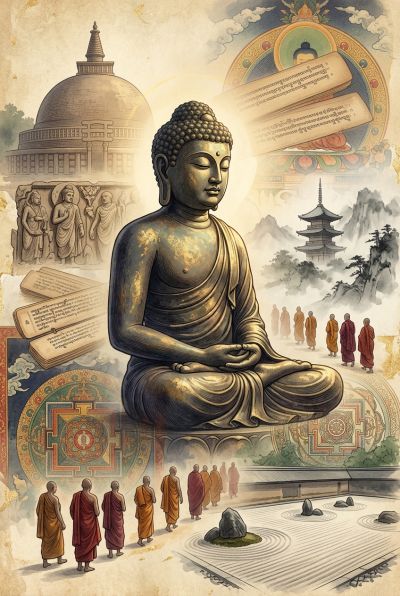
*Buddhism’s Journey* traces the expansion of the faith from its origins in the Ganges heartland across the diverse cultural landscapes of Asia. The narrative begins with the formation of the early Sangha and the pivotal imperial patronage of Ashoka, which transformed a regional movement into a missionary religion. Facilitated by the Silk Road's caravan corridors and maritime monsoon routes, the Dharma migrated through the Greco-Buddhist crucible of Gandhara and the oasis kingdoms of the Tarim Basin, eventually reaching China. This transmission was anchored by the monumental labor of translators like Kumārajīva and the intrepid journeys of pilgrims such as Xuanzang, who bridged Indic and Sinic worlds.
As Buddhism localized in East Asia, it underwent profound philosophical and institutional shifts. The book details the migration of Madhyamaka and Yogācāra doctrines, which evolved into distinct Chinese, Korean, and Japanese schools. Central to this process was the materiality of the faith—the transition from birch bark and palm leaf to the revolutionary technology of woodblock printing, culminating in massive undertakings like the *Tripitaka Koreana*. The text highlights how specific scriptures, particularly the *Lotus* and *Flower Garland* sutras, shaped regional spiritual identities and inspired a vast corpus of art, iconography, and vernacular literature.
The latter half of the book explores the specific trajectories of the Southern and Eastern lineages. It examines Sri Lanka’s role as the persistent guardian of Theravāda orthodoxy and its influence on the kingdoms of Southeast Asia, such as Pagan and Ayutthaya. Simultaneously, it maps the unique development of Tantric currents on the Tibetan plateau and the populist "Kamakura Turn" in Japan. Throughout these transitions, the narrative emphasizes the role of monastic economies, the agency of female patrons, and the integration of Buddhist practice with indigenous folk cults and state governance.
The final chapters address the resilience of Buddhism through historical crises, including state-sponsored persecutions and colonial encounters. In the modern era, the Dharma has transitioned from traditional imperial structures to globalized networks, characterized by reform movements, "Humanistic Buddhism," and the digital dissemination of teachings. Ultimately, the book presents Buddhism not as a static set of beliefs, but as a "braided river system"—a dynamic, adaptable tradition that has continuously refashioned itself while maintaining a core commitment to the path of enlightenment.
What You'll Find Inside:
- Traces Buddhism’s expansion from the Ganges heartland across Central Asia via Silk Road caravans and maritime monsoon routes, showing how trade networks carried monks, texts, and relics.
- Examines imperial patronage—from Ashoka’s missionary edicts to Kushan and Tang support—and its role in founding monasteries, stupas, and translation bureaus.
- Highlights the transformative translation work of figures like Kumārajīva and Xuanzang, whose precise renderings shaped Chinese Buddhist doctrine and canon.
- Details the doctrinal migrations of Madhyamaka and Yogācāra into East Asia and their influence on indigenous schools such as Tiantai, Huayan, Chan, and Pure Land.
- Explores the material culture of Buddhist texts—from birch bark and palm-leaf manuscripts to woodblock printing—and the economic foundations of monastic communities tied to land, labor, and state relations.
Who's It For:
This book is ideal for scholars and students of Asian religions, Buddhist studies, and world history who seek a comprehensive, interdisciplinary account of Buddhism’s trans-Asian journey. It will also appeal to general readers interested in how ideas, art, and institutions travel across cultures, offering rich insights into the interplay of trade, translation, patronage, and local adaptation that shaped East Asian Buddhism.
Table of Contents:
- Introduction
- Chapter 1 The Ganges Heartland: Early Communities and Canon Formation
- Chapter 2 Ashoka and Imperial Patronage: Missions and Moral Geography
- Chapter 3 Monsoon and Caravan: Trade Routes as Vectors of Dharma
- Chapter 4 Gandhara and the Kushan Nexus: Greco-Buddhist Encounters
- Chapter 5 From Taxila to Khotan: Crossing the Northwest Frontier
- Chapter 6 Oases of the Tarim: Monasteries along the Silk Road
- Chapter 7 Translators and Go-Betweens: Early Chinese Buddhist Contacts
- Chapter 8 Kumārajīva and the Chang’an Turn: Rendering Sanskrit into Chinese
- Chapter 9 Doctrinal Migrations: Madhyamaka and Yogācāra in East Asia
- Chapter 10 Scripts, Surfaces, and Seals: Manuscripts from Birch Bark to Paper
- Chapter 11 Pilgrims’ Paths: Faxian, Xuanzang, and Yijing
- Chapter 12 The Lotus and the Flower Garland: Sutras that Shaped East Asia
- Chapter 13 Monastic Economies: Land, Labor, and State Relations
- Chapter 14 Images in Motion: Iconography, Relics, and Portable Shrines
- Chapter 15 Tibet and the High Plateau: Tantric Currents and Translation
- Chapter 16 Korea’s Gateways: Silla Networks and Goryeo’s Canon
- Chapter 17 Japan’s Adaptations: Nara, Heian, and the Kamakura Turn
- Chapter 18 Sri Lanka and Theravāda Lineages: A Southern Pivot
- Chapter 19 Mainland Southeast Asia: Pagan, Ayutthaya, and Lanna Connections
- Chapter 20 Maritime Routes: From the Bay of Bengal to the South China Sea
- Chapter 21 Women, Patronage, and Pious Mobility
- Chapter 22 Printing the Dharma: From Dunhuang to the Tripitaka Koreana
- Chapter 23 Crisis and Continuity: Persecution, Reform, and Resilience
- Chapter 24 Localizing the Buddha: Vernacular Literatures and Folk Cults
- Chapter 25 Modern Echoes: Colonial Encounters, Reform, and Global Circuits
Author:
Published By:
Date Published:
March 7, 2026
Type:
Nonfiction
Language:
English
Word Count:
46,422 words
Reading Time:
3 hours 15 minutes
Sample:
Order:
Order Buddhism’s Journey (Paperback) on MixCache.com:
Buy NowPrint copy is made to order and ships worldwide. Includes the ebook free, ready to read instantly.
$5 account credit for all new MixCache.com accounts, usable toward any ebook purchase!*