
Browse by Category
Fiction
- Action & Adventure
- African American
- Anthologies
- Children's Fiction
- Classics
- Comics & Graphic Novels
- Coming of Age
- Contemporary
- Cultural & Regional
- Drama
- Erotica
- Fantasy
- General
- Historical Fiction
- Horror
- Humor & Satire
- Literary Fiction
- Mystery, Thriller & Suspense
- Poetry
- Religious & Inspirational
- Romance
- Science Fiction
- Short Stories
- War & Military
- Westerns
- Women's Fiction
- Young Adult
Non-Fiction
- Antiques & Collectibles
- Arts & Photography
- Biographies & Memoirs
- Business & Money
- Children's Non-Fiction
-
Computers & Technology
- Artificial Intelligence
- Computer Science
- Cybersecurity & Cryptography
- Data Science & Analytics
- Databases & Big Data
- Game Development & Design
- General
- Hardware & DIY
- Mobile App Development
- Networking & Cloud Computing
- Operating Systems
- Programming
- Robotics
- Software
- Software Engineering
- User Experience (UX) & Design
- Web Development & Design
- Cooking, Food & Wine
- Crafts, Hobbies & Home
- Education & Teaching
- Engineering
- General
- Health, Fitness & Dieting
-
History
- African History
- African History - North Africa
- African History - Sub-Saharan Africa
- American History
- American History - 20th Century
- American History - Civil War
- American History - Colonial Period
- Ancient History
- Asian History
- Asian History - China
- Asian History - India
- Asian History - Japan
- Asian History - Southeast Asia
- European History
- European History - Ancient Greece
- European History - Ancient Rome
- European History - Medieval
- European History - Modern
- European History - Renaissance
- General
- Middle Eastern History
- Military History
- Military History - Aviation
- Military History - Naval
- Social & Cultural History
- World History
- Humor & Entertainment
- Industrial Technology
- Language Learning
- Law
- LGBTQ+ Non-Fiction
- Literary Criticism
- Medical Books
- Parenting & Relationships
- Philosophy
- Politics & Social Sciences
- Reference
- Religion & Spirituality
-
Science & Math
- Agricultural Sciences
- Astronomy & Space Science
- Behavioral Sciences
- Biological Sciences
- Botany & Plant Science
- Chemistry
- Earth Sciences
- Engineering - Chemical
- Engineering - Civil
- Engineering - Electrical
- Engineering - Mechanical
- Environment
- General
- Geology
- Mathematics
- Nature & Ecology
- Oceanography
- Paleontology
- Physics
- Statistics
- Self-Help
- Sports & Outdoors
- Study Aids
- Sustainability & Green Living
- Textbooks
- Transportation
- Travel
- True Crime
- Urban Planning & Development
- Veterinary Medicine
- Writing & Publishing
Jump to Section
MixCache.com Total Access
Unlimited reading and audiobooks for every book published by MixCache.com.
Included titles carry the MTA badge.
Learn more →A History of Hawaii
About this book:




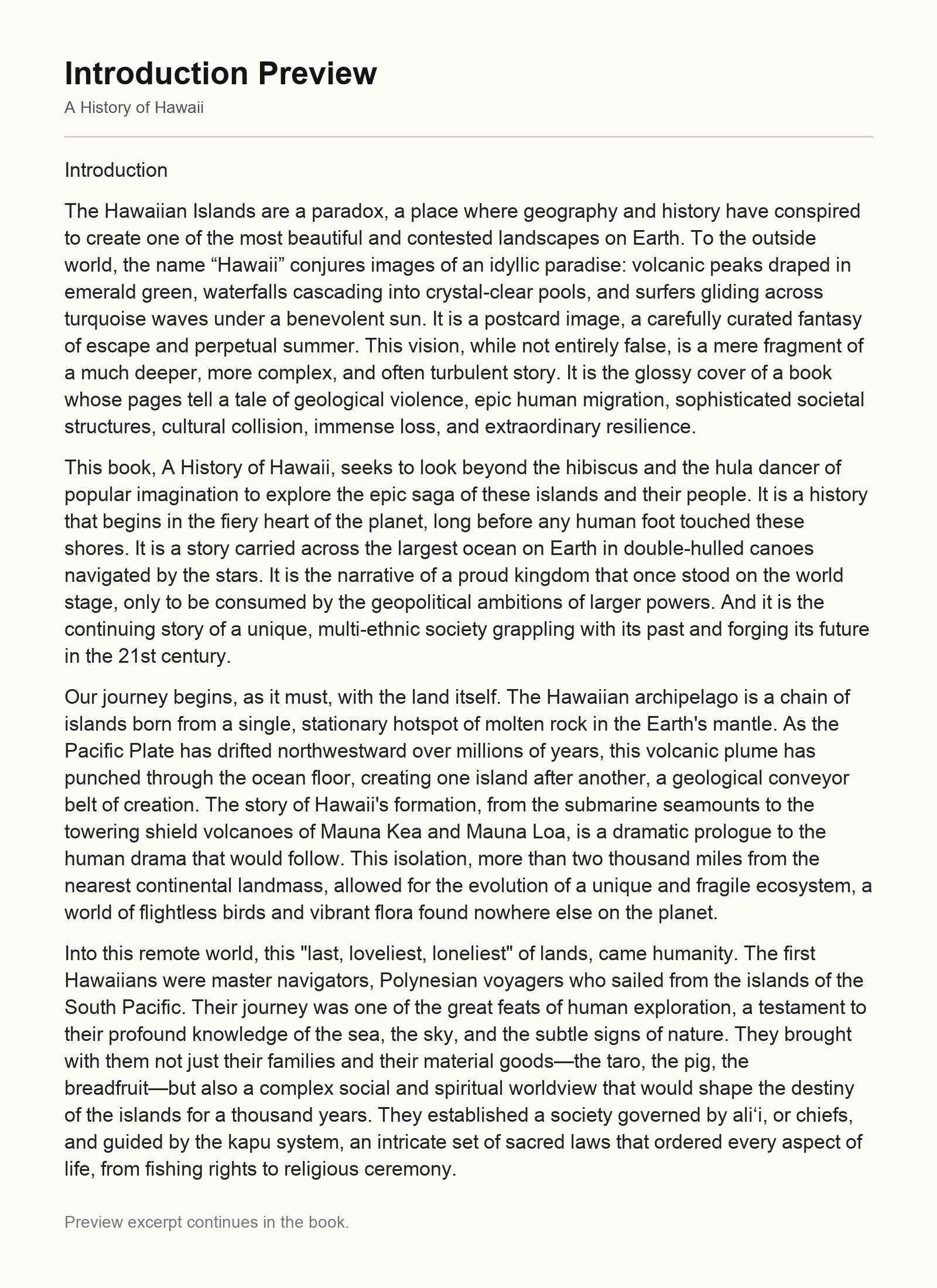
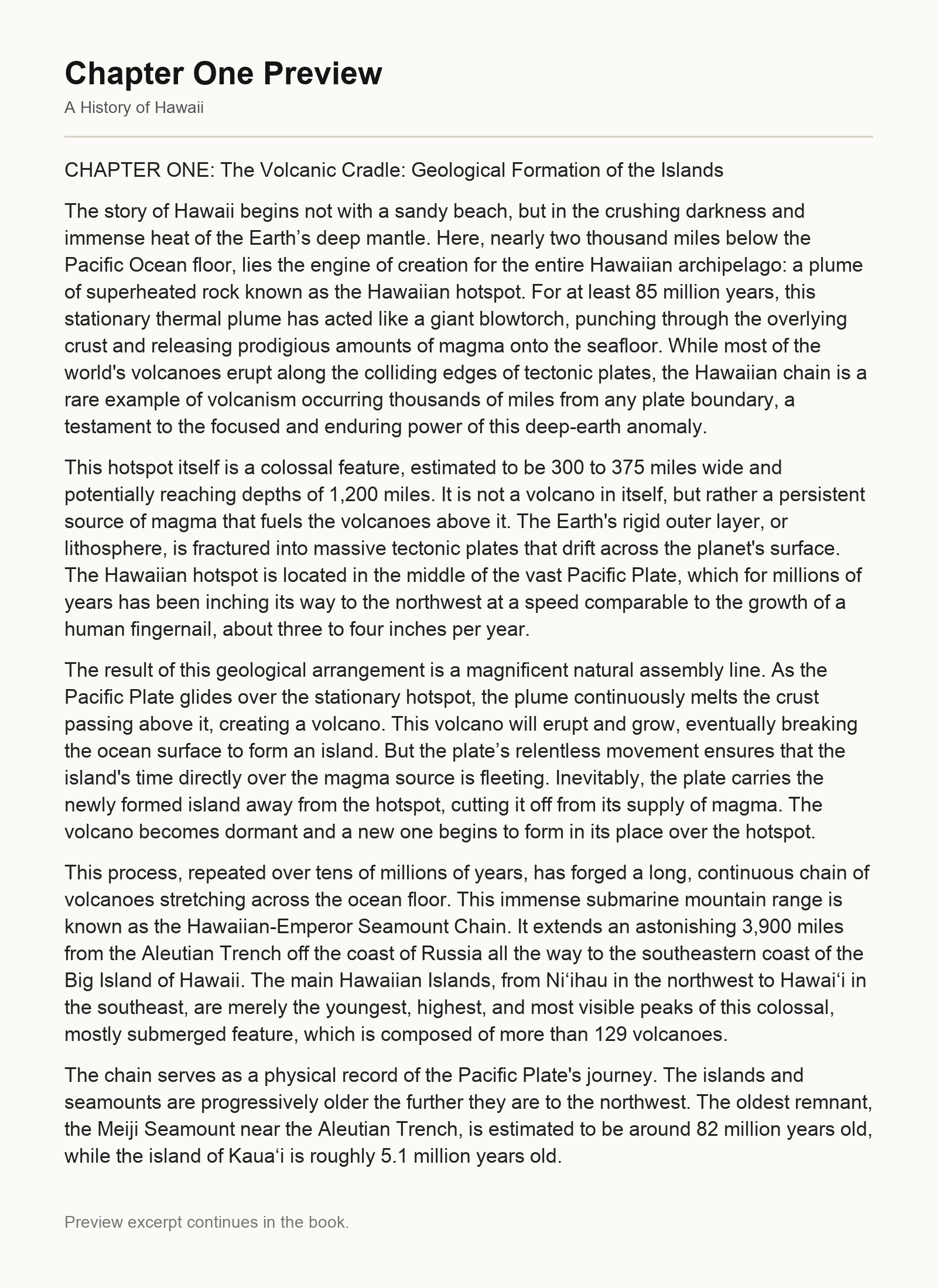
A History of Hawaii invites readers to explore the islands from their fiery geological birth to the vibrant, multicultural society of today. Beginning with the volcanic hotspot that built the archipelago over millions of years, the narrative explains how isolation fostered unique ecosystems and set the stage for the daring voyages of Polynesian navigators who first settled Hawaii using star‑guided double‑hulled canoes. Readers will learn how these early Hawaiians developed a sophisticated social order anchored by the kapu system, the ahupuaʻa land division, and a spiritual worldview that balanced gods, land, and people for centuries before outside contact.
The book then follows the dramatic turning points that reshaped the kingdom: Captain Cook’s arrival and the unintended spread of disease and foreign goods; Kamehameha the Great’s unification of the islands through warfare and Western weapons; the transformative sandalwood and whaling booms; and the pivotal arrival of New England missionaries who introduced Christianity, a written language, and new laws that began to remake Hawaiian society. Each chapter reveals how foreign influence, economic shifts, and internal reforms altered the balance of power, setting the stage for the monarchy’s constitutional evolution and the profound land changes of the Great Māhele.
Readers will experience the rise and fall of the Hawaiian monarchy through the reigns of Kamehameha III, the pleasure‑loving Kalākaua, and the last queen, Liliʻuokalani, whose overthrow in 1893—backed by U.S. marines—led to the Republic of Hawaii and eventual annexation. The narrative details how the sugar industry reshaped the islands’ demographics, bringing laborers from China, Japan, Portugal, the Philippines, and Puerto Rico to work on plantations controlled by the powerful “Big Five” corporations, and how World War II, the attack on Pearl Harbor, and the postwar Democratic Revolution of 1954 transformed Hawaii’s political landscape and paved the way to statehood in 1959.
Beyond political milestones, the book delves into the cultural renaissance of the 1970s that revived Hawaiian language, hula, slack‑key guitar, and the voyaging canoe Hōkūleʻa, while tracing the modern Native Hawaiian movement’s pursuit of sovereignty and land rights, from the protection of Kahoʻolawe to the ongoing struggles over Mauna Kea. It also examines the dual‑edged sword of mass tourism—its economic boon, environmental strain, and cultural commodification—and looks ahead to the twenty‑first century’s challenges of climate change, housing costs, renewable energy goals, and the enduring tension between a global paradise image and the lived realities of Hawaii’s diverse people. By the end, readers will have a deep, balanced understanding of how geology, migration, conflict, and resilience have continually forged and reforged the identity of the Hawaiian Islands.
What You'll Find Inside:
- The geological formation of the Hawaiian Islands through volcanic activity from a stationary hotspot as the Pacific Plate moves northwestward, creating the island chain over millions of years.
- The remarkable voyage of Polynesian navigators who settled Hawaii using double-hulled canoes and traditional wayfinding techniques guided by stars, ocean swells, and natural signs.
- The sophisticated pre-contact Hawaiian society governed by the aliʻi (chiefs) and kapu system, featuring the ahupuaʻa land management approach that sustained communities for centuries.
- The overthrow of Queen Liliʻuokalani and the Hawaiian Kingdom in 1893 by American businessmen with U.S. military support, leading to annexation and the end of Hawaiian sovereignty.
- Modern challenges including the Hawaiian Renaissance cultural revival, sovereignty movements, tourism's environmental and social impacts, and 21st-century issues like climate change and economic dependency.
Who's It For:
This book is ideal for students, educators, and general readers seeking a comprehensive understanding of Hawaii's complex history beyond tourist stereotypes. It will particularly benefit those interested in Pacific Islander history, indigenous sovereignty movements, colonialism's impacts, and how geography shapes societal development. Readers wanting to grasp the multicultural foundations of modern Hawaii and the ongoing tensions between economic development and cultural preservation will find valuable insights in this balanced, multifaceted narrative.
Table of Contents:
- Introduction
- Chapter 1 The Volcanic Cradle: Geological Formation of the Islands
- Chapter 2 Voyagers of the Pacific: The First Polynesian Settlers
- Chapter 3 A Society of Chiefs and Commoners: The Kapu System and Early Hawaiian Life
- Chapter 4 The Arrival of Captain Cook: First Contact and its Consequences
- Chapter 5 Kamehameha the Great: The Unification of the Hawaiian Islands
- Chapter 6 Sandalwood and Whalers: The Transformation of a Kingdom's Economy
- Chapter 7 The Coming of the Missionaries: A New Faith and a Written Language
- Chapter 8 The Reign of Kamehameha III: The Birth of a Constitutional Monarchy
- Chapter 9 Mid-Century Challenges: Foreign Influence and the Great Māhele
- Chapter 10 The Sugar Barons: Plantations and the Demand for Labor
- Chapter 11 A Global Monarchy: King Kalākaua's Tour and the ʻIolani Palace
- Chapter 12 The Bayonet Constitution: The Erosion of Monarchical Power
- Chapter 13 Queen Liliʻuokalani: The Last Monarch and the Overthrow of the Kingdom
- Chapter 14 The Republic of Hawaii: A Nation in Limbo
- Chapter 15 Annexation: The Stars and Stripes Rise Over Hawaii
- Chapter 16 A New Territory: The Organic Act and the First Big Five
- Chapter 17 Plantation Life: A Multiethnic Society in the Making
- Chapter 18 A Day of Infamy: Pearl Harbor and World War II
- Chapter 19 The Democratic Revolution of 1954: A Shift in Political Power
- Chapter 20 The Path to Statehood: Hawaii Becomes the 50th State
- Chapter 21 The Hawaiian Renaissance: A Cultural Reawakening
- Chapter 22 Land and Sovereignty: The Modern Native Hawaiian Movement
- Chapter 23 Tourism and its Toll: Balancing Economy and Environment
- Chapter 24 A Pacific Melting Pot: Immigration and Contemporary Hawaiian Society
- Chapter 25 The Future of the Islands: Challenges and Hopes for the 21st Century
Author:
Published By:
Date Published:
May 27, 2026
Type:
Nonfiction
Language:
English
Also Available In:
Word Count:
47,805 words
Reading Time:
3 hours 21 minutes
Sample:
Order:
Order A History of Hawaii (Hardcover) on MixCache.com:
Buy NowPrint copy is made to order and ships worldwide. Includes the ebook free, ready to read instantly.
$5 account credit for all new MixCache.com accounts, usable toward any ebook purchase!*


