Browse by Category
Fiction
- Action & Adventure
- African American
- Anthologies
- Children's Fiction
- Classics
- Comics & Graphic Novels
- Coming of Age
- Contemporary
- Cultural & Regional
- Drama
- Erotica
- Fantasy
- General
- Historical Fiction
- Horror
- Humor & Satire
- Literary Fiction
- Mystery, Thriller & Suspense
- Poetry
- Religious & Inspirational
- Romance
- Science Fiction
- Short Stories
- War & Military
- Westerns
- Women's Fiction
- Young Adult
Non-Fiction
- Antiques & Collectibles
- Arts & Photography
- Biographies & Memoirs
- Business & Money
- Children's Non-Fiction
-
Computers & Technology
- Artificial Intelligence
- Computer Science
- Cybersecurity & Cryptography
- Data Science & Analytics
- Databases & Big Data
- Game Development & Design
- General
- Hardware & DIY
- Mobile App Development
- Networking & Cloud Computing
- Operating Systems
- Programming
- Robotics
- Software
- Software Engineering
- User Experience (UX) & Design
- Web Development & Design
- Cooking, Food & Wine
- Crafts, Hobbies & Home
- Education & Teaching
- Engineering
- General
- Health, Fitness & Dieting
-
History
- African History
- African History - North Africa
- African History - Sub-Saharan Africa
- American History
- American History - 20th Century
- American History - Civil War
- American History - Colonial Period
- Ancient History
- Asian History
- Asian History - China
- Asian History - India
- Asian History - Japan
- Asian History - Southeast Asia
- European History
- European History - Ancient Greece
- European History - Ancient Rome
- European History - Medieval
- European History - Modern
- European History - Renaissance
- General
- Middle Eastern History
- Military History
- Military History - Aviation
- Military History - Naval
- Social & Cultural History
- World History
- Humor & Entertainment
- Industrial Technology
- Language Learning
- Law
- LGBTQ+ Non-Fiction
- Literary Criticism
- Medical Books
- Parenting & Relationships
- Philosophy
- Politics & Social Sciences
- Reference
- Religion & Spirituality
-
Science & Math
- Agricultural Sciences
- Astronomy & Space Science
- Behavioral Sciences
- Biological Sciences
- Botany & Plant Science
- Chemistry
- Earth Sciences
- Engineering - Chemical
- Engineering - Civil
- Engineering - Electrical
- Engineering - Mechanical
- Environment
- General
- Geology
- Mathematics
- Nature & Ecology
- Oceanography
- Paleontology
- Physics
- Statistics
- Self-Help
- Sports & Outdoors
- Study Aids
- Sustainability & Green Living
- Textbooks
- Transportation
- Travel
- True Crime
- Urban Planning & Development
- Veterinary Medicine
- Writing & Publishing
Jump to Section
MixCache.com Total Access
Unlimited reading and audiobooks for every book published by MixCache.com.
Included titles carry the MTA badge.
Learn more →
Land, Drought, and Empire: Environmental Change and Human Resilience in African History
MTA
Climate, Agriculture, and Resource Management from Antiquity to the Present
About this book:
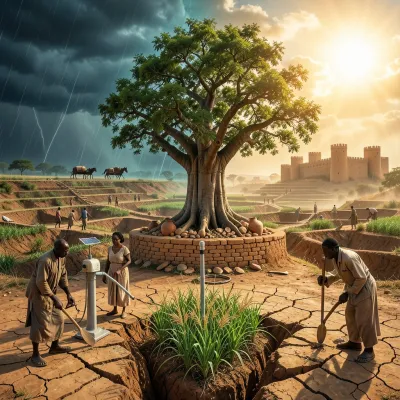
"Land, Drought, and Empire: Environmental Change and Human Resilience in African History" presents a comprehensive re-evaluation of African history through an environmental lens, arguing that climate variability, land use, and human adaptation are central to understanding the continent's social and political transformations. The book posits that African societies did not merely react passively to environmental pressures but actively shaped their environments and developed remarkable resilience strategies. It synthesizes a vast array of evidence, from paleoclimate data like lake sediments and speleothems to archaeological findings, oral histories, and administrative records, to illustrate the intricate, braided relationship between ecological signals and human decisions across millennia.
The narrative spans from deep time, exploring the dramatic shifts from Pleistocene aridity to the African Humid Period and the subsequent drying of the Sahara, which shaped early mobility patterns and resource management. It then delves into specific regions, examining how hydrological regimes influenced state formation in the Nile Valley, the rise of West African empires along the Sahel, the maritime trade and coastal ecologies of the Swahili coast, agricultural intensification in the Ethiopian highlands, and the banana complex in the Great Lakes region. The book also highlights the importance of shifting cultivation and oil palms in the Congo Basin, and the sophisticated mobility strategies of pastoralist groups like the Fulani, Maasai, Somali, and Tuareg in dryland environments.
A significant portion of the book addresses the profound impacts of disease (tsetse, malaria, rinderpest) on settlement patterns, economies, and power dynamics, demonstrating how biological factors acted as ecological engineers. It also traces the transformative effects of Atlantic trade, slavery, and cash crops, which integrated African environments into global extractive economies. The text then examines colonial-era water engineering, including irrigation schemes and dams, and the subsequent postcolonial development dreams in drylands, revealing their often unintended environmental and social consequences. The Sahelian droughts of 1968-1985 and the ensuing "desertification debate" are analyzed as a critical period that redefined understandings of environmental crisis and resilience.
Finally, the book brings the story to the present, exploring the ecologies of war and displacement, the advent of climate services, satellite monitoring, and famine early warning systems, and the reimagination of commons through community-based natural resource management. It concludes by synthesizing these themes within the concept of the African Anthropocene, arguing that resilience in Africa is an ongoing process of negotiation, adaptation, and social creativity in the face of persistent uncertainty. The core message is that Africa's environmental history is not a tale of vulnerability but a testament to human ingenuity and continuous struggle to align human aspirations with ecological limits, emphasizing that durable solutions are often local, flexible, and deeply integrated with existing knowledge systems.
What You'll Find Inside:
- Climate variability has been a constant partner in African history, shaping empires, migrations, and social organization rather than acting as a deterministic force.
- Human resilience emerges from flexible strategies such as mobility, diversification, agroforestry, and farmer-managed natural regeneration, which buffer against environmental shocks.
- Colonial and postcolonial water engineering projects often prioritized export-oriented agriculture and state control, creating unintended ecological and social consequences that persist today.
- Disease ecologies (tsetse, malaria, rinderpest) have profoundly influenced settlement patterns, livestock keeping, and the distribution of power across the continent.
- Transboundary river governance and climate forecasting illustrate ongoing negotiations over water, justice, and cooperation in the face of increasing climatic uncertainty.
Who's It For:
This book is intended for scholars and graduate students in African history, environmental studies, anthropology, and geography who seek an interdisciplinary understanding of how climate, ecology, and society have interacted over millennia. It will also be valuable for policymakers, development practitioners, and climate adaptation professionals looking for historical insights into resilient water management, pastoral mobility, and community-based natural resource management in Africa.
Table of Contents:
- Introduction
- Chapter 1 Landscapes in Deep Time: From Pleistocene Aridity to the African Humid Period
- Chapter 2 Tracing Climate and History: Proxies, Archives, and Interdisciplinary Methods
- Chapter 3 Rivers of Empire: Nile Flood Regimes and State Formation
- Chapter 4 The Green Sahara and Pastoral Frontiers: Mobility, Milk, and Stone
- Chapter 5 Sahelian Shores: Drought Cycles and the Rise of West African Empires
- Chapter 6 Monsoon Worlds: The Swahili Coast, Trade Winds, and Coastal Ecologies
- Chapter 7 Highlands and Terraces: Ethiopia’s Watersheds and Agricultural Intensification
- Chapter 8 Lakes, Soils, and Staple Shifts: The Great Lakes Region and the Banana Complex
- Chapter 9 Forest Edges: Shifting Cultivation, Oil Palms, and the Congo Basin Commons
- Chapter 10 Pastures and Pathways: Fulani, Maasai, Somali, and Tuareg Strategies of Mobility
- Chapter 11 Disease and Domesticate: Tsetse, Malaria, Rinderpest, and the Ecology of Power
- Chapter 12 Climate Variability and the Medieval to Early Modern Transition
- Chapter 13 Atlantic Turbulence: Slavery, Cash Crops, and Coastal Transformations
- Chapter 14 Engineering Water: Colonial Irrigation, Dams, and the Politics of Flow
- Chapter 15 Timber, Minerals, and Fire: Extractive Economies and Environmental Change
- Chapter 16 Cities of Dust and Concrete: Urban Growth, Sanitation, and Water Supply
- Chapter 17 Markets, Famine, and Relief: From the Nineteenth Century to the Interwar Years
- Chapter 18 Development Dreams and Drylands: Schemes, Boreholes, and the Postcolonial State
- Chapter 19 The Sahel in Crisis: 1968–1985 Droughts and the Desertification Debate
- Chapter 20 Conflict, Displacement, and the Ecologies of War
- Chapter 21 Watching the Rains: Satellites, Forecasts, and Famine Early Warning
- Chapter 22 Commons Reimagined: Community-Based Natural Resource Management
- Chapter 23 Rivers Negotiated: Transboundary Hydropolitics in the Nile, Niger, and Zambezi Basins
- Chapter 24 Farming with Uncertainty: Agroforestry, FMNR, and Climate Services
- Chapter 25 Resilience and Justice in the African Anthropocene: A Synthesis
Author:
Published By:
Date Published:
May 5, 2026
Type:
Nonfiction
Language:
English
Word Count:
57,808 words
Reading Time:
4 hours 3 minutes
Sample:
Order:
Order Land, Drought, and Empire: Environmental Change and Human Resilience in African History (Hardcover) on MixCache.com:
Buy NowPrint copy is made to order and ships worldwide. Includes the ebook free, ready to read instantly.
$5 account credit for all new MixCache.com accounts, usable toward any ebook purchase!*