
Browse by Category
Fiction
- Action & Adventure
- African American
- Anthologies
- Children's Fiction
- Classics
- Comics & Graphic Novels
- Coming of Age
- Contemporary
- Cultural & Regional
- Drama
- Erotica
- Fantasy
- General
- Historical Fiction
- Horror
- Humor & Satire
- Literary Fiction
- Mystery, Thriller & Suspense
- Poetry
- Religious & Inspirational
- Romance
- Science Fiction
- Short Stories
- War & Military
- Westerns
- Women's Fiction
- Young Adult
Non-Fiction
- Antiques & Collectibles
- Arts & Photography
- Biographies & Memoirs
- Business & Money
- Children's Non-Fiction
-
Computers & Technology
- Artificial Intelligence
- Computer Science
- Cybersecurity & Cryptography
- Data Science & Analytics
- Databases & Big Data
- Game Development & Design
- General
- Hardware & DIY
- Mobile App Development
- Networking & Cloud Computing
- Operating Systems
- Programming
- Robotics
- Software
- Software Engineering
- User Experience (UX) & Design
- Web Development & Design
- Cooking, Food & Wine
- Crafts, Hobbies & Home
- Education & Teaching
- Engineering
- General
- Health, Fitness & Dieting
-
History
- African History
- African History - North Africa
- African History - Sub-Saharan Africa
- American History
- American History - 20th Century
- American History - Civil War
- American History - Colonial Period
- Ancient History
- Asian History
- Asian History - China
- Asian History - India
- Asian History - Japan
- Asian History - Southeast Asia
- European History
- European History - Ancient Greece
- European History - Ancient Rome
- European History - Medieval
- European History - Modern
- European History - Renaissance
- General
- Middle Eastern History
- Military History
- Military History - Aviation
- Military History - Naval
- Social & Cultural History
- World History
- Humor & Entertainment
- Industrial Technology
- Language Learning
- Law
- LGBTQ+ Non-Fiction
- Literary Criticism
- Medical Books
- Parenting & Relationships
- Philosophy
- Politics & Social Sciences
- Reference
- Religion & Spirituality
-
Science & Math
- Agricultural Sciences
- Astronomy & Space Science
- Behavioral Sciences
- Biological Sciences
- Botany & Plant Science
- Chemistry
- Earth Sciences
- Engineering - Chemical
- Engineering - Civil
- Engineering - Electrical
- Engineering - Mechanical
- Environment
- General
- Geology
- Mathematics
- Nature & Ecology
- Oceanography
- Paleontology
- Physics
- Statistics
- Self-Help
- Sports & Outdoors
- Study Aids
- Sustainability & Green Living
- Textbooks
- Transportation
- Travel
- True Crime
- Urban Planning & Development
- Veterinary Medicine
- Writing & Publishing
Jump to Section

Want unlimited access to all books published by MixCache.com (plus their audiobooks)? Try MixCache.com Total Access. Look for the MTA badge on book covers to identify included titles.
Access to infinite ebooks: Don't see the book you want? Suggest it and we'll create it (free!) for you from scratch with our powerful AI book writer. Then read it with MTA - besides profiting from any sales it makes!
Railways and Rubber: The Congo Free State and the Political Economy of Exploitation
MTA
A Microhistory of Violence, Governance, and International Reform
About this book:
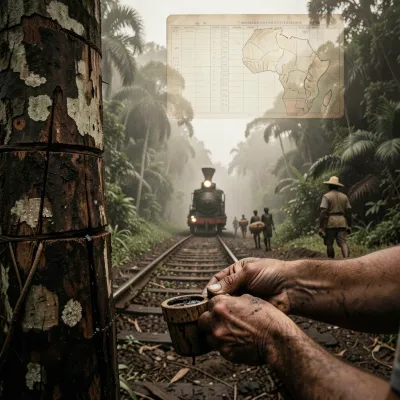
*Railways and Rubber: The Congo Free State and the Political Economy of Exploitation* provides a comprehensive microhistory of King Leopold II’s personal rule over the Congo, a unique colonial experiment that refashioned sovereignty into a private business model. The narrative details how Leopold utilized humanitarian rhetoric—specifically the abolition of the slave trade—to secure international legitimacy at the Berlin Conference, while simultaneously establishing a ruthless concessionary system. This regime outsourced governance to private corporations, turning the Congo into a patchwork of corporate fiefdoms where the pursuit of global commodities like wild rubber and ivory was prioritized over human life and ecological stability.
The book emphasizes the critical role of infrastructure and administrative metrics in facilitating systemic violence. The construction of the Matadi–Léopoldville railway and the expansion of river steamer networks reorganized the African landscape into corridors of extraction, allowing for the rapid projection of force and the efficient transport of goods. Within this framework, the state implemented a "jurisprudence of exploitation," utilizing quotas, hostage-taking, and standardized corporal punishment—rationalized through meticulous bookkeeping—to compel labor. This bureaucratic normalization allowed distant shareholders in Europe to profit from a regime that treated Congolese families and their domestic labor as invisible subsidies to the rubber boom.
A major arc of the text focuses on the transnational reform movement that eventually challenged Leopold’s legitimacy. Led by figures like E. D. Morel and Roger Casement, and supported by a diverse coalition of missionaries and journalists, the Congo Reform Association utilized new technologies—such as photography and forensic accounting—to create a "counter-archive" of atrocity. By documenting the gap between the state’s civilizing rhetoric and the reality of forced labor and famine, these activists successfully shifted international diplomacy. This pressure eventually forced the annexation of the territory by Belgium in 1908, though the book notes that many extractive structures and habits of rule persisted under the new colonial administration.
In its concluding analysis, the book explores the enduring legacies of concessionary sovereignty. It argues that the Congo Free State was not an historical aberration but a prototype for modern forms of privatized governance and resource extraction. The patterns of land alienation, ecological degradation, and the prioritization of global market demands over local rights continue to resonate in contemporary struggles over the Congo’s mineral wealth. By centering Congolese voices and resistance strategies alongside the ledgers of power, the work restores human agency to a story of institutionalized greed, offering a sobering reflection on the ethics of global capitalism and the persistent challenge of corporate accountability.
What You'll Find Inside:
- The Congo Free State transformed sovereignty into a privatized business model where violence, infrastructure, and markets were systematically integrated to enable exploitation.
- Wild rubber extraction drove a regime of forced labor through quotas, hostage-taking, and exemplary violence that synchronized with railway timetables and global demand cycles.
- Infrastructure like the Matadi-Léopoldville railway functioned as both economic conduit and tool of state control, reorganizing space and time for extraction.
- International activism by missionaries, journalists, and reformers created a counter-archive that challenged official denials and helped precipitate annexation.
- The book centers Congolese voices and resistance, revealing how families bore hidden costs through women's unpaid labor and children held as collateral.
Who's It For:
This book is ideal for scholars and students of colonial history, African studies, political economy, and human rights, particularly those interested in the mechanics of colonial exploitation, the intersection of infrastructure and governance, historical patterns of resource extraction, and the origins of international human rights activism. Researchers studying comparative colonialism, corporate accountability, and the legacies of concessionary systems will find valuable insights into how sovereignty was privatized and how resistance shaped reform efforts.
Author:
Published By:
Date Published:
May 5, 2026
Type:
Nonfiction
Language:
English
Word Count:
81,001 words
Reading Time:
5 hours 40 minutes
Sample:
Order:
Order Railways and Rubber: The Congo Free State and the Political Economy of Exploitation (Hardcover) on MixCache.com:
Buy NowPrint copy is made to order and ships worldwide. Includes the ebook free, ready to read instantly.
$5 account credit for all new MixCache.com accounts, usable toward any ebook purchase!*


