
Browse by Category
Fiction
- Action & Adventure
- African American
- Anthologies
- Children's Fiction
- Classics
- Comics & Graphic Novels
- Coming of Age
- Contemporary
- Cultural & Regional
- Drama
- Erotica
- Fantasy
- General
- Historical Fiction
- Horror
- Humor & Satire
- Literary Fiction
- Mystery, Thriller & Suspense
- Poetry
- Religious & Inspirational
- Romance
- Science Fiction
- Short Stories
- War & Military
- Westerns
- Women's Fiction
- Young Adult
Non-Fiction
- Antiques & Collectibles
- Arts & Photography
- Biographies & Memoirs
- Business & Money
- Children's Non-Fiction
-
Computers & Technology
- Artificial Intelligence
- Computer Science
- Cybersecurity & Cryptography
- Data Science & Analytics
- Databases & Big Data
- Game Development & Design
- General
- Hardware & DIY
- Mobile App Development
- Networking & Cloud Computing
- Operating Systems
- Programming
- Robotics
- Software
- Software Engineering
- User Experience (UX) & Design
- Web Development & Design
- Cooking, Food & Wine
- Crafts, Hobbies & Home
- Education & Teaching
- Engineering
- General
- Health, Fitness & Dieting
-
History
- African History
- African History - North Africa
- African History - Sub-Saharan Africa
- American History
- American History - 20th Century
- American History - Civil War
- American History - Colonial Period
- Ancient History
- Asian History
- Asian History - China
- Asian History - India
- Asian History - Japan
- Asian History - Southeast Asia
- European History
- European History - Ancient Greece
- European History - Ancient Rome
- European History - Medieval
- European History - Modern
- European History - Renaissance
- General
- Middle Eastern History
- Military History
- Military History - Aviation
- Military History - Naval
- Social & Cultural History
- World History
- Humor & Entertainment
- Industrial Technology
- Language Learning
- Law
- LGBTQ+ Non-Fiction
- Literary Criticism
- Medical Books
- Parenting & Relationships
- Philosophy
- Politics & Social Sciences
- Reference
- Religion & Spirituality
-
Science & Math
- Agricultural Sciences
- Astronomy & Space Science
- Behavioral Sciences
- Biological Sciences
- Botany & Plant Science
- Chemistry
- Earth Sciences
- Engineering - Chemical
- Engineering - Civil
- Engineering - Electrical
- Engineering - Mechanical
- Environment
- General
- Geology
- Mathematics
- Nature & Ecology
- Oceanography
- Paleontology
- Physics
- Statistics
- Self-Help
- Sports & Outdoors
- Study Aids
- Sustainability & Green Living
- Textbooks
- Transportation
- Travel
- True Crime
- Urban Planning & Development
- Veterinary Medicine
- Writing & Publishing
Jump to Section
MixCache.com Total Access
Unlimited reading and audiobooks for every book published by MixCache.com.
Included titles carry the MTA badge.
Learn more →
Albania's Enclosed Past: Life Under the Hoxha Dictatorship
MTA
A Nation Isolated by Stalinism and Secrecy
About this book:
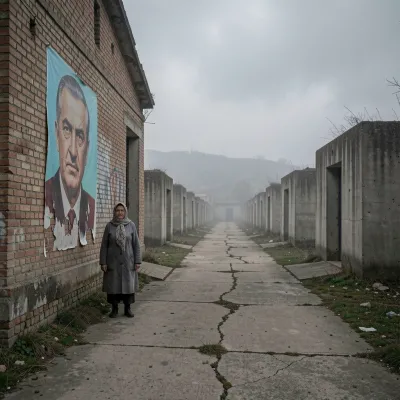
Albania's Enclosed Past traces the trajectory of Albania from its wartime liberation to the fall of communism, focusing on the four‑decade rule of Enver Hoxha. After breaking with Yugoslavia in 1948, Hoxha aligned first with the Soviet Union and then with China, using each alliance to purge rivals and cement his authority while rejecting any deviation from his rigid Stalinist interpretation. The regime pursued radical collectivization, rapid heavy‑industry industrialization, and a campaign of state atheism that destroyed religious institutions and suppressed faith, all enforced by an extensive propaganda machine, the Sigurimi secret police, and a system of internal passports that tightly controlled movement and fostered a climate of fear and distrust.
Hoxha cultivated an all‑encompassing personality cult, presenting himself as the infallible guardian of true Marxism‑Leninism, while the nation embraced a doctrine of self‑reliance (vetëvendosje) that drove an absurd bunkerization program—hundreds of thousands of concrete fortifications built to defend against an imagined invasion—and left the economy technologically backward and chronically short of consumer goods. Education, youth organizations, and the arts were harnessed to indoctrinate a “new socialist man,” and any dissent was met with purges, show trials, forced labor camps, and pervasive surveillance that penetrated every aspect of daily life.
By the late 1980s the economic stagnation, growing discontent, and the collapse of communist regimes in Eastern Europe eroded Hoxha’s system; after his death in 1985, successor Ramiz Alia attempted hesitant reforms but could not stave off the tide of change. The early 1990s saw mass protests, the toppling of Hoxha’s statues, the first multiparty elections, and the eventual dismantling of the one‑party state, the Sigurimi, and the constitutional bans on religion and foreign loans. Albania’s transition was turbulent, marked by economic crisis and a painful reckoning with the past, yet it opened the door to democratic politics, market reforms, and a slow reconnection with the world—while the material and psychological legacies of bunkers, suppressed faith, and distrust continue to shape contemporary Albania.
What You'll Find Inside:
- Albania's extreme isolation through successive breaks with Yugoslavia, the Soviet Union, and China, creating a hermetically sealed state pursuing ideological purity at all costs.
- The comprehensive machinery of control including internal passports, the Sigurimi secret police, pervasive surveillance networks, and restricted movement that monitored every aspect of citizens' lives.
- Ideological transformation through forced state atheism, Enver Hoxha's personality cult, education indoctrination, and socialist realism that reshaped Albanian identity and consciousness.
- Economic policies of self-reliance (vetëvendosje) and the bunkerization program that prioritized ideological purity over prosperity, leading to technological backwardness and chronic shortages.
- Personal narratives revealing daily life under dictatorship and the enduring psychological legacy that continued to shape Albania long after communism's collapse.
Who's It For:
This book is essential reading for students and scholars of Cold War history, communist regimes, and Balkan studies who seek to understand one of Europe's most isolated and extreme socialist experiments. It will particularly benefit readers interested in totalitarian systems, ideological purity, and how dictatorship reshapes every facet of society from economics to personal belief. Anyone studying political science, sociology, or history will find valuable insights into the mechanisms of control, the consequences of extreme self-reliance policies, and the long-term societal impact of pervasive surveillance and fear.
Table of Contents:
- Introduction
- Chapter 1 The Roots of Isolation: Albania's Post-War Landscape
- Chapter 2 Enver Hoxha's Rise to Power and the Yugoslav Split
- Chapter 3 Embracing Stalinism: The Soviet Alliance and its Ideological Impact
- Chapter 4 Forging a New Society: Collectivization and Industrialization
- Chapter 5 The Purges and the Consolidation of Power
- Chapter 6 The Sino-Albanian Alliance: A Peculiar Partnership
- Chapter 7 Cultural Revolution Albanian Style: The War on Religion
- Chapter 8 Atheism as State Policy: Eradicating Faith
- Chapter 9 The Enverist Cult: Personality and Propaganda
- Chapter 10 Life in the Bloc: Everyday Existence Under Dictatorship
- Chapter 11 Internal Passports and Restricted Movement: Controlling the Populace
- Chapter 12 Propaganda and Censorship: Shaping Public Thought
- Chapter 13 Education and Indoctrination: Raising the New Socialist Man
- Chapter 14 The Sigurimi: Albania's Secret Police
- Chapter 15 Fear and Surveillance: The Climate of Distrust
- Chapter 16 Self-Reliance (Vetëvendosje): An Economic Enigma
- Chapter 17 Bunkers and Defense: A Nation Under Siege Mentality
- Chapter 18 Artistic Expression and Socialist Realism
- Chapter 19 International Relations and Albania's Diplomatic Isolation
- Chapter 20 The Hoxhaist Legacy: Successors and Shifting Policies
- Chapter 21 Economic Stagnation and Growing Discontent
- Chapter 22 The Collapse of Communism and Albania's Transition
- Chapter 23 Memories of Isolation: Personal Narratives of the Dictatorship
- Chapter 24 Confronting the Past: Coming to Terms with Hoxha's Regime
- Chapter 25 Albania Today: Echoes of an Enclosed Past
Author:
Published By:
Date Published:
July 19, 2026
Type:
Nonfiction
Language:
English
Word Count:
38,835 words
Reading Time:
2 hours 43 minutes
Sample:
MixCache.com Total Access
Get unlimited access to this book + all books published by MixCache.com for $11.99/month
Subscribe to MTAOr purchase this book individually below
Order:
Buy the Albania's Enclosed Past: Life Under the Hoxha Dictatorship ebook on MixCache.com:
Buy Now
Full ebook will be available immediately
- read online or download as a PDF file.
$5 account credit for all new MixCache.com accounts, usable toward any ebook purchase!*


Ratings & Reviews
Ask Questions About This Book
Have a question about the content? Ask our AI assistant!
Start by asking a question about "Albania's Enclosed Past: Life Under the Hoxha Dictatorship"
Example: "Does this book mention William Shakespeare?"
Thinking...