
Browse by Category
Fiction
- Action & Adventure
- African American
- Anthologies
- Children's Fiction
- Classics
- Comics & Graphic Novels
- Coming of Age
- Contemporary
- Cultural & Regional
- Drama
- Erotica
- Fantasy
- General
- Historical Fiction
- Horror
- Humor & Satire
- Literary Fiction
- Mystery, Thriller & Suspense
- Poetry
- Religious & Inspirational
- Romance
- Science Fiction
- Short Stories
- War & Military
- Westerns
- Women's Fiction
- Young Adult
Non-Fiction
- Antiques & Collectibles
- Arts & Photography
- Biographies & Memoirs
- Business & Money
- Children's Non-Fiction
-
Computers & Technology
- Artificial Intelligence
- Computer Science
- Cybersecurity & Cryptography
- Data Science & Analytics
- Databases & Big Data
- Game Development & Design
- General
- Hardware & DIY
- Mobile App Development
- Networking & Cloud Computing
- Operating Systems
- Programming
- Robotics
- Software
- Software Engineering
- User Experience (UX) & Design
- Web Development & Design
- Cooking, Food & Wine
- Crafts, Hobbies & Home
- Education & Teaching
- Engineering
- General
- Health, Fitness & Dieting
-
History
- African History
- African History - North Africa
- African History - Sub-Saharan Africa
- American History
- American History - 20th Century
- American History - Civil War
- American History - Colonial Period
- Ancient History
- Asian History
- Asian History - China
- Asian History - India
- Asian History - Japan
- Asian History - Southeast Asia
- European History
- European History - Ancient Greece
- European History - Ancient Rome
- European History - Medieval
- European History - Modern
- European History - Renaissance
- General
- Middle Eastern History
- Military History
- Military History - Aviation
- Military History - Naval
- Social & Cultural History
- World History
- Humor & Entertainment
- Industrial Technology
- Language Learning
- Law
- LGBTQ+ Non-Fiction
- Literary Criticism
- Medical Books
- Parenting & Relationships
- Philosophy
- Politics & Social Sciences
- Reference
- Religion & Spirituality
-
Science & Math
- Agricultural Sciences
- Astronomy & Space Science
- Behavioral Sciences
- Biological Sciences
- Botany & Plant Science
- Chemistry
- Earth Sciences
- Engineering - Chemical
- Engineering - Civil
- Engineering - Electrical
- Engineering - Mechanical
- Environment
- General
- Geology
- Mathematics
- Nature & Ecology
- Oceanography
- Paleontology
- Physics
- Statistics
- Self-Help
- Sports & Outdoors
- Study Aids
- Sustainability & Green Living
- Textbooks
- Transportation
- Travel
- True Crime
- Urban Planning & Development
- Veterinary Medicine
- Writing & Publishing
Jump to Section
MixCache.com Total Access
Unlimited reading and audiobooks for every book published by MixCache.com.
Included titles carry the MTA badge.
Learn more →
The Hidden Lives of Deep-Sea Creatures
MTA
Exploring the Mysteries of Ocean Depths
About this book:
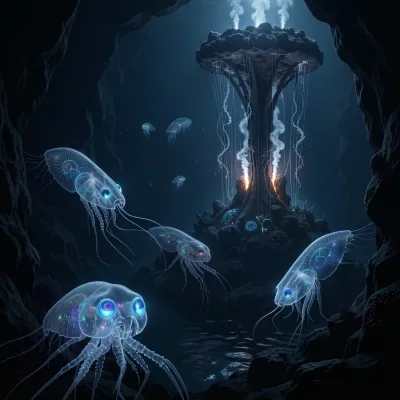
The deep ocean, a vast and enigmatic realm of perpetual darkness and crushing pressure, harbors ecosystems and organisms that challenge our understanding of life. The book explores the mesopelagic “Twilight Zone” to the hadal depths of the Mariana Trench, revealing how creatures adapt through biochemical mechanisms like piezolytes—proteins that stabilize cellular structures under extreme pressure—and bioluminescence, a widespread adaptation used for hunting, defense, and communication in the absence of sunlight. These adaptations, coupled with the phenomena of chemosynthesis (where microbes convert inorganic chemicals into energy at hydrothermal vents and cold seeps), highlight the ingenuity of life in extreme environments, decoupled from solar energy and thriving in isolation.
Beyond survival strategies, the book delves into the unique ecological dynamics of the deep sea, such as diel vertical migration, where species ascend to feed in surface waters under cover of darkness, and reproductive strategies like sexual parasitism in anglerfish and the extended brooding periods of deep-sea octopuses. The deep-sea food web, largely fueled by scarce marine snow and ephemeral chemosynthetic oases, underscores the importance of opportunistic feeding, symbiosis, and larval dispersal in overcoming vastness and scarcity. Gigantism in species like giant isopods and colossal squids, along with the ancient lineages preserved in the deep (like coelacanths and horseshoe crabs), further illustrate the evolutionary resilience and time-capsule nature of these ecosystems.
The role of deep-sea creatures in global ecosystems is profound, acting as carbon sinks through marine snow processing and playing critical roles in biogeochemical cycles, including nitrogen and sulfur. Hydrothermal vents and cold seeps, while localized, support dense communities of life and may hold clues to early life on Earth. Yet these fragile ecosystems face increasing threats from human activities: bottom trawling, deep-sea mining, pollution, and climate change-induced changes in ocean chemistry and temperature. The book emphasizes the interconnectedness of these environments, warning that damage to deep-sea habitats could disrupt planetary processes and reduce biodiversity, which remains largely unexplored with over 80% of species still unknown.
Technological advancements, from remotely operated vehicles (ROVs) to environmental DNA analysis, have unlocked much of the deep’s mysteries and will be vital for future conservation efforts. However, as the book concludes, safeguarding the abyss is urgent. Conservation strategies—establishing marine protected areas, regulating mining, and addressing climate change—are essential to preserve these ecosystems, which are not just wonders but indispensable components of Earth’s life-support systems. The hidden lives of deep-sea creatures remind us that even the most remote environments are vulnerable and interconnected with human survival, making their protection a collective responsibility.
What You'll Find Inside:
- Explores unique adaptations of deep-sea life, including bioluminescence, pressure resistance, and specialized feeding strategies for survival in extreme environments.
- Examines chemosynthetic ecosystems around hydrothermal vents and cold seeps that thrive without sunlight, revealing life's ability to harness chemical energy.
- Highlights the ecological importance of the deep sea, including its role in global carbon cycles, nutrient distribution, and serving as biodiversity reservoirs critical to planetary health.
- Discusses the phenomenon of deep-sea gigantism and alien-like morphologies, showcasing evolutionary innovations in response to resource scarcity and environmental extremes.
- Addresses urgent conservation challenges like deep-sea mining, pollution, and climate change impacts, emphasizing the need for global protection efforts to preserve these fragile ecosystems.
Who's It For:
This book is ideal for marine biology students, researchers, educators, and nature enthusiasts fascinated by the ocean's mysteries. It appeals to those interested in evolutionary biology, ecosystem dynamics, and environmental conservation, offering insights into one of Earth's least understood yet ecologically vital realms.
Table of Contents:
- Introduction: A Plunge into the Abyss
- Chapter 1: The Ocean's Twilight Zone: Life in the Mesopelagic
- Chapter 2: Adaptations to Extreme Pressure: The Crushing Depths
- Chapter 3: Bioluminescence: Lights in the Darkness
- Chapter 4: Chemosynthesis: Life Without Sunlight
- Chapter 5: Hydrothermal Vents: Oases of the Deep
- Chapter 6: Cold Seeps: Methane-Fueled Ecosystems
- Chapter 7: The Mariana Trench: Earth's Deepest Frontier
- Chapter 8: Anglerfish and Their Lures: Deception in the Deep
- Chapter 9: Gigantism in the Deep Sea: Explaining the Unusually Large
- Chapter 10: Specialized Senses: Navigating a Lightless World
- Chapter 11: Reproduction Strategies: Overcoming the Vastness
- Chapter 12: Deep-Sea Corals: Gardens of the Abyss
- Chapter 13: Journey of the Larvae: Dispersal in the Deep
- Chapter 14: The Deep-Sea Food Web: Scarcity and Opportunism
- Chapter 15: Marine Snow: The Constant Fall of Nutrients
- Chapter 16: Vent Communities: A World Apart
- Chapter 17: Alien-Like Inhabitants: Unveiling Bizarre Forms
- Chapter 18: Preserving the Deep: Threats and Conservation
- Chapter 19: Technology of the Deep: Exploring the Unseen
- Chapter 20: The Future of Deep-Sea Exploration: New Discoveries Await
- Chapter 21: Ancient Lineages: Relics of the Deep Past
- Chapter 22: Deep-Sea Microbes: The Unseen Majority
- Chapter 23: The Role of Deep-Sea Creatures in Global Ecosystems
- Chapter 24: Unanswered Questions: The Remaining Mysteries of the Deep
- Chapter 25: A Call to Protect: Safeguarding Our Ocean's Depths
Author:
Published By:
Date Published:
July 13, 2026
Type:
Nonfiction
Language:
English
Word Count:
38,777 words
Reading Time:
2 hours 43 minutes
Sample:
Order:
Order The Hidden Lives of Deep-Sea Creatures (Hardcover) on MixCache.com:
Buy NowPrint copy is made to order and ships worldwide. Includes the ebook free, ready to read instantly.
$5 account credit for all new MixCache.com accounts, usable toward any ebook purchase!*


