Browse by Category
Fiction
- Action & Adventure
- African American
- Anthologies
- Children's Fiction
- Classics
- Comics & Graphic Novels
- Coming of Age
- Contemporary
- Cultural & Regional
- Drama
- Erotica
- Fantasy
- General
- Historical Fiction
- Horror
- Humor & Satire
- Literary Fiction
- Mystery, Thriller & Suspense
- Poetry
- Religious & Inspirational
- Romance
- Science Fiction
- Short Stories
- War & Military
- Westerns
- Women's Fiction
- Young Adult
Non-Fiction
- Antiques & Collectibles
- Arts & Photography
- Biographies & Memoirs
- Business & Money
- Children's Non-Fiction
-
Computers & Technology
- Artificial Intelligence
- Computer Science
- Cybersecurity & Cryptography
- Data Science & Analytics
- Databases & Big Data
- Game Development & Design
- General
- Hardware & DIY
- Mobile App Development
- Networking & Cloud Computing
- Operating Systems
- Programming
- Robotics
- Software
- Software Engineering
- User Experience (UX) & Design
- Web Development & Design
- Cooking, Food & Wine
- Crafts, Hobbies & Home
- Education & Teaching
- Engineering
- General
- Health, Fitness & Dieting
-
History
- African History
- African History - North Africa
- African History - Sub-Saharan Africa
- American History
- American History - 20th Century
- American History - Civil War
- American History - Colonial Period
- Ancient History
- Asian History
- Asian History - China
- Asian History - India
- Asian History - Japan
- Asian History - Southeast Asia
- European History
- European History - Ancient Greece
- European History - Ancient Rome
- European History - Medieval
- European History - Modern
- European History - Renaissance
- General
- Middle Eastern History
- Military History
- Military History - Aviation
- Military History - Naval
- Social & Cultural History
- World History
- Humor & Entertainment
- Industrial Technology
- Language Learning
- Law
- LGBTQ+ Non-Fiction
- Literary Criticism
- Medical Books
- Parenting & Relationships
- Philosophy
- Politics & Social Sciences
- Reference
- Religion & Spirituality
-
Science & Math
- Agricultural Sciences
- Astronomy & Space Science
- Behavioral Sciences
- Biological Sciences
- Botany & Plant Science
- Chemistry
- Earth Sciences
- Engineering - Chemical
- Engineering - Civil
- Engineering - Electrical
- Engineering - Mechanical
- Environment
- General
- Geology
- Mathematics
- Nature & Ecology
- Oceanography
- Paleontology
- Physics
- Statistics
- Self-Help
- Sports & Outdoors
- Study Aids
- Sustainability & Green Living
- Textbooks
- Transportation
- Travel
- True Crime
- Urban Planning & Development
- Veterinary Medicine
- Writing & Publishing
Jump to Section
MixCache.com Total Access
Unlimited reading and audiobooks for every book published by MixCache.com.
Included titles carry the MTA badge.
Learn more →
Greatest of the Ottomans
MTA
A Biography of Suleiman the Magnificent
About this book:
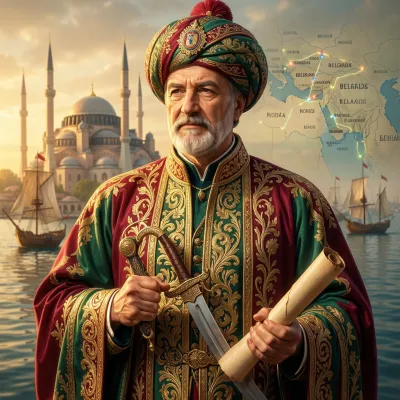
Suleiman the Magnificent ascended the Ottoman throne in 1520 after a smooth succession from his father Selim I. His early reign was marked by decisive military campaigns that secured the empire’s European flank: the capture of Belgrade in 1521 removed a long‑standing obstacle to expansion into Hungary, while the conquest of Rhodes in 1522 eliminated the Knights Hospitaller’s foothold in the eastern Mediterranean and affirmed Ottoman naval dominance. The victory at Mohács in 1526 shattered the Kingdom of Hungary, opening the Danubian plain to Ottoman control and establishing Suleiman’s reputation as a formidable conqueror whose armies soon reached the gates of Vienna in 1529, though logistical constraints forced a withdrawal.
At the height of his power, Suleiman combined martial prowess with sophisticated statecraft. He instituted the Kanun-i Osmani, a comprehensive legal code that harmonized secular and religious law, standardizing taxation, criminal justice, and land tenure across his diverse realms. His administration, overseen by capable grand viziers such as Pargalı Ibrahim Pasha and later Sokollu Mehmed Pasha, relied on a refined bureaucracy, efficient tax collection, and meticulous record‑keeping that enabled governance of a transcontinental empire. Suleiman also fostered a golden age of culture: patronizing the architect Mimar Sinan (whose masterpiece, the Süleymaniye Mosque complex, blended religious, educational, and charitable functions), supporting poets, calligraphers, and artists, and promoting intellectual life in medreses and libraries. Diplomatically, he forged the Franco‑Ottoman alliance to counter Habsburg hegemony, secured the Treaty of Amasya with the Safavid Empire to stabilize the eastern frontier, and used Hayreddin Barbarossa’s fleet to dominate the Mediterranean, projecting power into North Africa and challenging Christian maritime powers.
In his later years, Suleiman’s reign was shadowed by harem intrigue and dynastic rivalry. The influence of his consort Hürrem Sultan reshaped imperial politics, contributing to the disgrace and execution of his longtime friend Ibrahim Pasha and fueling the succession struggle among his sons. Suspicion and political maneuvering led to the strangling of his eldest, Mustafa, and later the execution of his son Bayezid, leaving Selim II as the sole heir. Despite personal illness and advancing age, Suleiman undertook one final campaign in 1566, laying siege to Szigetvár; he died in his tent just before the fortress fell, his death concealed until the army’s return secured the succession. Suleiman left an empire at its zenith—militarily powerful, legally orderly, administratively sophisticated, culturally rich, and economically prosperous—yet also planted seeds of future trouble through fratricidal succession practices, the gradual withdrawal of sultans from direct rule, and emerging economic shifts from new Atlantic trade routes. His legacy endured as the Lawgiver (Kanuni) and the Magnificent, a benchmark of imperial strength, justice, and cultural achievement that shaped Ottoman identity for centuries.
What You'll Find Inside:
- Suleiman's military campaigns that expanded the Ottoman Empire to its zenith, including the conquest of Belgrade, Rhodes, and the decisive victory at Mohács
- His legacy as 'Kanuni' (the Lawgiver) through the creation of the Kanun-i Osmani, a comprehensive legal code that brought justice and order to the empire
- Suleiman's patronage of arts and culture that fostered the Ottoman Golden Age, featuring masterpieces like the Süleymaniye Mosque and the works of Mimar Sinan
- The sophisticated administrative and governance systems Suleiman refined to rule a vast transcontinental empire spanning three continents
- The intricate dynamics of Suleiman's court, including the influence of Hürrem Sultan and the tragic dynastic struggles that shaped imperial succession
Who's It For:
This book is ideal for history enthusiasts, students of Ottoman or world history, and readers interested in biographies of transformative leaders. It will particularly appeal to those fascinated by the intersection of military conquest, legal reform, and cultural flourishing during the Renaissance era. Anyone seeking to understand how one ruler's vision shaped an empire's golden age and left an enduring legacy across three continents will find this comprehensive biography both informative and engaging.
Table of Contents:
- Introduction
- Chapter 1 The Ottoman Dawn: A New Power Rises
- Chapter 2 A Prince's Education: Forging a Future Sultan
- Chapter 3 Accession to the Throne: The Young Suleiman Takes Command
- Chapter 4 The Belgrade Campaign: A Triumphant Beginning
- Chapter 5 The Conquest of Rhodes: Mastering the Mediterranean
- Chapter 6 The Battle of Mohács: Reshaping the Map of Europe
- Chapter 7 The First Siege of Vienna: Testing the Empire's Limits
- Chapter 8 Pargalı Ibrahim Pasha: Rise and Fall of a Grand Vizier
- Chapter 9 Lawgiver and Reformer: Crafting the Kanun-i Osmani
- Chapter 10 The Safavid Wars: Eastward Expansion and Rivalry
- Chapter 11 Naval Supremacy: Hayreddin Barbarossa and the Ottoman Fleet
- Chapter 12 Royal Marriages and Harem Intrigue: Hürrem Sultan's Influence
- Chapter 13 The Sons of Suleiman: Dynastic Struggles and Successors
- Chapter 14 Patron of the Arts: Architecture, Poetry, and Golden Age Culture
- Chapter 15 The Suleymaniye Mosque: A Monument to an Empire
- Chapter 16 The Siege of Szigetvár: A Sultan's Final Campaign
- Chapter 17 The Ottoman Military Machine: Tactics, Technology, and Training
- Chapter 18 Administration and Governance: Running a Vast Empire
- Chapter 19 Diplomacy and Alliances: The Ottoman Empire on the World Stage
- Chapter 20 Daily Life in the Ottoman Empire: Society and Culture
- Chapter 21 Economic Prosperity and Trade Routes
- Chapter 22 Religious Tolerance and Diversity Under Ottoman Rule
- Chapter 23 Challenges and Decline: Seeds of Future Troubles
- Chapter 24 Legacy of a Lawgiver: Suleiman's Enduring Impact
- Chapter 25 The Magnificent Sultan: An Assessment of a Reign
Author:
Published By:
Date Published:
July 10, 2026
Type:
Nonfiction
Language:
English
Word Count:
40,935 words
Reading Time:
2 hours 52 minutes
Sample:
Order:
Order Greatest of the Ottomans (Hardcover) on MixCache.com:
Buy NowPrint copy is made to order and ships worldwide. Includes the ebook free, ready to read instantly.
$5 account credit for all new MixCache.com accounts, usable toward any ebook purchase!*