
Browse by Category
Fiction
- Action & Adventure
- African American
- Anthologies
- Children's Fiction
- Classics
- Comics & Graphic Novels
- Coming of Age
- Contemporary
- Cultural & Regional
- Drama
- Erotica
- Fantasy
- General
- Historical Fiction
- Horror
- Humor & Satire
- Literary Fiction
- Mystery, Thriller & Suspense
- Poetry
- Religious & Inspirational
- Romance
- Science Fiction
- Short Stories
- War & Military
- Westerns
- Women's Fiction
- Young Adult
Non-Fiction
- Antiques & Collectibles
- Arts & Photography
- Biographies & Memoirs
- Business & Money
- Children's Non-Fiction
-
Computers & Technology
- Artificial Intelligence
- Computer Science
- Cybersecurity & Cryptography
- Data Science & Analytics
- Databases & Big Data
- Game Development & Design
- General
- Hardware & DIY
- Mobile App Development
- Networking & Cloud Computing
- Operating Systems
- Programming
- Robotics
- Software
- Software Engineering
- User Experience (UX) & Design
- Web Development & Design
- Cooking, Food & Wine
- Crafts, Hobbies & Home
- Education & Teaching
- Engineering
- General
- Health, Fitness & Dieting
-
History
- African History
- African History - North Africa
- African History - Sub-Saharan Africa
- American History
- American History - 20th Century
- American History - Civil War
- American History - Colonial Period
- Ancient History
- Asian History
- Asian History - China
- Asian History - India
- Asian History - Japan
- Asian History - Southeast Asia
- European History
- European History - Ancient Greece
- European History - Ancient Rome
- European History - Medieval
- European History - Modern
- European History - Renaissance
- General
- Middle Eastern History
- Military History
- Military History - Aviation
- Military History - Naval
- Social & Cultural History
- World History
- Humor & Entertainment
- Industrial Technology
- Language Learning
- Law
- LGBTQ+ Non-Fiction
- Literary Criticism
- Medical Books
- Parenting & Relationships
- Philosophy
- Politics & Social Sciences
- Reference
- Religion & Spirituality
-
Science & Math
- Agricultural Sciences
- Astronomy & Space Science
- Behavioral Sciences
- Biological Sciences
- Botany & Plant Science
- Chemistry
- Earth Sciences
- Engineering - Chemical
- Engineering - Civil
- Engineering - Electrical
- Engineering - Mechanical
- Environment
- General
- Geology
- Mathematics
- Nature & Ecology
- Oceanography
- Paleontology
- Physics
- Statistics
- Self-Help
- Sports & Outdoors
- Study Aids
- Sustainability & Green Living
- Textbooks
- Transportation
- Travel
- True Crime
- Urban Planning & Development
- Veterinary Medicine
- Writing & Publishing
Jump to Section

Want unlimited access to all books published by MixCache.com (plus their audiobooks)? Try MixCache.com Total Access. Look for the MTA badge on book covers to identify included titles.
Access to infinite ebooks: Don't see the book you want? Suggest it and we'll create it (free!) for you from scratch with our powerful AI book writer. Then read it with MTA - besides profiting from any sales it makes!
Rivers and Roads: Infrastructure and Provincial Development in China
MTA
Canals, railways, and highways as engines of provincial history — one province per chapter
About this book:
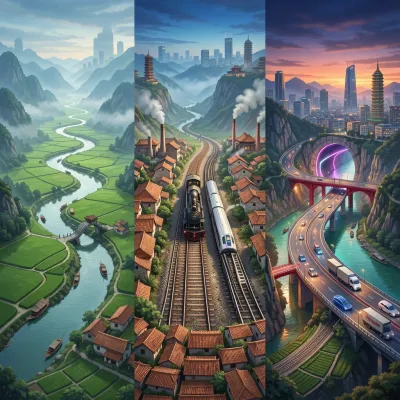
Rivers and Roads argues that infrastructure is a central force in China’s provincial development, not merely a background condition. Across canals, railways, highways, ports, dams, bridges, and high-speed rail, the book shows how transport and waterworks have repeatedly reordered markets, migration, settlement, industry, and state power. Its core insight is that national infrastructure programs produced sharply different provincial outcomes because local terrain, resources, politics, and histories shaped how each network was built and who benefited from it.
The eastern provinces illustrate how water and coastal access helped create China’s most dynamic economic regions. Jiangsu’s Grand Canal and Yangtze corridors supported grain transport, industrial cities, and modern port-logistics systems; Zhejiang combined private enterprise with bridges, expressways, and Ningbo-Zhoushan’s global port role; Shandong shifted from canal and Yellow River landscapes toward rail corridors and Qingdao’s coastal trade; Hebei became bound to Beijing through railways, highways, ports, and water-transfer systems; Guangdong’s Pearl River Delta turned ports, expressways, high-speed rail, and Hong Kong-Macau links into the machinery of the “world factory”; Hainan overcame island isolation through ring roads, upgraded ports, airports, ferries, and high-speed rail.
The central and interior chapters emphasize junctions, watersheds, and state-led integration. Henan’s Zhengzhou rose from railway crossing to national logistics super-hub; Hubei’s Wuhan became a Yangtze heartland shaped by bridges, flood control, and the Three Gorges Dam; Hunan’s Xiang River, railways, roads, and agricultural markets integrated food production with migration and manufacturing; Anhui balanced Huai River flood control with Yangtze-linked industrialization; Jiangxi’s Gan River and Poyang Lake connected it to the Yangtze while railways and highways linked its minerals and cities; Shaanxi and Gansu revived the logic of the Silk Road through the Longhai line, landports, high-speed rail, and China-Europe freight corridors.
The western, northeastern, border, and island chapters show infrastructure as a tool for overcoming geography and redefining regional identity. Shanxi’s coal economy was built on mule tracks, heavy-haul railways, and polluting freight corridors; Sichuan and Guizhou conquered mountains through bridges, tunnels, expressways, and poverty-alleviation roads; Yunnan and Guangxi became gateways to Southeast Asia through old caravan routes, colonial railways, modern corridors, ports, and border links; Xinjiang’s deserts were crossed by pipelines, rail loops, highways, and the Khorgos gateway; Liaoning, Jilin, and Heilongjiang reveal how railways, ports, oilfields, grain, and cross-border links shaped Northeast China’s industrial rise and renewal. Taiwan’s sugar railways, freeways, ports, and high-speed rail show how island connectivity supported both economic modernization and identity formation.
Taken together, the book presents infrastructure as a protagonist in China’s provincial histories. It created opportunity and integration, but also displacement, pollution, regional inequality, ecological risk, and new dependencies. From ancient canals to high-speed rail and smart logistics, each layer of connectivity transformed how people lived, worked, migrated, traded, and imagined their futures. The book’s broader conclusion is that China’s development has been built through the continual remaking of rivers and roads—and that the next challenge is to make those networks faster, fairer, more resilient, and more sustainable.
What You'll Find Inside:
- Explore how canals, railways, and highways have historically and contemporarily driven provincial development in China, acting as protagonists rather than passive backdrops.
- Discover case studies of 25 provinces, each highlighting unique challenges and innovations in adapting national infrastructure programs to local geographic and cultural contexts.
- Analyze the interplay between infrastructure and migration, showing how transport networks reshape labor markets, urban growth, and social structures.
- Understand the evolution of transport modes—from ancient waterways to modern high-speed rail—and their ecological, economic, and governance implications.
- Examine China's strategic integration of infrastructure with global initiatives like the Belt and Road, while addressing environmental sustainability and regional disparities.
Who's It For:
This book is essential for academics, policymakers, urban planners, and historians interested in infrastructure-led development, especially within China’s provincial and regional contexts. It will also benefit graduate students and researchers studying geography, public policy, and economic development, offering comparative insights into how connectivity shapes livelihoods and landscapes across diverse terrains.
Author:
Published By:
Date Published:
June 11, 2026
Type:
Nonfiction
Language:
English
Word Count:
50,450 words
Reading Time:
3 hours 32 minutes
Sample:
MixCache.com Total Access
Get unlimited access to this book + all books published by MixCache.com for $11.99/month
Subscribe to MTAOr purchase this book individually below
Order:
Buy the Rivers and Roads: Infrastructure and Provincial Development in China ebook on MixCache.com:
Buy Now
Full ebook will be available immediately
- read online or download as a PDF file.
$5 account credit for all new MixCache.com accounts, usable toward any ebook purchase!*




Ratings & Reviews
Ask Questions About This Book
Have a question about the content? Ask our AI assistant!
Start by asking a question about "Rivers and Roads: Infrastructure and Provincial Development in China"
Example: "Does this book mention William Shakespeare?"
Thinking...