
Browse by Category
Fiction
- Action & Adventure
- African American
- Anthologies
- Children's Fiction
- Classics
- Comics & Graphic Novels
- Coming of Age
- Contemporary
- Cultural & Regional
- Drama
- Erotica
- Fantasy
- General
- Historical Fiction
- Horror
- Humor & Satire
- Literary Fiction
- Mystery, Thriller & Suspense
- Poetry
- Religious & Inspirational
- Romance
- Science Fiction
- Short Stories
- War & Military
- Westerns
- Women's Fiction
- Young Adult
Non-Fiction
- Antiques & Collectibles
- Arts & Photography
- Biographies & Memoirs
- Business & Money
- Children's Non-Fiction
-
Computers & Technology
- Artificial Intelligence
- Computer Science
- Cybersecurity & Cryptography
- Data Science & Analytics
- Databases & Big Data
- Game Development & Design
- General
- Hardware & DIY
- Mobile App Development
- Networking & Cloud Computing
- Operating Systems
- Programming
- Robotics
- Software
- Software Engineering
- User Experience (UX) & Design
- Web Development & Design
- Cooking, Food & Wine
- Crafts, Hobbies & Home
- Education & Teaching
- Engineering
- General
- Health, Fitness & Dieting
-
History
- African History
- African History - North Africa
- African History - Sub-Saharan Africa
- American History
- American History - 20th Century
- American History - Civil War
- American History - Colonial Period
- Ancient History
- Asian History
- Asian History - China
- Asian History - India
- Asian History - Japan
- Asian History - Southeast Asia
- European History
- European History - Ancient Greece
- European History - Ancient Rome
- European History - Medieval
- European History - Modern
- European History - Renaissance
- General
- Middle Eastern History
- Military History
- Military History - Aviation
- Military History - Naval
- Social & Cultural History
- World History
- Humor & Entertainment
- Industrial Technology
- Language Learning
- Law
- LGBTQ+ Non-Fiction
- Literary Criticism
- Medical Books
- Parenting & Relationships
- Philosophy
- Politics & Social Sciences
- Reference
- Religion & Spirituality
-
Science & Math
- Agricultural Sciences
- Astronomy & Space Science
- Behavioral Sciences
- Biological Sciences
- Botany & Plant Science
- Chemistry
- Earth Sciences
- Engineering - Chemical
- Engineering - Civil
- Engineering - Electrical
- Engineering - Mechanical
- Environment
- General
- Geology
- Mathematics
- Nature & Ecology
- Oceanography
- Paleontology
- Physics
- Statistics
- Self-Help
- Sports & Outdoors
- Study Aids
- Sustainability & Green Living
- Textbooks
- Transportation
- Travel
- True Crime
- Urban Planning & Development
- Veterinary Medicine
- Writing & Publishing
Jump to Section

Want unlimited access to all books published by MixCache.com (plus their audiobooks)? Try MixCache.com Total Access. Look for the MTA badge on book covers to identify included titles.
Access to infinite ebooks: Don't see the book you want? Suggest it and we'll create it (free!) for you from scratch with our powerful AI book writer. Then read it with MTA - besides profiting from any sales it makes!
Canals and Commerce: Amsterdam’s Rise as a Merchant Republic
MTA
Trade networks, religious tolerance, and urban engineering in Amsterdam
About this book:
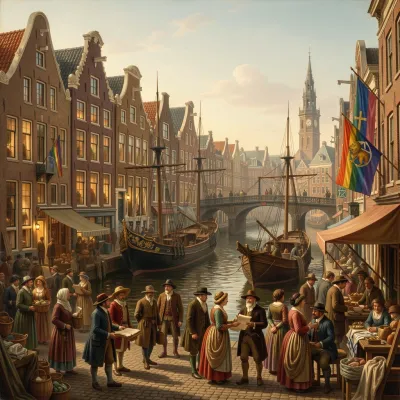
Amsterdam’s transformation into a merchant republic in the 17th century was driven by a convergence of engineering, institutional innovation, and social pragmatism. The city’s physical reshaping—particularly the Grachtengordel canal ring—converted marshland into a structured hub for commerce, with infrastructure like dredged ports, shipyards, and windmill-powered water systems enabling efficient trade. Canals and locks became more than scenic features; they were instruments of economic expansion, facilitating both cargo transport and urban development. This engineering mastery laid the groundwork for Amsterdam’s role as a central node in global trade networks, supported by the Dutch East India Company (VOC) and West India Company (WIC), which expanded Dutch influence into Asia and the Atlantic, respectively, though these ventures came with moral costs, including slavery and colonial exploitation.
Financial institutions like the Wisselbank and Bourse were pivotal in reducing risks for merchants and standardizing transactions. The Wisselbank introduced a stable currency for international trade, while the Bourse pioneered joint-stock companies and futures markets, enabling capital aggregation and speculative investment. Legal frameworks—including specialized courts, marine insurance, and notarial systems—provided predictability and trust in a complex commercial ecosystem. These innovations, paired with a regulatory ethos that balanced risk and reward, allowed Amsterdam to become a financial powerhouse, though episodes like Tulip Mania highlighted the perils of speculative excess.
Social policies were equally central to Amsterdam’s success. Religious tolerance, though often pragmatic rather than principled, attracted skilled migrants like Sephardic Jews, Huguenots, and other refugees, who brought capital, networks, and expertise. Urban planners accommodated this diversity through hidden churches, distinct neighborhoods, and inclusive governance, while institutions like the Poor Chamber managed poverty to maintain stability. The city’s ability to integrate labor and talent from across Europe underpinned its economic dynamism, even as disparities persisted between elite merchant families and working-class migrants.
The book concludes by reflecting on how Amsterdam’s rise and eventual decline offer lessons for modern urbanism. Its combination of adaptive infrastructure, accountable governance, and openness to diversity demonstrates how cities can harness geography, innovation, and social cohesion to drive prosperity. However, its "waning tides" in the 18th century—marked by entrenched oligarchy, rising competition, and the burdens of empire—underscore the importance of continuous adaptation. Amsterdam’s legacy lies in its integration of practical solutions with long-term vision, offering a model for designing cities that are not only economically resilient but also socially inclusive and environmentally sustainable.
What You'll Find Inside:
- How Amsterdam's canal system (Grachtengordel) functioned as integrated infrastructure that enabled commercial growth through water management, transport efficiency, and urban planning
- The financial innovations that created stability - the Wisselbank's standardized currency and the Bourse's organized share trading that reduced risk and enabled global ventures like the VOC
- How religious tolerance and pragmatic migration policies attracted skilled workers, capital, and global networks from Sephardic Jews, Huguenots, and other refugees, transforming diversity into economic advantage
- The development of sophisticated legal and contractual systems (notaries, commercial courts) that minimized disputes, enforced agreements, and built trust essential for complex international trade
- Timeless lessons for modern cities on integrating infrastructure, institutions, and inclusion to design open, prosperous, and resilient urban economies that turn geography into opportunity
Who's It For:
This book is for city makers, urban planners, and policymakers seeking historical insights for contemporary challenges; financiers and economic historians interested in the origins of modern financial systems; and citizens curious about how infrastructure, legal frameworks, and social policies interact to create urban prosperity. It will particularly benefit those working on urban resilience, immigration policy, financial regulation, or inclusive economic development who want to understand Amsterdam's integrated approach as a case study for modern city design.
Author:
Published By:
Date Published:
June 10, 2026
Type:
Nonfiction
Language:
English
Word Count:
55,258 words
Reading Time:
3 hours 52 minutes
Sample:
MixCache.com Total Access
Get unlimited access to this book + all books published by MixCache.com for $11.99/month
Subscribe to MTAOr purchase this book individually below
Order:
Buy the Canals and Commerce: Amsterdam’s Rise as a Merchant Republic ebook on MixCache.com:
Buy Now
Full ebook will be available immediately
- read online or download as a PDF file.
$5 account credit for all new MixCache.com accounts, usable toward any ebook purchase!*



Ratings & Reviews
Ask Questions About This Book
Have a question about the content? Ask our AI assistant!
Start by asking a question about "Canals and Commerce: Amsterdam’s Rise as a Merchant Republic"
Example: "Does this book mention William Shakespeare?"
Thinking...