
Browse by Category
Fiction
- Action & Adventure
- African American
- Anthologies
- Children's Fiction
- Classics
- Comics & Graphic Novels
- Coming of Age
- Contemporary
- Cultural & Regional
- Drama
- Erotica
- Fantasy
- General
- Historical Fiction
- Horror
- Humor & Satire
- Literary Fiction
- Mystery, Thriller & Suspense
- Poetry
- Religious & Inspirational
- Romance
- Science Fiction
- Short Stories
- War & Military
- Westerns
- Women's Fiction
- Young Adult
Non-Fiction
- Antiques & Collectibles
- Arts & Photography
- Biographies & Memoirs
- Business & Money
- Children's Non-Fiction
-
Computers & Technology
- Artificial Intelligence
- Computer Science
- Cybersecurity & Cryptography
- Data Science & Analytics
- Databases & Big Data
- Game Development & Design
- General
- Hardware & DIY
- Mobile App Development
- Networking & Cloud Computing
- Operating Systems
- Programming
- Robotics
- Software
- Software Engineering
- User Experience (UX) & Design
- Web Development & Design
- Cooking, Food & Wine
- Crafts, Hobbies & Home
- Education & Teaching
- Engineering
- General
- Health, Fitness & Dieting
-
History
- African History
- African History - North Africa
- African History - Sub-Saharan Africa
- American History
- American History - 20th Century
- American History - Civil War
- American History - Colonial Period
- Ancient History
- Asian History
- Asian History - China
- Asian History - India
- Asian History - Japan
- Asian History - Southeast Asia
- European History
- European History - Ancient Greece
- European History - Ancient Rome
- European History - Medieval
- European History - Modern
- European History - Renaissance
- General
- Middle Eastern History
- Military History
- Military History - Aviation
- Military History - Naval
- Social & Cultural History
- World History
- Humor & Entertainment
- Industrial Technology
- Language Learning
- Law
- LGBTQ+ Non-Fiction
- Literary Criticism
- Medical Books
- Parenting & Relationships
- Philosophy
- Politics & Social Sciences
- Reference
- Religion & Spirituality
-
Science & Math
- Agricultural Sciences
- Astronomy & Space Science
- Behavioral Sciences
- Biological Sciences
- Botany & Plant Science
- Chemistry
- Earth Sciences
- Engineering - Chemical
- Engineering - Civil
- Engineering - Electrical
- Engineering - Mechanical
- Environment
- General
- Geology
- Mathematics
- Nature & Ecology
- Oceanography
- Paleontology
- Physics
- Statistics
- Self-Help
- Sports & Outdoors
- Study Aids
- Sustainability & Green Living
- Textbooks
- Transportation
- Travel
- True Crime
- Urban Planning & Development
- Veterinary Medicine
- Writing & Publishing
Jump to Section
MixCache.com Total Access
Unlimited reading and audiobooks for every book published by MixCache.com.
Included titles carry the MTA badge.
Learn more →
Delhi Metro and Mobility
MTA
How rapid transit reshaped commuting, land use, and accessibility in New Delhi
About this book:
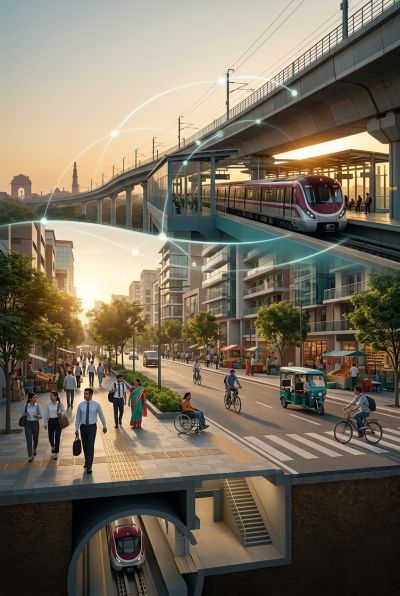
The Delhi Metro emerged as a response to Delhi's severe traffic congestion, pollution, and inadequate public transport, with planning tracing back to 1969 studies. The Delhi Metro Rail Corporation (DMRC) was established in 1995 as a joint venture with equal equity from the central and Delhi governments, granting it operational autonomy. Visionary leadership under E. Sreedharan ensured Phase I (65.1 km) was completed ahead of schedule in 2006, setting a benchmark for Indian infrastructure. Subsequent phases expanded the network to over 370 km across 10 lines, employing Tunnel Boring Machines for underground sections, Communication-Based Train Control for efficiency, and a mix of elevated, at-grade, and underground alignments to navigate Delhi's dense urban fabric and historical sites.
Operations prioritized high frequency, reliability (exceeding 99% punctuality), and safety through platform screen doors, rigorous maintenance, and centralized control. The metro triggered a significant mode shift from buses, autos, and private vehicles by offering speed, predictability, air-conditioning, and enhanced security, particularly via women-only coaches. Accessibility was embedded through universal design—lifts, tactile paving, Braille signage, and priority seating—while effective first and last-mile connectivity via feeder buses, e-rickshaws, and walking remained crucial for maximizing the system's reach. Multimodal integration with DTC buses, suburban rail, the Airport Express Line, and informal feeder services created a cohesive network, facilitated by integrated stations and common mobility card aspirations.
Beyond transport, the Delhi Metro reshaped land use, spurring densification, mixed-use development, and transit-oriented development (TOD) around stations, which boosted property values and created employment hubs. It generated substantial direct and indirect jobs in construction, operations, retail, and informal sectors, while improving air quality, reducing noise pollution, and enhancing road safety by shifting trips from roads. Financial sustainability balanced farebox revenue with diversified streams like advertising, property development, and consultancy, alongside value capture mechanisms. Governance involved complex coordination among DMRC, central/state agencies, municipal bodies, and regulators, while resilience was demonstrated through robust safety protocols and adaptive responses to challenges like the COVID-19 pandemic. The metro also evolved into a cultural public space fostering social interaction, civic pride, and equitable access considerations, though challenges of affordability for low-income groups and gentrification persisted.
The Delhi Metro offers transferable lessons for other megacities: the necessity of an autonomous, professionally led institution; visionary leadership committed to quality and deadlines; financial diversification beyond fares; phased, iterative expansion building credibility; phased expansion building credibility; embracing modern technology like TBMs and CBTC; prioritizing multimodal integration and last-mile solutions; embedding gender inclusion and safety measures; balancing affordability with financial viability through transparent fare policy; investing in environmental sustainability via regenerative braking and renewable energy; and designing stations as inclusive public spaces that reflect local culture. Its experience underscores that metro systems are not just infrastructure but catalysts for broader urban transformation, requiring continuous adaptation to local context to ensure benefits are widely shared and sustainable.
What You'll Find Inside:
- How the Delhi Metro catalyzed land use transformations, promoting density, mixed-use development, and re-centralization around transit corridors.
- The profound shift in commuter behavior and mode share, with detailed analysis of travel patterns, ridership analytics, and peak management strategies.
- Comprehensive accessibility and inclusion measures addressing gender safety, universal design for persons with disabilities, and creating equitable public spaces.
- Innovative financial models including value capture mechanisms, public-private partnerships, and non-fare revenue streams that ensured long-term viability.
- Environmental and health impacts, including air quality improvement, noise reduction, and the metro's role as a sustainable mobility solution in a megacity context.
Who's It For:
This book is essential for urban transport planners, civil engineers, and policymakers involved in megacity infrastructure projects, particularly those studying or implementing rapid transit systems in developing regions. It also serves as a valuable resource for urban studies researchers and students seeking to understand the interconnected dynamics of transit, land use, equity, and sustainability in large metropolitan areas like Delhi.
Table of Contents:
- Introduction
- Chapter 1 From Vision to Reality: The Conception of the Delhi Metro
- Chapter 2 Building a Megaproject: Institutions, Leadership, and Finance
- Chapter 3 Engineering the Network: Alignments, Tunnels, and Elevated Corridors
- Chapter 4 Phases of Expansion: I to IV and Beyond
- Chapter 5 Operations and Service Design: Frequencies, Headways, and Reliability
- Chapter 6 The Commuter’s Journey: Travel Behavior and Mode Shift
- Chapter 7 Accessibility and Inclusion: Gender, Safety, and Universal Design
- Chapter 8 Affordability and Fare Policy: Balancing Access and Viability
- Chapter 9 Stations as Places: Architecture, Wayfinding, and Public Space
- Chapter 10 First and Last Mile: Feeder Buses, E‑Rickshaws, and Walking
- Chapter 11 Multimodal Integration: Buses, Suburban Rail, and Airports
- Chapter 12 Ridership Analytics: Data, Demand, and Peak Management
- Chapter 13 Land Use Transformations: Density, Mixed Use, and Re‑centralization
- Chapter 14 Transit‑Oriented Development: Policy, Practice, and Pitfalls
- Chapter 15 Real Estate and Economic Uplift: Property Values and Jobs
- Chapter 16 Environment and Health: Air Quality, Noise, and Road Safety
- Chapter 17 Energy and Sustainability: Rolling Stock, Power, and Green Stations
- Chapter 18 Digital Mobility: Ticketing, Payments, and Mobility‑as‑a‑Service
- Chapter 19 Governance and Regulation: DMRC, Agencies, and Coordination
- Chapter 20 Finance and Value Capture: PPPs, Advertising, and Non‑Fare Revenue
- Chapter 21 Equity and Social Outcomes: Who Benefits, Who Is Left Behind?
- Chapter 22 Resilience and Risk: Construction Safety, Operations, and Pandemics
- Chapter 23 Culture and Urban Life: The Metro as Public Space
- Chapter 24 Case Studies: Corridor Impacts across Delhi and NCR
- Chapter 25 Lessons for Other Megacities: Transferability and Cautionary Tales
Author:
Published By:
Date Published:
June 6, 2026
Type:
Nonfiction
Language:
English
Word Count:
42,913 words
Reading Time:
3 hours
Sample:
MixCache.com Total Access
Get unlimited access to this book + all books published by MixCache.com for $11.99/month
Subscribe to MTAOr purchase this book individually below
Order:
Buy the Delhi Metro and Mobility ebook on MixCache.com:
Buy Now
Full ebook will be available immediately
- read online or download as a PDF file.
$5 account credit for all new MixCache.com accounts, usable toward any ebook purchase!*





Ratings & Reviews
Ask Questions About This Book
Have a question about the content? Ask our AI assistant!
Start by asking a question about "Delhi Metro and Mobility"
Example: "Does this book mention William Shakespeare?"
Thinking...