Browse by Category
Fiction
- Action & Adventure
- African American
- Anthologies
- Children's Fiction
- Classics
- Comics & Graphic Novels
- Coming of Age
- Contemporary
- Cultural & Regional
- Drama
- Erotica
- Fantasy
- General
- Historical Fiction
- Horror
- Humor & Satire
- Literary Fiction
- Mystery, Thriller & Suspense
- Poetry
- Religious & Inspirational
- Romance
- Science Fiction
- Short Stories
- War & Military
- Westerns
- Women's Fiction
- Young Adult
Non-Fiction
- Antiques & Collectibles
- Arts & Photography
- Biographies & Memoirs
- Business & Money
- Children's Non-Fiction
-
Computers & Technology
- Artificial Intelligence
- Computer Science
- Cybersecurity & Cryptography
- Data Science & Analytics
- Databases & Big Data
- Game Development & Design
- General
- Hardware & DIY
- Mobile App Development
- Networking & Cloud Computing
- Operating Systems
- Programming
- Robotics
- Software
- Software Engineering
- User Experience (UX) & Design
- Web Development & Design
- Cooking, Food & Wine
- Crafts, Hobbies & Home
- Education & Teaching
- Engineering
- General
- Health, Fitness & Dieting
-
History
- African History
- African History - North Africa
- African History - Sub-Saharan Africa
- American History
- American History - 20th Century
- American History - Civil War
- American History - Colonial Period
- Ancient History
- Asian History
- Asian History - China
- Asian History - India
- Asian History - Japan
- Asian History - Southeast Asia
- European History
- European History - Ancient Greece
- European History - Ancient Rome
- European History - Medieval
- European History - Modern
- European History - Renaissance
- General
- Middle Eastern History
- Military History
- Military History - Aviation
- Military History - Naval
- Social & Cultural History
- World History
- Humor & Entertainment
- Industrial Technology
- Language Learning
- Law
- LGBTQ+ Non-Fiction
- Literary Criticism
- Medical Books
- Parenting & Relationships
- Philosophy
- Politics & Social Sciences
- Reference
- Religion & Spirituality
-
Science & Math
- Agricultural Sciences
- Astronomy & Space Science
- Behavioral Sciences
- Biological Sciences
- Botany & Plant Science
- Chemistry
- Earth Sciences
- Engineering - Chemical
- Engineering - Civil
- Engineering - Electrical
- Engineering - Mechanical
- Environment
- General
- Geology
- Mathematics
- Nature & Ecology
- Oceanography
- Paleontology
- Physics
- Statistics
- Self-Help
- Sports & Outdoors
- Study Aids
- Sustainability & Green Living
- Textbooks
- Transportation
- Travel
- True Crime
- Urban Planning & Development
- Veterinary Medicine
- Writing & Publishing
Jump to Section
MixCache.com Total Access
Unlimited reading and audiobooks for every book published by MixCache.com.
Included titles carry the MTA badge.
Learn more →A History of Slovakia
About this book:
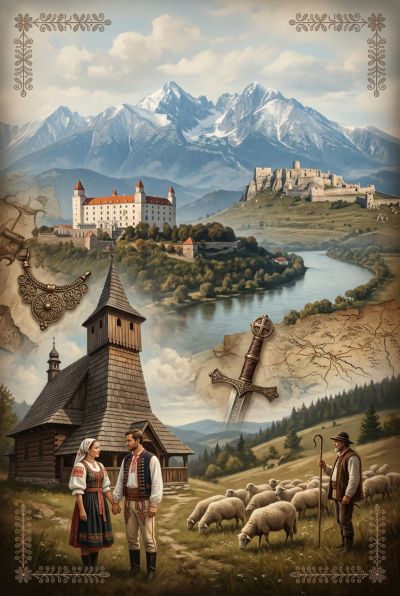
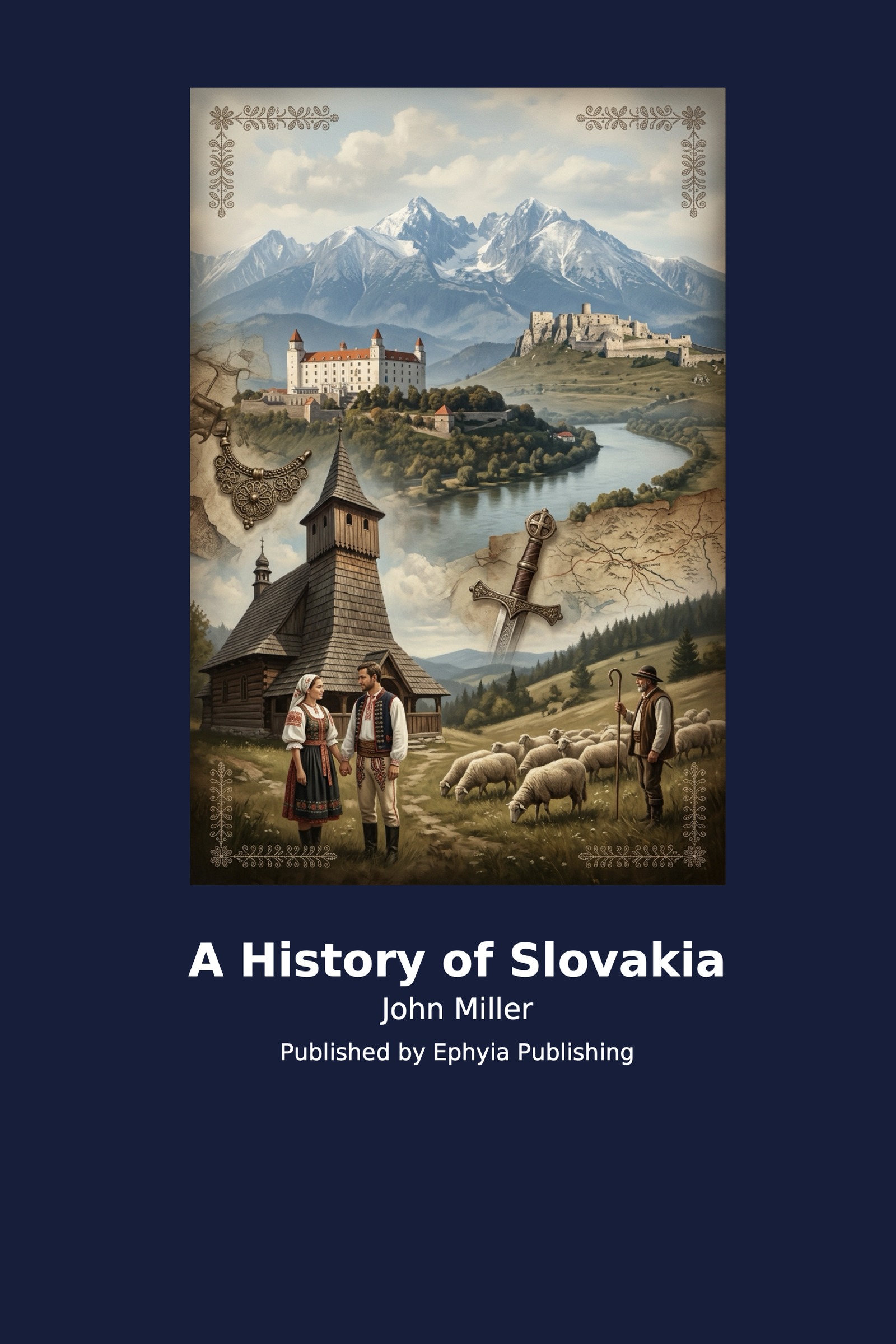
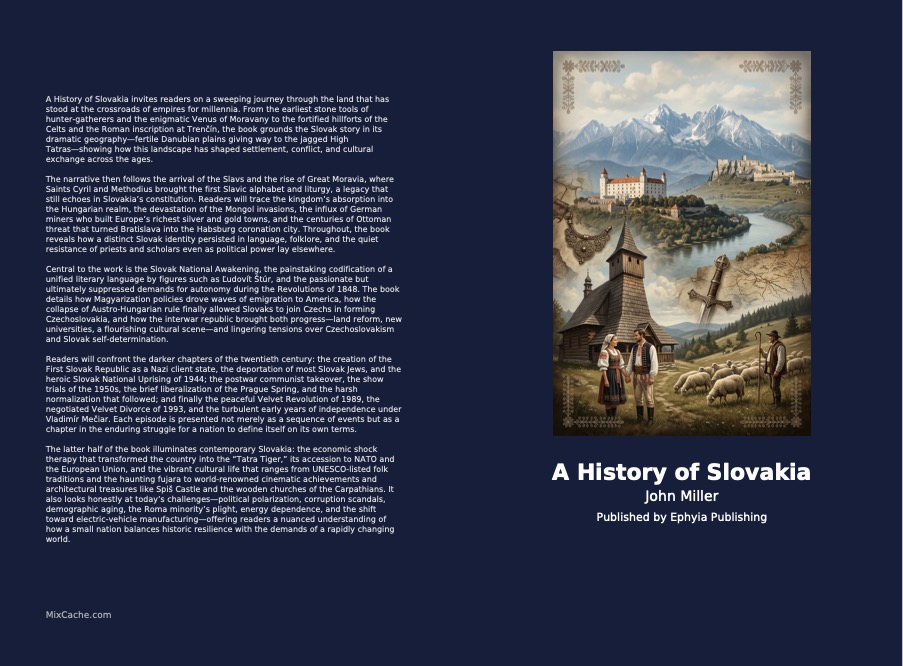
A History of Slovakia invites readers on a sweeping journey through the land that has stood at the crossroads of empires for millennia. From the earliest stone tools of hunter‑gatherers and the enigmatic Venus of Moravany to the fortified hillforts of the Celts and the Roman inscription at Trenčín, the book grounds the Slovak story in its dramatic geography—fertile Danubian plains giving way to the jagged High Tatras—showing how this landscape has shaped settlement, conflict, and cultural exchange across the ages.
The narrative then follows the arrival of the Slavs and the rise of Great Moravia, where Saints Cyril and Methodius brought the first Slavic alphabet and liturgy, a legacy that still echoes in Slovakia’s constitution. Readers will trace the kingdom’s absorption into the Hungarian realm, the devastation of the Mongol invasions, the influx of German miners who built Europe’s richest silver and gold towns, and the centuries of Ottoman threat that turned Bratislava into the Habsburg coronation city. Throughout, the book reveals how a distinct Slovak identity persisted in language, folklore, and the quiet resistance of priests and scholars even as political power lay elsewhere.
Central to the work is the Slovak National Awakening, the painstaking codification of a unified literary language by figures such as Ľudovít Štúr, and the passionate but ultimately suppressed demands for autonomy during the Revolutions of 1848. The book details how Magyarization policies drove waves of emigration to America, how the collapse of Austro‑Hungarian rule finally allowed Slovaks to join Czechs in forming Czechoslovakia, and how the interwar republic brought both progress—land reform, new universities, a flourishing cultural scene—and lingering tensions over Czechoslovakism and Slovak self‑determination.
Readers will confront the darker chapters of the twentieth century: the creation of the First Slovak Republic as a Nazi client state, the deportation of most Slovak Jews, and the heroic Slovak National Uprising of 1944; the postwar communist takeover, the show trials of the 1950s, the brief liberalization of the Prague Spring, and the harsh normalization that followed; and finally the peaceful Velvet Revolution of 1989, the negotiated Velvet Divorce of 1993, and the turbulent early years of independence under Vladimír Mečiar. Each episode is presented not merely as a sequence of events but as a chapter in the enduring struggle for a nation to define itself on its own terms.
The latter half of the book illuminates contemporary Slovakia: the economic shock therapy that transformed the country into the “Tatra Tiger,” its accession to NATO and the European Union, and the vibrant cultural life that ranges from UNESCO‑listed folk traditions and the haunting fujara to world‑renowned cinematic achievements and architectural treasures like Spiš Castle and the wooden churches of the Carpathians. It also looks honestly at today’s challenges—political polarization, corruption scandals, demographic aging, the Roma minority’s plight, energy dependence, and the shift toward electric‑vehicle manufacturing—offering readers a nuanced understanding of how a small nation balances historic resilience with the demands of a rapidly changing world.
What You'll Find Inside:
- Traces Slovak origins from prehistoric inhabitants through the Great Moravian Empire and the Cyril‑Methodian mission, which laid the cultural and linguistic foundations of the nation.
- Details a millennium under Hungarian rule, highlighting the Slovak National Awakening, the codification of the Slovak language, and the struggle against Magyarization.
- Explores the birth of Czechoslovakia, World War II experiences including the Slovak National Uprising, and the subsequent communist era from 1948 to 1989.
- Chronicles the peaceful Velvet Divorce, Slovakia’s transition to independence, and its rapid integration into NATO and the European Union in the 2000s.
- Examines contemporary Slovakia’s political polarization, economic challenges (including the shift from the 'Tatra Tiger' model), and enduring cultural traditions amid EU and NATO membership.
Who's It For:
This book is ideal for university students, scholars, and general readers interested in Central European history, nation‑building, and the interplay of culture and politics. It provides a comprehensive yet accessible narrative that will benefit anyone seeking to understand Slovakia’s unique journey from early Slavic settlement to its role as a modern EU and NATO member.
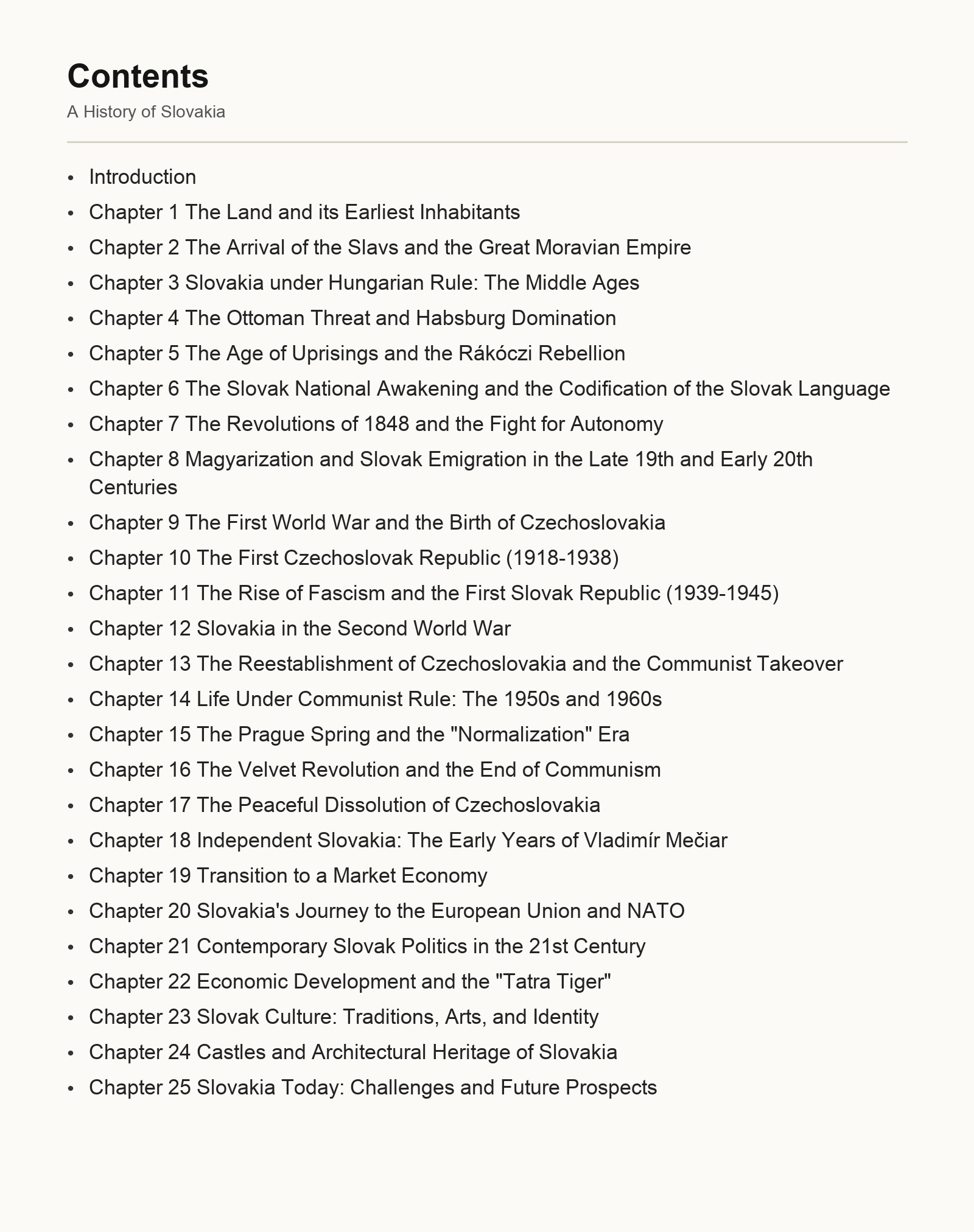
Table of Contents:
- Introduction
- Chapter 1 The Land and its Earliest Inhabitants
- Chapter 2 The Arrival of the Slavs and the Great Moravian Empire
- Chapter 3 Slovakia under Hungarian Rule: The Middle Ages
- Chapter 4 The Ottoman Threat and Habsburg Domination
- Chapter 5 The Age of Uprisings and the Rákóczi Rebellion
- Chapter 6 The Slovak National Awakening and the Codification of the Slovak Language
- Chapter 7 The Revolutions of 1848 and the Fight for Autonomy
- Chapter 8 Magyarization and Slovak Emigration in the Late 19th and Early 20th Centuries
- Chapter 9 The First World War and the Birth of Czechoslovakia
- Chapter 10 The First Czechoslovak Republic (1918-1938)
- Chapter 11 The Rise of Fascism and the First Slovak Republic (1939-1945)
- Chapter 12 Slovakia in the Second World War
- Chapter 13 The Reestablishment of Czechoslovakia and the Communist Takeover
- Chapter 14 Life Under Communist Rule: The 1950s and 1960s
- Chapter 15 The Prague Spring and the "Normalization" Era
- Chapter 16 The Velvet Revolution and the End of Communism
- Chapter 17 The Peaceful Dissolution of Czechoslovakia
- Chapter 18 Independent Slovakia: The Early Years of Vladimír Mečiar
- Chapter 19 Transition to a Market Economy
- Chapter 20 Slovakia's Journey to the European Union and NATO
- Chapter 21 Contemporary Slovak Politics in the 21st Century
- Chapter 22 Economic Development and the "Tatra Tiger"
- Chapter 23 Slovak Culture: Traditions, Arts, and Identity
- Chapter 24 Castles and Architectural Heritage of Slovakia
- Chapter 25 Slovakia Today: Challenges and Future Prospects
Author:
Published By:
Date Published:
May 29, 2026
Type:
Nonfiction
Language:
English
Also Available In:
Word Count:
45,798 words
Reading Time:
3 hours 12 minutes
Sample:
Order:
Order A History of Slovakia (Hardcover) on MixCache.com:
Buy NowPrint copy is made to order and ships worldwide. Includes the ebook free, ready to read instantly.
$5 account credit for all new MixCache.com accounts, usable toward any ebook purchase!*