Browse by Category
Fiction
- Action & Adventure
- African American
- Anthologies
- Children's Fiction
- Classics
- Comics & Graphic Novels
- Coming of Age
- Contemporary
- Cultural & Regional
- Drama
- Erotica
- Fantasy
- General
- Historical Fiction
- Horror
- Humor & Satire
- Literary Fiction
- Mystery, Thriller & Suspense
- Poetry
- Religious & Inspirational
- Romance
- Science Fiction
- Short Stories
- War & Military
- Westerns
- Women's Fiction
- Young Adult
Non-Fiction
- Antiques & Collectibles
- Arts & Photography
- Biographies & Memoirs
- Business & Money
- Children's Non-Fiction
-
Computers & Technology
- Artificial Intelligence
- Computer Science
- Cybersecurity & Cryptography
- Data Science & Analytics
- Databases & Big Data
- Game Development & Design
- General
- Hardware & DIY
- Mobile App Development
- Networking & Cloud Computing
- Operating Systems
- Programming
- Robotics
- Software
- Software Engineering
- User Experience (UX) & Design
- Web Development & Design
- Cooking, Food & Wine
- Crafts, Hobbies & Home
- Education & Teaching
- Engineering
- General
- Health, Fitness & Dieting
-
History
- African History
- African History - North Africa
- African History - Sub-Saharan Africa
- American History
- American History - 20th Century
- American History - Civil War
- American History - Colonial Period
- Ancient History
- Asian History
- Asian History - China
- Asian History - India
- Asian History - Japan
- Asian History - Southeast Asia
- European History
- European History - Ancient Greece
- European History - Ancient Rome
- European History - Medieval
- European History - Modern
- European History - Renaissance
- General
- Middle Eastern History
- Military History
- Military History - Aviation
- Military History - Naval
- Social & Cultural History
- World History
- Humor & Entertainment
- Industrial Technology
- Language Learning
- Law
- LGBTQ+ Non-Fiction
- Literary Criticism
- Medical Books
- Parenting & Relationships
- Philosophy
- Politics & Social Sciences
- Reference
- Religion & Spirituality
-
Science & Math
- Agricultural Sciences
- Astronomy & Space Science
- Behavioral Sciences
- Biological Sciences
- Botany & Plant Science
- Chemistry
- Earth Sciences
- Engineering - Chemical
- Engineering - Civil
- Engineering - Electrical
- Engineering - Mechanical
- Environment
- General
- Geology
- Mathematics
- Nature & Ecology
- Oceanography
- Paleontology
- Physics
- Statistics
- Self-Help
- Sports & Outdoors
- Study Aids
- Sustainability & Green Living
- Textbooks
- Transportation
- Travel
- True Crime
- Urban Planning & Development
- Veterinary Medicine
- Writing & Publishing
Jump to Section
MixCache.com Total Access
Unlimited reading and audiobooks for every book published by MixCache.com.
Included titles carry the MTA badge.
Learn more →A History of Senegal
About this book:
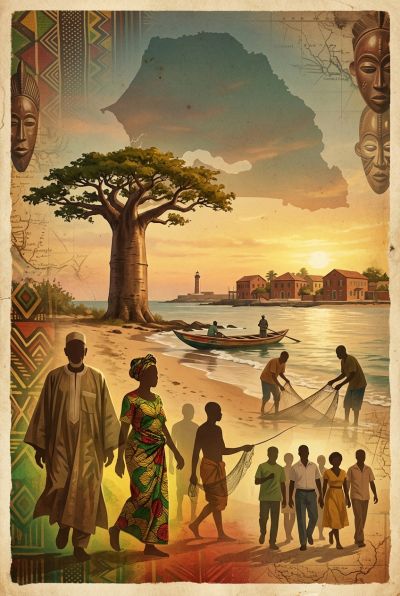

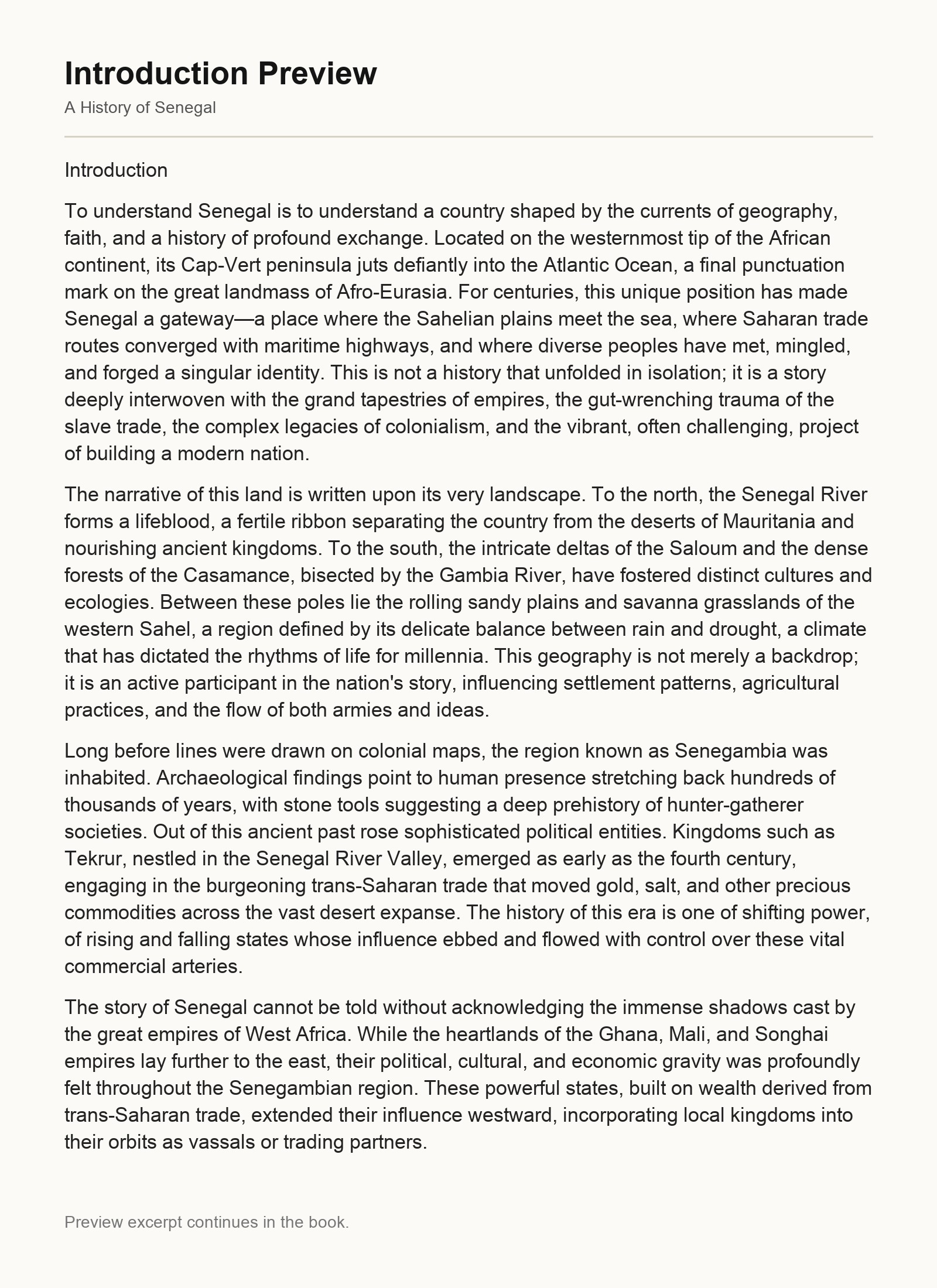
A History of Senegal offers readers a sweeping journey through the land that has long stood at the crossroads of Africa and the Atlantic world. Beginning with the stone tools of Paleolithic hunter‑gatherers and the enigmatic Senegambian stone circles, the narrative traces the rise of early kingdoms like Tekrur, the far‑reaching influence of the Ghana, Mali, and Songhai empires, and the emergence of the Jolof Confederation as a distinctly Senegambian powerhouse. Each chapter reveals how geography, trade, and shifting alliances shaped the foundations of societies long before European sails appeared on the horizon.
The book then immerses the reader in the tumultuous centuries of contact with the wider world: the arrival of Portuguese navigators, the rise of the transatlantic slave trade and its haunting legacy on Gorée Island, and the gradual establishment of French footholds in the Four Communes of Saint‑Louis, Gorée, Dakar, and Rufisque. It examines the brutal realities of colonial conquest, the varied forms of resistance and adaptation—from armed uprisings to the spiritual and economic resilience of Sufi brotherhoods—and the gradual awakening of nationalist consciousness embodied by figures like Blaise Diagne and Léopold Sédar Senghor.
Moving into the post‑independence era, the work explores the ambitious nation‑building projects of Senghor’s presidency, the philosophical sway of Négritude, the challenges of single‑party rule, and the subsequent democratic openings under Abdou Diouf and Abdoulaye Wade. Readers will witness the peaceful transfer of power in 2000, the economic trials of structural adjustment, the lingering Casamance conflict, and the daring infrastructure drives that sought to transform Senegal into an emerging economy while balancing tradition with modernity.
In its final sections, the book brings the story into the present, detailing Senegal’s youthful population, rapid urbanization, and the profound impact of climate change on historic cities like Saint‑Louis. It explains how the recent discovery of offshore oil and gas reserves has raised both hope and anxiety, prompting a national debate over resource management, corruption, and the potential for a new national currency. Throughout, the enduring spirit of teranga—Senegalese hospitality and solidarity—serves as a cultural thread that connects past struggles to future possibilities.
By weaving together archaeology, politics, economics, religion, and daily life, A History of Senegal equips readers with a deep understanding of a nation that has repeatedly defied expectations. Whether you are a student of African history, a traveler seeking cultural insight, or a professional interested in contemporary West African dynamics, this volume provides the context and nuance needed to appreciate Senegal’s remarkable journey from ancient stone circles to the ballot boxes of 2024.
What You'll Find Inside:
- The book traces Senegal's ancient foundations from Paleolithic stone tools and the enigmatic Senegambian stone circles to early kingdoms like Tekrur that engaged in trans-Saharan trade.
- It details the profound influence of the Ghana, Mali, and Songhai empires and the rise of the Jolof Empire as a distinct Senegambian powerhouse before European arrival.
- The transatlantic slave trade's devastating impact is examined, with Gorée Island highlighted as a powerful symbol of this horrific commerce and its lasting legacy on Senegalese society.
- French colonial rule, the unique status of the Four Communes, and Senegalese responses—including armed resistance, the rise of Sufi brotherhoods, and the fight for citizenship led by Blaise Diagne—are thoroughly explored.
- The narrative follows Senegal's path to independence, the Senghor presidency and Négritude, subsequent political and economic challenges, the Casamance conflict, and concludes with the historic 2024 presidential election that marked a democratic renewal.
Who's It For:
This book is ideal for undergraduate and graduate students of African history, political science, and post-colonial studies, as well as general readers seeking a comprehensive yet accessible understanding of Senegal's complex past and present. It will also benefit researchers, policymakers, and anyone interested in West African affairs, democratic transitions, and the cultural dynamics that shape nation-building.
Table of Contents:
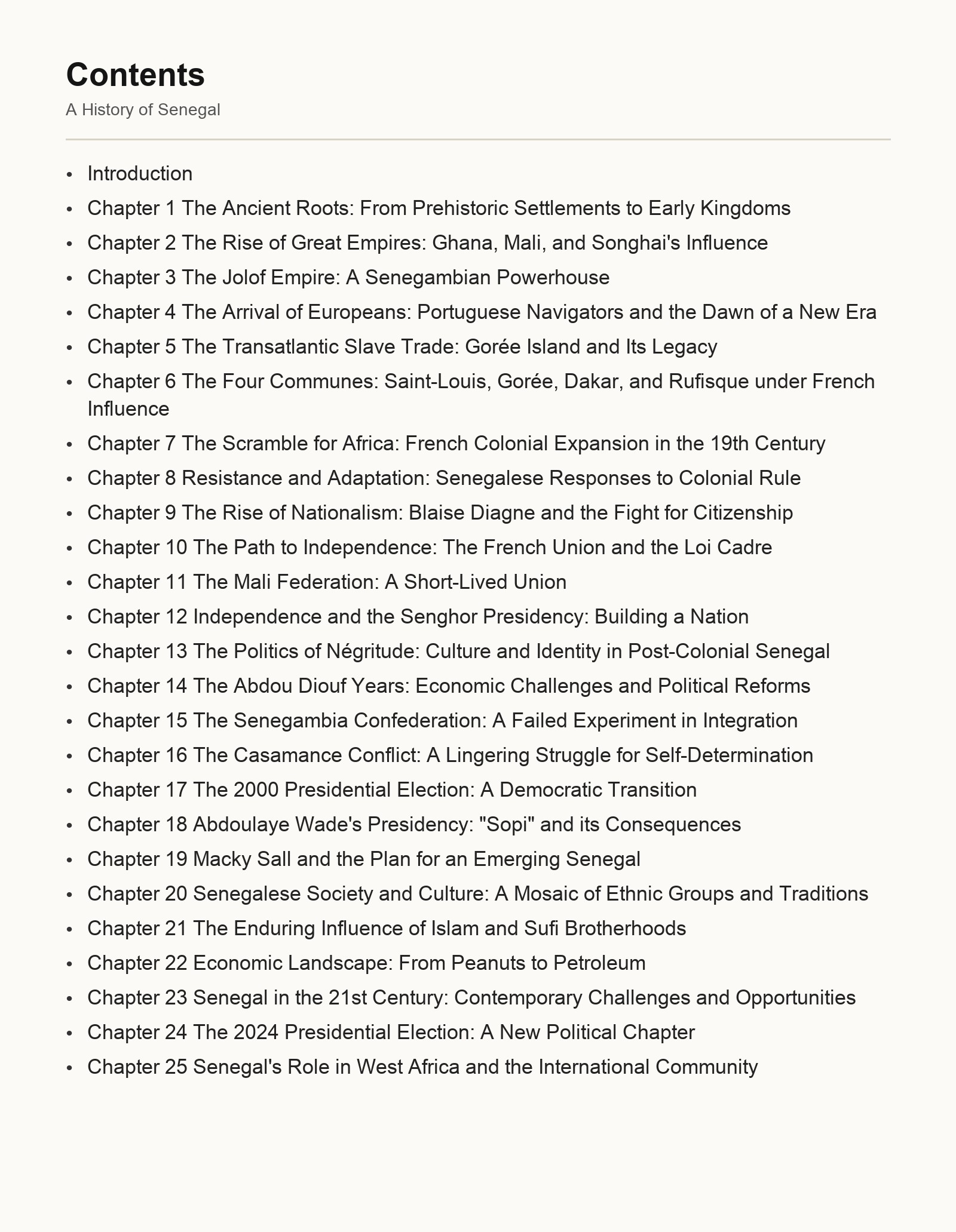
- Introduction
- Chapter 1 The Ancient Roots: From Prehistoric Settlements to Early Kingdoms
- Chapter 2 The Rise of Great Empires: Ghana, Mali, and Songhai's Influence
- Chapter 3 The Jolof Empire: A Senegambian Powerhouse
- Chapter 4 The Arrival of Europeans: Portuguese Navigators and the Dawn of a New Era.
- Chapter 5 The Transatlantic Slave Trade: Gorée Island and Its Legacy
- Chapter 6 The Four Communes: Saint-Louis, Gorée, Dakar, and Rufisque under French Influence
- Chapter 7 The Scramble for Africa: French Colonial Expansion in the 19th Century
- Chapter 8 Resistance and Adaptation: Senegalese Responses to Colonial Rule
- Chapter 9 The Rise of Nationalism: Blaise Diagne and the Fight for Citizenship
- Chapter 10 The Path to Independence: The French Union and the Loi Cadre.
- Chapter 11 The Mali Federation: A Short-Lived Union.
- Chapter 12 Independence and the Senghor Presidency: Building a Nation.
- Chapter 13 The Politics of Négritude: Culture and Identity in Post-Colonial Senegal
- Chapter 14 The Abdou Diouf Years: Economic Challenges and Political Reforms.
- Chapter 15 The Senegambia Confederation: A Failed Experiment in Integration.
- Chapter 16 The Casamance Conflict: A Lingering Struggle for Self-Determination.
- Chapter 17 The 2000 Presidential Election: A Democratic Transition
- Chapter 18 Abdoulaye Wade's Presidency: "Sopi" and its Consequences
- Chapter 19 Macky Sall and the Plan for an Emerging Senegal
- Chapter 20 Senegalese Society and Culture: A Mosaic of Ethnic Groups and Traditions
- Chapter 21 The Enduring Influence of Islam and Sufi Brotherhoods
- Chapter 22 Economic Landscape: From Peanuts to Petroleum
- Chapter 23 Senegal in the 21st Century: Contemporary Challenges and Opportunities
- Chapter 24 The 2024 Presidential Election: A New Political Chapter
- Chapter 25 Senegal's Role in West Africa and the International Community
Author:
Published By:
Date Published:
May 29, 2026
Type:
Nonfiction
Language:
English
Word Count:
47,876 words
Reading Time:
3 hours 21 minutes
Sample:
Order:
Order A History of Senegal (Hardcover) on MixCache.com:
Buy NowPrint copy is made to order and ships worldwide. Includes the ebook free, ready to read instantly.
$5 account credit for all new MixCache.com accounts, usable toward any ebook purchase!*