Browse by Category
Fiction
- Action & Adventure
- African American
- Anthologies
- Children's Fiction
- Classics
- Comics & Graphic Novels
- Coming of Age
- Contemporary
- Cultural & Regional
- Drama
- Erotica
- Fantasy
- General
- Historical Fiction
- Horror
- Humor & Satire
- Literary Fiction
- Mystery, Thriller & Suspense
- Poetry
- Religious & Inspirational
- Romance
- Science Fiction
- Short Stories
- War & Military
- Westerns
- Women's Fiction
- Young Adult
Non-Fiction
- Antiques & Collectibles
- Arts & Photography
- Biographies & Memoirs
- Business & Money
- Children's Non-Fiction
-
Computers & Technology
- Artificial Intelligence
- Computer Science
- Cybersecurity & Cryptography
- Data Science & Analytics
- Databases & Big Data
- Game Development & Design
- General
- Hardware & DIY
- Mobile App Development
- Networking & Cloud Computing
- Operating Systems
- Programming
- Robotics
- Software
- Software Engineering
- User Experience (UX) & Design
- Web Development & Design
- Cooking, Food & Wine
- Crafts, Hobbies & Home
- Education & Teaching
- Engineering
- General
- Health, Fitness & Dieting
-
History
- African History
- African History - North Africa
- African History - Sub-Saharan Africa
- American History
- American History - 20th Century
- American History - Civil War
- American History - Colonial Period
- Ancient History
- Asian History
- Asian History - China
- Asian History - India
- Asian History - Japan
- Asian History - Southeast Asia
- European History
- European History - Ancient Greece
- European History - Ancient Rome
- European History - Medieval
- European History - Modern
- European History - Renaissance
- General
- Middle Eastern History
- Military History
- Military History - Aviation
- Military History - Naval
- Social & Cultural History
- World History
- Humor & Entertainment
- Industrial Technology
- Language Learning
- Law
- LGBTQ+ Non-Fiction
- Literary Criticism
- Medical Books
- Parenting & Relationships
- Philosophy
- Politics & Social Sciences
- Reference
- Religion & Spirituality
-
Science & Math
- Agricultural Sciences
- Astronomy & Space Science
- Behavioral Sciences
- Biological Sciences
- Botany & Plant Science
- Chemistry
- Earth Sciences
- Engineering - Chemical
- Engineering - Civil
- Engineering - Electrical
- Engineering - Mechanical
- Environment
- General
- Geology
- Mathematics
- Nature & Ecology
- Oceanography
- Paleontology
- Physics
- Statistics
- Self-Help
- Sports & Outdoors
- Study Aids
- Sustainability & Green Living
- Textbooks
- Transportation
- Travel
- True Crime
- Urban Planning & Development
- Veterinary Medicine
- Writing & Publishing
Jump to Section
MixCache.com Total Access
Unlimited reading and audiobooks for every book published by MixCache.com.
Included titles carry the MTA badge.
Learn more →A History of the Papacy
About this book:
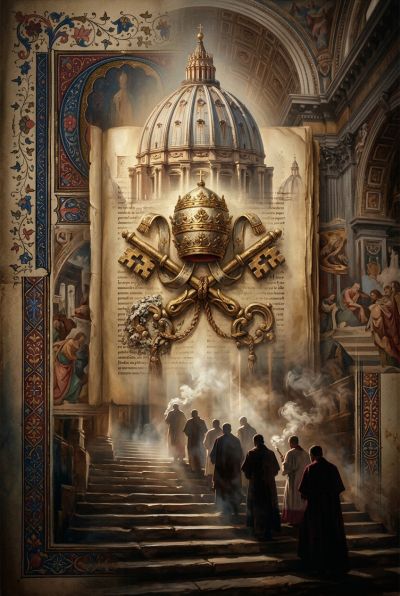


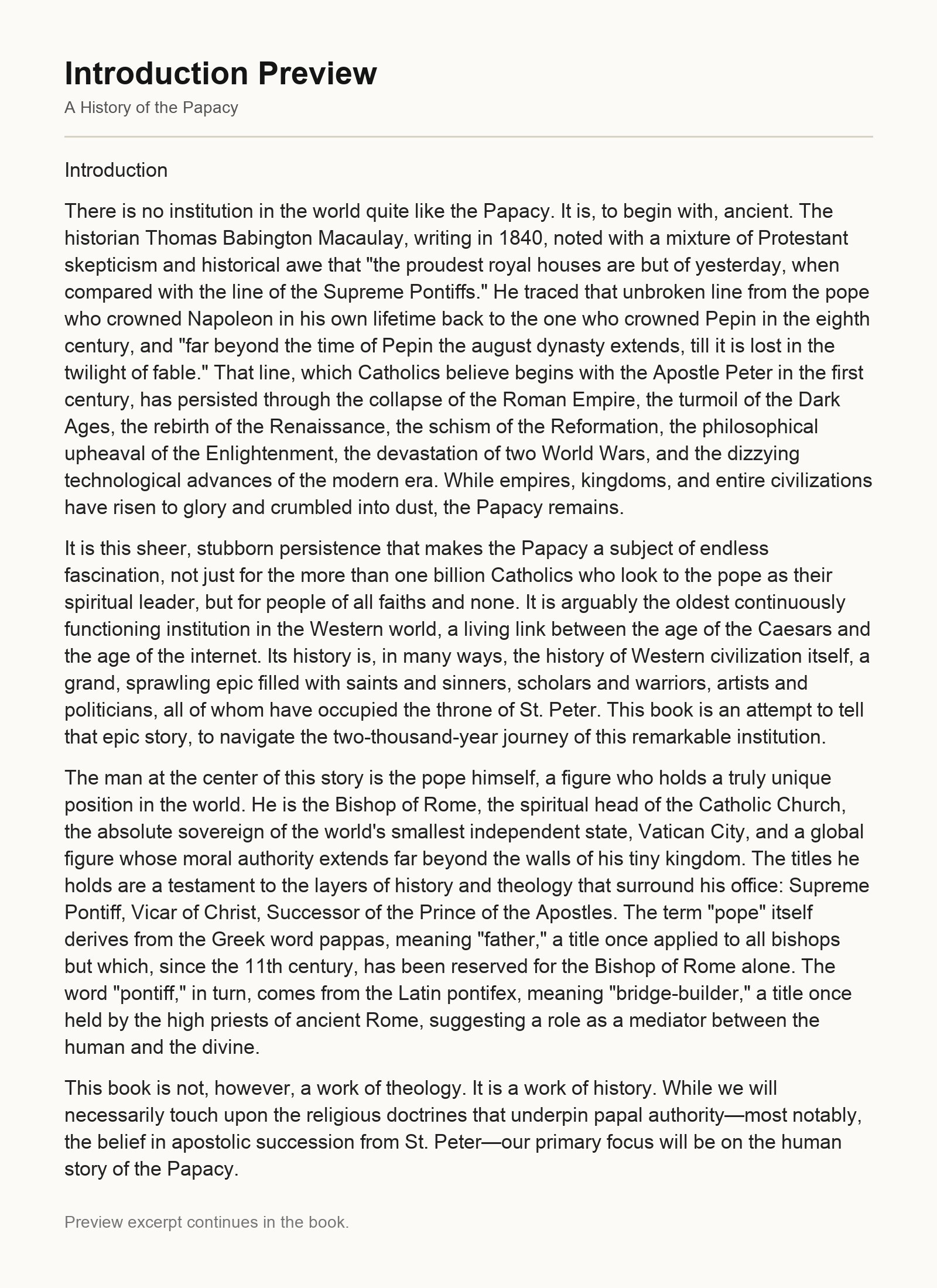
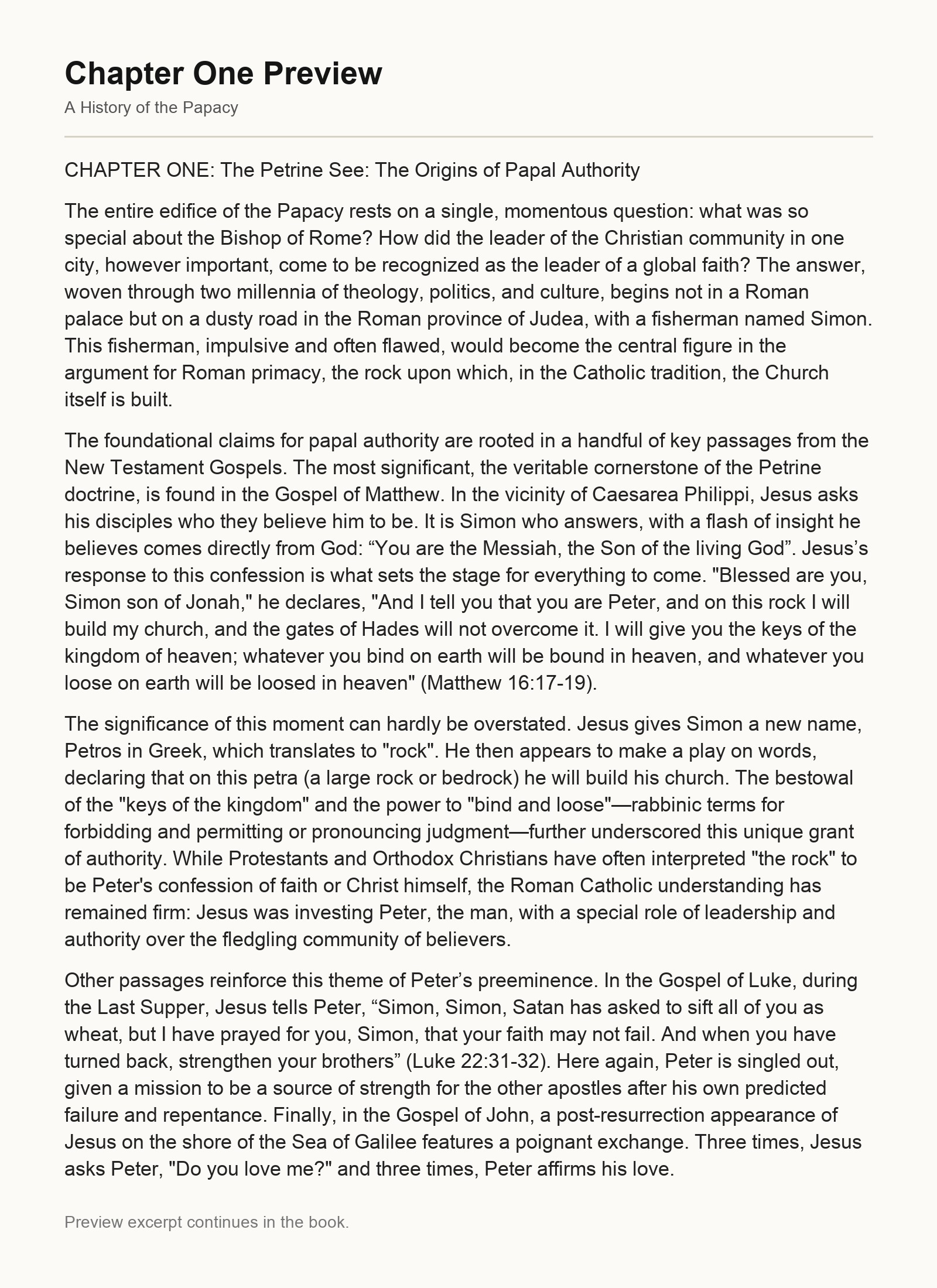
This sweeping narrative traces the extraordinary two‑thousand‑year journey of the papacy from its humble beginnings with the fisherman Peter to its role as a global moral voice in the twenty‑first century. Readers will discover how a persecuted sect in imperial Rome evolved into an institution that crowned emperors, shaped European politics, and endured invasions, schisms, and reformations while maintaining an unbroken line of succession that Catholics believe stems directly from Christ’s commission to Peter.
Through vivid chapters, the book illuminates the dramatic contradictions that have defined papal history: saints and sinners, scholars and warriors, patrons of sublime art and wielders of the interdict. You will walk alongside Leo the Great confronting Attila, Gregory the Great stabilizing Rome after the empire’s fall, the ambitious Renaissance popes who commissioned Michelangelo and Raphael, and the reform‑era pontiffs who confronted Luther and convened the Council of Trent. Each era reveals how the pope balanced spiritual authority with temporal power, often becoming a kingmaker, a diplomat, or a prisoner in his own palace.
The work also explores the papacy’s cultural legacy, from the foundation of the Vatican Library and the splendors of Baroque Rome to the modern encyclicals that address social justice, ecology, and interfaith dialogue. Readers will gain insight into pivotal moments such as the Avignon captivity, the Great Western Schism, the declaration of papal infallibility at Vatican I, and the transformative Second Vatican Council, seeing how the Church responded to modernity, totalitarianism, and the pressing challenges of the contemporary world.
Beyond the grandeur, the book does not shy away from the darker chapters—the corruption of the Borgia court, the sack of Rome, the Galileo affair, and the clerical abuse crisis—offering a balanced view of an institution that has both inspired and faltered. By examining these episodes, readers will understand how the papacy has continually reinvented itself, adapting to shifting political landscapes while striving to preserve its core mission in a rapidly changing age.
Ultimately, this history equips readers to appreciate the papacy not merely as a religious office but as a central thread in the tapestry of Western civilization—one that has influenced law, art, politics, and global thought for two millennia. Whether you are a student of history, a person of faith, or simply curious about how an ancient institution remains relevant today, this book offers a compelling, accessible, and deeply informative journey through the triumphs, trials, and enduring legacy of the See of Peter.
What You'll Find Inside:
- The scriptural and historical foundations of papal authority based on Peter's role and apostolic succession
- How the papacy evolved from a persecuted sect to a temporal power through alliances with secular rulers like the Franks and Holy Roman Emperors
- Major reform movements that reshaped the papacy including the Gregorian Reform, Council of Trent, and Second Vatican Council
- The papacy's role as a European power broker through events like launching the Crusades and crowning emperors such as Charlemagne
- How the papacy has adapted to modern challenges while maintaining its spiritual mission in the 21st century
Who's It For:
This book is ideal for students of religious history, scholars of Catholicism, and general readers interested in understanding how one of the world's oldest institutions has shaped Western civilization. It provides valuable context for anyone seeking to comprehend the papacy's enduring influence on politics, culture, and spirituality across two millennia. Readers will gain insight into how the office has navigated crises, reform movements, and changing global landscapes while maintaining its claim to spiritual leadership.
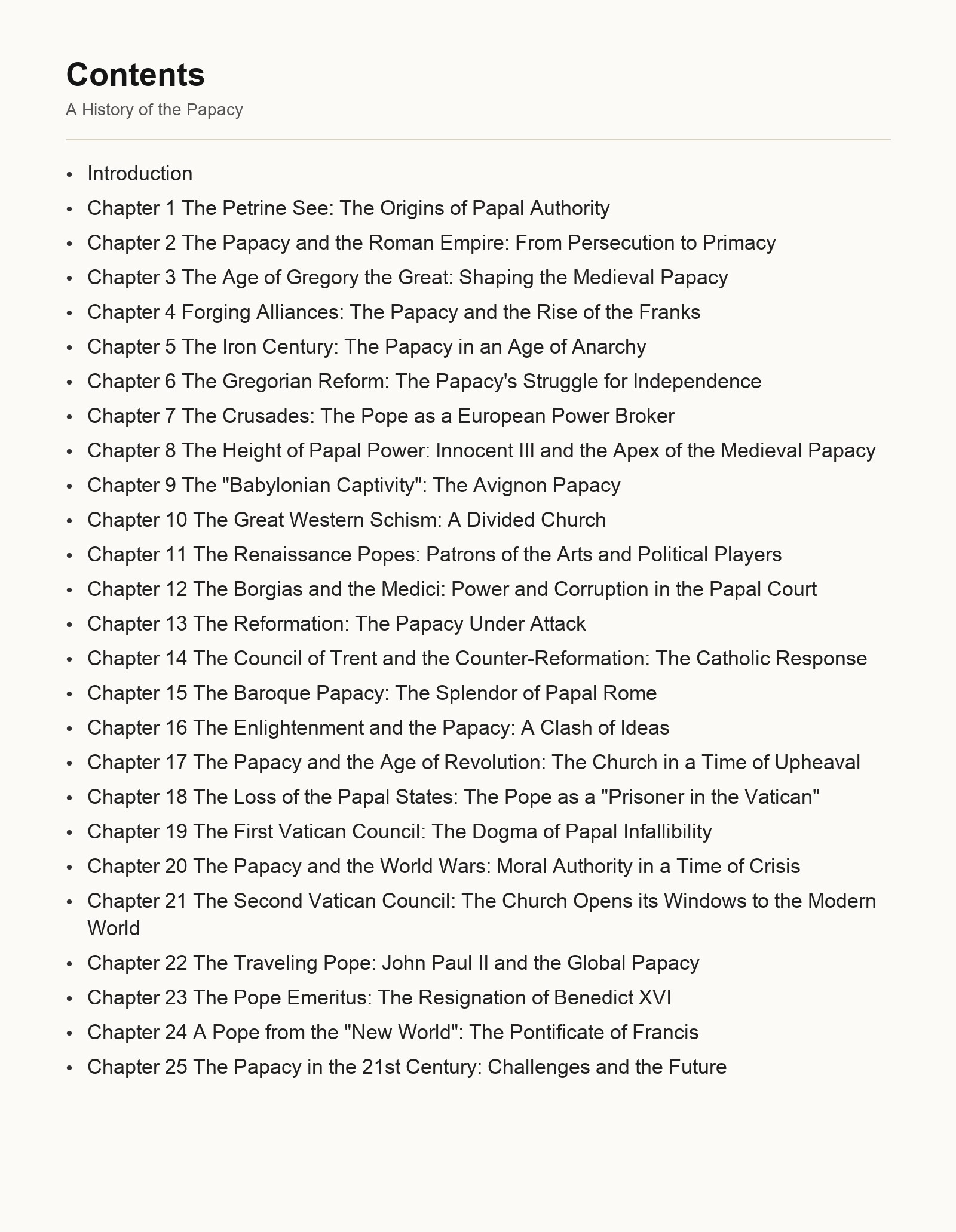
Table of Contents:
- Introduction
- Chapter 1 The Petrine See: The Origins of Papal Authority
- Chapter 2 The Papacy and the Roman Empire: From Persecution to Primacy
- Chapter 3 The Age of Gregory the Great: Shaping the Medieval Papacy
- Chapter 4 Forging Alliances: The Papacy and the Rise of the Franks
- Chapter 5 The Iron Century: The Papacy in an Age of Anarchy
- Chapter 6 The Gregorian Reform: The Papacy's Struggle for Independence
- Chapter 7 The Crusades: The Pope as a European Power Broker
- Chapter 8 The Height of Papal Power: Innocent III and the Apex of the Medieval Papacy
- Chapter 9 The "Babylonian Captivity": The Avignon Papacy
- Chapter 10 The Great Western Schism: A Divided Church
- Chapter 11 The Renaissance Popes: Patrons of the Arts and Political Players
- Chapter 12 The Borgias and the Medici: Power and Corruption in the Papal Court
- Chapter 13 The Reformation: The Papacy Under Attack
- Chapter 14 The Council of Trent and the Counter-Reformation: The Catholic Response
- Chapter 15 The Baroque Papacy: The Splendor of Papal Rome
- Chapter 16 The Enlightenment and the Papacy: A Clash of Ideas
- Chapter 17 The Papacy and the Age of Revolution: The Church in a Time of Upheaval
- Chapter 18 The Loss of the Papal States: The Pope as a "Prisoner in the Vatican"
- Chapter 19 The First Vatican Council: The Dogma of Papal Infallibility
- Chapter 20 The Papacy and the World Wars: Moral Authority in a Time of Crisis
- Chapter 21 The Second Vatican Council: The Church Opens its Windows to the Modern World
- Chapter 22 The Traveling Pope: John Paul II and the Global Papacy
- Chapter 23 The Pope Emeritus: The Resignation of Benedict XVI
- Chapter 24 A Pope from the "New World": The Pontificate of Francis
- Chapter 25 The Papacy in the 21st Century: Challenges and the Future
Author:
Published By:
Date Published:
May 29, 2026
Type:
Nonfiction
Language:
English
Also Available In:
Spanish, Italian, Dutch, Portuguese
Word Count:
58,088 words
Reading Time:
4 hours 4 minutes
Sample:
Order:
Order A History of the Papacy (Paperback) on MixCache.com:
Buy NowPrint copy is made to order and ships worldwide. Includes the ebook free, ready to read instantly.
$5 account credit for all new MixCache.com accounts, usable toward any ebook purchase!*