Browse by Category
Fiction
- Action & Adventure
- African American
- Anthologies
- Children's Fiction
- Classics
- Comics & Graphic Novels
- Coming of Age
- Contemporary
- Cultural & Regional
- Drama
- Erotica
- Fantasy
- General
- Historical Fiction
- Horror
- Humor & Satire
- Literary Fiction
- Mystery, Thriller & Suspense
- Poetry
- Religious & Inspirational
- Romance
- Science Fiction
- Short Stories
- War & Military
- Westerns
- Women's Fiction
- Young Adult
Non-Fiction
- Antiques & Collectibles
- Arts & Photography
- Biographies & Memoirs
- Business & Money
- Children's Non-Fiction
-
Computers & Technology
- Artificial Intelligence
- Computer Science
- Cybersecurity & Cryptography
- Data Science & Analytics
- Databases & Big Data
- Game Development & Design
- General
- Hardware & DIY
- Mobile App Development
- Networking & Cloud Computing
- Operating Systems
- Programming
- Robotics
- Software
- Software Engineering
- User Experience (UX) & Design
- Web Development & Design
- Cooking, Food & Wine
- Crafts, Hobbies & Home
- Education & Teaching
- Engineering
- General
- Health, Fitness & Dieting
-
History
- African History
- African History - North Africa
- African History - Sub-Saharan Africa
- American History
- American History - 20th Century
- American History - Civil War
- American History - Colonial Period
- Ancient History
- Asian History
- Asian History - China
- Asian History - India
- Asian History - Japan
- Asian History - Southeast Asia
- European History
- European History - Ancient Greece
- European History - Ancient Rome
- European History - Medieval
- European History - Modern
- European History - Renaissance
- General
- Middle Eastern History
- Military History
- Military History - Aviation
- Military History - Naval
- Social & Cultural History
- World History
- Humor & Entertainment
- Industrial Technology
- Language Learning
- Law
- LGBTQ+ Non-Fiction
- Literary Criticism
- Medical Books
- Parenting & Relationships
- Philosophy
- Politics & Social Sciences
- Reference
- Religion & Spirituality
-
Science & Math
- Agricultural Sciences
- Astronomy & Space Science
- Behavioral Sciences
- Biological Sciences
- Botany & Plant Science
- Chemistry
- Earth Sciences
- Engineering - Chemical
- Engineering - Civil
- Engineering - Electrical
- Engineering - Mechanical
- Environment
- General
- Geology
- Mathematics
- Nature & Ecology
- Oceanography
- Paleontology
- Physics
- Statistics
- Self-Help
- Sports & Outdoors
- Study Aids
- Sustainability & Green Living
- Textbooks
- Transportation
- Travel
- True Crime
- Urban Planning & Development
- Veterinary Medicine
- Writing & Publishing
Jump to Section
MixCache.com Total Access
Unlimited reading and audiobooks for every book published by MixCache.com.
Included titles carry the MTA badge.
Learn more →A History of Mauritania
About this book:
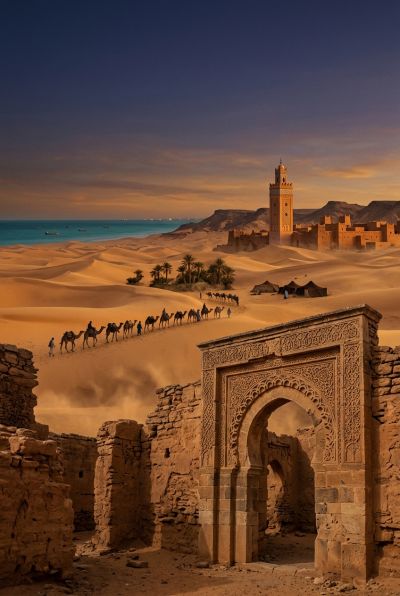
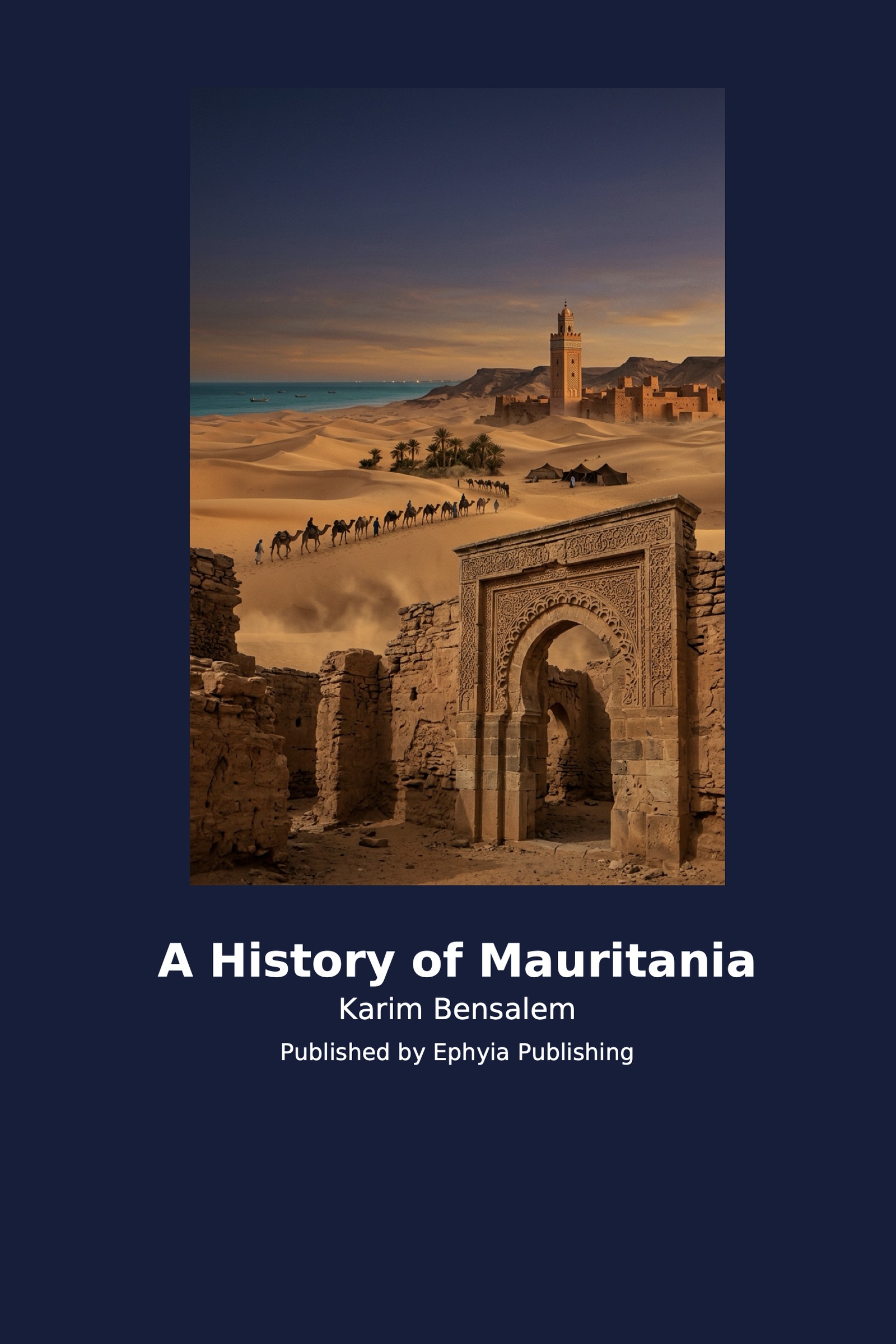
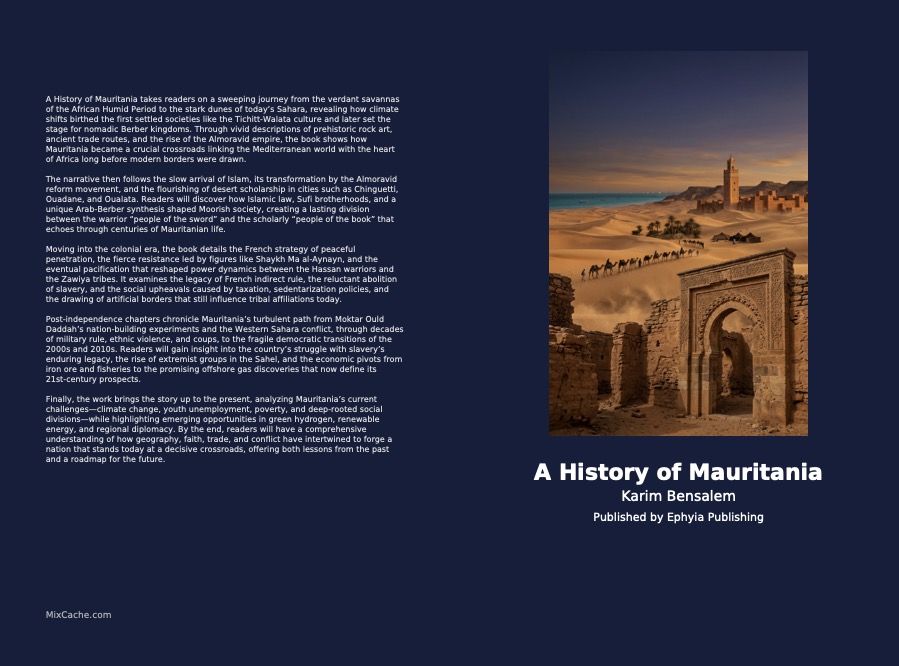
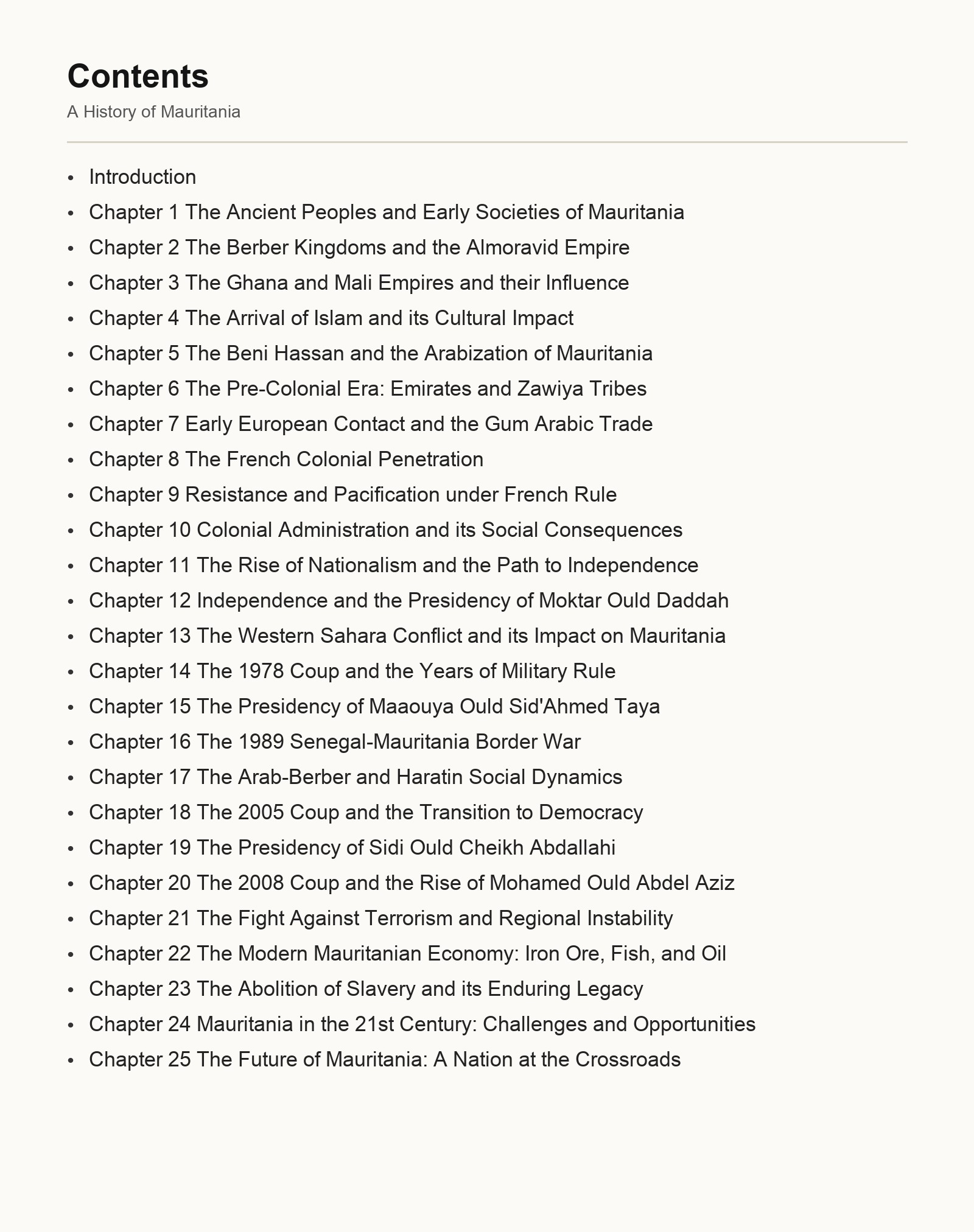
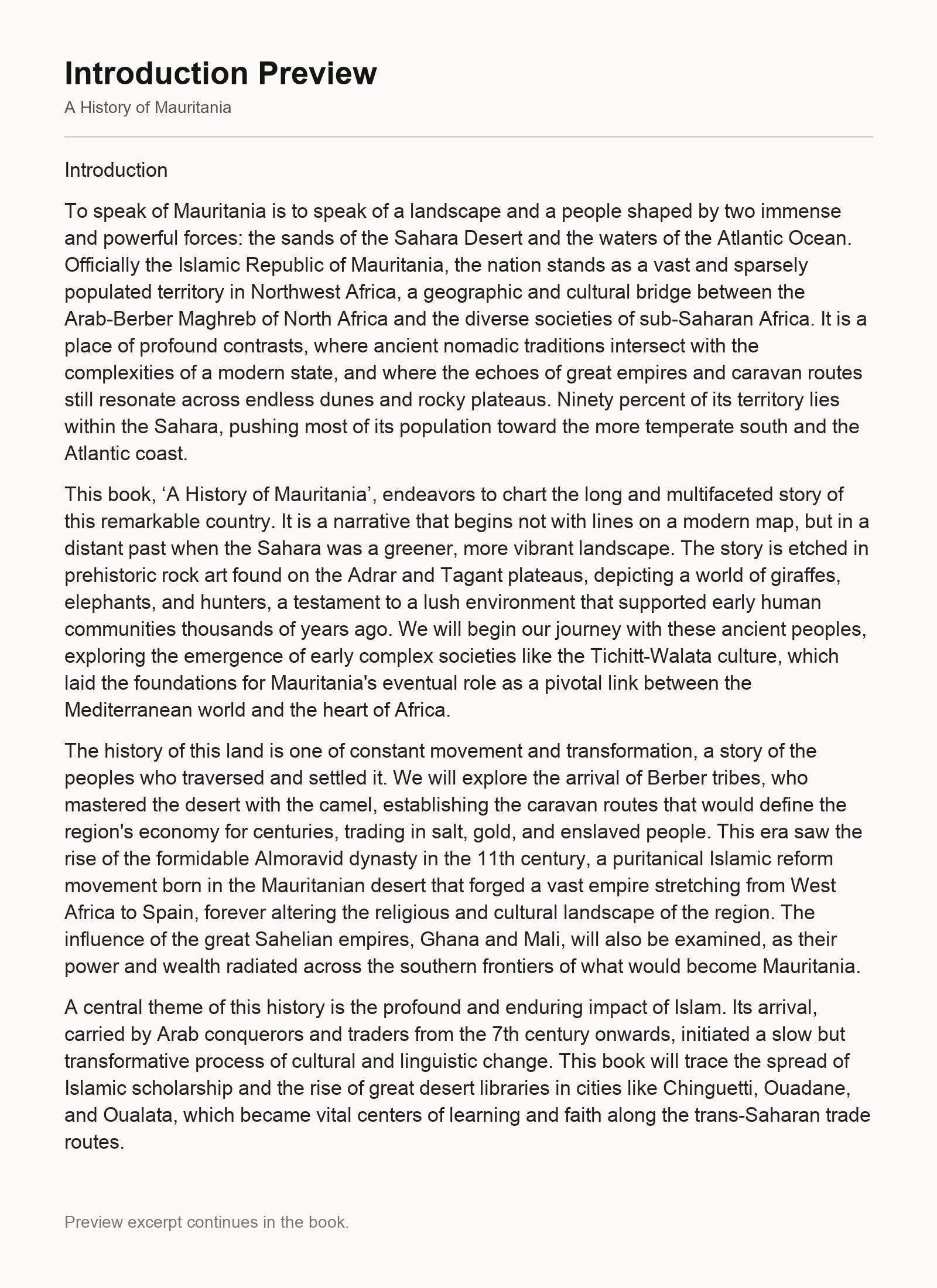
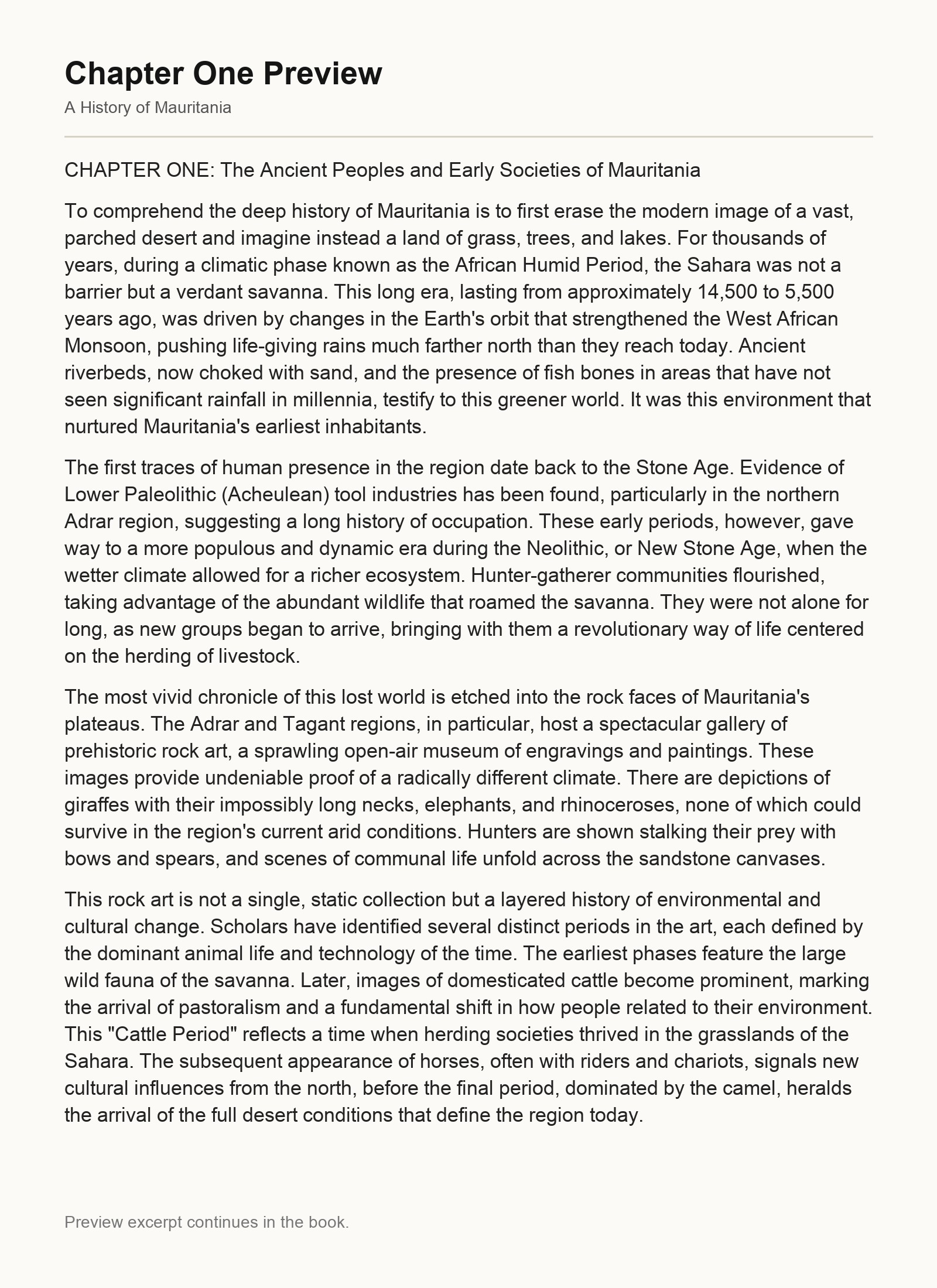
A History of Mauritania takes readers on a sweeping journey from the verdant savannas of the African Humid Period to the stark dunes of today’s Sahara, revealing how climate shifts birthed the first settled societies like the Tichitt‑Walata culture and later set the stage for nomadic Berber kingdoms. Through vivid descriptions of prehistoric rock art, ancient trade routes, and the rise of the Almoravid empire, the book shows how Mauritania became a crucial crossroads linking the Mediterranean world with the heart of Africa long before modern borders were drawn.
The narrative then follows the slow arrival of Islam, its transformation by the Almoravid reform movement, and the flourishing of desert scholarship in cities such as Chinguetti, Ouadane, and Oualata. Readers will discover how Islamic law, Sufi brotherhoods, and a unique Arab‑Berber synthesis shaped Moorish society, creating a lasting division between the warrior “people of the sword” and the scholarly “people of the book” that echoes through centuries of Mauritanian life.
Moving into the colonial era, the book details the French strategy of peaceful penetration, the fierce resistance led by figures like Shaykh Ma al‑Aynayn, and the eventual pacification that reshaped power dynamics between the Hassan warriors and the Zawiya tribes. It examines the legacy of French indirect rule, the reluctant abolition of slavery, and the social upheavals caused by taxation, sedentarization policies, and the drawing of artificial borders that still influence tribal affiliations today.
Post‑independence chapters chronicle Mauritania’s turbulent path from Moktar Ould Daddah’s nation‑building experiments and the Western Sahara conflict, through decades of military rule, ethnic violence, and coups, to the fragile democratic transitions of the 2000s and 2010s. Readers will gain insight into the country’s struggle with slavery’s enduring legacy, the rise of extremist groups in the Sahel, and the economic pivots from iron ore and fisheries to the promising offshore gas discoveries that now define its 21st‑century prospects.
Finally, the work brings the story up to the present, analyzing Mauritania’s current challenges—climate change, youth unemployment, poverty, and deep‑rooted social divisions—while highlighting emerging opportunities in green hydrogen, renewable energy, and regional diplomacy. By the end, readers will have a comprehensive understanding of how geography, faith, trade, and conflict have intertwined to forge a nation that stands today at a decisive crossroads, offering both lessons from the past and a roadmap for the future.
What You'll Find Inside:
- Explores Mauritania's ancient roots, from the Tichitt-Walata civilization of the Green Sahara to the trans-Saharan trade networks that connected Mediterranean and sub-Saharan Africa.
- Details the rise of the Almoravid Empire, a puritanical Islamic movement born in the Mauritanian desert that shaped religious and political landscapes across West Africa and into Spain.
- Examines the complex social hierarchy of Moorish society, including the Arab-Berber elite, Haratin population, and sub-Saharan African groups, with particular attention to slavery's enduring legacy.
- Traces Mauritania's journey from French colonial rule through independence, coups, and democratic transitions, highlighting key events like the Western Sahara conflict and 1989 Senegal-Mauritania Border War.
- Analyzes contemporary Mauritania, covering its natural resource economy (iron ore, fisheries, offshore gas), security challenges in the Sahel, and 21st-century opportunities in renewable energy.
Who's It For:
This comprehensive history is essential reading for students and scholars of African history, particularly those focused on Northwest Africa and the Sahel region. It will also benefit policymakers, diplomats, and development professionals working with Mauritania who need to understand the country's complex social dynamics, political history, and economic challenges. General readers interested in post-colonial state formation, Islamic history in Africa, or contemporary African affairs will find this book both informative and accessible.
Table of Contents:
- Introduction
- Chapter 1 The Ancient Peoples and Early Societies of Mauritania
- Chapter 2 The Berber Kingdoms and the Almoravid Empire
- Chapter 3 The Ghana and Mali Empires and their Influence
- Chapter 4 The Arrival of Islam and its Cultural Impact
- Chapter 5 The Beni Hassan and the Arabization of Mauritania
- Chapter 6 The Pre-Colonial Era: Emirates and Zawiya Tribes
- Chapter 7 Early European Contact and the Gum Arabic Trade
- Chapter 8 The French Colonial Penetration
- Chapter 9 Resistance and Pacification under French Rule
- Chapter 10 Colonial Administration and its Social Consequences
- Chapter 11 The Rise of Nationalism and the Path to Independence
- Chapter 12 Independence and the Presidency of Moktar Ould Daddah
- Chapter 13 The Western Sahara Conflict and its Impact on Mauritania
- Chapter 14 The 1978 Coup and the Years of Military Rule
- Chapter 15 The Presidency of Maaouya Ould Sid'Ahmed Taya
- Chapter 16 The 1989 Senegal-Mauritania Border War
- Chapter 17 The Arab-Berber and Haratin Social Dynamics
- Chapter 18 The 2005 Coup and the Transition to Democracy
- Chapter 19 The Presidency of Sidi Ould Cheikh Abdallahi
- Chapter 20 The 2008 Coup and the Rise of Mohamed Ould Abdel Aziz
- Chapter 21 The Fight Against Terrorism and Regional Instability
- Chapter 22 The Modern Mauritanian Economy: Iron Ore, Fish, and Oil
- Chapter 23 The Abolition of Slavery and its Enduring Legacy
- Chapter 24 Mauritania in the 21st Century: Challenges and Opportunities
- Chapter 25 The Future of Mauritania: A Nation at the Crossroads
Author:
Published By:
Date Published:
May 29, 2026
Type:
Nonfiction
Language:
English
Also Available In:
Word Count:
37,050 words
Reading Time:
2 hours 36 minutes
Sample:
Order:
Order A History of Mauritania (Paperback) on MixCache.com:
Buy NowPrint copy is made to order and ships worldwide. Includes the ebook free, ready to read instantly.
$5 account credit for all new MixCache.com accounts, usable toward any ebook purchase!*