
Browse by Category
Fiction
- Action & Adventure
- African American
- Anthologies
- Children's Fiction
- Classics
- Comics & Graphic Novels
- Coming of Age
- Contemporary
- Cultural & Regional
- Drama
- Erotica
- Fantasy
- General
- Historical Fiction
- Horror
- Humor & Satire
- Literary Fiction
- Mystery, Thriller & Suspense
- Poetry
- Religious & Inspirational
- Romance
- Science Fiction
- Short Stories
- War & Military
- Westerns
- Women's Fiction
- Young Adult
Non-Fiction
- Antiques & Collectibles
- Arts & Photography
- Biographies & Memoirs
- Business & Money
- Children's Non-Fiction
-
Computers & Technology
- Artificial Intelligence
- Computer Science
- Cybersecurity & Cryptography
- Data Science & Analytics
- Databases & Big Data
- Game Development & Design
- General
- Hardware & DIY
- Mobile App Development
- Networking & Cloud Computing
- Operating Systems
- Programming
- Robotics
- Software
- Software Engineering
- User Experience (UX) & Design
- Web Development & Design
- Cooking, Food & Wine
- Crafts, Hobbies & Home
- Education & Teaching
- Engineering
- General
- Health, Fitness & Dieting
-
History
- African History
- African History - North Africa
- African History - Sub-Saharan Africa
- American History
- American History - 20th Century
- American History - Civil War
- American History - Colonial Period
- Ancient History
- Asian History
- Asian History - China
- Asian History - India
- Asian History - Japan
- Asian History - Southeast Asia
- European History
- European History - Ancient Greece
- European History - Ancient Rome
- European History - Medieval
- European History - Modern
- European History - Renaissance
- General
- Middle Eastern History
- Military History
- Military History - Aviation
- Military History - Naval
- Social & Cultural History
- World History
- Humor & Entertainment
- Industrial Technology
- Language Learning
- Law
- LGBTQ+ Non-Fiction
- Literary Criticism
- Medical Books
- Parenting & Relationships
- Philosophy
- Politics & Social Sciences
- Reference
- Religion & Spirituality
-
Science & Math
- Agricultural Sciences
- Astronomy & Space Science
- Behavioral Sciences
- Biological Sciences
- Botany & Plant Science
- Chemistry
- Earth Sciences
- Engineering - Chemical
- Engineering - Civil
- Engineering - Electrical
- Engineering - Mechanical
- Environment
- General
- Geology
- Mathematics
- Nature & Ecology
- Oceanography
- Paleontology
- Physics
- Statistics
- Self-Help
- Sports & Outdoors
- Study Aids
- Sustainability & Green Living
- Textbooks
- Transportation
- Travel
- True Crime
- Urban Planning & Development
- Veterinary Medicine
- Writing & Publishing
Jump to Section
MixCache.com Total Access
Unlimited reading and audiobooks for every book published by MixCache.com.
Included titles carry the MTA badge.
Learn more →A History of Cape Verde
About this book:


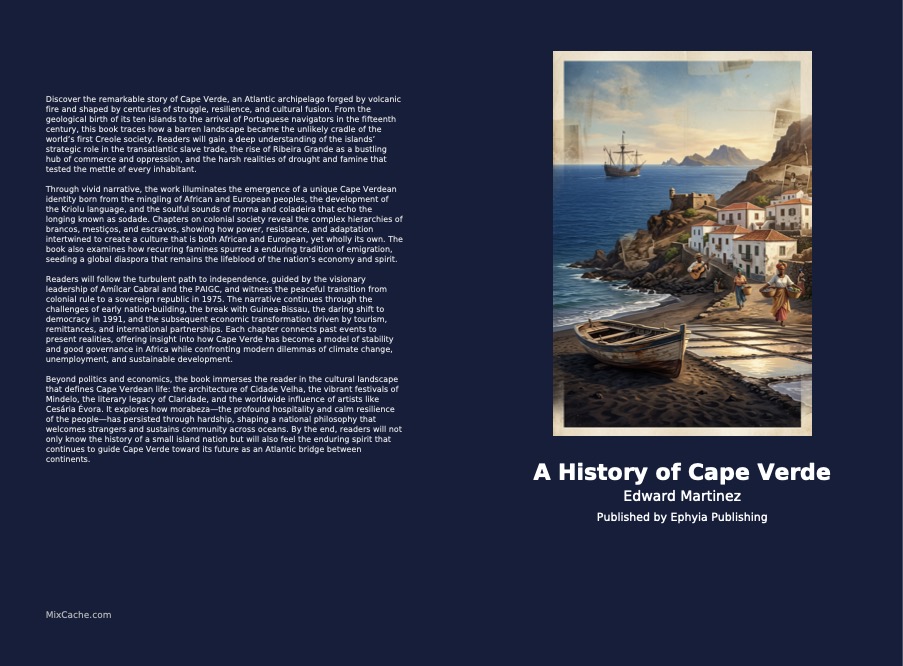
Discover the remarkable story of Cape Verde, an Atlantic archipelago forged by volcanic fire and shaped by centuries of struggle, resilience, and cultural fusion. From the geological birth of its ten islands to the arrival of Portuguese navigators in the fifteenth century, this book traces how a barren landscape became the unlikely cradle of the world’s first Creole society. Readers will gain a deep understanding of the islands’ strategic role in the transatlantic slave trade, the rise of Ribeira Grande as a bustling hub of commerce and oppression, and the harsh realities of drought and famine that tested the mettle of every inhabitant.
Through vivid narrative, the work illuminates the emergence of a unique Cape Verdean identity born from the mingling of African and European peoples, the development of the Kriolu language, and the soulful sounds of morna and coladeira that echo the longing known as sodade. Chapters on colonial society reveal the complex hierarchies of brancos, mestiços, and escravos, showing how power, resistance, and adaptation intertwined to create a culture that is both African and European, yet wholly its own. The book also examines how recurring famines spurred a enduring tradition of emigration, seeding a global diaspora that remains the lifeblood of the nation’s economy and spirit.
Readers will follow the turbulent path to independence, guided by the visionary leadership of Amílcar Cabral and the PAIGC, and witness the peaceful transition from colonial rule to a sovereign republic in 1975. The narrative continues through the challenges of early nation‑building, the break with Guinea‑Bissau, the daring shift to democracy in 1991, and the subsequent economic transformation driven by tourism, remittances, and international partnerships. Each chapter connects past events to present realities, offering insight into how Cape Verde has become a model of stability and good governance in Africa while confronting modern dilemmas of climate change, unemployment, and sustainable development.
Beyond politics and economics, the book immerses the reader in the cultural landscape that defines Cape Verdean life: the architecture of Cidade Velha, the vibrant festivals of Mindelo, the literary legacy of Claridade, and the worldwide influence of artists like Cesária Évora. It explores how morabeza—the profound hospitality and calm resilience of the people—has persisted through hardship, shaping a national philosophy that welcomes strangers and sustains community across oceans. By the end, readers will not only know the history of a small island nation but will also feel the enduring spirit that continues to guide Cape Verde toward its future as an Atlantic bridge between continents.
What You'll Find Inside:
- The geological formation of Cape Verde as volcanic islands and its strategic Atlantic position
- Cape Verde's pivotal role in the transatlantic slave trade and emergence of Creole society
- How recurrent droughts and famines drove emigration and created a global diaspora
- The independence struggle led by Amílcar Cabral and the PAIGC
- Cape Verde's democratic transition and development as an 'Atlantic Bridge' nation
Who's It For:
This book is ideal for students and scholars of African history, particularly those interested in Lusophone Africa, colonialism, and post-colonial development. It will also resonate deeply with members of the Cape Verdean diaspora seeking to understand their historical roots, as well as readers interested in migration studies, nation-building processes, and the unique challenges faced by small island developing states in the modern world.
Table of Contents:
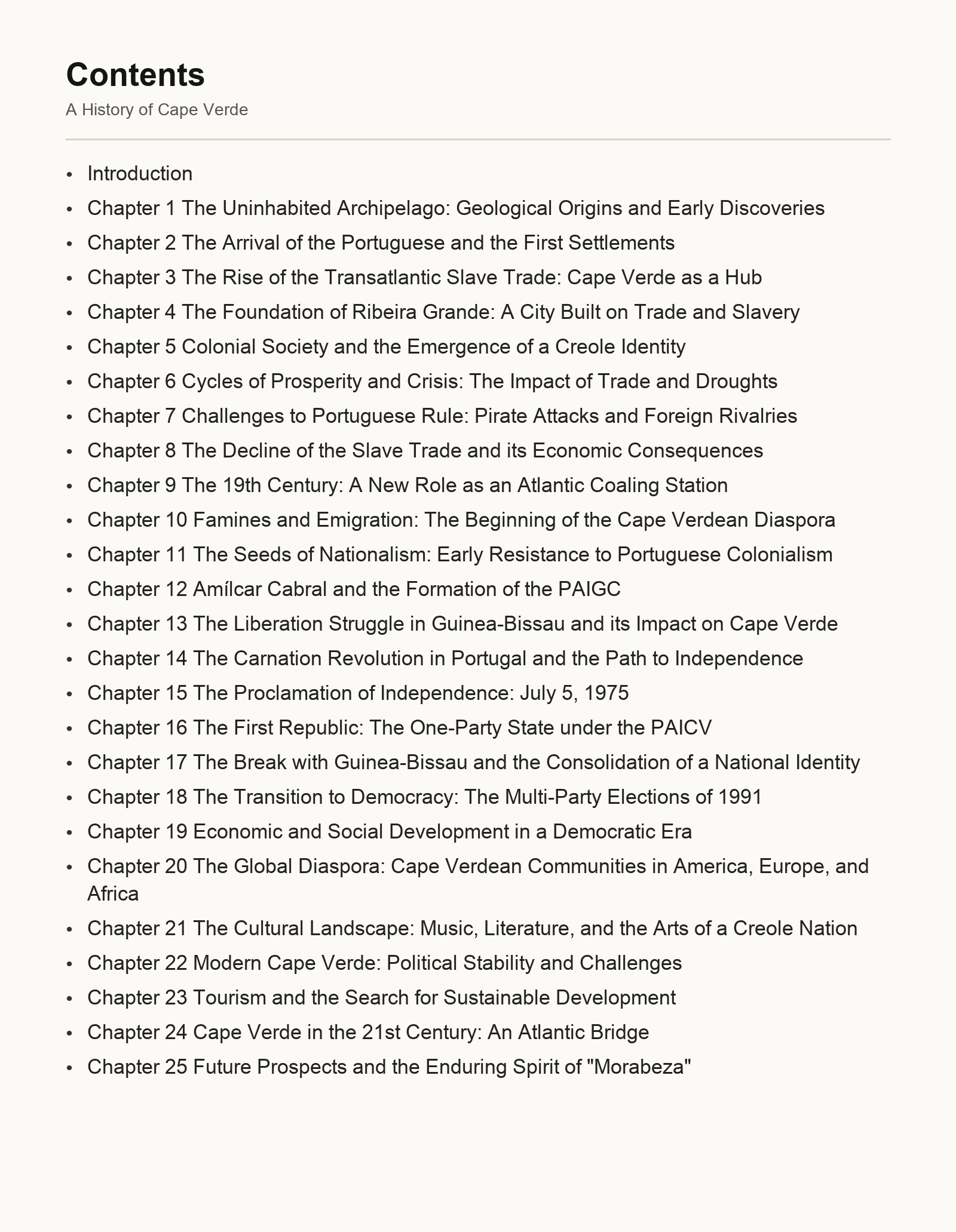
- Introduction
- Chapter 1 The Uninhabited Archipelago: Geological Origins and Early Discoveries
- Chapter 2 The Arrival of the Portuguese and the First Settlements
- Chapter 3 The Rise of the Transatlantic Slave Trade: Cape Verde as a Hub
- Chapter 4 The Foundation of Ribeira Grande: A City Built on Trade and Slavery.
- Chapter 5 Colonial Society and the Emergence of a Creole Identity
- Chapter 6 Cycles of Prosperity and Crisis: The Impact of Trade and Droughts.
- Chapter 7 Challenges to Portuguese Rule: Pirate Attacks and Foreign Rivalries.
- Chapter 8 The Decline of the Slave Trade and its Economic Consequences.
- Chapter 9 The 19th Century: A New Role as an Atlantic Coaling Station
- Chapter 10 Famines and Emigration: The Beginning of the Cape Verdean Diaspora.
- Chapter 11 The Seeds of Nationalism: Early Resistance to Portuguese Colonialism
- Chapter 12 Amílcar Cabral and the Formation of the PAIGC.
- Chapter 13 The Liberation Struggle in Guinea-Bissau and its Impact on Cape Verde.
- Chapter 14 The Carnation Revolution in Portugal and the Path to Independence.
- Chapter 15 The Proclamation of Independence: July 5, 1975.
- Chapter 16 The First Republic: The One-Party State under the PAICV.
- Chapter 17 The Break with Guinea-Bissau and the Consolidation of a National Identity.
- Chapter 18 The Transition to Democracy: The Multi-Party Elections of 1991.
- Chapter 19 Economic and Social Development in a Democratic Era
- Chapter 20 The Global Diaspora: Cape Verdean Communities in America, Europe, and Africa.
- Chapter 21 The Cultural Landscape: Music, Literature, and the Arts of a Creole Nation
- Chapter 22 Modern Cape Verde: Political Stability and Challenges.
- Chapter 23 Tourism and the Search for Sustainable Development
- Chapter 24 Cape Verde in the 21st Century: An Atlantic Bridge
- Chapter 25 Future Prospects and the Enduring Spirit of "Morabeza"
Author:
Published By:
Date Published:
May 29, 2026
Type:
Nonfiction
Language:
English
Also Available In:
Word Count:
47,743 words
Reading Time:
3 hours 21 minutes
Sample:
Order:
Buy the A History of Cape Verde ebook on MixCache.com:
Buy NowThe full ebook will be available immediately to read instantly on any device.
$5 account credit for all new MixCache.com accounts, usable toward any ebook purchase!*






Ratings & Reviews
Ask Questions About This Book
Have a question about the content? Ask our AI assistant!
Start by asking a question about "A History of Cape Verde"
Example: "Does this book mention William Shakespeare?"
Thinking...