
Browse by Category
Fiction
- Action & Adventure
- African American
- Anthologies
- Children's Fiction
- Classics
- Comics & Graphic Novels
- Coming of Age
- Contemporary
- Cultural & Regional
- Drama
- Erotica
- Fantasy
- General
- Historical Fiction
- Horror
- Humor & Satire
- Literary Fiction
- Mystery, Thriller & Suspense
- Poetry
- Religious & Inspirational
- Romance
- Science Fiction
- Short Stories
- War & Military
- Westerns
- Women's Fiction
- Young Adult
Non-Fiction
- Antiques & Collectibles
- Arts & Photography
- Biographies & Memoirs
- Business & Money
- Children's Non-Fiction
-
Computers & Technology
- Artificial Intelligence
- Computer Science
- Cybersecurity & Cryptography
- Data Science & Analytics
- Databases & Big Data
- Game Development & Design
- General
- Hardware & DIY
- Mobile App Development
- Networking & Cloud Computing
- Operating Systems
- Programming
- Robotics
- Software
- Software Engineering
- User Experience (UX) & Design
- Web Development & Design
- Cooking, Food & Wine
- Crafts, Hobbies & Home
- Education & Teaching
- Engineering
- General
- Health, Fitness & Dieting
-
History
- African History
- African History - North Africa
- African History - Sub-Saharan Africa
- American History
- American History - 20th Century
- American History - Civil War
- American History - Colonial Period
- Ancient History
- Asian History
- Asian History - China
- Asian History - India
- Asian History - Japan
- Asian History - Southeast Asia
- European History
- European History - Ancient Greece
- European History - Ancient Rome
- European History - Medieval
- European History - Modern
- European History - Renaissance
- General
- Middle Eastern History
- Military History
- Military History - Aviation
- Military History - Naval
- Social & Cultural History
- World History
- Humor & Entertainment
- Industrial Technology
- Language Learning
- Law
- LGBTQ+ Non-Fiction
- Literary Criticism
- Medical Books
- Parenting & Relationships
- Philosophy
- Politics & Social Sciences
- Reference
- Religion & Spirituality
-
Science & Math
- Agricultural Sciences
- Astronomy & Space Science
- Behavioral Sciences
- Biological Sciences
- Botany & Plant Science
- Chemistry
- Earth Sciences
- Engineering - Chemical
- Engineering - Civil
- Engineering - Electrical
- Engineering - Mechanical
- Environment
- General
- Geology
- Mathematics
- Nature & Ecology
- Oceanography
- Paleontology
- Physics
- Statistics
- Self-Help
- Sports & Outdoors
- Study Aids
- Sustainability & Green Living
- Textbooks
- Transportation
- Travel
- True Crime
- Urban Planning & Development
- Veterinary Medicine
- Writing & Publishing
Jump to Section
MixCache.com Total Access
Unlimited reading and audiobooks for every book published by MixCache.com.
Included titles carry the MTA badge.
Learn more →A History of Henan
About this book:
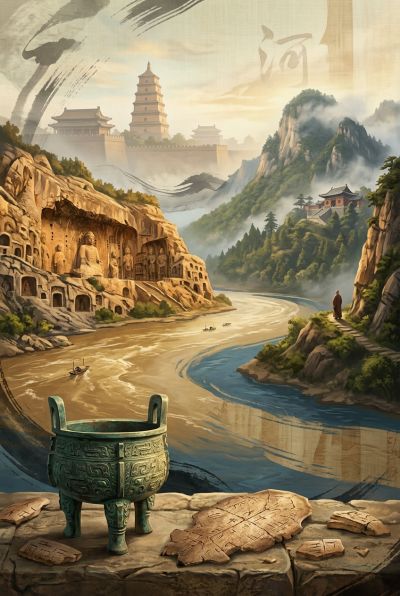
A History of Henan invites readers to walk the very soil where Chinese civilization first took root, tracing a continuous narrative from Neolithic villages along the Yellow River to the high‑speed rail hubs of twenty‑first‑century Zhengzhou. Through vivid chapters on the Peiligang, Yangshao, and Longshan cultures, the book reveals how early millet farming, painted pottery, and the first walled towns laid the foundations for state society, and how the enigmatic Erlitou settlement offers a tangible glimpse into China’s possible first dynasty. Readers will experience the awe of discovering oracle bones at Anyang, the birthplace of Chinese writing, and marvel at the bronze ritual vessels that powered Shang kings and their divinatory rites.
The narrative then follows the shifting tides of power as the Zhou introduced the Mandate of Heaven from Luoyang, as the Spring and Autumn and Warring States periods turned Henan into a bloody chessboard of competing states, and as the Qin, Han, and Tang dynasties transformed the province into the empire’s political and economic heart. Readers will learn how the Grand Canal made Luoyang a cosmopolitan capital, how Empress Wu Zetian elevated the city to divine status, and how the Longmen Grottoes became a monumental testament to Buddhist faith and artistic synthesis under the Northern Wei and Tang courts. Each era is illustrated with concrete archaeological evidence, from the turquoise dragon of Erlitou to the colossal Vairocana Buddha, allowing the reader to feel the material culture that defined each age.
War, flood, and famine are examined not as mere footnotes but as shaping forces that repeatedly tested Henan’s resilience. The book details the catastrophic 1938 Yellow River breach, the devastating 1942 famine, and the ferocious battles of the Second Sino‑Japanese War and the Chinese Civil War, showing how the province’s strategic grain wealth made it both a prize and a battleground. Readers will understand how these traumas sparked social upheavals—from the Yellow Turban and Red Eyebrows rebellions to the Nationalist government’s loss of legitimacy—and how they set the stage for the Communist victory that finally brought a semblance of order after a century of turmoil.
In the modern era, the focus shifts to renewal and transformation: the household responsibility system that revived agricultural productivity, the rise of Zhengzhou as a national central city and iPhone‑manufacturing hub, and the South‑to‑North Water Diversion Project that alleviates chronic water scarcity. The book explores how Henan’s ancient cultural heritage—Yinxu, Longmen, the Shaolin Temple—coexists with cutting‑edge industry, and how the province is confronting environmental challenges while redefining its identity through a cultural renaissance that challenges old stereotypes. By the end, readers will have gained a deep, multidimensional understanding of how a single province has mirrored, influenced, and endured the sweeping currents of Chinese history, and why Henan remains indispensable to the nation’s past, present, and future.
What You'll Find Inside:
- Henan's 3,000+ year history as China's political and cultural center, hosting capitals of more than 20 dynasties from Shang to Northern Song
- The dual legacy of the Yellow River - creating fertile agricultural lands while causing catastrophic floods that shaped Henan's resilience and engineering innovations
- How Henan became the perpetual battleground of Chinese history, from Spring and Autumn period conflicts to the 1938 Yellow River diversion and modern wars
- The province's extraordinary cultural contributions including oracle bone writing, Shang bronzes, Longmen Grottoes, and Shaolin martial arts
- Henan's transformation into modern China's breadbasket and emerging industrial powerhouse while facing challenges in preserving its vast cultural heritage
Who's It For:
This book is ideal for students, scholars, and enthusiasts of Chinese history who seek to understand how Henan province served as the cradle and continual heart of Chinese civilization. It will particularly benefit readers interested in the interplay between geography, agriculture, and political power throughout history, as well as those studying China's cultural heritage sites and modern transformation. General readers with a passion for deep historical narratives will also find value in this comprehensive account of a region that has shaped China's destiny for millennia.
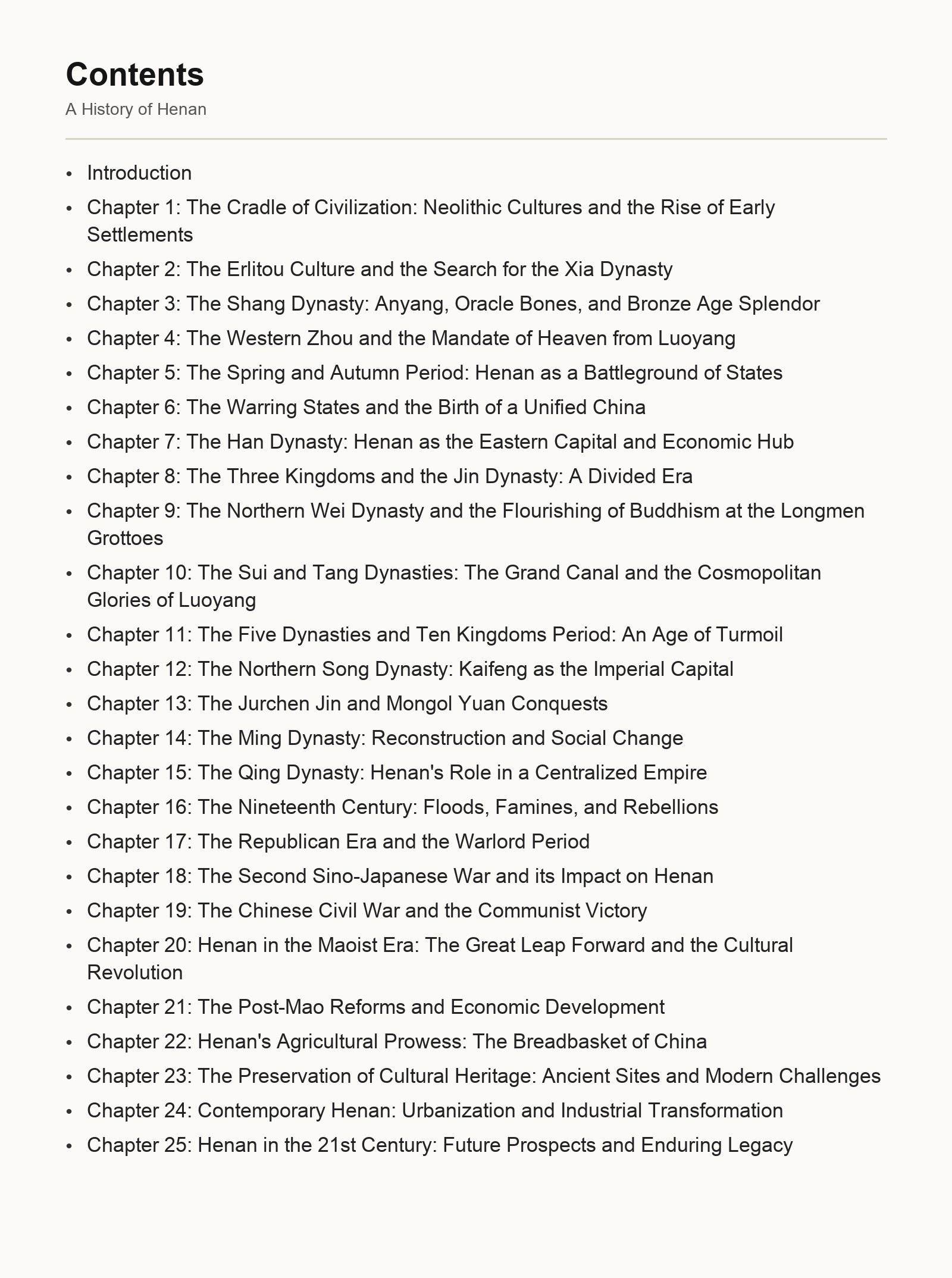
Table of Contents:
- Introduction
- Chapter 1: The Cradle of Civilization: Neolithic Cultures and the Rise of Early Settlements
- Chapter 2: The Erlitou Culture and the Search for the Xia Dynasty
- Chapter 3: The Shang Dynasty: Anyang, Oracle Bones, and Bronze Age Splendor
- Chapter 4: The Western Zhou and the Mandate of Heaven from Luoyang
- Chapter 5: The Spring and Autumn Period: Henan as a Battleground of States
- Chapter 6: The Warring States and the Birth of a Unified China
- Chapter 7: The Han Dynasty: Henan as the Eastern Capital and Economic Hub
- Chapter 8: The Three Kingdoms and the Jin Dynasty: A Divided Era
- Chapter 9: The Northern Wei Dynasty and the Flourishing of Buddhism at the Longmen Grottoes
- Chapter 10: The Sui and Tang Dynasties: The Grand Canal and the Cosmopolitan Glories of Luoyang
- Chapter 11: The Five Dynasties and Ten Kingdoms Period: An Age of Turmoil
- Chapter 12: The Northern Song Dynasty: Kaifeng as the Imperial Capital
- Chapter 13: The Jurchen Jin and Mongol Yuan Conquests
- Chapter 14: The Ming Dynasty: Reconstruction and Social Change
- Chapter 15: The Qing Dynasty: Henan's Role in a Centralized Empire
- Chapter 16: The Nineteenth Century: Floods, Famines, and Rebellions
- Chapter 17: The Republican Era and the Warlord Period
- Chapter 18: The Second Sino-Japanese War and its Impact on Henan
- Chapter 19: The Chinese Civil War and the Communist Victory
- Chapter 20: Henan in the Maoist Era: The Great Leap Forward and the Cultural Revolution
- Chapter 21: The Post-Mao Reforms and Economic Development
- Chapter 22: Henan's Agricultural Prowess: The Breadbasket of China
- Chapter 23: The Preservation of Cultural Heritage: Ancient Sites and Modern Challenges
- Chapter 24: Contemporary Henan: Urbanization and Industrial Transformation
- Chapter 25: Henan in the 21st Century: Future Prospects and Enduring Legacy
Author:
Published By:
Date Published:
May 29, 2026
Type:
Nonfiction
Language:
English
Also Available In:
Word Count:
50,591 words
Reading Time:
3 hours 33 minutes
Sample:
Order:
Buy the A History of Henan ebook on MixCache.com:
Buy NowThe full ebook will be available immediately to read instantly on any device.
$5 account credit for all new MixCache.com accounts, usable toward any ebook purchase!*




Ratings & Reviews
Ask Questions About This Book
Have a question about the content? Ask our AI assistant!
Start by asking a question about "A History of Henan"
Example: "Does this book mention William Shakespeare?"
Thinking...