Browse by Category
Fiction
- Action & Adventure
- African American
- Anthologies
- Children's Fiction
- Classics
- Comics & Graphic Novels
- Coming of Age
- Contemporary
- Cultural & Regional
- Drama
- Erotica
- Fantasy
- General
- Historical Fiction
- Horror
- Humor & Satire
- Literary Fiction
- Mystery, Thriller & Suspense
- Poetry
- Religious & Inspirational
- Romance
- Science Fiction
- Short Stories
- War & Military
- Westerns
- Women's Fiction
- Young Adult
Non-Fiction
- Antiques & Collectibles
- Arts & Photography
- Biographies & Memoirs
- Business & Money
- Children's Non-Fiction
-
Computers & Technology
- Artificial Intelligence
- Computer Science
- Cybersecurity & Cryptography
- Data Science & Analytics
- Databases & Big Data
- Game Development & Design
- General
- Hardware & DIY
- Mobile App Development
- Networking & Cloud Computing
- Operating Systems
- Programming
- Robotics
- Software
- Software Engineering
- User Experience (UX) & Design
- Web Development & Design
- Cooking, Food & Wine
- Crafts, Hobbies & Home
- Education & Teaching
- Engineering
- General
- Health, Fitness & Dieting
-
History
- African History
- African History - North Africa
- African History - Sub-Saharan Africa
- American History
- American History - 20th Century
- American History - Civil War
- American History - Colonial Period
- Ancient History
- Asian History
- Asian History - China
- Asian History - India
- Asian History - Japan
- Asian History - Southeast Asia
- European History
- European History - Ancient Greece
- European History - Ancient Rome
- European History - Medieval
- European History - Modern
- European History - Renaissance
- General
- Middle Eastern History
- Military History
- Military History - Aviation
- Military History - Naval
- Social & Cultural History
- World History
- Humor & Entertainment
- Industrial Technology
- Language Learning
- Law
- LGBTQ+ Non-Fiction
- Literary Criticism
- Medical Books
- Parenting & Relationships
- Philosophy
- Politics & Social Sciences
- Reference
- Religion & Spirituality
-
Science & Math
- Agricultural Sciences
- Astronomy & Space Science
- Behavioral Sciences
- Biological Sciences
- Botany & Plant Science
- Chemistry
- Earth Sciences
- Engineering - Chemical
- Engineering - Civil
- Engineering - Electrical
- Engineering - Mechanical
- Environment
- General
- Geology
- Mathematics
- Nature & Ecology
- Oceanography
- Paleontology
- Physics
- Statistics
- Self-Help
- Sports & Outdoors
- Study Aids
- Sustainability & Green Living
- Textbooks
- Transportation
- Travel
- True Crime
- Urban Planning & Development
- Veterinary Medicine
- Writing & Publishing
Jump to Section
MixCache.com Total Access
Unlimited reading and audiobooks for every book published by MixCache.com.
Included titles carry the MTA badge.
Learn more →A History of Physics
About this book:
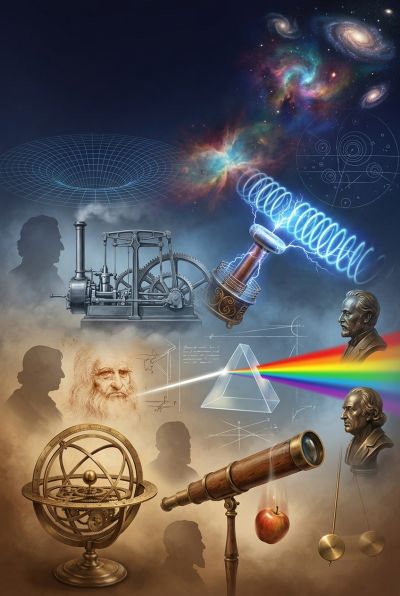
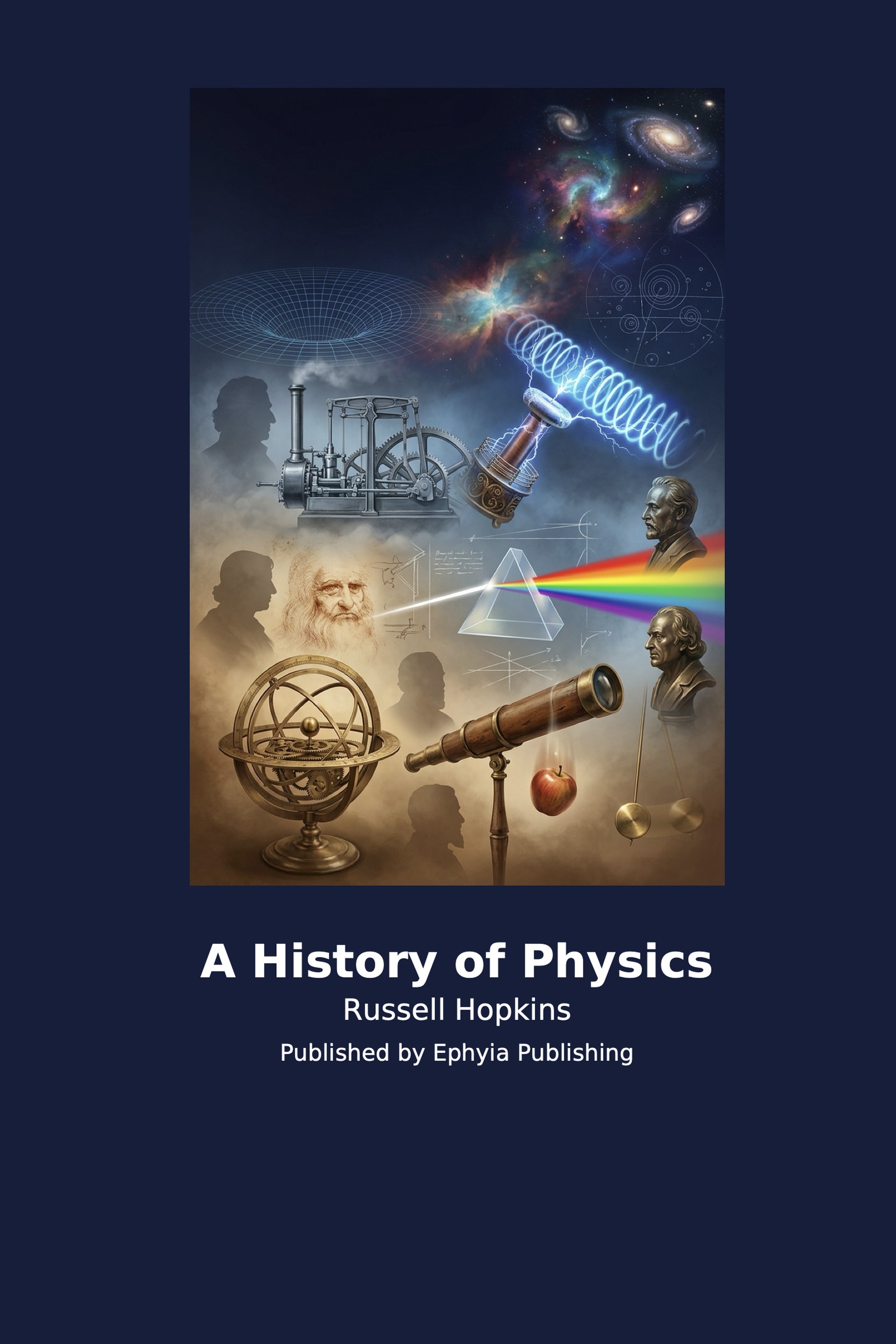
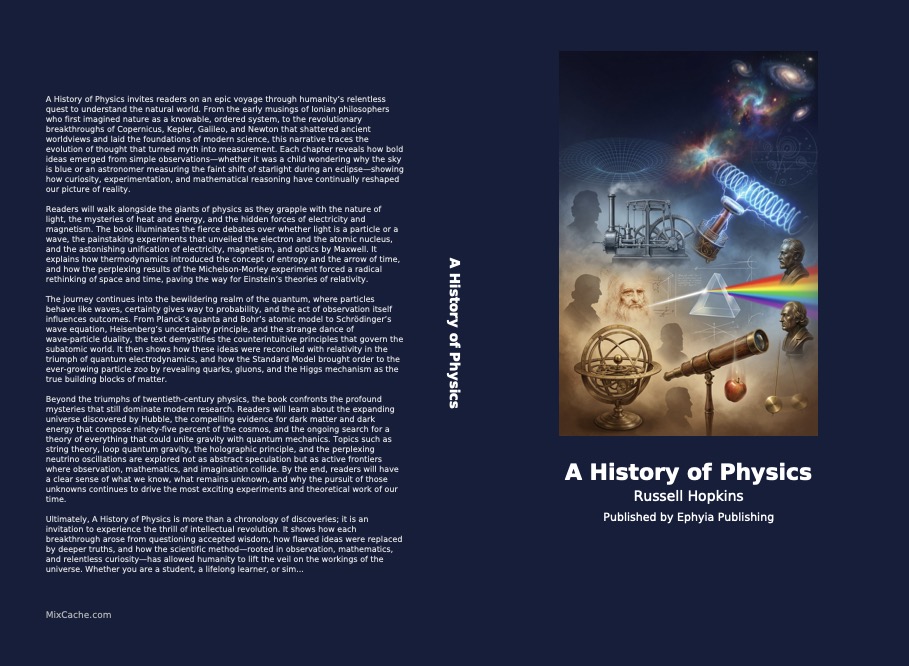
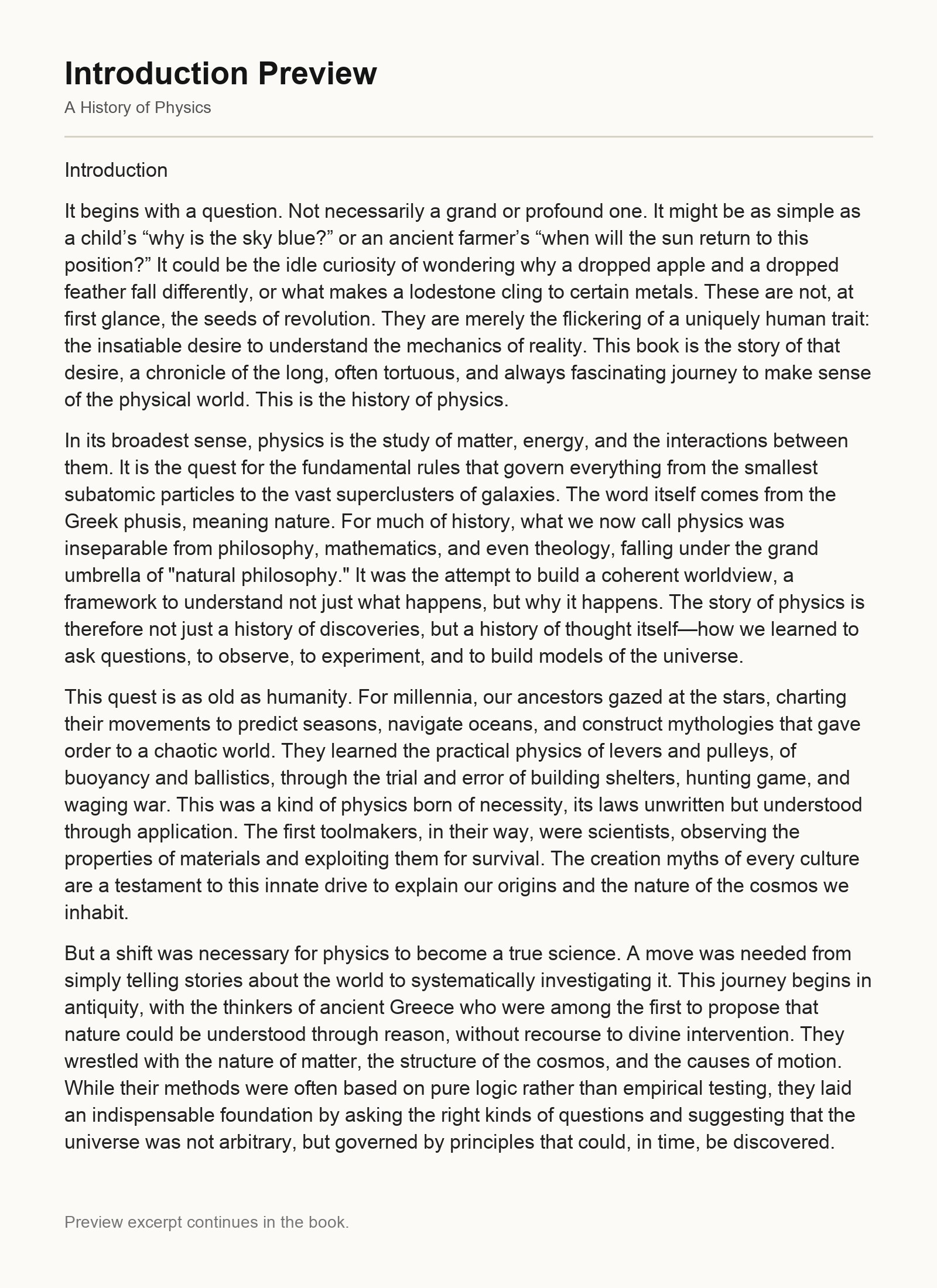
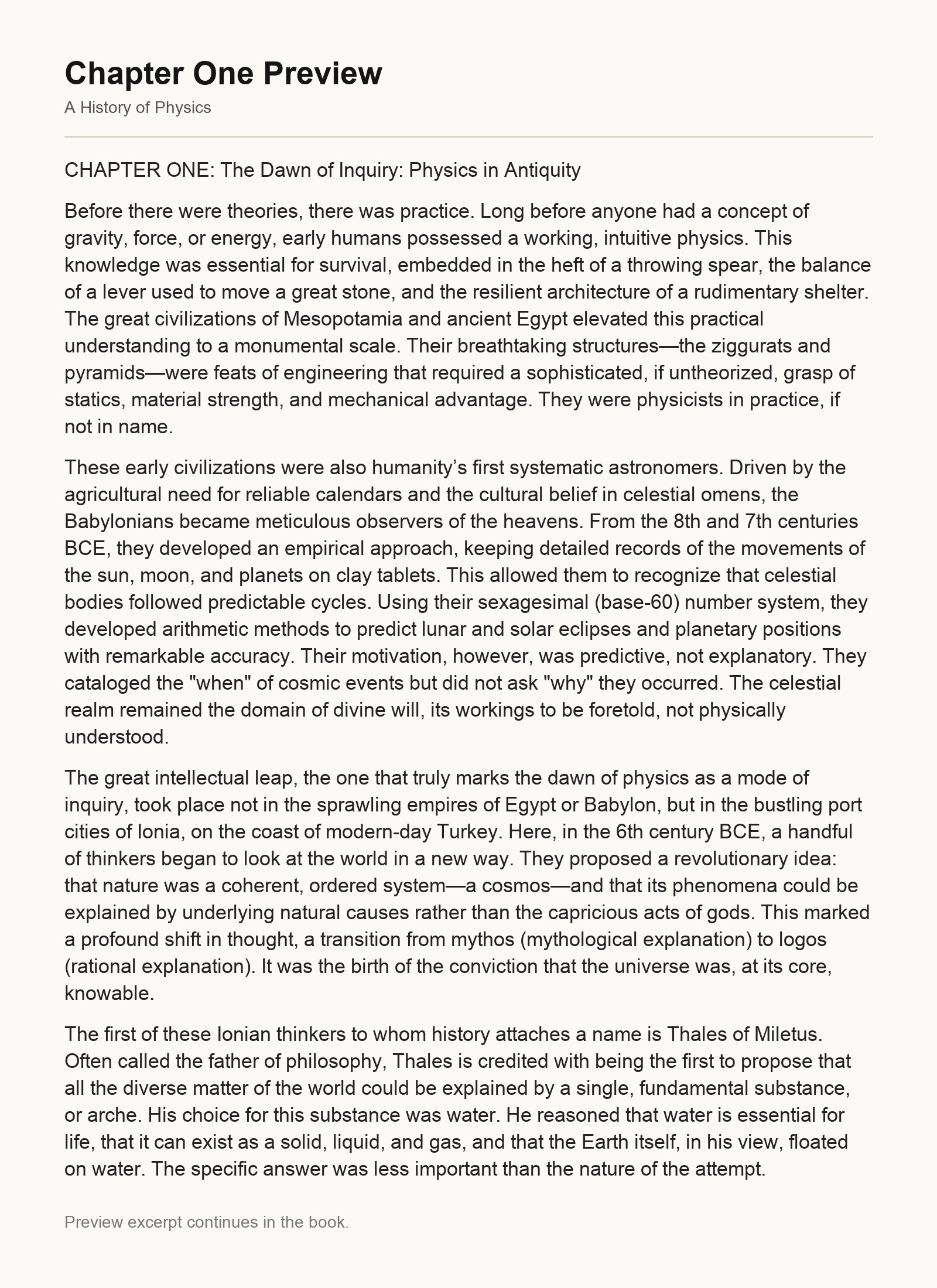
A History of Physics invites readers on an epic voyage through humanity’s relentless quest to understand the natural world. From the early musings of Ionian philosophers who first imagined nature as a knowable, ordered system, to the revolutionary breakthroughs of Copernicus, Kepler, Galileo, and Newton that shattered ancient worldviews and laid the foundations of modern science, this narrative traces the evolution of thought that turned myth into measurement. Each chapter reveals how bold ideas emerged from simple observations—whether it was a child wondering why the sky is blue or an astronomer measuring the faint shift of starlight during an eclipse—showing how curiosity, experimentation, and mathematical reasoning have continually reshaped our picture of reality.
Readers will walk alongside the giants of physics as they grapple with the nature of light, the mysteries of heat and energy, and the hidden forces of electricity and magnetism. The book illuminates the fierce debates over whether light is a particle or a wave, the painstaking experiments that unveiled the electron and the atomic nucleus, and the astonishing unification of electricity, magnetism, and optics by Maxwell. It explains how thermodynamics introduced the concept of entropy and the arrow of time, and how the perplexing results of the Michelson‑Morley experiment forced a radical rethinking of space and time, paving the way for Einstein’s theories of relativity.
The journey continues into the bewildering realm of the quantum, where particles behave like waves, certainty gives way to probability, and the act of observation itself influences outcomes. From Planck’s quanta and Bohr’s atomic model to Schrödinger’s wave equation, Heisenberg’s uncertainty principle, and the strange dance of wave‑particle duality, the text demystifies the counterintuitive principles that govern the subatomic world. It then shows how these ideas were reconciled with relativity in the triumph of quantum electrodynamics, and how the Standard Model brought order to the ever‑growing particle zoo by revealing quarks, gluons, and the Higgs mechanism as the true building blocks of matter.
Beyond the triumphs of twentieth‑century physics, the book confronts the profound mysteries that still dominate modern research. Readers will learn about the expanding universe discovered by Hubble, the compelling evidence for dark matter and dark energy that compose ninety‑five percent of the cosmos, and the ongoing search for a theory of everything that could unite gravity with quantum mechanics. Topics such as string theory, loop quantum gravity, the holographic principle, and the perplexing neutrino oscillations are explored not as abstract speculation but as active frontiers where observation, mathematics, and imagination collide. By the end, readers will have a clear sense of what we know, what remains unknown, and why the pursuit of those unknowns continues to drive the most exciting experiments and theoretical work of our time.
Ultimately, A History of Physics is more than a chronology of discoveries; it is an invitation to experience the thrill of intellectual revolution. It shows how each breakthrough arose from questioning accepted wisdom, how flawed ideas were replaced by deeper truths, and how the scientific method—rooted in observation, mathematics, and relentless curiosity—has allowed humanity to lift the veil on the workings of the universe. Whether you are a student, a lifelong learner, or simply someone who gazes at the night sky and wonders, this book will enrich your appreciation of the cosmos and equip you with the story behind the equations, the experiments, and the ideas that shape our understanding of everything from the smallest quark to the largest galaxy.
What You'll Find Inside:
- Traces the evolution of physics from ancient Greek natural philosophy through the Scientific Revolution to modern quantum mechanics and relativity
- Explores how key figures like Galileo, Newton, Einstein, and Planck revolutionized our understanding of motion, gravity, light, and the quantum world
- Examines the development of major theories including electromagnetism, thermodynamics, the Standard Model of particle physics, and cosmology
- Discusses current mysteries in physics such as dark matter, dark energy, and the quest for a unified theory of everything
- Written as an accessible narrative focused on ideas rather than equations, making complex concepts approachable for general readers
Who's It For:
This book is written for general readers with an interest in science who want to understand the historical development of physics concepts without needing advanced mathematical knowledge. It's ideal for curious adults, students seeking conceptual foundations, and anyone fascinated by how humanity's understanding of the universe has evolved from ancient times to cutting-edge modern physics.
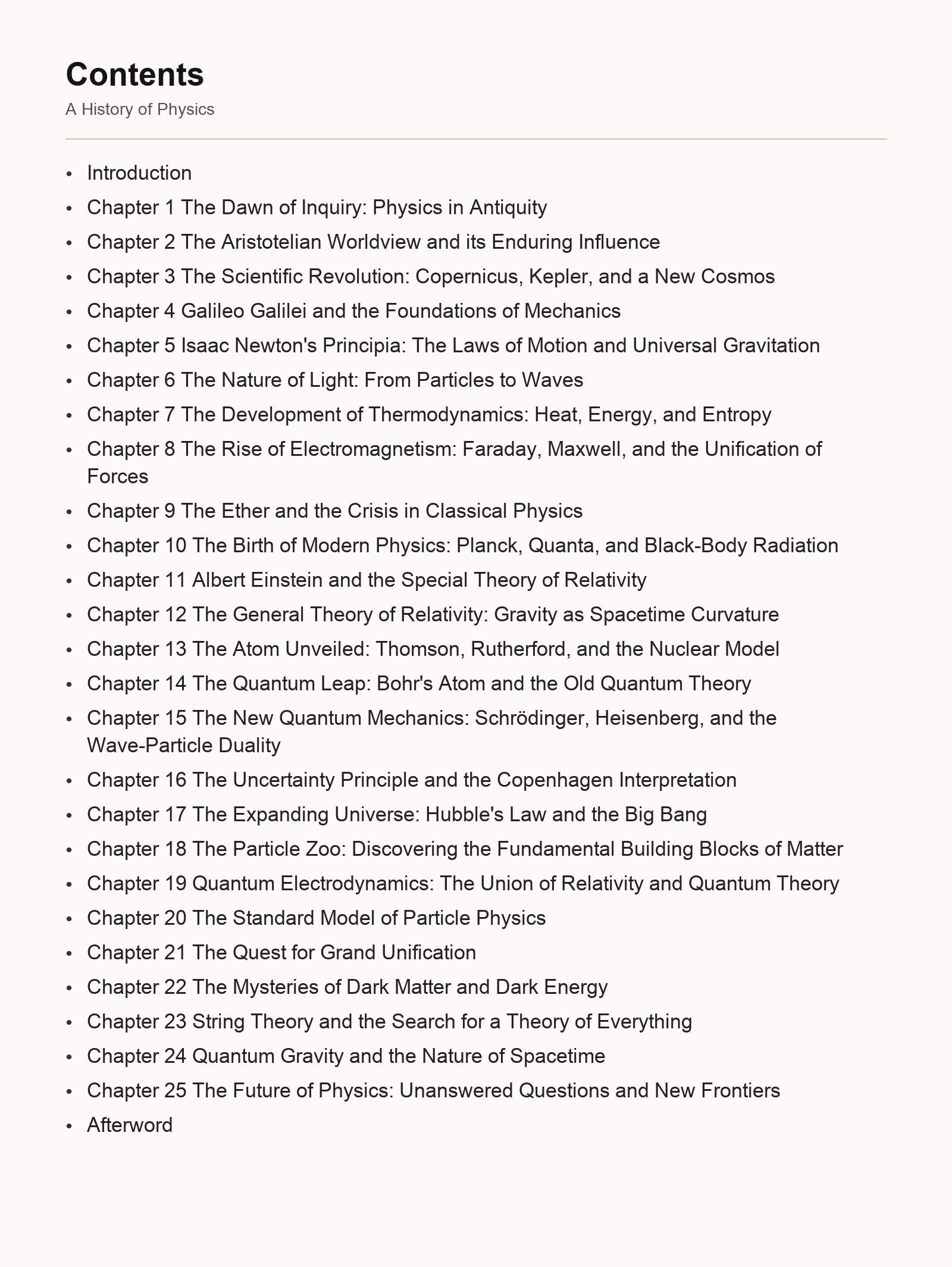
Table of Contents:
- Introduction
- Chapter 1 The Dawn of Inquiry: Physics in Antiquity
- Chapter 2 The Aristotelian Worldview and its Enduring Influence
- Chapter 3 The Scientific Revolution: Copernicus, Kepler, and a New Cosmos
- Chapter 4 Galileo Galilei and the Foundations of Mechanics
- Chapter 5 Isaac Newton's Principia: The Laws of Motion and Universal Gravitation
- Chapter 6 The Nature of Light: From Particles to Waves
- Chapter 7 The Development of Thermodynamics: Heat, Energy, and Entropy
- Chapter 8 The Rise of Electromagnetism: Faraday, Maxwell, and the Unification of Forces
- Chapter 9 The Ether and the Crisis in Classical Physics
- Chapter 10 The Birth of Modern Physics: Planck, Quanta, and Black-Body Radiation
- Chapter 11 Albert Einstein and the Special Theory of Relativity
- Chapter 12 The General Theory of Relativity: Gravity as Spacetime Curvature
- Chapter 13 The Atom Unveiled: Thomson, Rutherford, and the Nuclear Model
- Chapter 14 The Quantum Leap: Bohr's Atom and the Old Quantum Theory
- Chapter 15 The New Quantum Mechanics: Schrödinger, Heisenberg, and the Wave-Particle Duality
- Chapter 16 The Uncertainty Principle and the Copenhagen Interpretation
- Chapter 17 The Expanding Universe: Hubble's Law and the Big Bang
- Chapter 18 The Particle Zoo: Discovering the Fundamental Building Blocks of Matter
- Chapter 19 Quantum Electrodynamics: The Union of Relativity and Quantum Theory
- Chapter 20 The Standard Model of Particle Physics
- Chapter 21 The Quest for Grand Unification
- Chapter 22 The Mysteries of Dark Matter and Dark Energy
- Chapter 23 String Theory and the Search for a Theory of Everything
- Chapter 24 Quantum Gravity and the Nature of Spacetime
- Chapter 25 The Future of Physics: Unanswered Questions and New Frontiers
- Afterword
Author:
Published By:
Date Published:
May 28, 2026
Type:
Nonfiction
Language:
English
Also Available In:
Word Count:
66,644 words
Reading Time:
4 hours 40 minutes
Sample:
Order:
Order A History of Physics (Hardcover) on MixCache.com:
Buy NowPrint copy is made to order and ships worldwide. Includes the ebook free, ready to read instantly.
$5 account credit for all new MixCache.com accounts, usable toward any ebook purchase!*