Browse by Category
Fiction
- Action & Adventure
- African American
- Anthologies
- Children's Fiction
- Classics
- Comics & Graphic Novels
- Coming of Age
- Contemporary
- Cultural & Regional
- Drama
- Erotica
- Fantasy
- General
- Historical Fiction
- Horror
- Humor & Satire
- Literary Fiction
- Mystery, Thriller & Suspense
- Poetry
- Religious & Inspirational
- Romance
- Science Fiction
- Short Stories
- War & Military
- Westerns
- Women's Fiction
- Young Adult
Non-Fiction
- Antiques & Collectibles
- Arts & Photography
- Biographies & Memoirs
- Business & Money
- Children's Non-Fiction
-
Computers & Technology
- Artificial Intelligence
- Computer Science
- Cybersecurity & Cryptography
- Data Science & Analytics
- Databases & Big Data
- Game Development & Design
- General
- Hardware & DIY
- Mobile App Development
- Networking & Cloud Computing
- Operating Systems
- Programming
- Robotics
- Software
- Software Engineering
- User Experience (UX) & Design
- Web Development & Design
- Cooking, Food & Wine
- Crafts, Hobbies & Home
- Education & Teaching
- Engineering
- General
- Health, Fitness & Dieting
-
History
- African History
- African History - North Africa
- African History - Sub-Saharan Africa
- American History
- American History - 20th Century
- American History - Civil War
- American History - Colonial Period
- Ancient History
- Asian History
- Asian History - China
- Asian History - India
- Asian History - Japan
- Asian History - Southeast Asia
- European History
- European History - Ancient Greece
- European History - Ancient Rome
- European History - Medieval
- European History - Modern
- European History - Renaissance
- General
- Middle Eastern History
- Military History
- Military History - Aviation
- Military History - Naval
- Social & Cultural History
- World History
- Humor & Entertainment
- Industrial Technology
- Language Learning
- Law
- LGBTQ+ Non-Fiction
- Literary Criticism
- Medical Books
- Parenting & Relationships
- Philosophy
- Politics & Social Sciences
- Reference
- Religion & Spirituality
-
Science & Math
- Agricultural Sciences
- Astronomy & Space Science
- Behavioral Sciences
- Biological Sciences
- Botany & Plant Science
- Chemistry
- Earth Sciences
- Engineering - Chemical
- Engineering - Civil
- Engineering - Electrical
- Engineering - Mechanical
- Environment
- General
- Geology
- Mathematics
- Nature & Ecology
- Oceanography
- Paleontology
- Physics
- Statistics
- Self-Help
- Sports & Outdoors
- Study Aids
- Sustainability & Green Living
- Textbooks
- Transportation
- Travel
- True Crime
- Urban Planning & Development
- Veterinary Medicine
- Writing & Publishing
Jump to Section
MixCache.com Total Access
Unlimited reading and audiobooks for every book published by MixCache.com.
Included titles carry the MTA badge.
Learn more →A History of Ecuador
About this book:
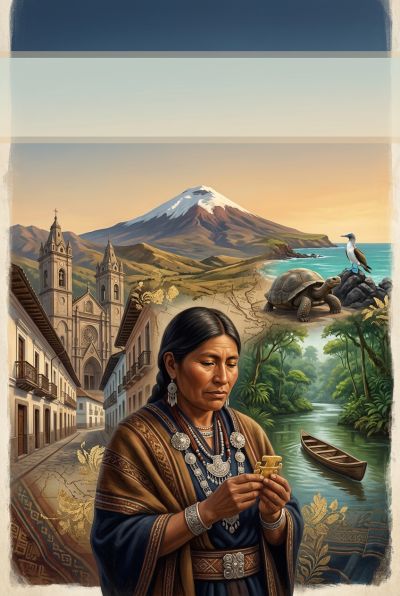
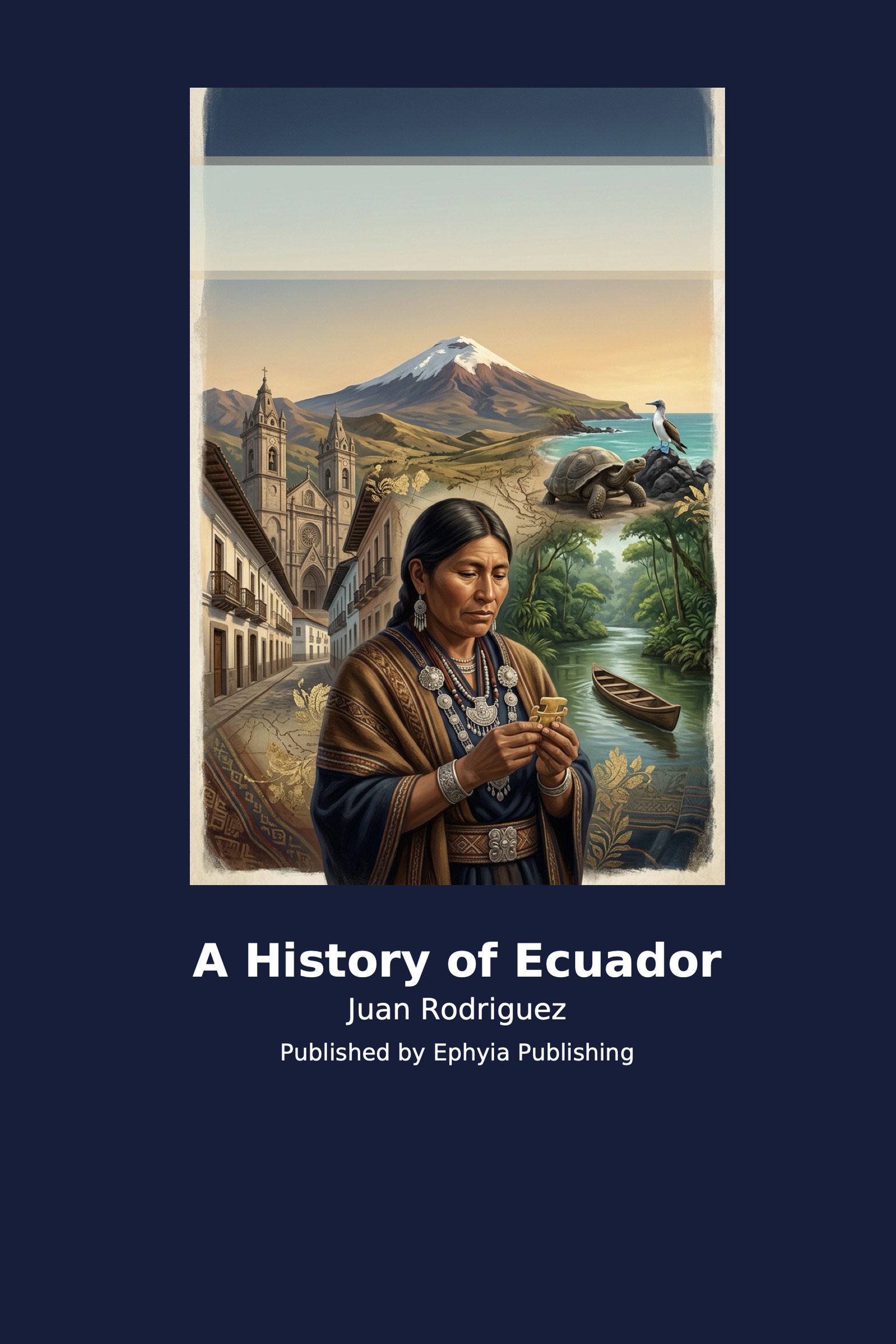
For readers seeking to understand how a nation's geography shapes its destiny, this comprehensive history of Ecuador reveals a story written in the Andes Mountains, the Pacific coast, the Amazon rainforest, and the Galápagos Islands. From the earliest inhabitants who crafted the first pottery in the Americas to the modern challenges of security and economic dependency, Juan Rodriguez traces how Ecuador's unique position on the equator has created both extraordinary diversity and profound internal divisions that have defined its turbulent journey.
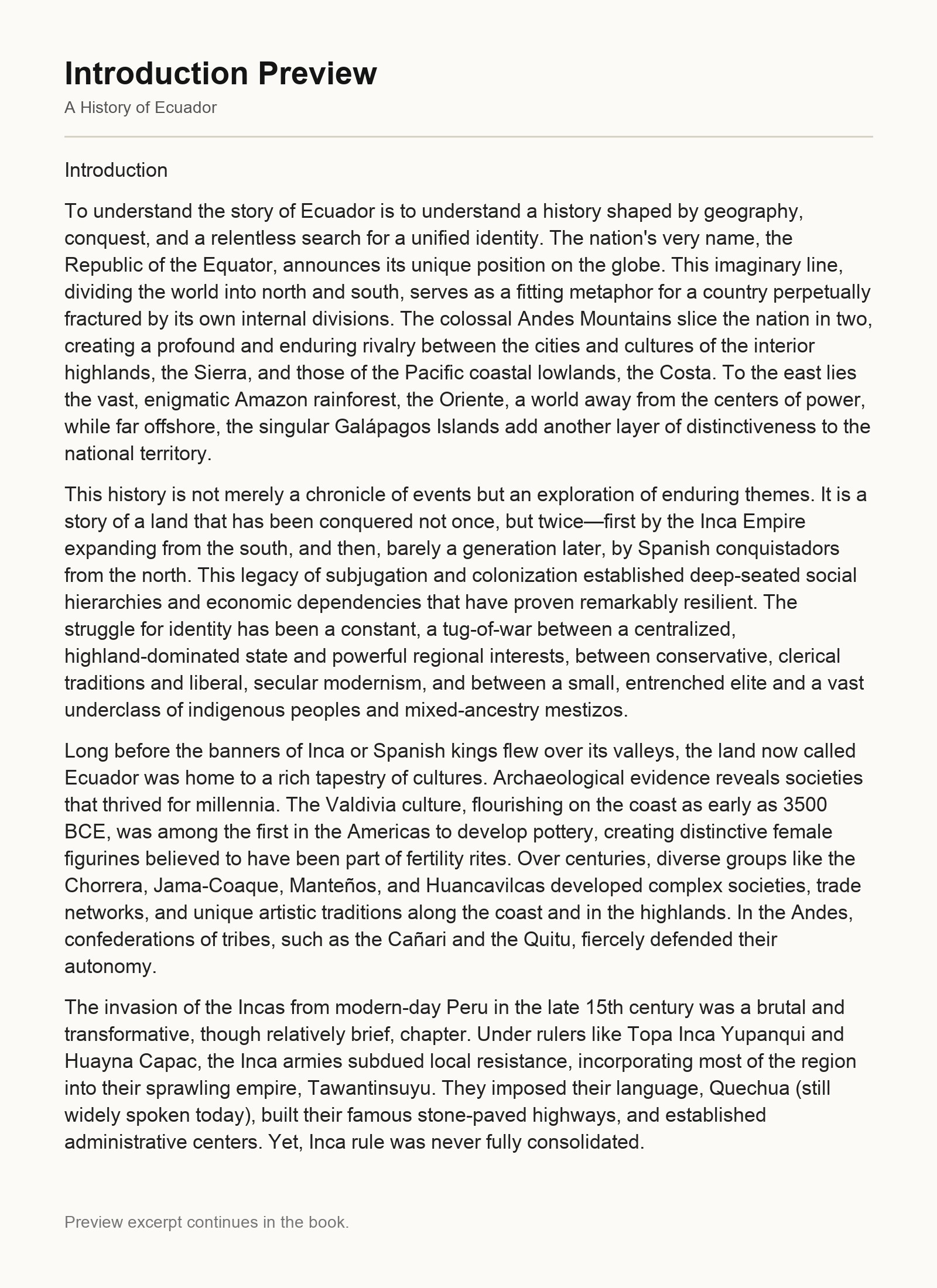
Readers will walk through the dual conquest that forged Ecuador's social foundations - first by the Inca Empire expanding from the south, then barely a generation later by Spanish conquistadors from the north. This legacy established deep-seated hierarchies and economic dependencies that proved remarkably resilient. The book explores how colonial society functioned through systems like the encomienda and mita, how the Quito School of Art produced masterpieces that blended European techniques with indigenous sensibilities, and how the territory was administered as the Royal Audience of Quito for nearly three centuries before independence.
The narrative continues through Ecuador's tumultuous path to nationhood, from the first cries of independence in 1809 to the decisive Battle of Pichincha in 1822, and the subsequent disappointment of incorporation into Bolívar's Gran Colombia experiment. Readers will experience the 19th century's parade of caudillos, the conservative modernization and theocratic rule of Gabriel García Moreno, the Liberal Revolution led by Eloy Alfaro that severed church and state, and the cacao boom that concentrated wealth in a coastal plutocracy while leaving deep regional divides.
Moving into the 20th century, readers will understand how oil transformed Ecuador's destiny after decades of instability, how the return to democracy in 1979 was immediately tested by economic crisis and border conflicts, how indigenous movements emerged to challenge centuries of marginalization, and how dollarization in 2000 sought to stabilize an economy ravaged by hyperinflation. The book culminates in an examination of contemporary Ecuador - its security challenges, economic fragility, environmental tensions, and the ongoing struggle to build a more inclusive society after two centuries of political volatility, offering readers not just a chronicle of events but a profound understanding of why Ecuador remains a nation perpetually in search of a unified identity.
What You'll Find Inside:
- Ecuador's enduring geographic divisions between the Sierra (highlands), Costa (coast), Oriente (Amazon), and Galápagos Islands have created persistent regional tensions that shape its political, social, and economic development throughout history.
- The nation's history is marked by cycles of boom and bust tied to single export commodities—first cacao, then bananas, and later oil—each boom concentrating wealth and power while each bust triggering economic crisis and political instability.
- A fundamental conflict has existed between conservative, clerical, and landowning elites of the highland capital Quito and liberal, mercantile, and secular forces of the coastal hub Guayaquil, driving much of Ecuador's political volatility since independence.
- The book traces the emergence and growing political power of Ecuador's indigenous movements, particularly CONAIE, from marginalized populations to formidable actors demanding plurinational state recognition and territorial rights.
- Contemporary Ecuador faces interconnected challenges including narcotrafficking violence, economic fragility from dollarization, deep political polarization following the Correa era, and the ongoing struggle to build a more inclusive society amid historic inequalities.
Who's It For:
This book is ideal for university students and academics specializing in Latin American history, Andean studies, or Ecuadorian politics; professionals working in international development, diplomacy, or business with Ecuador; and deeply interested general readers seeking a thorough understanding of the historical forces that have shaped this complex nation. It assumes no prior specialized knowledge but rewards readers with a serious commitment to understanding Ecuador's intricate past and its implications for contemporary challenges.
Table of Contents:
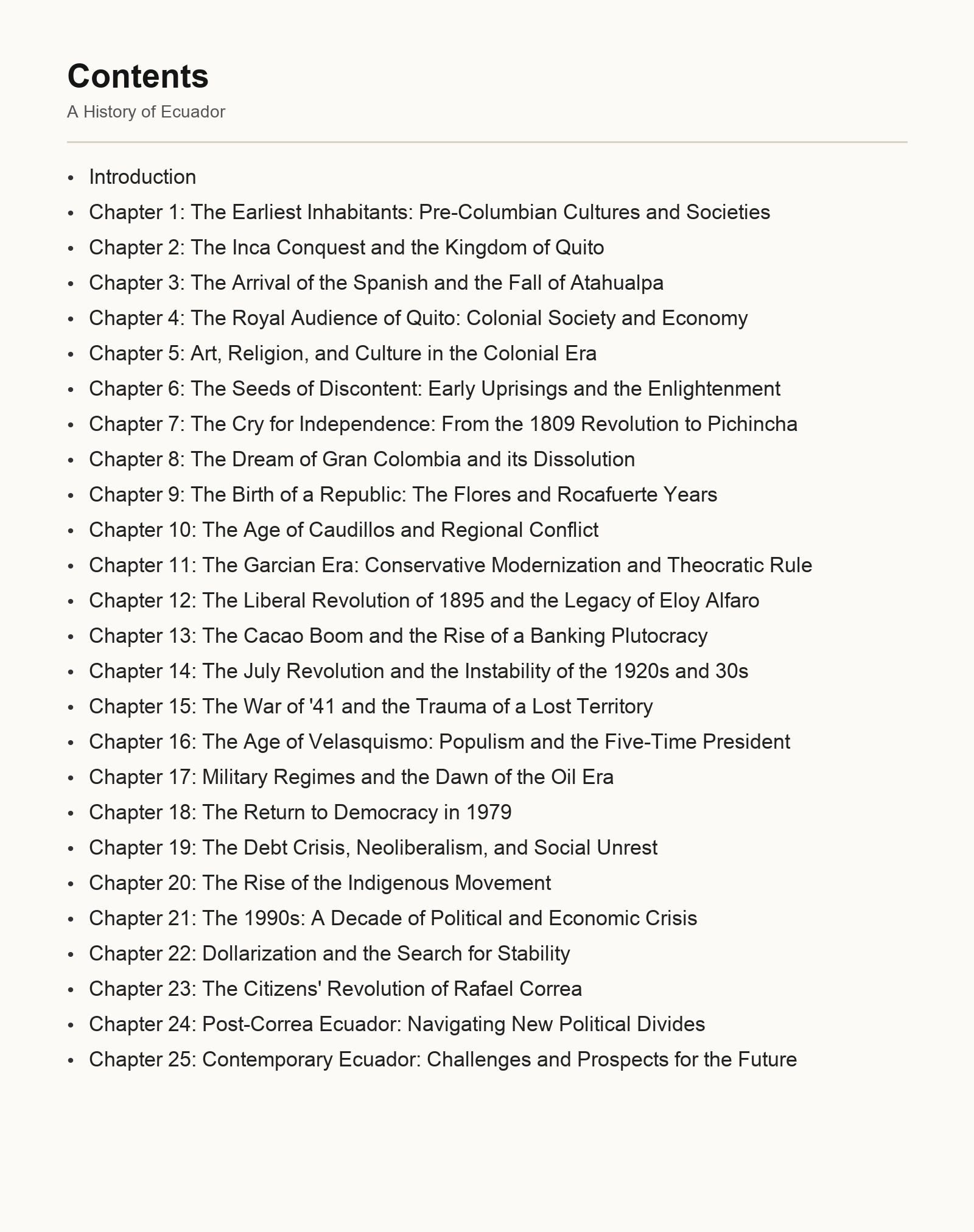
- Introduction
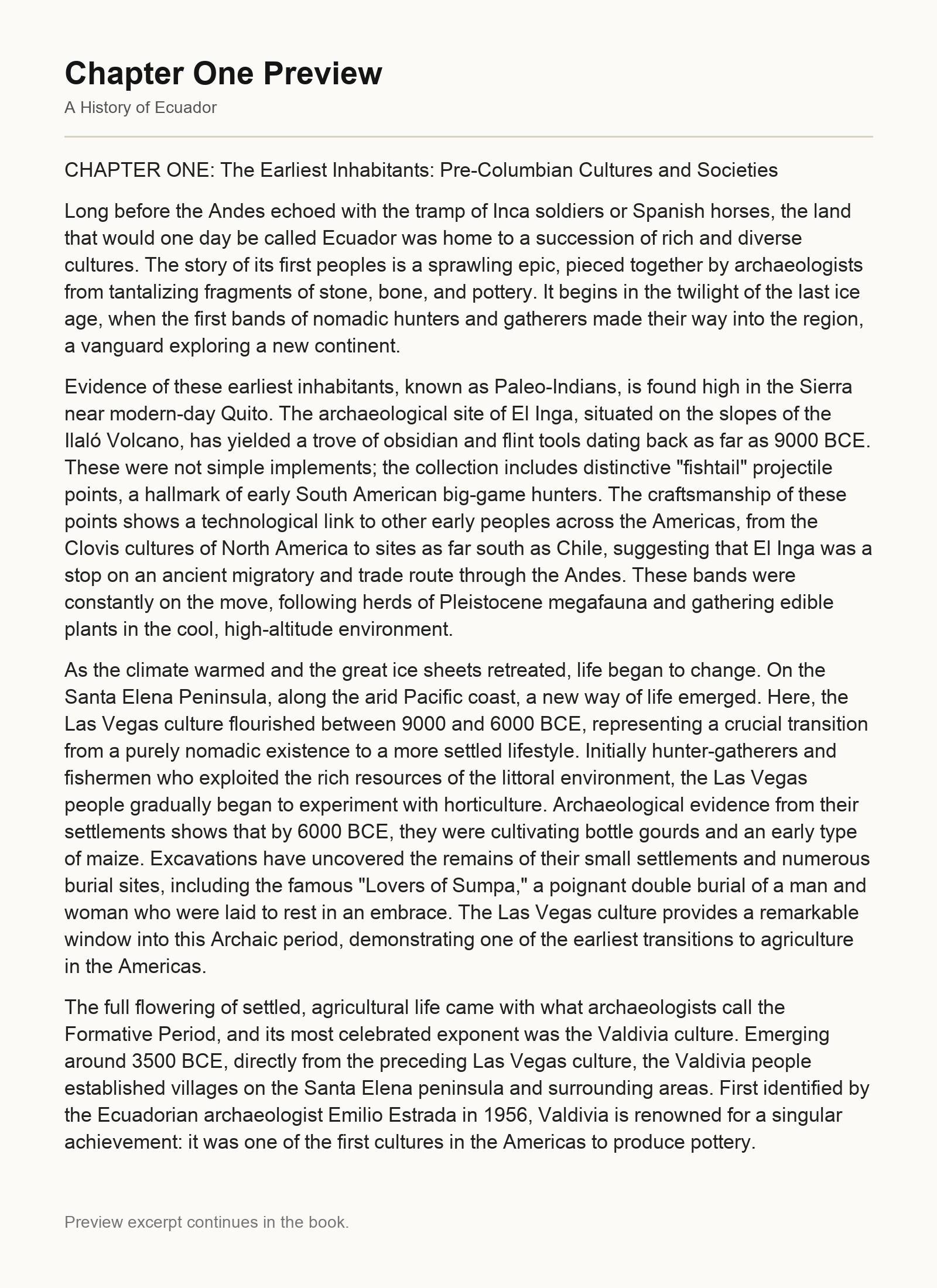
- Chapter 1: The Earliest Inhabitants: Pre-Columbian Cultures and Societies
- Chapter 2: The Inca Conquest and the Kingdom of Quito
- Chapter 3: The Arrival of the Spanish and the Fall of Atahualpa
- Chapter 4: The Royal Audience of Quito: Colonial Society and Economy
- Chapter 5: Art, Religion, and Culture in the Colonial Era
- Chapter 6: The Seeds of Discontent: Early Uprisings and the Enlightenment
- Chapter 7: The Cry for Independence: From the 1809 Revolution to Pichincha
- Chapter 8: The Dream of Gran Colombia and its Dissolution
- Chapter 9: The Birth of a Republic: The Flores and Rocafuerte Years
- Chapter 10: The Age of Caudillos and Regional Conflict
- Chapter 11: The Garcian Era: Conservative Modernization and Theocratic Rule
- Chapter 12: The Liberal Revolution of 1895 and the Legacy of Eloy Alfaro
- Chapter 13: The Cacao Boom and the Rise of a Banking Plutocracy
- Chapter 14: The July Revolution and the Instability of the 1920s and 30s
- Chapter 15: The War of '41 and the Trauma of a Lost Territory
- Chapter 16: The Age of Velasquismo: Populism and the Five-Time President
- Chapter 17: Military Regimes and the Dawn of the Oil Era
- Chapter 18: The Return to Democracy in 1979
- Chapter 19: The Debt Crisis, Neoliberalism, and Social Unrest
- Chapter 20: The Rise of the Indigenous Movement
- Chapter 21: The 1990s: A Decade of Political and Economic Crisis
- Chapter 22: Dollarization and the Search for Stability
- Chapter 23: The Citizens' Revolution of Rafael Correa
- Chapter 24: Post-Correa Ecuador: Navigating New Political Divides
- Chapter 25: Contemporary Ecuador: Challenges and Prospects for the Future
Author:
Published By:
Date Published:
May 28, 2026
Type:
Nonfiction
Language:
English
Also Available In:
Word Count:
44,505 words
Reading Time:
3 hours 7 minutes
Sample:
Order:
Order A History of Ecuador (Paperback) on MixCache.com:
Buy NowPrint copy is made to order and ships worldwide. Includes the ebook free, ready to read instantly.
$5 account credit for all new MixCache.com accounts, usable toward any ebook purchase!*