Browse by Category
Fiction
- Action & Adventure
- African American
- Anthologies
- Children's Fiction
- Classics
- Comics & Graphic Novels
- Coming of Age
- Contemporary
- Cultural & Regional
- Drama
- Erotica
- Fantasy
- General
- Historical Fiction
- Horror
- Humor & Satire
- Literary Fiction
- Mystery, Thriller & Suspense
- Poetry
- Religious & Inspirational
- Romance
- Science Fiction
- Short Stories
- War & Military
- Westerns
- Women's Fiction
- Young Adult
Non-Fiction
- Antiques & Collectibles
- Arts & Photography
- Biographies & Memoirs
- Business & Money
- Children's Non-Fiction
-
Computers & Technology
- Artificial Intelligence
- Computer Science
- Cybersecurity & Cryptography
- Data Science & Analytics
- Databases & Big Data
- Game Development & Design
- General
- Hardware & DIY
- Mobile App Development
- Networking & Cloud Computing
- Operating Systems
- Programming
- Robotics
- Software
- Software Engineering
- User Experience (UX) & Design
- Web Development & Design
- Cooking, Food & Wine
- Crafts, Hobbies & Home
- Education & Teaching
- Engineering
- General
- Health, Fitness & Dieting
-
History
- African History
- African History - North Africa
- African History - Sub-Saharan Africa
- American History
- American History - 20th Century
- American History - Civil War
- American History - Colonial Period
- Ancient History
- Asian History
- Asian History - China
- Asian History - India
- Asian History - Japan
- Asian History - Southeast Asia
- European History
- European History - Ancient Greece
- European History - Ancient Rome
- European History - Medieval
- European History - Modern
- European History - Renaissance
- General
- Middle Eastern History
- Military History
- Military History - Aviation
- Military History - Naval
- Social & Cultural History
- World History
- Humor & Entertainment
- Industrial Technology
- Language Learning
- Law
- LGBTQ+ Non-Fiction
- Literary Criticism
- Medical Books
- Parenting & Relationships
- Philosophy
- Politics & Social Sciences
- Reference
- Religion & Spirituality
-
Science & Math
- Agricultural Sciences
- Astronomy & Space Science
- Behavioral Sciences
- Biological Sciences
- Botany & Plant Science
- Chemistry
- Earth Sciences
- Engineering - Chemical
- Engineering - Civil
- Engineering - Electrical
- Engineering - Mechanical
- Environment
- General
- Geology
- Mathematics
- Nature & Ecology
- Oceanography
- Paleontology
- Physics
- Statistics
- Self-Help
- Sports & Outdoors
- Study Aids
- Sustainability & Green Living
- Textbooks
- Transportation
- Travel
- True Crime
- Urban Planning & Development
- Veterinary Medicine
- Writing & Publishing
Jump to Section
MixCache.com Total Access
Unlimited reading and audiobooks for every book published by MixCache.com.
Included titles carry the MTA badge.
Learn more →Slavery in the United States
About this book:

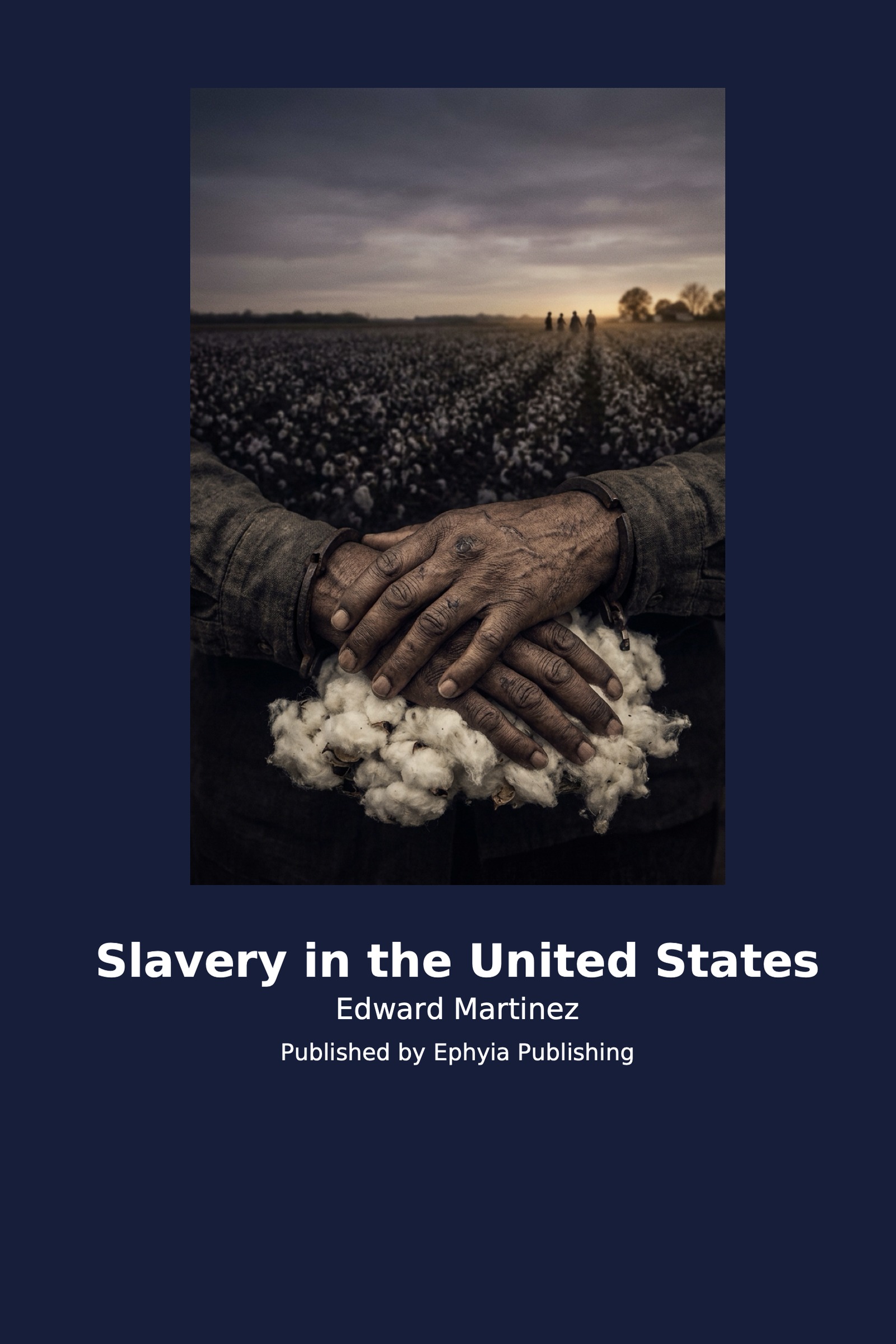
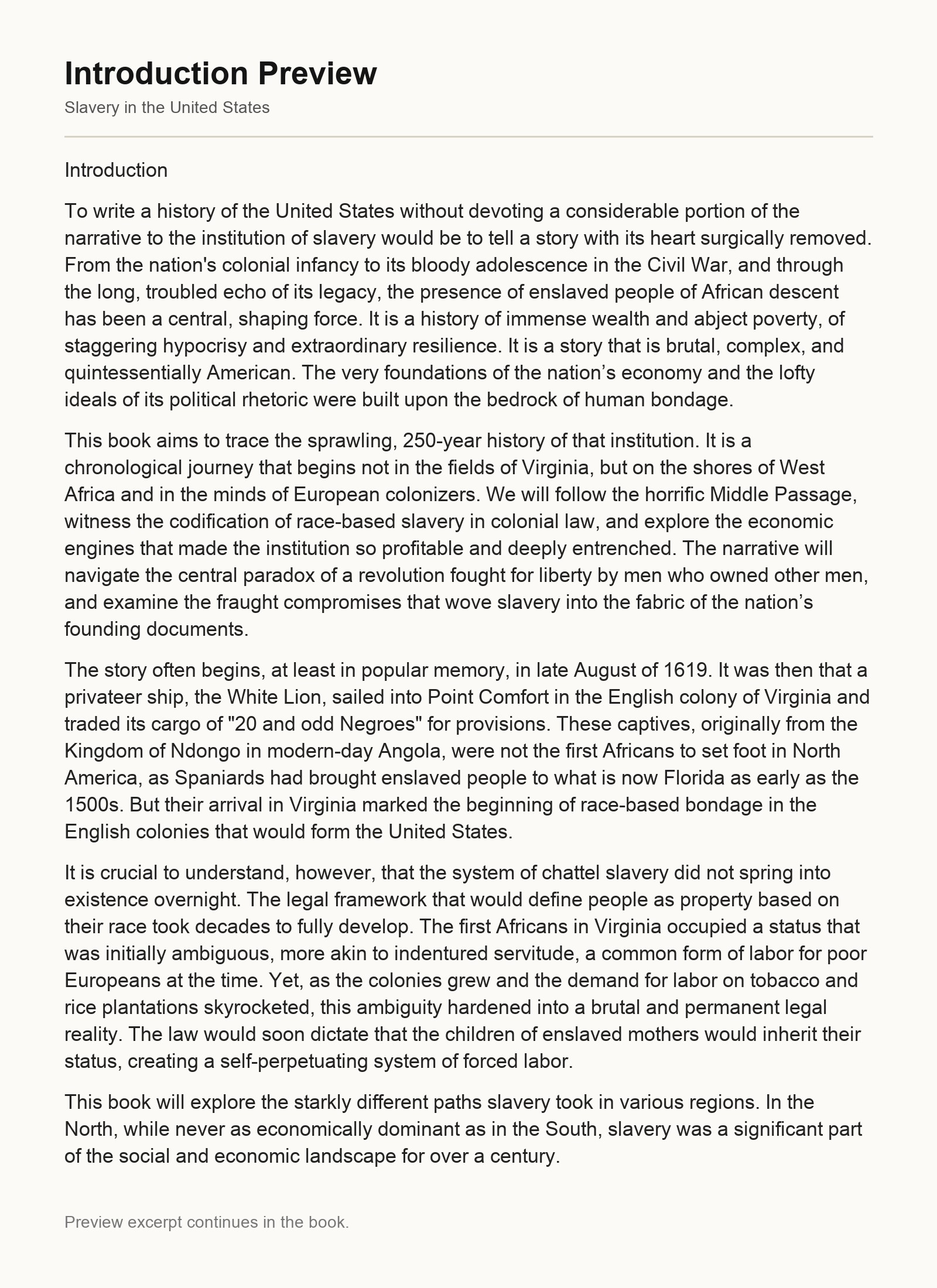
This book offers a sweeping, chronological journey through the 250‑year history of slavery in the United States, beginning with the African roots of the transatlantic trade and ending with the enduring legacies that shape modern America. Readers will trace how European demand for sugar and cotton transformed a scattered practice into a global system of human trafficking, and how the Middle Passage delivered millions of Africans to a life of bondage that would become foundational to the nation’s economy and social order.
Each chapter builds on the last to reveal the legal, economic, and human dimensions of the institution. You will explore the gradual shift from ambiguous indentured status to lifelong, hereditary chattel slavery, see how colonial laws codified race as a determinant of freedom, and understand the regional contrasts between the North’s urban slave labor and the South’s plantation empire driven by tobacco, rice, indigo, and ultimately cotton. The narrative also delves into the everyday realities of enslaved life—work regimens, diet, housing, family formation, and the vibrant culture of religion, music, and folklore that sustained communities despite relentless oppression.
Beyond the mechanics of bondage, the book highlights the many forms of resistance that defined the enslaved experience. From subtle acts of sabotage and the creation of fugitive networks like the Underground Railroad to major rebellions such as Stono, Nat Turner’s uprising, and the Haitian‑inspired conspiracies of Gabriel and Denmark Vesey, readers will grasp how enslaved people continually challenged their captivity and forced the nation to confront its contradictions. The text also examines the political crises that erupted as the nation expanded westward, showing how compromises like the Three‑Fifths Clause, the Fugitive Slave Act, and the Dred Scott decision deepened the sectional divide that ultimately led to civil war.
The final sections follow the war’s transformation from a struggle to preserve the Union into a war for freedom, detailing the Emancipation Proclamation, the recruitment of Black soldiers, and the passage of the Thirteenth Amendment. Readers will witness the tumultuous Reconstruction era, the rise of Jim Crow, the Great Migration, and the long‑standing economic and social disparities that trace directly back to slavery’s legacy. By the end, you will have a comprehensive understanding of how slavery shaped American ideals, institutions, and everyday life, and why confronting this history is essential to grasping the United States today.
What You'll Find Inside:
- The transatlantic slave trade's brutal mechanics and evolution from African and European precursors to an industrial-scale system of human trafficking that fueled colonial economies.
- How colonial and federal laws systematically codified racial slavery, creating legal frameworks that defined people as property and protected the institution for centuries.
- The economic engines of slavery—from tobacco and rice to cotton—and how enslaved labor generated wealth that became the nation's largest financial asset by 1860.
- The vibrant culture, family structures, and diverse forms of resistance developed by enslaved people despite brutal oppression, including religion, music, folklore, and armed revolt.
- The political crises over slavery's expansion, the Civil War as a transformative conflict for freedom, and slavery's enduring legacies in modern American society.
Who's It For:
This book is ideal for students, educators, and general readers seeking a comprehensive understanding of slavery's central role in shaping American history, economics, and society. It provides the historical context necessary to comprehend the roots of contemporary racial inequalities and the nation's ongoing struggle to fulfill its founding ideals of liberty and equality.
Table of Contents:
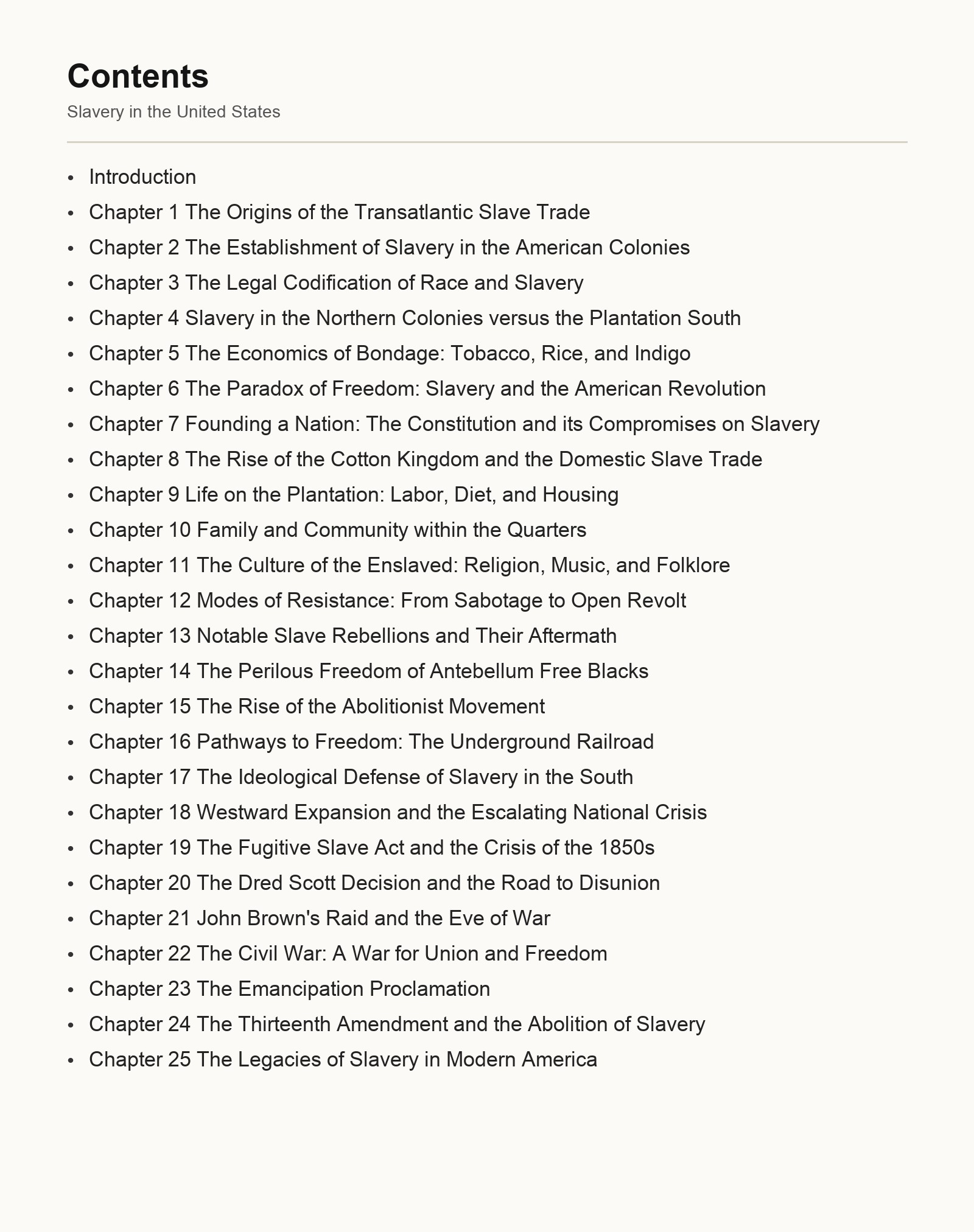
- Introduction
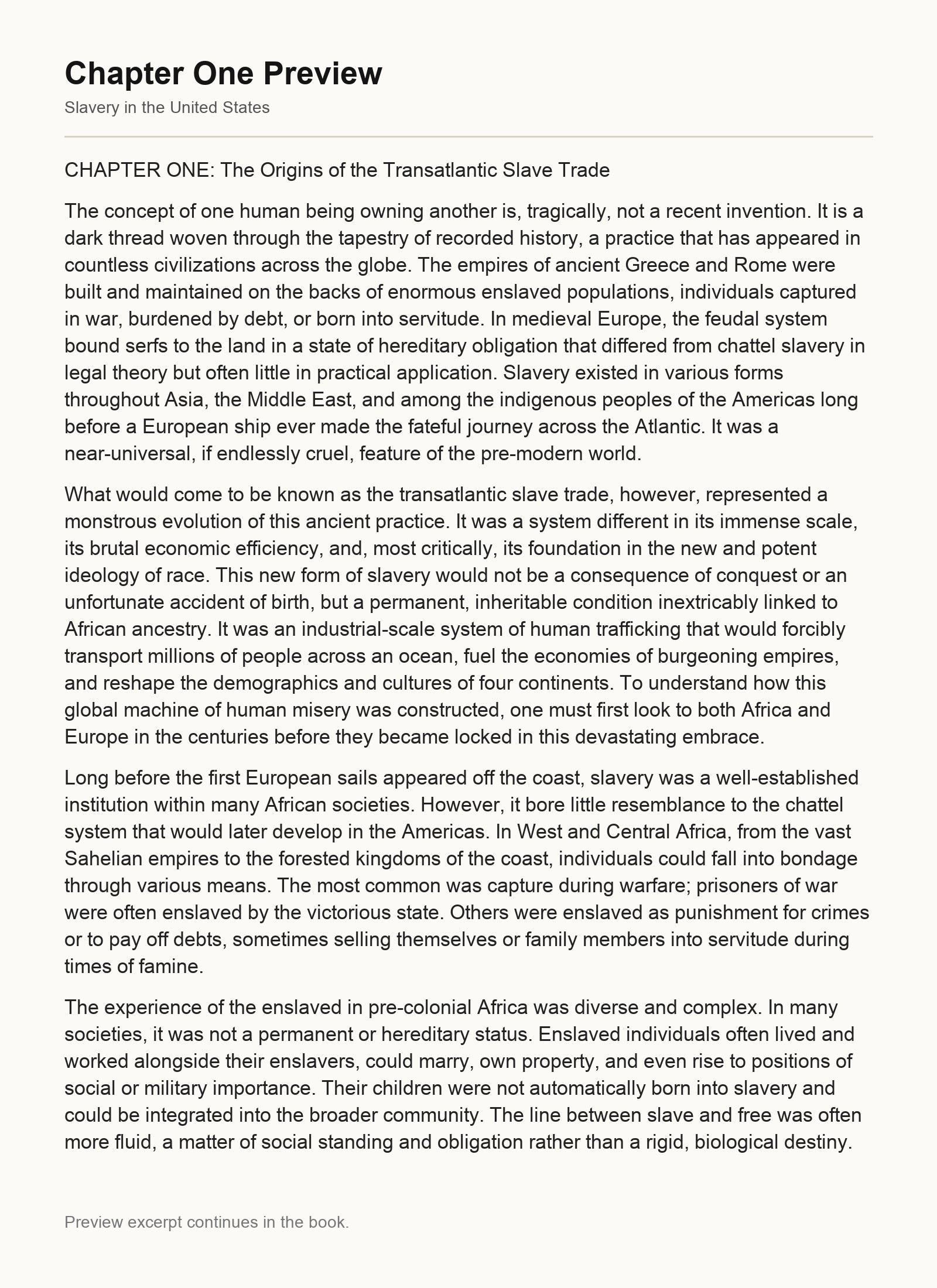
- Chapter 1 The Origins of the Transatlantic Slave Trade
- Chapter 2 The Establishment of Slavery in the American Colonies
- Chapter 3 The Legal Codification of Race and Slavery
- Chapter 4 Slavery in the Northern Colonies versus the Plantation South
- Chapter 5 The Economics of Bondage: Tobacco, Rice, and Indigo
- Chapter 6 The Paradox of Freedom: Slavery and the American Revolution
- Chapter 7 Founding a Nation: The Constitution and its Compromises on Slavery
- Chapter 8 The Rise of the Cotton Kingdom and the Domestic Slave Trade
- Chapter 9 Life on the Plantation: Labor, Diet, and Housing
- Chapter 10 Family and Community within the Quarters
- Chapter 11 The Culture of the Enslaved: Religion, Music, and Folklore
- Chapter 12 Modes of Resistance: From Sabotage to Open Revolt
- Chapter 13 Notable Slave Rebellions and Their Aftermath
- Chapter 14 The Perilous Freedom of Antebellum Free Blacks
- Chapter 15 The Rise of the Abolitionist Movement
- Chapter 16 Pathways to Freedom: The Underground Railroad
- Chapter 17 The Ideological Defense of Slavery in the South
- Chapter 18 Westward Expansion and the Escalating National Crisis
- Chapter 19 The Fugitive Slave Act and the Crisis of the 1850s
- Chapter 20 The Dred Scott Decision and the Road to Disunion
- Chapter 21 John Brown's Raid and the Eve of War
- Chapter 22 The Civil War: A War for Union and Freedom
- Chapter 23 The Emancipation Proclamation
- Chapter 24 The Thirteenth Amendment and the Abolition of Slavery
- Chapter 25 The Legacies of Slavery in Modern America
Author:
Published By:
Date Published:
May 26, 2026
Type:
Nonfiction
Language:
English
Also Available In:
Word Count:
51,576 words
Reading Time:
3 hours 37 minutes
Sample:
Order:
Order Slavery in the United States (Paperback) on MixCache.com:
Buy NowPrint copy is made to order and ships worldwide. Includes the ebook free, ready to read instantly.
$5 account credit for all new MixCache.com accounts, usable toward any ebook purchase!*