
Browse by Category
Fiction
- Action & Adventure
- African American
- Anthologies
- Children's Fiction
- Classics
- Comics & Graphic Novels
- Coming of Age
- Contemporary
- Cultural & Regional
- Drama
- Erotica
- Fantasy
- General
- Historical Fiction
- Horror
- Humor & Satire
- Literary Fiction
- Mystery, Thriller & Suspense
- Poetry
- Religious & Inspirational
- Romance
- Science Fiction
- Short Stories
- War & Military
- Westerns
- Women's Fiction
- Young Adult
Non-Fiction
- Antiques & Collectibles
- Arts & Photography
- Biographies & Memoirs
- Business & Money
- Children's Non-Fiction
-
Computers & Technology
- Artificial Intelligence
- Computer Science
- Cybersecurity & Cryptography
- Data Science & Analytics
- Databases & Big Data
- Game Development & Design
- General
- Hardware & DIY
- Mobile App Development
- Networking & Cloud Computing
- Operating Systems
- Programming
- Robotics
- Software
- Software Engineering
- User Experience (UX) & Design
- Web Development & Design
- Cooking, Food & Wine
- Crafts, Hobbies & Home
- Education & Teaching
- Engineering
- General
- Health, Fitness & Dieting
-
History
- African History
- African History - North Africa
- African History - Sub-Saharan Africa
- American History
- American History - 20th Century
- American History - Civil War
- American History - Colonial Period
- Ancient History
- Asian History
- Asian History - China
- Asian History - India
- Asian History - Japan
- Asian History - Southeast Asia
- European History
- European History - Ancient Greece
- European History - Ancient Rome
- European History - Medieval
- European History - Modern
- European History - Renaissance
- General
- Middle Eastern History
- Military History
- Military History - Aviation
- Military History - Naval
- Social & Cultural History
- World History
- Humor & Entertainment
- Industrial Technology
- Language Learning
- Law
- LGBTQ+ Non-Fiction
- Literary Criticism
- Medical Books
- Parenting & Relationships
- Philosophy
- Politics & Social Sciences
- Reference
- Religion & Spirituality
-
Science & Math
- Agricultural Sciences
- Astronomy & Space Science
- Behavioral Sciences
- Biological Sciences
- Botany & Plant Science
- Chemistry
- Earth Sciences
- Engineering - Chemical
- Engineering - Civil
- Engineering - Electrical
- Engineering - Mechanical
- Environment
- General
- Geology
- Mathematics
- Nature & Ecology
- Oceanography
- Paleontology
- Physics
- Statistics
- Self-Help
- Sports & Outdoors
- Study Aids
- Sustainability & Green Living
- Textbooks
- Transportation
- Travel
- True Crime
- Urban Planning & Development
- Veterinary Medicine
- Writing & Publishing
Jump to Section
MixCache.com Total Access
Unlimited reading and audiobooks for every book published by MixCache.com.
Included titles carry the MTA badge.
Learn more →A History of Peru
About this book:
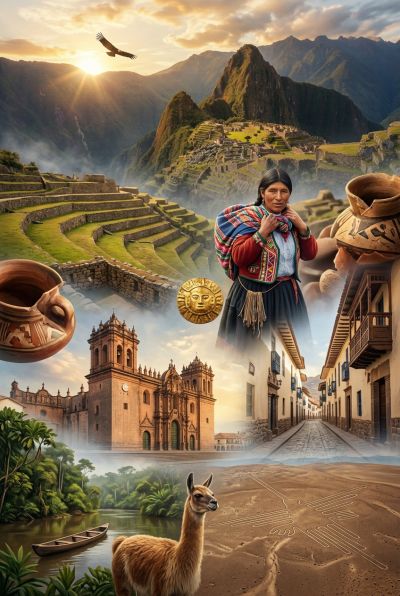
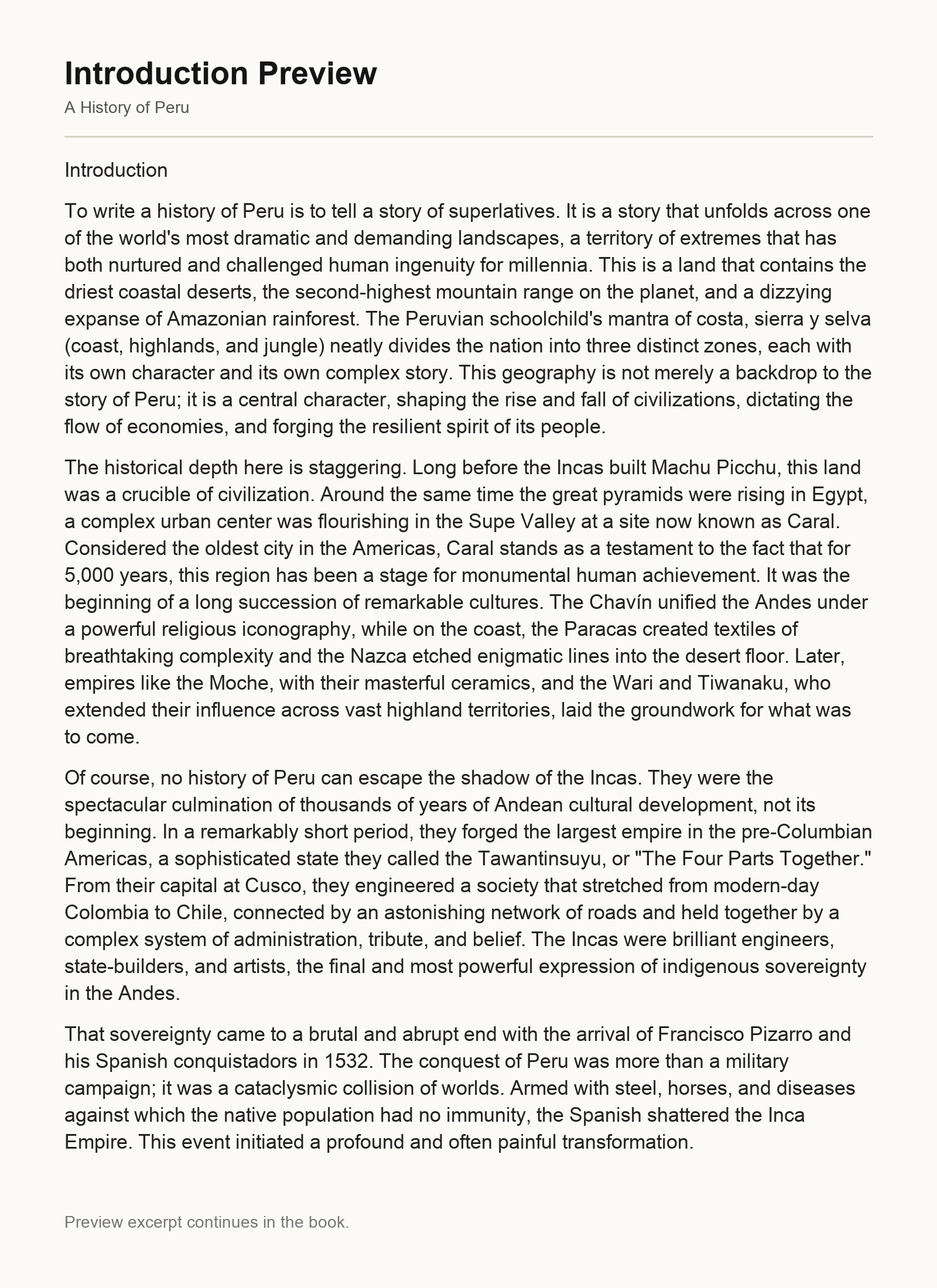
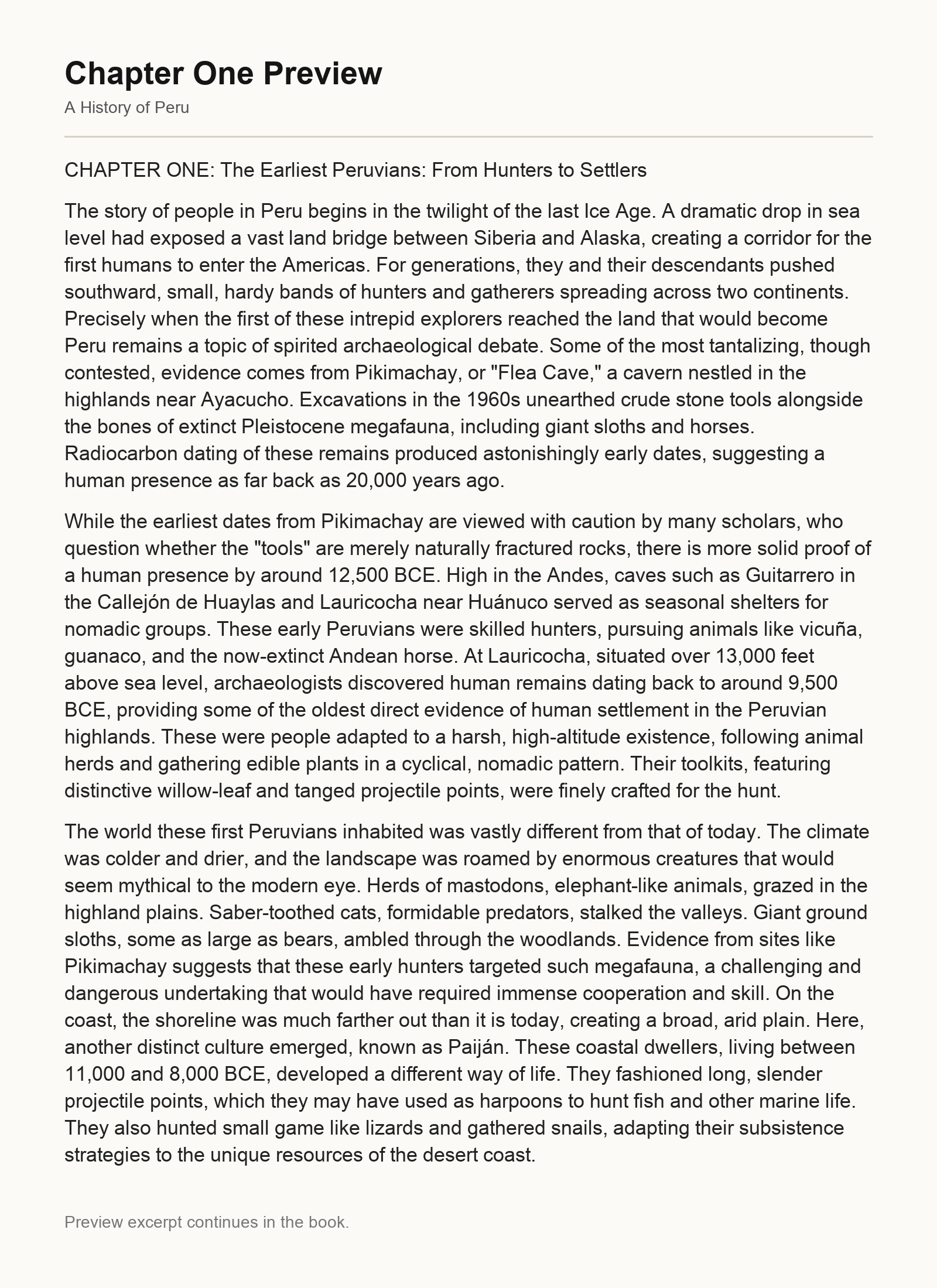
A History of Peru invites readers on an epic journey through five millennia of human achievement on one of the planet’s most dramatic landscapes. From the earliest hunter‑gatherers who stalked megafauna in the high Andes to the innovative desert fishermen of the Paiján culture, the book reveals how Peru’s diverse geography forged resilient societies that domesticated potatoes, quinoa, llamas, and alpacas long before the rise of cities. Readers will walk alongside the first urban planners of Caral, marvel at the mysterious Nazca Lines, and discover the sophisticated textile art and cranial surgery of the Paracas people, gaining a deep appreciation for the ingenuity that flourished in the Andes long before the Incas.
The narrative then carries the reader into the heart of Andean civilization, exploring the rise and fall of powerful highland empires such as Tiwanaku and Wari, the coastal kingdoms of Chimú and Chincha, and the breathtaking expansion of the Inca state under Pachacuti. Chapters detail the engineering marvels of the Qhapaq Ñan road system, the spiritual life of the Tawantinsuyu, and the tragic encounter with Francisco Pizarro that shattered an empire. Through vivid descriptions of battles, rituals, and daily life, the book shows how conquest, resistance, and cultural synthesis reshaped Peru’s social fabric across centuries.
Moving beyond the colonial era, the text illuminates the turbulent path to independence, the struggles of caudillo rule, and the boom‑and‑bust cycles driven by guano, nitrates, and later mineral exports. Readers will experience the optimism of the Aristocratic Republic, the authoritarian modernization of Leguía’s Oncenio, and the radical experiments of the Velasco Alvarado regime, each revealing how foreign ideals, internal conflicts, and economic ambitions repeatedly tested the nation’s cohesion. The account of the internal armed conflict, the rise of the Shining Path, and the Fujimori era offers a stark look at violence, human rights abuses, and the quest for stability in recent decades.
Finally, the book brings the story to the present, tracing Peru’s commodity‑driven growth, political crises, and ongoing struggles with corruption, inequality, and identity. It highlights the emergence of a vibrant culinary scene as a source of national pride and examines the challenges of building a diversified economy while confronting the legacies of extractive industries and social conflict. By the end, readers will have a comprehensive understanding of how Peru’s past continues to shape its prospects, leaving them with a nuanced view of a nation defined by both extraordinary resilience and ongoing transformation.
What You'll Find Inside:
- The book traces Peru's history from the earliest human settlements (20,000 years ago) through the rise of remarkable ancient civilizations like Caral (oldest city in the Americas) and the Inca Empire.
- It details the Spanish conquest, the fall of the Inca Empire, and the establishment of the Viceroyalty of Peru, including the exploitation of indigenous labor in silver mines like Potosí.
- The narrative covers Peru's turbulent path to independence led by figures like San Martín and Bolívar, followed by decades of caudillo politics and the guano export boom.
- It examines the 20th century including the Velasco Alvarado regime's radical reforms, the rise of the Shining Path insurgency, and the controversial Fujimori era of neoliberalism and authoritarianism.
- The book concludes with analysis of modern Peru's challenges including economic growth dependent on commodity exports, persistent corruption, social conflicts, and ongoing debates about national identity.
Who's It For:
This book would be most beneficial for students, academics, and general readers interested in Latin American history, particularly the Andes region. It provides a comprehensive overview spanning from prehistoric times to the 21st century, making it suitable for anyone seeking to understand how geography, indigenous civilizations, colonialism, and modern political movements have shaped Peru's complex identity. Readers interested in the rise and fall of empires, the impacts of conquest and colonialism, indigenous resistance movements, and the challenges of post-colonial nation-building would find this work particularly valuable.
Table of Contents:
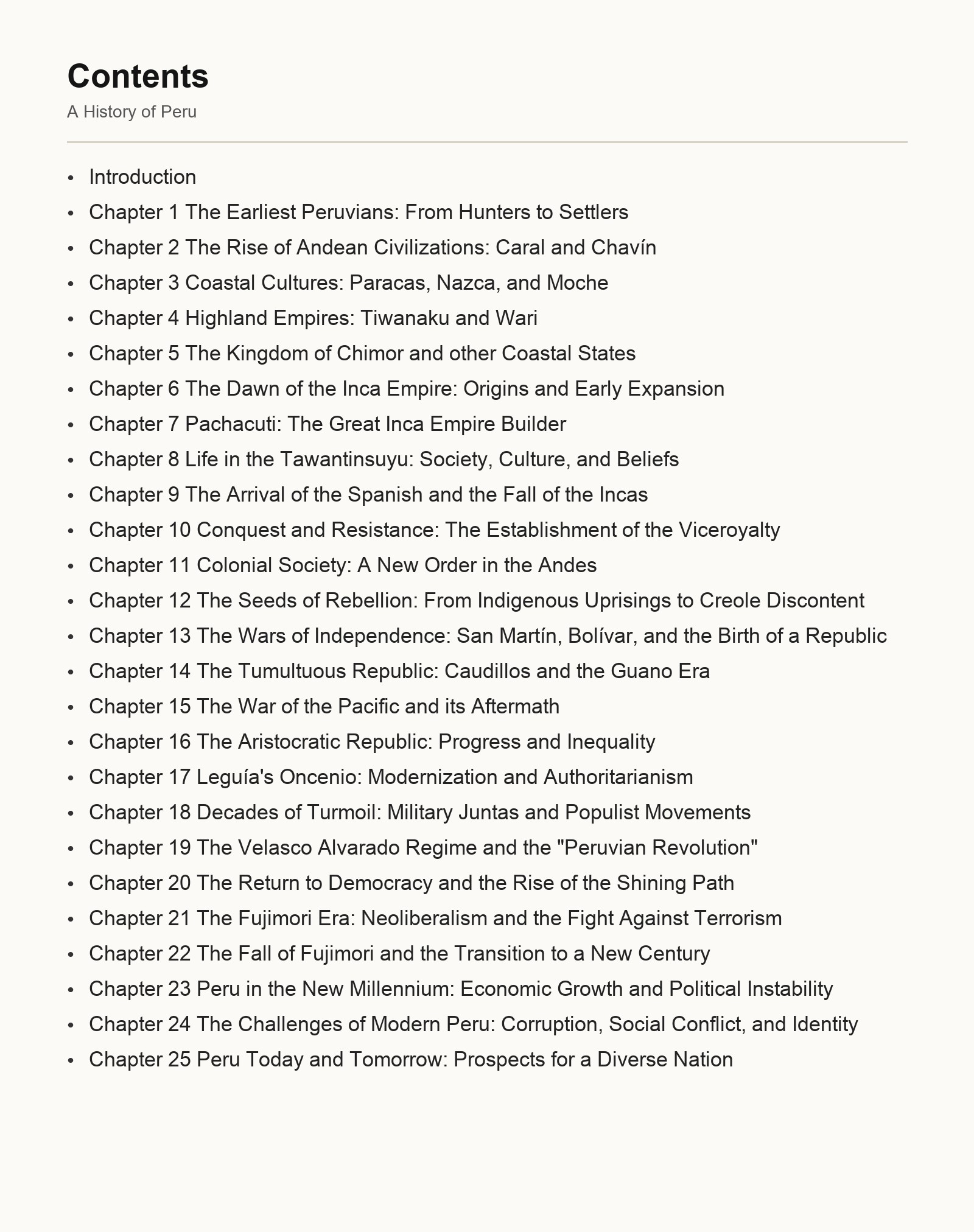
- Introduction
- Chapter 1 The Earliest Peruvians: From Hunters to Settlers
- Chapter 2 The Rise of Andean Civilizations: Caral and Chavín
- Chapter 3 Coastal Cultures: Paracas, Nazca, and Moche
- Chapter 4 Highland Empires: Tiwanaku and Wari
- Chapter 5 The Kingdom of Chimor and other Coastal States
- Chapter 6 The Dawn of the Inca Empire: Origins and Early Expansion
- Chapter 7 Pachacuti: The Great Inca Empire Builder
- Chapter 8 Life in the Tawantinsuyu: Society, Culture, and Beliefs
- Chapter 9 The Arrival of the Spanish and the Fall of the Incas
- Chapter 10 Conquest and Resistance: The Establishment of the Viceroyalty
- Chapter 11 Colonial Society: A New Order in the Andes
- Chapter 12 The Seeds of Rebellion: From Indigenous Uprisings to Creole Discontent
- Chapter 13 The Wars of Independence: San Martín, Bolívar, and the Birth of a Republic
- Chapter 14 The Tumultuous Republic: Caudillos and the Guano Era
- Chapter 15 The War of the Pacific and its Aftermath
- Chapter 16 The Aristocratic Republic: Progress and Inequality
- Chapter 17 Leguía's Oncenio: Modernization and Authoritarianism
- Chapter 18 Decades of Turmoil: Military Juntas and Populist Movements
- Chapter 19 The Velasco Alvarado Regime and the "Peruvian Revolution"
- Chapter 20 The Return to Democracy and the Rise of the Shining Path
- Chapter 21 The Fujimori Era: Neoliberalism and the Fight Against Terrorism
- Chapter 22 The Fall of Fujimori and the Transition to a New Century
- Chapter 23 Peru in the New Millennium: Economic Growth and Political Instability
- Chapter 24 The Challenges of Modern Peru: Corruption, Social Conflict, and Identity
- Chapter 25 Peru Today and Tomorrow: Prospects for a Diverse Nation
Author:
Published By:
Date Published:
May 25, 2026
Type:
Nonfiction
Language:
English
Also Available In:
Word Count:
48,505 words
Reading Time:
3 hours 24 minutes
Sample:
Order:
Order A History of Peru (Paperback) on MixCache.com:
Buy NowPrint copy is made to order and ships worldwide. Includes the ebook free, ready to read instantly.
$5 account credit for all new MixCache.com accounts, usable toward any ebook purchase!*


