Browse by Category
Fiction
- Action & Adventure
- African American
- Anthologies
- Children's Fiction
- Classics
- Comics & Graphic Novels
- Coming of Age
- Contemporary
- Cultural & Regional
- Drama
- Erotica
- Fantasy
- General
- Historical Fiction
- Horror
- Humor & Satire
- Literary Fiction
- Mystery, Thriller & Suspense
- Poetry
- Religious & Inspirational
- Romance
- Science Fiction
- Short Stories
- War & Military
- Westerns
- Women's Fiction
- Young Adult
Non-Fiction
- Antiques & Collectibles
- Arts & Photography
- Biographies & Memoirs
- Business & Money
- Children's Non-Fiction
-
Computers & Technology
- Artificial Intelligence
- Computer Science
- Cybersecurity & Cryptography
- Data Science & Analytics
- Databases & Big Data
- Game Development & Design
- General
- Hardware & DIY
- Mobile App Development
- Networking & Cloud Computing
- Operating Systems
- Programming
- Robotics
- Software
- Software Engineering
- User Experience (UX) & Design
- Web Development & Design
- Cooking, Food & Wine
- Crafts, Hobbies & Home
- Education & Teaching
- Engineering
- General
- Health, Fitness & Dieting
-
History
- African History
- African History - North Africa
- African History - Sub-Saharan Africa
- American History
- American History - 20th Century
- American History - Civil War
- American History - Colonial Period
- Ancient History
- Asian History
- Asian History - China
- Asian History - India
- Asian History - Japan
- Asian History - Southeast Asia
- European History
- European History - Ancient Greece
- European History - Ancient Rome
- European History - Medieval
- European History - Modern
- European History - Renaissance
- General
- Middle Eastern History
- Military History
- Military History - Aviation
- Military History - Naval
- Social & Cultural History
- World History
- Humor & Entertainment
- Industrial Technology
- Language Learning
- Law
- LGBTQ+ Non-Fiction
- Literary Criticism
- Medical Books
- Parenting & Relationships
- Philosophy
- Politics & Social Sciences
- Reference
- Religion & Spirituality
-
Science & Math
- Agricultural Sciences
- Astronomy & Space Science
- Behavioral Sciences
- Biological Sciences
- Botany & Plant Science
- Chemistry
- Earth Sciences
- Engineering - Chemical
- Engineering - Civil
- Engineering - Electrical
- Engineering - Mechanical
- Environment
- General
- Geology
- Mathematics
- Nature & Ecology
- Oceanography
- Paleontology
- Physics
- Statistics
- Self-Help
- Sports & Outdoors
- Study Aids
- Sustainability & Green Living
- Textbooks
- Transportation
- Travel
- True Crime
- Urban Planning & Development
- Veterinary Medicine
- Writing & Publishing
Jump to Section
MixCache.com Total Access
Unlimited reading and audiobooks for every book published by MixCache.com.
Included titles carry the MTA badge.
Learn more →A History of Saint Lucia
About this book:
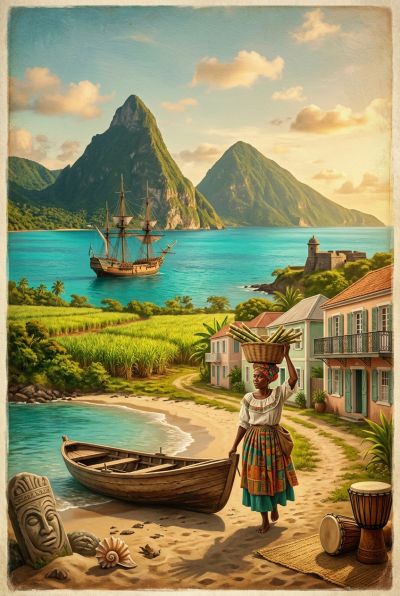
A History of Saint Lucia offers readers a sweeping narrative that begins with the island’s first peoples and carries them through centuries of conquest, resistance, and rebirth. From the Arawak farmers who named the land Iouanalao to the Carib warriors who called it Hewanorra, the book uncovers the deep roots of a society shaped by migration, ingenuity, and a fierce connection to the volcanic terrain. Readers will walk alongside these early communities, discovering how their agricultural practices, spiritual beliefs, and artistic expressions laid the foundation for a uniquely Creole identity that endures today.
The narrative then plunges into the turbulent era of European rivalry, revealing how Saint Lucia became the “Helen of the West Indies,” changing hands fourteen times as Britain and France vied for control of its strategic harbours and fertile valleys. Chapters detail the rise of sugar plantations, the brutal realities of the transatlantic slave trade, and the emergence of a rigid social hierarchy that defined daily life for generations. Readers will gain insight into the economic engines that powered the island, the human cost of white gold, and the complex interplay of French, British, African, and Caribbean influences that forged a new colonial society.
At the heart of the story lies the relentless struggle for freedom. The book chronicles the Brigand War, where enslaved Africans and French Republicans forged a guerrilla army that challenged British rule, and the resilient Maroon communities that turned the island’s mountainous interior into sanctuaries of autonomy. Readers will experience the hope and heartbreak of emancipation, the flawed apprenticeship system, and the rise of a peasantry that reclaimed land and independence after slavery’s end. These chapters illuminate how resistance, adaptation, and cultural preservation became cornerstones of Saint Lucian identity.
Moving into the twentieth century, the text explores the island’s role in both World Wars, the devastation of the 1948 Castries fire, and the birth of political consciousness that gave rise to trade unions and the Saint Lucia Labour Party. Readers will follow the journey from Crown colony to Associated Statehood, through the brief experiment of the West Indies Federation, and finally to the hard‑won independence of 1979. The narrative highlights the leadership of figures like John Compton and George Odlum, showing how competing visions of development, tourism, and social justice shaped the nation’s early years as a sovereign state.
Finally, the book brings readers into the modern era, examining the shift from banana dependence to a tourism‑driven economy, the vibrant celebration of Kwéyòl language and culture, and the ongoing challenges of climate change, crime, and global economic shifts. By the end, readers will not only have learned the facts of Saint Lucia’s past but will also have felt the pulse of its people—their resilience, creativity, and unyielding quest for self‑determination—offering a deep appreciation for how a small volcanic island continues to navigate the tides of history while forging its own future.
What You'll Find Inside:
- The island’s earliest societies, the Arawaks and later the Caribs, established sophisticated agrarian cultures long before European contact.
- Saint Lucia became a fiercely contested prize between France and Britain, changing hands fourteen times due to its strategic harbour and windward position.
- The rise of sugar plantations entrenched slavery, sparking resistance through Maroon communities and the Brigand War inspired by revolutionary ideals.
- Emancipation in 1834 led to a peasantry that abandoned estates for independent farming, reshaping the island’s social and economic landscape.
- Post-independence, Saint Lucia transitioned from banana dependence to tourism as its economic pillar while navigating political shifts and cultural identity rooted in Kwéyòl and Afro‑French‑British fusion.
Who's It For:
This book is ideal for students and scholars of Caribbean history, post‑colonial studies, and Atlantic slavery, as well as general readers seeking a thorough, accessible narrative of Saint Lucia’s evolution from indigenous societies through colonial rivalry, emancipation, and nation‑building to its contemporary challenges and cultural identity.
Table of Contents:
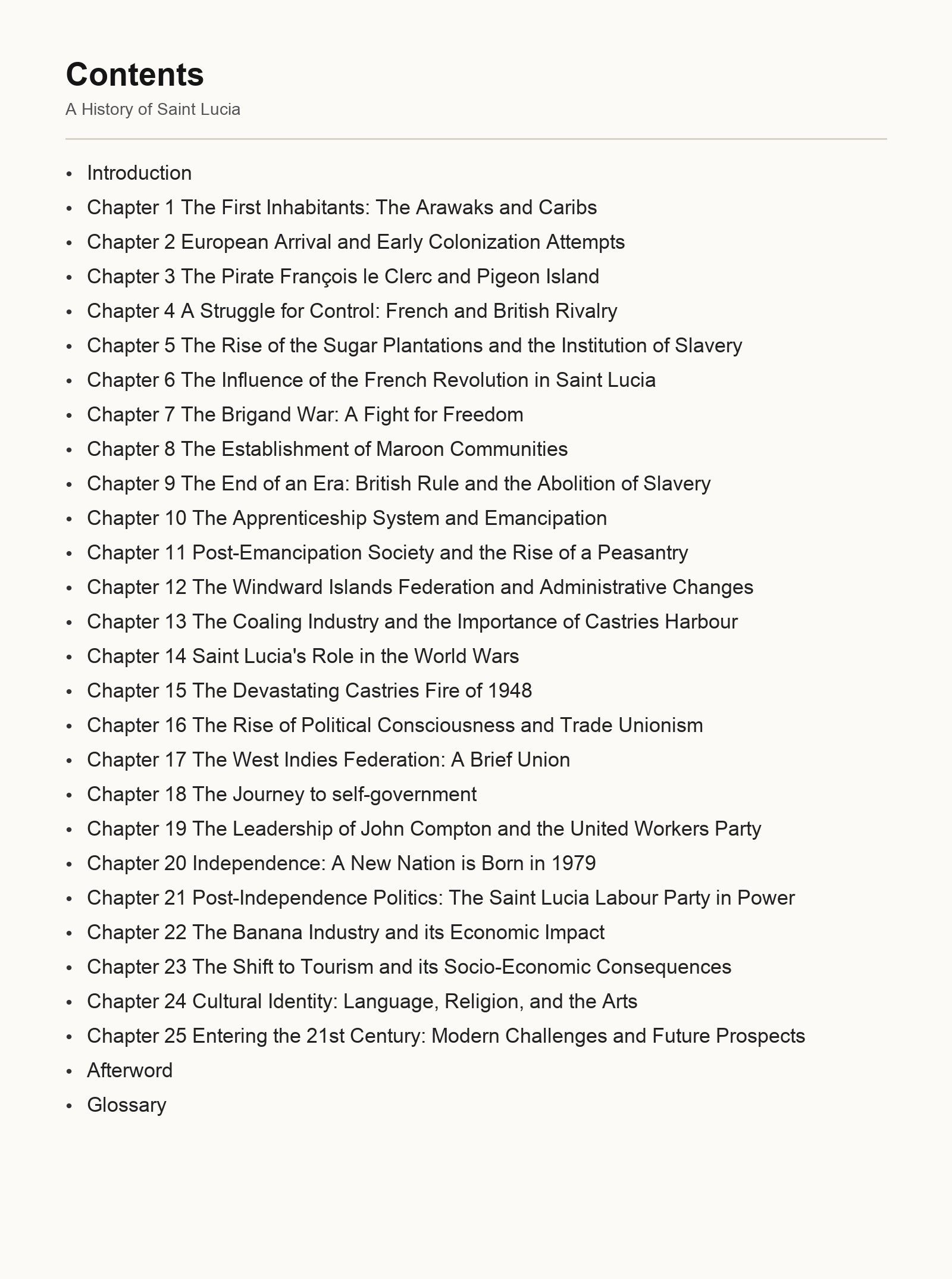
- Introduction
- Chapter 1 The First Inhabitants: The Arawaks and Caribs
- Chapter 2 European Arrival and Early Colonization Attempts
- Chapter 3 The Pirate François le Clerc and Pigeon Island
- Chapter 4 A Struggle for Control: French and British Rivalry
- Chapter 5 The Rise of the Sugar Plantations and the Institution of Slavery
- Chapter 6 The Influence of the French Revolution in Saint Lucia
- Chapter 7 The Brigand War: A Fight for Freedom
- Chapter 8 The Establishment of Maroon Communities
- Chapter 9 The End of an Era: British Rule and the Abolition of Slavery
- Chapter 10 The Apprenticeship System and Emancipation
- Chapter 11 Post-Emancipation Society and the Rise of a Peasantry
- Chapter 12 The Windward Islands Federation and Administrative Changes
- Chapter 13 The Coaling Industry and the Importance of Castries Harbour
- Chapter 14 Saint Lucia's Role in the World Wars
- Chapter 15 The Devastating Castries Fire of 1948
- Chapter 16 The Rise of Political Consciousness and Trade Unionism
- Chapter 17 The West Indies Federation: A Brief Union
- Chapter 18 The Journey to self-government
- Chapter 19 The Leadership of John Compton and the United Workers Party
- Chapter 20 Independence: A New Nation is Born in 1979
- Chapter 21 Post-Independence Politics: The Saint Lucia Labour Party in Power
- Chapter 22 The Banana Industry and its Economic Impact
- Chapter 23 The Shift to Tourism and its Socio-Economic Consequences
- Chapter 24 Cultural Identity: Language, Religion, and the Arts
- Chapter 25 Entering the 21st Century: Modern Challenges and Future Prospects
- Afterword
- Glossary
Author:
Published By:
Date Published:
May 25, 2026
Type:
Nonfiction
Language:
English
Also Available In:
Word Count:
44,567 words
Reading Time:
3 hours 7 minutes
Sample:
Order:
Order A History of Saint Lucia (Hardcover) on MixCache.com:
Buy NowPrint copy is made to order and ships worldwide. Includes the ebook free, ready to read instantly.
$5 account credit for all new MixCache.com accounts, usable toward any ebook purchase!*