Browse by Category
Fiction
- Action & Adventure
- African American
- Anthologies
- Children's Fiction
- Classics
- Comics & Graphic Novels
- Coming of Age
- Contemporary
- Cultural & Regional
- Drama
- Erotica
- Fantasy
- General
- Historical Fiction
- Horror
- Humor & Satire
- Literary Fiction
- Mystery, Thriller & Suspense
- Poetry
- Religious & Inspirational
- Romance
- Science Fiction
- Short Stories
- War & Military
- Westerns
- Women's Fiction
- Young Adult
Non-Fiction
- Antiques & Collectibles
- Arts & Photography
- Biographies & Memoirs
- Business & Money
- Children's Non-Fiction
-
Computers & Technology
- Artificial Intelligence
- Computer Science
- Cybersecurity & Cryptography
- Data Science & Analytics
- Databases & Big Data
- Game Development & Design
- General
- Hardware & DIY
- Mobile App Development
- Networking & Cloud Computing
- Operating Systems
- Programming
- Robotics
- Software
- Software Engineering
- User Experience (UX) & Design
- Web Development & Design
- Cooking, Food & Wine
- Crafts, Hobbies & Home
- Education & Teaching
- Engineering
- General
- Health, Fitness & Dieting
-
History
- African History
- African History - North Africa
- African History - Sub-Saharan Africa
- American History
- American History - 20th Century
- American History - Civil War
- American History - Colonial Period
- Ancient History
- Asian History
- Asian History - China
- Asian History - India
- Asian History - Japan
- Asian History - Southeast Asia
- European History
- European History - Ancient Greece
- European History - Ancient Rome
- European History - Medieval
- European History - Modern
- European History - Renaissance
- General
- Middle Eastern History
- Military History
- Military History - Aviation
- Military History - Naval
- Social & Cultural History
- World History
- Humor & Entertainment
- Industrial Technology
- Language Learning
- Law
- LGBTQ+ Non-Fiction
- Literary Criticism
- Medical Books
- Parenting & Relationships
- Philosophy
- Politics & Social Sciences
- Reference
- Religion & Spirituality
-
Science & Math
- Agricultural Sciences
- Astronomy & Space Science
- Behavioral Sciences
- Biological Sciences
- Botany & Plant Science
- Chemistry
- Earth Sciences
- Engineering - Chemical
- Engineering - Civil
- Engineering - Electrical
- Engineering - Mechanical
- Environment
- General
- Geology
- Mathematics
- Nature & Ecology
- Oceanography
- Paleontology
- Physics
- Statistics
- Self-Help
- Sports & Outdoors
- Study Aids
- Sustainability & Green Living
- Textbooks
- Transportation
- Travel
- True Crime
- Urban Planning & Development
- Veterinary Medicine
- Writing & Publishing
Jump to Section
MixCache.com Total Access
Unlimited reading and audiobooks for every book published by MixCache.com.
Included titles carry the MTA badge.
Learn more →
Underrated Philosophical Movements
Exploring the Lesser-Known Ideas That Shaped Thought
About this book:



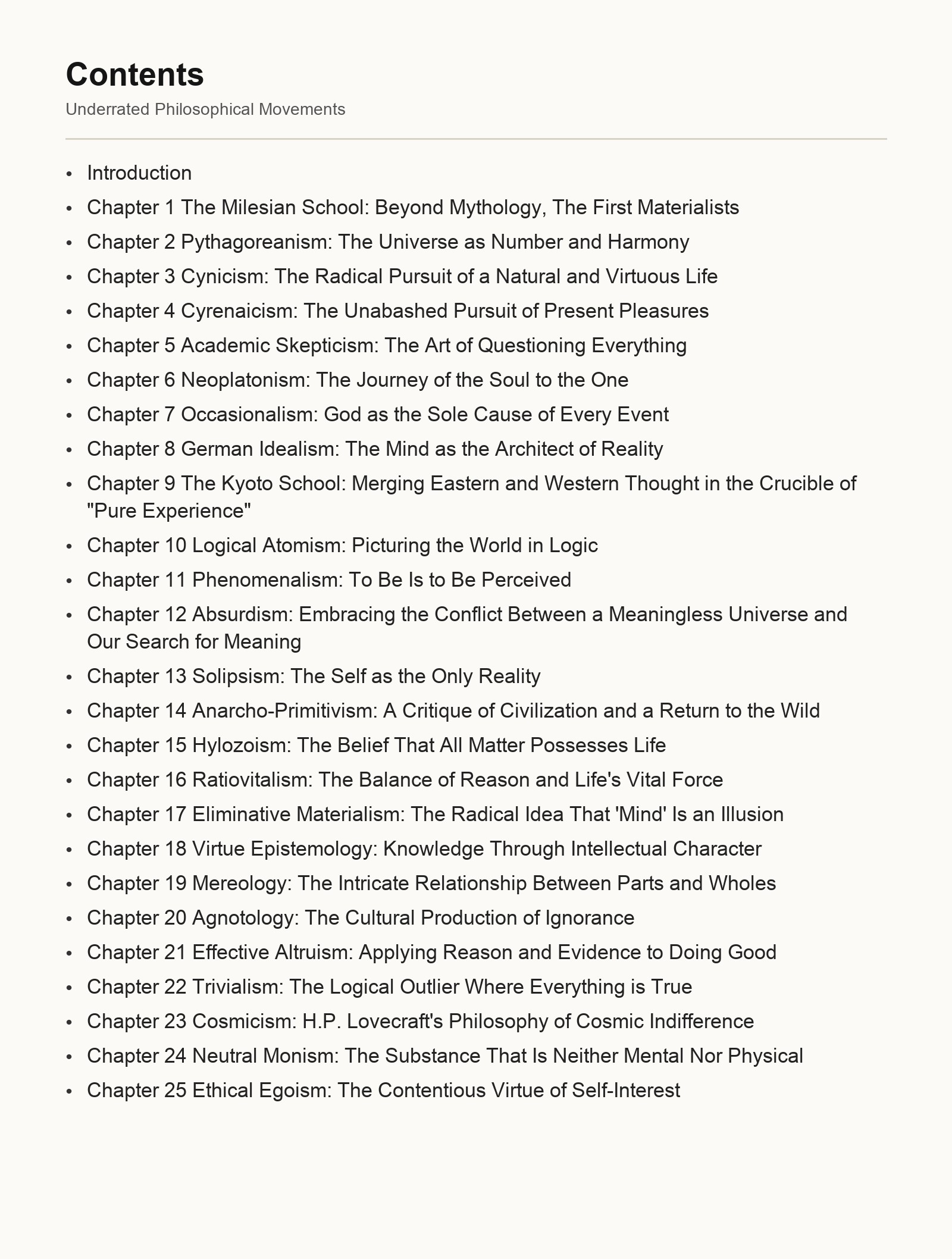
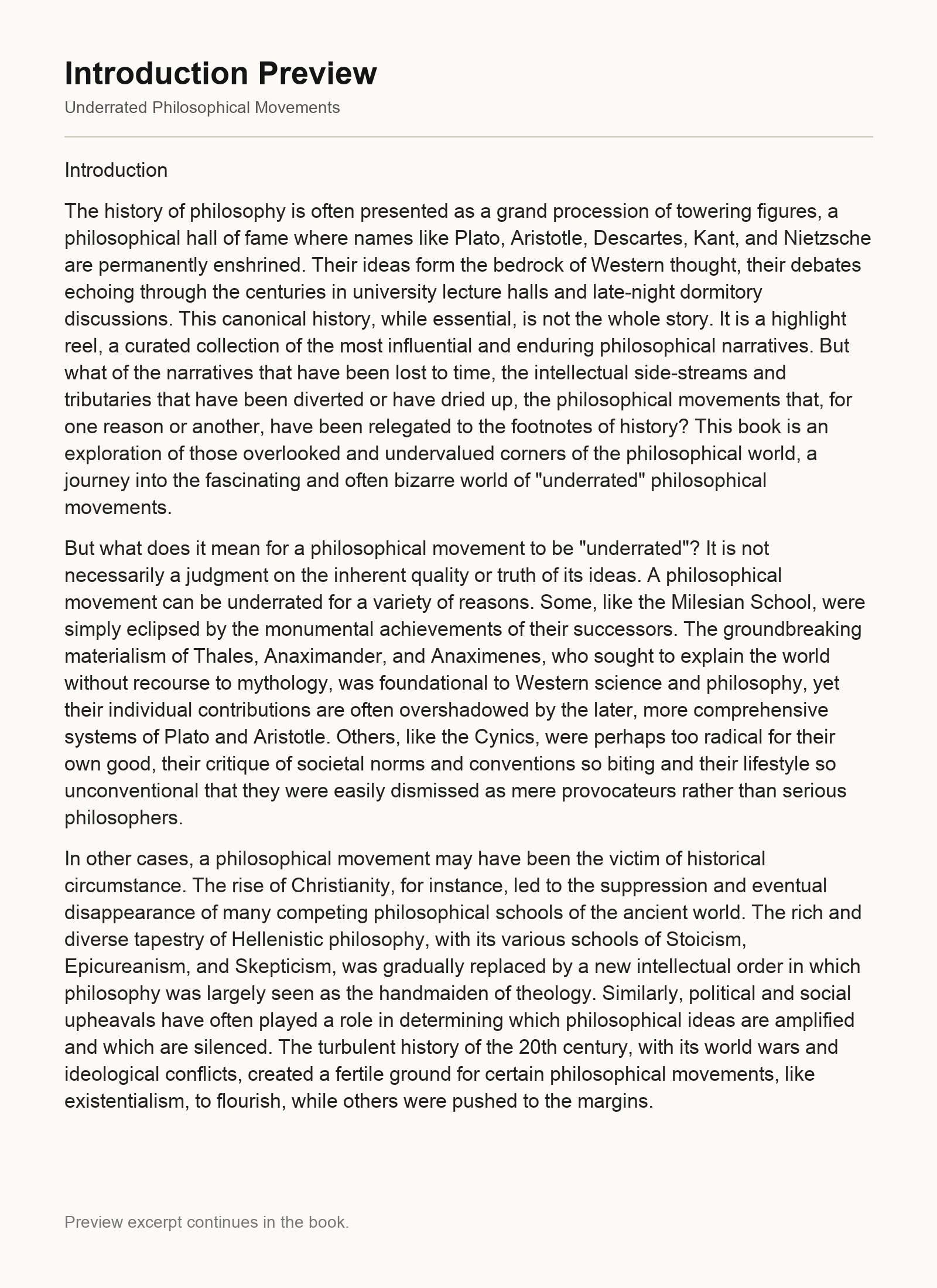
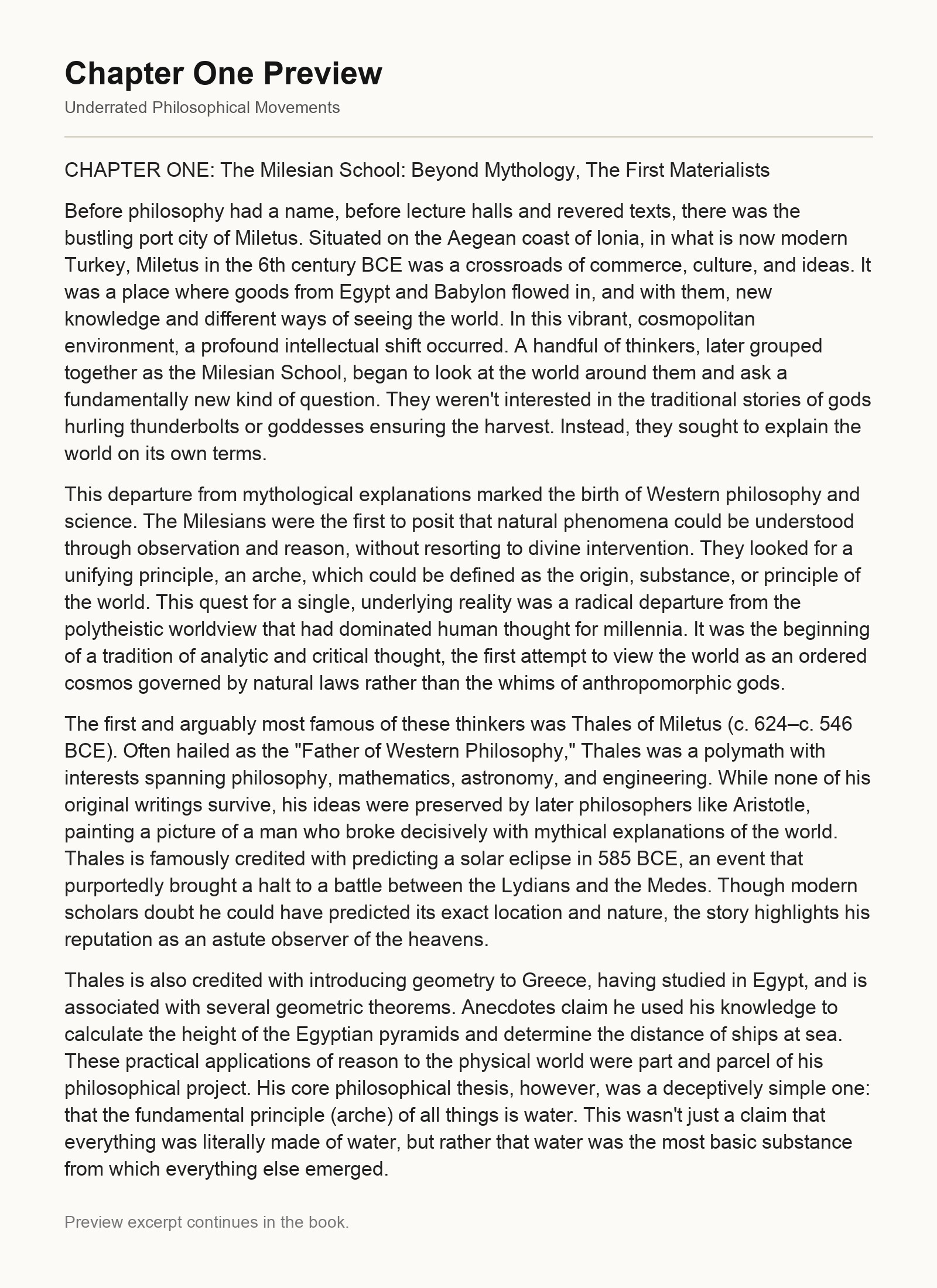
Underrated Philosophical Movements invites readers on a sweeping tour of the ideas that have slipped between the cracks of the canonical tradition, from the earliest materialist speculations of the Milesians to the provocative logic of trivialism and the ecological radicalism of anarcho‑primitivism. Each chapter unpacks a distinct school of thought, showing how its core claims emerged from specific historical pressures and how they continue to echo in contemporary debates about knowledge, ethics, and the nature of reality. By tracing these overlooked currents, the book reveals the rich tapestry of human questioning that extends far beyond the familiar names of Plato, Kant, or Nietzsche.
Readers will gain concrete tools for critical thinking as they encounter movements that challenge ordinary assumptions—whether it is the Pyrrhonist suspension of judgment that teaches how to act without certainty, the virtue‑epistemological shift that redirects focus from justified true belief to the intellectual character of the knower, or the neutral monist proposal that mind and matter are two aspects of a single underlying stuff. The book demonstrates how these theories handle classic problems such as the mind‑body relation, the justification of belief, and the possibility of meaning in an indifferent universe, offering fresh perspectives that can be applied to everyday reasoning and decision‑making.
Beyond abstract argumentation, the volume emphasizes the lived dimensions of philosophy: the ascetic provocations of the Cynics, the pleasure‑centered ethics of the Cyrenaics, the passionate revolt of the absurdists, and the practical, evidence‑driven ethic of effective altruism. By exploring how these schools translated their ideas into ways of life—through diet, speech, political action, or personal habits—readers experience philosophy not just as a set of doctrines but as a series of experiments in living that can inspire personal reflection and behavioral change.
The book also highlights the social and political forces that shape what ideas survive or fade. Chapters on agnotology expose how ignorance can be manufactured, while the discussions of the Kyoto School and eliminative materialism illustrate how cultural context, scientific progress, and technological change influence philosophical relevance. This awareness equips readers to interrogate contemporary information ecosystems, recognize hidden biases, and appreciate why certain perspectives remain marginalized despite their potential insight.
Ultimately, Underrated Philosophical Movements offers a journey that broadens intellectual horizons, cultivates humility about the limits of any single worldview, and stimulates a sense of wonder at the diversity of human thought. Readers will finish with a deeper appreciation for the philosophical undercurrents that have quietly shaped science, art, politics, and personal ethics, and with a toolkit of alternative concepts they can bring to bear on the pressing questions of meaning, knowledge, and how to live well in a complex world.
What You'll Find Inside:
- The book reveals how early materialist thinkers such as the Milesian School replaced myth with natural explanations, founding the tradition of rational inquiry into the world's underlying principles.
- It presents radical ethical alternatives—from Cynic asceticism to Cyrenaic hedonism—that challenge conventional ideas of virtue, happiness, and the good life.
- Readers encounter skeptical and anti‑realist traditions like Academic Skepticism, Phenomenalism, and Trivialism, which interrogate the limits of knowledge, perception, and language.
- The text explores syntheses of Eastern and Western thought, including the Kyoto School and Neutral Monism, seeking to overcome mind‑matter dualities through concepts of pure experience and neutral substance.
- Contemporary movements such as Effective Altruism and Eliminative Materialism are examined, showing how rigorous reasoning and evidence can reshape ethics and our understanding of the mind.
Who's It For:
This book is ideal for philosophy students, scholars, and intellectually curious readers who want to move beyond the canonical figures and discover the depth and variety of lesser‑known philosophical movements. It will also appeal to interdisciplinary thinkers interested in the historical development of ideas across science, religion, ethics, and culture. Anyone seeking fresh perspectives on enduring questions about reality, knowledge, and the good life will find valuable insights here.
Table of Contents:
- Introduction
- Chapter 1 The Milesian School: Beyond Mythology, The First Materialists
- Chapter 2 Pythagoreanism: The Universe as Number and Harmony
- Chapter 3 Cynicism: The Radical Pursuit of a Natural and Virtuous Life
- Chapter 4 Cyrenaicism: The Unabashed Pursuit of Present Pleasures
- Chapter 5 Academic Skepticism: The Art of Questioning Everything
- Chapter 6 Neoplatonism: The Journey of the Soul to the One
- Chapter 7 Occasionalism: God as the Sole Cause of Every Event
- Chapter 8 German Idealism: The Mind as the Architect of Reality
- Chapter 9 The Kyoto School: Merging Eastern and Western Thought in the Crucible of "Pure Experience"
- Chapter 10 Logical Atomism: Picturing the World in Logic
- Chapter 11 Phenomenalism: To Be Is to Be Perceived
- Chapter 12 Absurdism: Embracing the Conflict Between a Meaningless Universe and Our Search for Meaning
- Chapter 13 Solipsism: The Self as the Only Reality
- Chapter 14 Anarcho-Primitivism: A Critique of Civilization and a Return to the Wild
- Chapter 15 Hylozoism: The Belief That All Matter Possesses Life
- Chapter 16 Ratiovitalism: The Balance of Reason and Life's Vital Force
- Chapter 17 Eliminative Materialism: The Radical Idea That 'Mind' Is an Illusion
- Chapter 18 Virtue Epistemology: Knowledge Through Intellectual Character
- Chapter 19 Mereology: The Intricate Relationship Between Parts and Wholes
- Chapter 20 Agnotology: The Cultural Production of Ignorance
- Chapter 21 Effective Altruism: Applying Reason and Evidence to Doing Good
- Chapter 22 Trivialism: The Logical Outlier Where Everything is True
- Chapter 23 Cosmicism: H.P. Lovecraft's Philosophy of Cosmic Indifference
- Chapter 24 Neutral Monism: The Substance That Is Neither Mental Nor Physical
- Chapter 25 Ethical Egoism: The Contentious Virtue of Self-Interest
Author:
Published By:
Date Published:
May 24, 2026
Type:
Nonfiction
Language:
English
Also Available In:
Word Count:
54,294 words
Reading Time:
3 hours 48 minutes
Sample:
Order:
Order Underrated Philosophical Movements (Paperback) on MixCache.com:
Buy NowPrint copy is made to order and ships worldwide. Includes the ebook free, ready to read instantly.
$5 account credit for all new MixCache.com accounts, usable toward any ebook purchase!*