
Browse by Category
Fiction
- Action & Adventure
- African American
- Anthologies
- Children's Fiction
- Classics
- Comics & Graphic Novels
- Coming of Age
- Contemporary
- Cultural & Regional
- Drama
- Erotica
- Fantasy
- General
- Historical Fiction
- Horror
- Humor & Satire
- Literary Fiction
- Mystery, Thriller & Suspense
- Poetry
- Religious & Inspirational
- Romance
- Science Fiction
- Short Stories
- War & Military
- Westerns
- Women's Fiction
- Young Adult
Non-Fiction
- Antiques & Collectibles
- Arts & Photography
- Biographies & Memoirs
- Business & Money
- Children's Non-Fiction
-
Computers & Technology
- Artificial Intelligence
- Computer Science
- Cybersecurity & Cryptography
- Data Science & Analytics
- Databases & Big Data
- Game Development & Design
- General
- Hardware & DIY
- Mobile App Development
- Networking & Cloud Computing
- Operating Systems
- Programming
- Robotics
- Software
- Software Engineering
- User Experience (UX) & Design
- Web Development & Design
- Cooking, Food & Wine
- Crafts, Hobbies & Home
- Education & Teaching
- Engineering
- General
- Health, Fitness & Dieting
-
History
- African History
- African History - North Africa
- African History - Sub-Saharan Africa
- American History
- American History - 20th Century
- American History - Civil War
- American History - Colonial Period
- Ancient History
- Asian History
- Asian History - China
- Asian History - India
- Asian History - Japan
- Asian History - Southeast Asia
- European History
- European History - Ancient Greece
- European History - Ancient Rome
- European History - Medieval
- European History - Modern
- European History - Renaissance
- General
- Middle Eastern History
- Military History
- Military History - Aviation
- Military History - Naval
- Social & Cultural History
- World History
- Humor & Entertainment
- Industrial Technology
- Language Learning
- Law
- LGBTQ+ Non-Fiction
- Literary Criticism
- Medical Books
- Parenting & Relationships
- Philosophy
- Politics & Social Sciences
- Reference
- Religion & Spirituality
-
Science & Math
- Agricultural Sciences
- Astronomy & Space Science
- Behavioral Sciences
- Biological Sciences
- Botany & Plant Science
- Chemistry
- Earth Sciences
- Engineering - Chemical
- Engineering - Civil
- Engineering - Electrical
- Engineering - Mechanical
- Environment
- General
- Geology
- Mathematics
- Nature & Ecology
- Oceanography
- Paleontology
- Physics
- Statistics
- Self-Help
- Sports & Outdoors
- Study Aids
- Sustainability & Green Living
- Textbooks
- Transportation
- Travel
- True Crime
- Urban Planning & Development
- Veterinary Medicine
- Writing & Publishing
Jump to Section
MixCache.com Total Access
Unlimited reading and audiobooks for every book published by MixCache.com.
Included titles carry the MTA badge.
Learn more →
Buddhism Across Traditions: Comparative Practices and Philosophies
MTA
A roadmap for understanding differences and dialogues between Theravada, Mahayana, and Vajrayana
About this book:
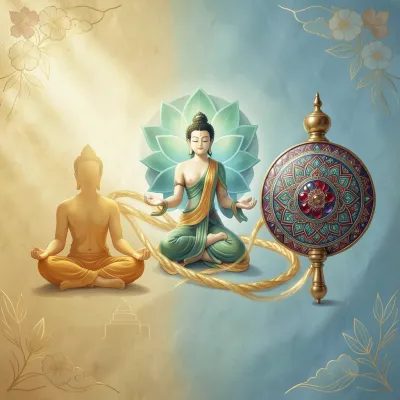
Buddhism Across Traditions: Comparative Practices and Philosophies presents Theravāda, Mahāyāna, and Vajrayāna as interconnected yet distinct expressions of a shared Buddhist heritage, tracing their historical origins from the Buddha’s teachings in ancient India through diverse transmission routes—Ashokan missions, Silk Road trade, maritime networks, and later colonial and global exchanges—that shaped their textual canons, doctrinal emphases, and cultural forms. The book outlines how each tradition preserves and interprets the Dharma: Theravāda centers on the Pāli Tipiṭaka and the ideal of the arahat who attains personal liberation through ethical discipline, meditative calm, and insight into impermanence, suffering, and no‑self; Mahāyāna expands the path with the bodhisattva vow, extensive sutras (including Prajñāpāramitā and Lotus Sūtras), and doctrines such as śūnyatā (emptiness) and tathāgatagarbha (Buddha‑nature) aimed at universal liberation; Vajrayāna builds on Mahāyāna foundations, adding tantric techniques—deity yoga, mantras, mudras, and guru‑disciple samaya commitments—that seek rapid enlightenment by transforming ordinary experience into enlightened awareness.
Philosophical and practical comparisons reveal both divergence and convergence. The Abhidhamma’s analytical dissection of dharmas contrasts with Madhyamaka’s logical refutation of inherent existence and Yogācāra’s mind‑only approach, yet all aim to dismantle delusion and cultivate wisdom. Correspondingly, the Noble Eightfold Path emphasizes gradual, self‑reliant progress toward arhatship; the Bodhisattva Path cultivates the six pāramitās over countless eons for the benefit of all beings; and the Vajra Path employs accelerated ritual and visualization to fuse wisdom and compassion. Ethical frameworks progress from the Theravāda Five Precepts and monastic Vinaya to Mahāyāna Bodhisattva precepts infused with bodhicitta, and Vajrayāna’s sacred samaya vows that guard tantric practice. Meditation foundations unite mindfulness, concentration, and insight across traditions, expressed as Theravāda samatha‑vipassanā, Mahāyāna mindfulness of bodhicitta and emptiness, and Vajrayāna deity yoga and subtle‑body work. Devotional practices—pūjā, chanting, and Guru Yoga—vary in form but share the purpose of generating merit, cultivating faith, and connecting with the Triple Gem. Central to all traditions is the interplay of compassion (karuṇā) and wisdom (prajñā), whether seen as the arahat’s natural outflow, the bodhisattva’s boundless altruism guided by emptiness, or the vajrayāna realization of their indivisibility through tantric symbolism. Doctrines of anattā (no‑self) and śūnyatā (emptiness) are progressively broadened—from the personal no‑self of Theravāda to the universal emptiness of Mahāyāna and finally to the non‑dual appearance‑emptiness of Vajrayāna—while karma and rebirth are understood as a causal continuum that can be purified, dedicated, or consciously navigated, especially in Vajrayāna’s bardo practices and the tulku institution.
Institutional and cultural life further differentiates the traditions. Monastic life rests on distinct Vinaya lineages—Pāli, Dharmaguptaka, and Mūlasarvāstivāda—with varying emphases on personal purification, Bodhisattva engagement, and scholastic‑tantric training. Lay practice focuses on merit‑making, festivals, home shrines, and the reciprocal support of monastics, adapting to local contexts from Theravāda Uposatha observances to Mahāyāna Pure Land chanting and Vajrayāna ngöndro preliminaries. Art and symbolism express each tradition’s vision: Theravāda’s serene Buddha images and stupas, Mahāyāna’s rich pantheon of bodhisattvas and pagodas, and Vajrayāna’s intricate mandalas, yidams, and thangkas. Translation histories—from Pāli preservation to Chinese and Tibetan canon formation and modern Western renderings—reveal ongoing hermeneutical work and debate. Women’s roles range from early bhikkhunī lineages and their revival to lay practitioners, yoginīs, and modern female teachers and leaders. Healing and protection rituals employ paritta chanting, Medicine Buddha invocations, and tantric methods such as Chöd, always framed by ethical motivation. Pilgrimage to sites like Bodh Gaya, the Four Sacred Mountains, and Mount Kailash reflects shared merit‑making and circumambulation, adapted to local geography. Dialogue and debate—from ancient councils to monastic disputation and contemporary conferences—have continually refined understanding, while modernity prompted reform movements responding to colonialism, nationalism, and globalization. The engagement of Buddhism with science, especially through the Mind and Life dialogues, highlights contemplative studies’ contributions to neuroscience and psychology. Engaged Buddhism translates compassion and wisdom into social action, peace‑building, environmentalism, and humanitarian work exemplified by figures like Thich Nhat Hanh and the Tzu Chi Foundation. Diaspora communities in the West have produced hybrid identities, convert movements, and pan‑Buddhist centers, negotiating tradition and innovation. Ultimately, the book advocates practicing pluralism through humility, contextual study, direct practice, respectful dialogue, and attention to shared fruits—recognizing that diverse forms are skillful means toward the common awakening of all beings.
What You'll Find Inside:
- Comparative analysis of Theravāda, Mahāyāna, and Vajrayāna traditions across philosophy, practice, and culture
- Examination of key philosophical systems: Abhidhamma (Theravāda), Madhyamaka and Yogācāra (Mahāyāna/Vajrayāna)
- Detailed comparison of spiritual paths: Noble Eightfold Path, Bodhisattva Path, and Vajra Path
- Analysis of ethical frameworks: Sīla, Bodhisattva Precepts, and Tantric Samaya commitments
- Exploration of shared practices and ritual differences: meditation, devotion, art, and monastic life across traditions
Who's It For:
This book is designed for students and teachers of religious studies or Buddhism seeking structured comparative material for academic study. It also serves practitioners and travelers who wish to deepen their understanding of diverse Buddhist expressions when visiting temples, monasteries, or engaging with different traditions. The content provides essential cultural context for respectful engagement and supports those interested in inter-tradition dialogue and pluralistic practice.
Table of Contents:
- Introduction
- Chapter 1 Mapping the Buddhist Landscape: From Early Schools to Living Traditions
- Chapter 2 Historical Origins and Transmission Routes
- Chapter 3 Canons and Commentaries: Pāli, Chinese, and Tibetan Corpora
- Chapter 4 Views of the Buddha: Teacher, Savior, and Cosmic Principle
- Chapter 5 The Nature of Reality: Abhidhamma, Madhyamaka, and Yogācāra
- Chapter 6 Paths and Stages: Noble Eightfold Path, Bodhisattva Path, and Vajra Path
- Chapter 7 Ethics and Vows: Sīla, Bodhisattva Precepts, and Samaya
- Chapter 8 Meditation Foundations: Mindfulness, Concentration, and Insight
- Chapter 9 Devotion and Ritual: Pūjā, Chanting, and Guru Yoga
- Chapter 10 Compassion and Wisdom: Karuṇā and Prajñā Across Traditions
- Chapter 11 Emptiness and No-Self: Comparative Doctrinal Readings
- Chapter 12 Karma and Rebirth: Divergences and Convergences
- Chapter 13 Monastic Life: Vinaya Lineages and Community Structures
- Chapter 14 Lay Practice: Merit, Festivals, and Home Rituals
- Chapter 15 Art and Symbolism: Stupas, Bodhisattvas, and Maṇḍalas
- Chapter 16 Sacred Texts in Translation: Language, Hermeneutics, and Debate
- Chapter 17 Women in Buddhism: Bhikkhunīs, Yoginīs, and Modern Voices
- Chapter 18 Healing and Protection: Ritual Technologies and Their Ethics
- Chapter 19 Pilgrimage and Sacred Geography: South Asia, East Asia, and the Himalayas
- Chapter 20 Dialogue and Debate: Councils, Commentaries, and Contemporary Conferences
- Chapter 21 Modernity and Reform: Colonial Encounters, Nationalism, and Globalization
- Chapter 22 Science and Mind: Contemplative Studies and Cognitive Dialogues
- Chapter 23 Engaged Buddhism: Social Action Across Traditions
- Chapter 24 Diaspora Communities: Practice in the West and Hybrid Identities
- Chapter 25 Practicing Pluralism: Guidelines for Inter-Tradition Study and Respectful Exchange
Author:
Published By:
Date Published:
May 24, 2026
Type:
Nonfiction
Language:
English
Word Count:
50,793 words
Reading Time:
3 hours 33 minutes
Sample:
MixCache.com Total Access
Get unlimited access to this book + all books published by MixCache.com for $11.99/month
Subscribe to MTAOr purchase this book individually below
Order:
Buy the Buddhism Across Traditions: Comparative Practices and Philosophies ebook on MixCache.com:
Buy Now
Full ebook will be available immediately
- read online or download as a PDF file.
$5 account credit for all new MixCache.com accounts, usable toward any ebook purchase!*




Ratings & Reviews
Ask Questions About This Book
Have a question about the content? Ask our AI assistant!
Start by asking a question about "Buddhism Across Traditions: Comparative Practices and Philosophies"
Example: "Does this book mention William Shakespeare?"
Thinking...