Browse by Category
Fiction
- Action & Adventure
- African American
- Anthologies
- Children's Fiction
- Classics
- Comics & Graphic Novels
- Coming of Age
- Contemporary
- Cultural & Regional
- Drama
- Erotica
- Fantasy
- General
- Historical Fiction
- Horror
- Humor & Satire
- Literary Fiction
- Mystery, Thriller & Suspense
- Poetry
- Religious & Inspirational
- Romance
- Science Fiction
- Short Stories
- War & Military
- Westerns
- Women's Fiction
- Young Adult
Non-Fiction
- Antiques & Collectibles
- Arts & Photography
- Biographies & Memoirs
- Business & Money
- Children's Non-Fiction
-
Computers & Technology
- Artificial Intelligence
- Computer Science
- Cybersecurity & Cryptography
- Data Science & Analytics
- Databases & Big Data
- Game Development & Design
- General
- Hardware & DIY
- Mobile App Development
- Networking & Cloud Computing
- Operating Systems
- Programming
- Robotics
- Software
- Software Engineering
- User Experience (UX) & Design
- Web Development & Design
- Cooking, Food & Wine
- Crafts, Hobbies & Home
- Education & Teaching
- Engineering
- General
- Health, Fitness & Dieting
-
History
- African History
- African History - North Africa
- African History - Sub-Saharan Africa
- American History
- American History - 20th Century
- American History - Civil War
- American History - Colonial Period
- Ancient History
- Asian History
- Asian History - China
- Asian History - India
- Asian History - Japan
- Asian History - Southeast Asia
- European History
- European History - Ancient Greece
- European History - Ancient Rome
- European History - Medieval
- European History - Modern
- European History - Renaissance
- General
- Middle Eastern History
- Military History
- Military History - Aviation
- Military History - Naval
- Social & Cultural History
- World History
- Humor & Entertainment
- Industrial Technology
- Language Learning
- Law
- LGBTQ+ Non-Fiction
- Literary Criticism
- Medical Books
- Parenting & Relationships
- Philosophy
- Politics & Social Sciences
- Reference
- Religion & Spirituality
-
Science & Math
- Agricultural Sciences
- Astronomy & Space Science
- Behavioral Sciences
- Biological Sciences
- Botany & Plant Science
- Chemistry
- Earth Sciences
- Engineering - Chemical
- Engineering - Civil
- Engineering - Electrical
- Engineering - Mechanical
- Environment
- General
- Geology
- Mathematics
- Nature & Ecology
- Oceanography
- Paleontology
- Physics
- Statistics
- Self-Help
- Sports & Outdoors
- Study Aids
- Sustainability & Green Living
- Textbooks
- Transportation
- Travel
- True Crime
- Urban Planning & Development
- Veterinary Medicine
- Writing & Publishing
Jump to Section
MixCache.com Total Access
Unlimited reading and audiobooks for every book published by MixCache.com.
Included titles carry the MTA badge.
Learn more →A History of Computer Games
About this book:
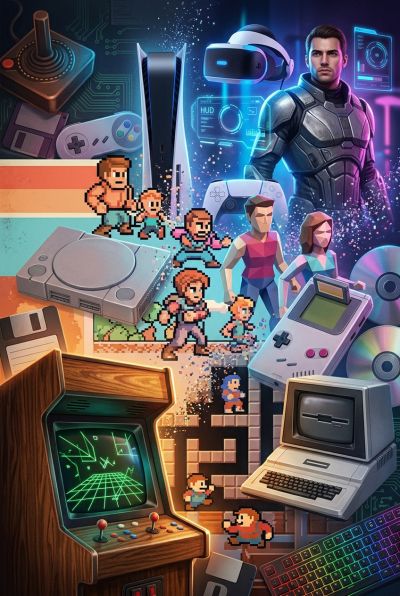
A History of Computer Games invites readers on a sweeping journey through more than half a century of interactive entertainment, from the earliest laboratory experiments on room‑sized mainframes to the global phenomena of virtual reality, esports, and cloud gaming. Each chapter builds on the last, revealing how simple concepts—like a bouncing dot on an oscilloscope or a two‑player duel in Spacewar!—evolved into the complex, culturally resonant experiences that shape modern life. By tracing the technical breakthroughs, business battles, and creative revolutions that defined each era, the book offers a clear, chronological map of how hardware limitations spurred inventive gameplay, how market crashes reset industry priorities, and how daring innovators turned niche hobbies into mainstream juggernauts.
Readers will discover the stories behind iconic milestones: the birth of the arcade with Pong and Space Invaders, the living‑room revolution sparked by the Magnavox Odyssey and the Atari 2600, the industry‑saving arrival of the Nintendo Entertainment System, the fierce 16‑bit console wars between Sega Genesis and Super Nintendo, and the leap to three‑dimensional worlds with Super Mario 64 and the PlayStation’s CD‑ROM dominance. The narrative also explores the parallel rise of PC gaming—from text adventures like Zork to the birth of the first‑person shooter with Doom and Quake—and the handheld revolution that brought Tetris and Pokémon to millions of pockets. Along the way, the book highlights how genres expanded, how online connectivity transformed solitary play into global communities, and how mobile devices redefined accessibility and revenue models.
Beyond recounting facts, the book delves into the cultural impact of gaming, showing how characters like Mario, Sonic, and Lara Croft became worldwide mascots, how MMORPGs such as World of Warcraft created persistent virtual societies, and how streaming platforms turned players into broadcasters and celebrities. It examines the rise of esports from basement LAN tournaments to stadium‑filling spectacles, and it explains how business models shifted from cartridge sales to digital downloads, free‑to‑play microtransactions, and subscription services like Xbox Game Pass. By linking technological advances to shifts in player behavior and societal perception, the text helps readers understand why gaming is now a dominant force in entertainment, education, and social interaction.
Finally, A History of Computer Games looks forward, unpacking the promise of virtual and augmented reality, the potential of artificial intelligence to create living, responsive game worlds, and the ongoing experiments in cloud gaming that could untether high‑end experiences from expensive hardware. The concluding chapters encourage readers to see the medium not just as a product of past innovations but as an evolving canvas where creativity, community, and technology continue to collide. Whether you are a longtime enthusiast, a student of media history, or someone curious about how a simple game of tennis on an oscilloscope grew into a multibillion‑dollar cultural phenomenon, this book provides the context, insight, and inspiration to appreciate every pixel, play session, and professional tournament that has shaped the world of computer games.
What You'll Find Inside:
- The complete chronological journey from 1950s laboratory experiments (like Tennis for Two and Spacewar!) to modern VR, AR, and cloud gaming technologies
- How pivotal technical innovations (cartridges, CD-ROMs, analog sticks, online connectivity) repeatedly transformed game design possibilities and player experiences
- The business evolution including console wars, the 1983 crash and recovery, and the shift from physical media to digital distribution and subscription models
- Gaming's transformation from arcade novelty to home entertainment staple, portable pastime, and global cultural force encompassing esports and mobile gaming
- The artistic maturation of games from simple score-chasers to narrative-driven experiences capable of emotional storytelling rivaling film and literature
Who's It For:
This book is ideal for gaming enthusiasts seeking to understand the historical context behind their favorite medium, students of media or technology history studying interactive entertainment's evolution, industry professionals looking for insights into past trends and innovations, and general readers interested in how technological innovation shapes cultural phenomena. Anyone curious about the origins of modern gaming will find this comprehensive history both informative and engaging.
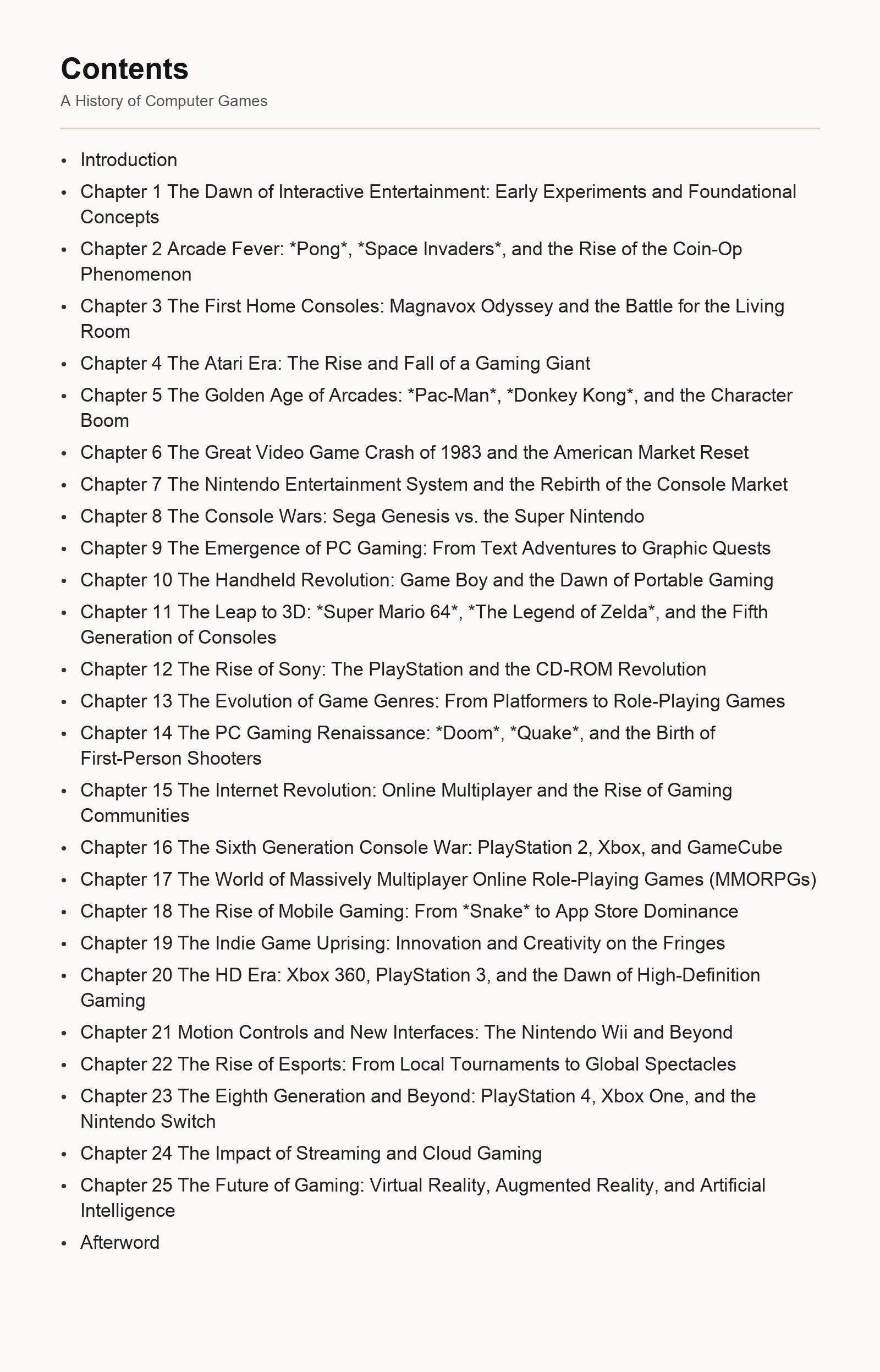
Table of Contents:
- Introduction
- Chapter 1 The Dawn of Interactive Entertainment: Early Experiments and Foundational Concepts
- Chapter 2 Arcade Fever: Pong, Space Invaders, and the Rise of the Coin-Op Phenomenon
- Chapter 3 The First Home Consoles: Magnavox Odyssey and the Battle for the Living Room
- Chapter 4 The Atari Era: The Rise and Fall of a Gaming Giant
- Chapter 5 The Golden Age of Arcades: Pac-Man, Donkey Kong, and the Character Boom
- Chapter 6 The Great Video Game Crash of 1983 and the American Market Reset
- Chapter 7 The Nintendo Entertainment System and the Rebirth of the Console Market
- Chapter 8 The Console Wars: Sega Genesis vs. the Super Nintendo
- Chapter 9 The Emergence of PC Gaming: From Text Adventures to Graphic Quests
- Chapter 10 The Handheld Revolution: Game Boy and the Dawn of Portable Gaming
- Chapter 11 The Leap to 3D: Super Mario 64, The Legend of Zelda, and the Fifth Generation of Consoles
- Chapter 12 The Rise of Sony: The PlayStation and the CD-ROM Revolution
- Chapter 13 The Evolution of Game Genres: From Platformers to Role-Playing Games
- Chapter 14 The PC Gaming Renaissance: Doom, Quake, and the Birth of First-Person Shooters
- Chapter 15 The Internet Revolution: Online Multiplayer and the Rise of Gaming Communities
- Chapter 16 The Sixth Generation Console War: PlayStation 2, Xbox, and GameCube
- Chapter 17 The World of Massively Multiplayer Online Role-Playing Games (MMORPGs)
- Chapter 18 The Rise of Mobile Gaming: From Snake to App Store Dominance
- Chapter 19 The Indie Game Uprising: Innovation and Creativity on the Fringes
- Chapter 20 The HD Era: Xbox 360, PlayStation 3, and the Dawn of High-Definition Gaming
- Chapter 21 Motion Controls and New Interfaces: The Nintendo Wii and Beyond
- Chapter 22 The Rise of Esports: From Local Tournaments to Global Spectacles
- Chapter 23 The Eighth Generation and Beyond: PlayStation 4, Xbox One, and the Nintendo Switch
- Chapter 24 The Impact of Streaming and Cloud Gaming
- Chapter 25 The Future of Gaming: Virtual Reality, Augmented Reality, and Artificial Intelligence
- Afterword
Author:
Published By:
Date Published:
May 24, 2026
Type:
Nonfiction
Language:
English
Also Available In:
Word Count:
55,348 words
Reading Time:
3 hours 53 minutes
Sample:
Order:
Order A History of Computer Games (Paperback) on MixCache.com:
Buy NowPrint copy is made to order and ships worldwide. Includes the ebook free, ready to read instantly.
$5 account credit for all new MixCache.com accounts, usable toward any ebook purchase!*