
Browse by Category
Fiction
- Action & Adventure
- African American
- Anthologies
- Children's Fiction
- Classics
- Comics & Graphic Novels
- Coming of Age
- Contemporary
- Cultural & Regional
- Drama
- Erotica
- Fantasy
- General
- Historical Fiction
- Horror
- Humor & Satire
- Literary Fiction
- Mystery, Thriller & Suspense
- Poetry
- Religious & Inspirational
- Romance
- Science Fiction
- Short Stories
- War & Military
- Westerns
- Women's Fiction
- Young Adult
Non-Fiction
- Antiques & Collectibles
- Arts & Photography
- Biographies & Memoirs
- Business & Money
- Children's Non-Fiction
-
Computers & Technology
- Artificial Intelligence
- Computer Science
- Cybersecurity & Cryptography
- Data Science & Analytics
- Databases & Big Data
- Game Development & Design
- General
- Hardware & DIY
- Mobile App Development
- Networking & Cloud Computing
- Operating Systems
- Programming
- Robotics
- Software
- Software Engineering
- User Experience (UX) & Design
- Web Development & Design
- Cooking, Food & Wine
- Crafts, Hobbies & Home
- Education & Teaching
- Engineering
- General
- Health, Fitness & Dieting
-
History
- African History
- African History - North Africa
- African History - Sub-Saharan Africa
- American History
- American History - 20th Century
- American History - Civil War
- American History - Colonial Period
- Ancient History
- Asian History
- Asian History - China
- Asian History - India
- Asian History - Japan
- Asian History - Southeast Asia
- European History
- European History - Ancient Greece
- European History - Ancient Rome
- European History - Medieval
- European History - Modern
- European History - Renaissance
- General
- Middle Eastern History
- Military History
- Military History - Aviation
- Military History - Naval
- Social & Cultural History
- World History
- Humor & Entertainment
- Industrial Technology
- Language Learning
- Law
- LGBTQ+ Non-Fiction
- Literary Criticism
- Medical Books
- Parenting & Relationships
- Philosophy
- Politics & Social Sciences
- Reference
- Religion & Spirituality
-
Science & Math
- Agricultural Sciences
- Astronomy & Space Science
- Behavioral Sciences
- Biological Sciences
- Botany & Plant Science
- Chemistry
- Earth Sciences
- Engineering - Chemical
- Engineering - Civil
- Engineering - Electrical
- Engineering - Mechanical
- Environment
- General
- Geology
- Mathematics
- Nature & Ecology
- Oceanography
- Paleontology
- Physics
- Statistics
- Self-Help
- Sports & Outdoors
- Study Aids
- Sustainability & Green Living
- Textbooks
- Transportation
- Travel
- True Crime
- Urban Planning & Development
- Veterinary Medicine
- Writing & Publishing
Jump to Section
MixCache.com Total Access
Unlimited reading and audiobooks for every book published by MixCache.com.
Included titles carry the MTA badge.
Learn more →A History of Equatorial Guinea
About this book:
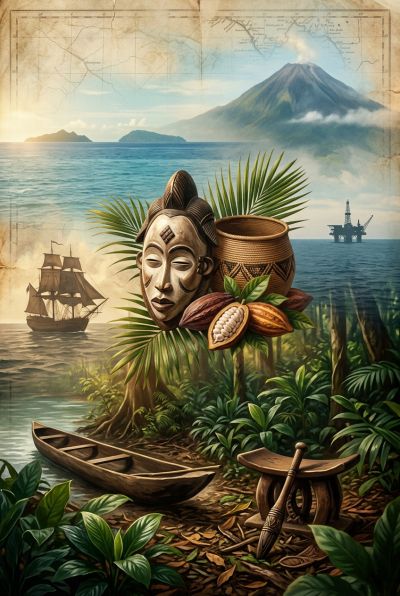
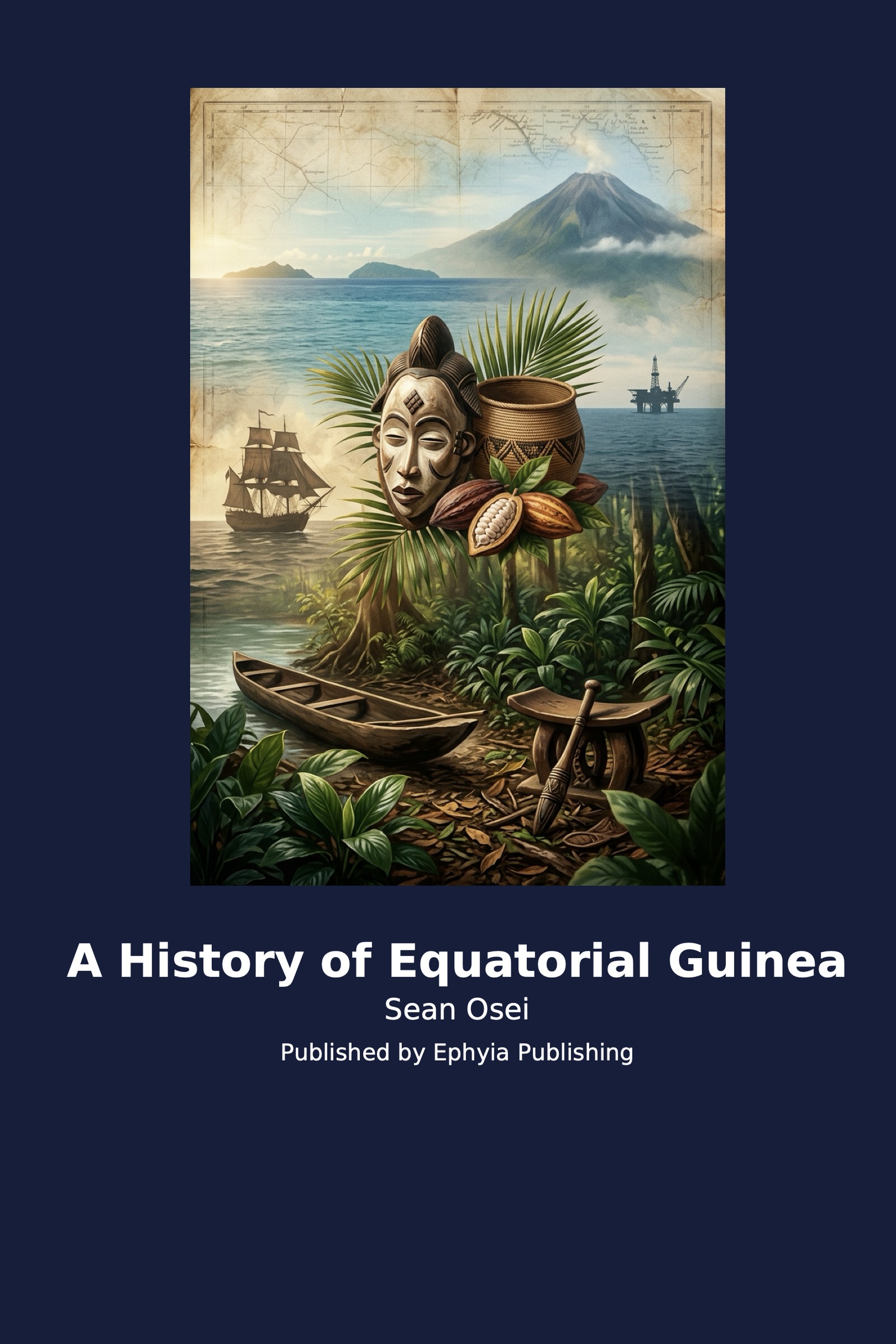
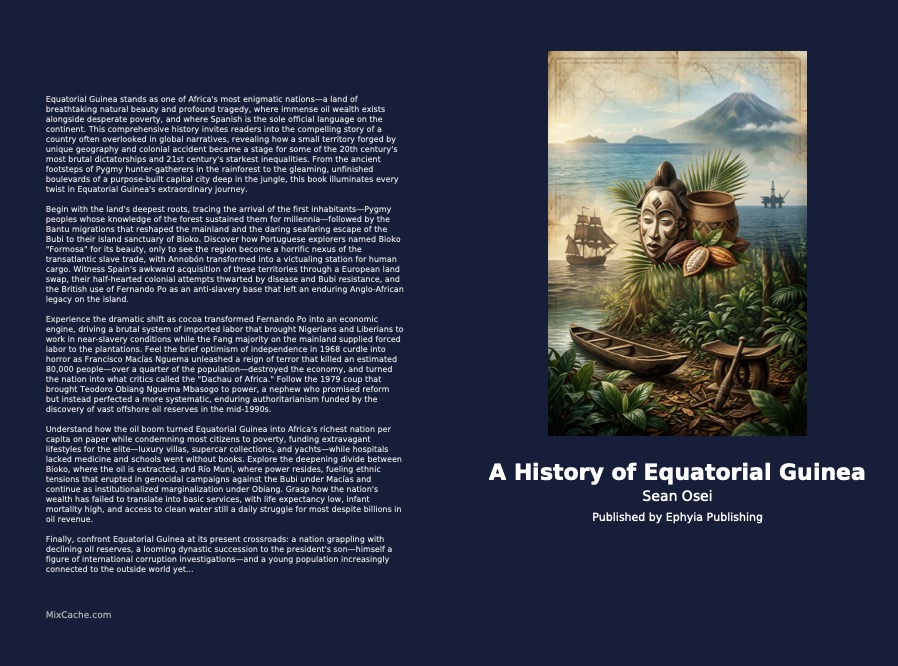
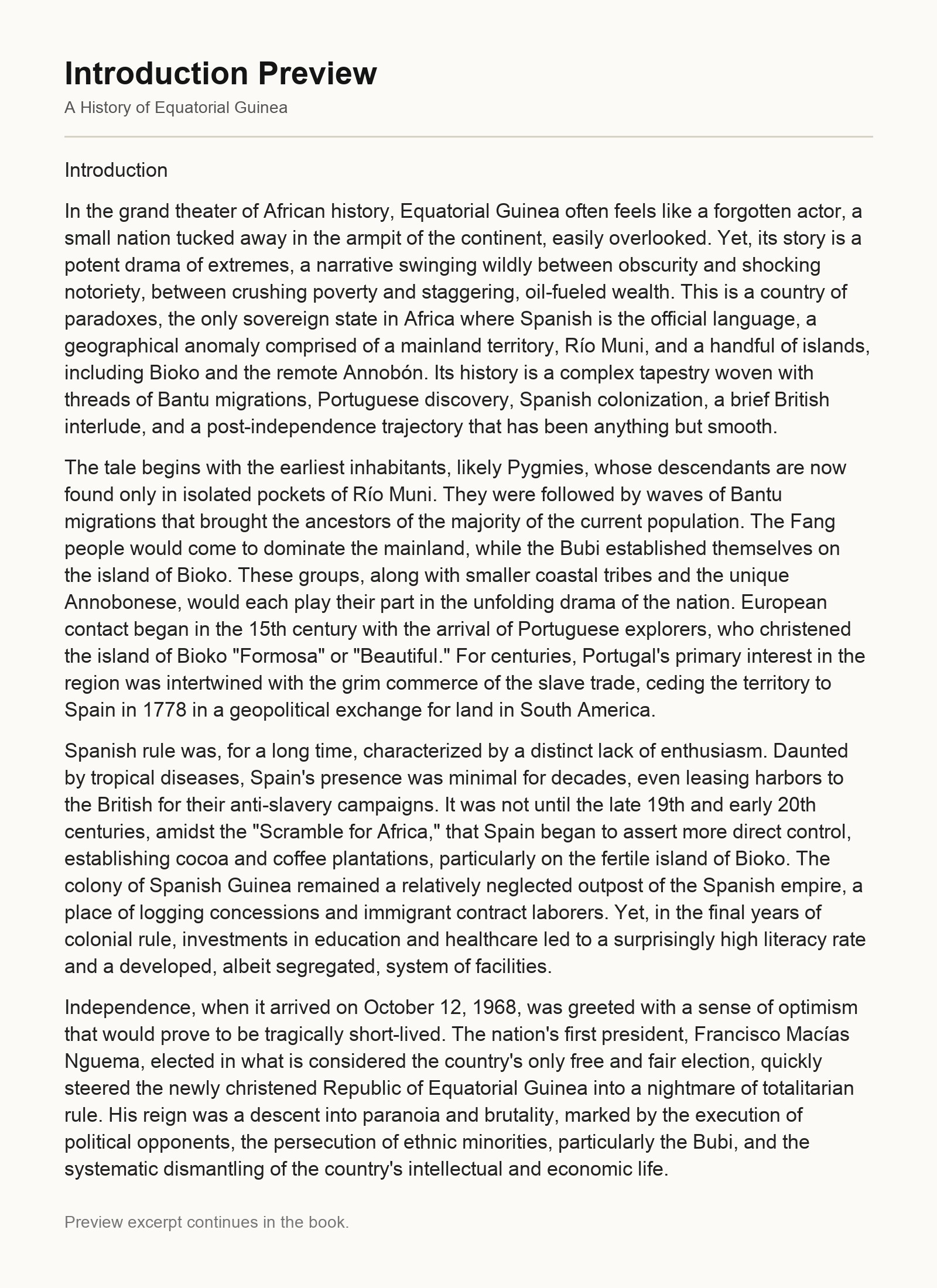
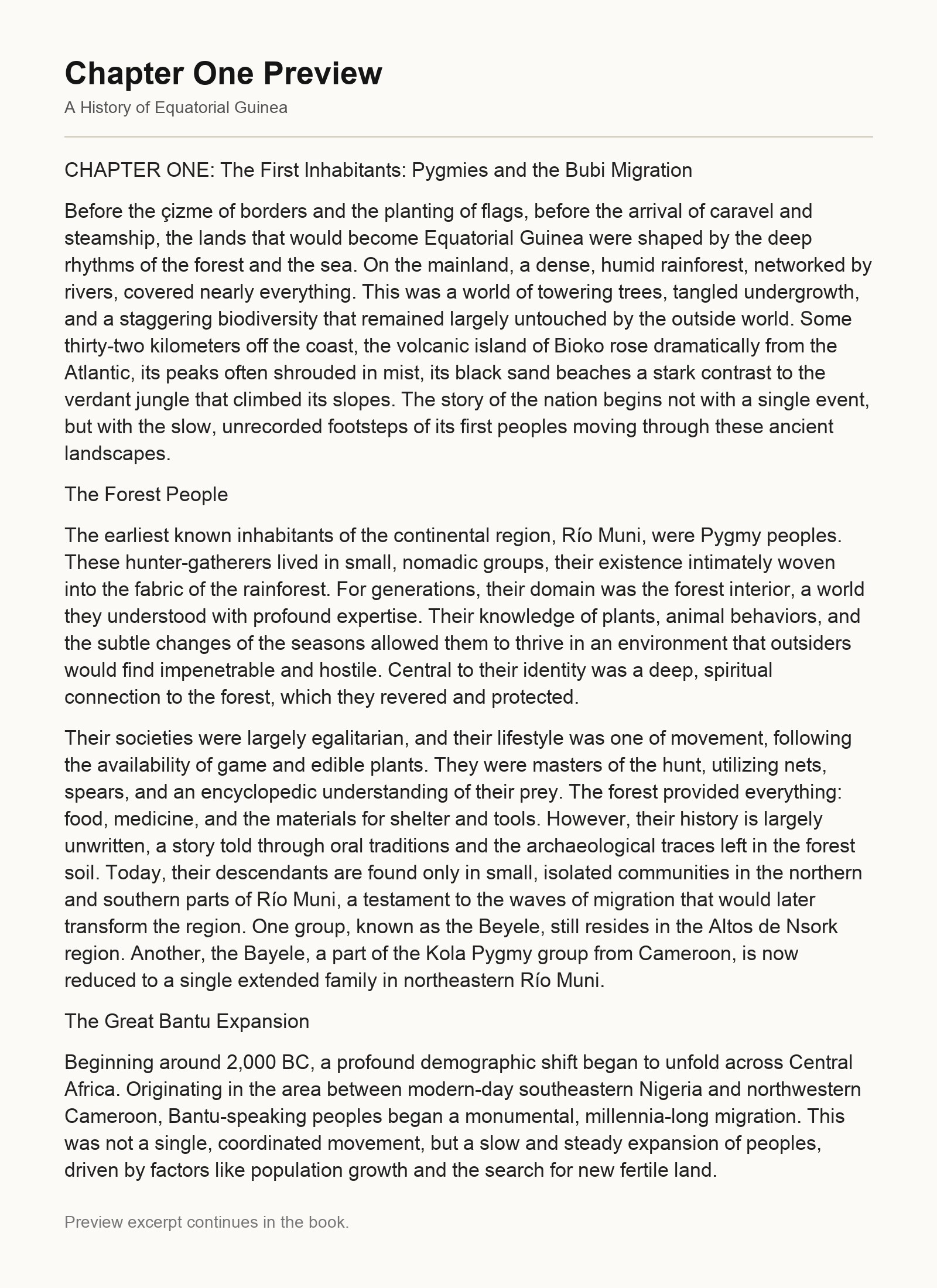
Equatorial Guinea stands as one of Africa's most enigmatic nations—a land of breathtaking natural beauty and profound tragedy, where immense oil wealth exists alongside desperate poverty, and where Spanish is the sole official language on the continent. This comprehensive history invites readers into the compelling story of a country often overlooked in global narratives, revealing how a small territory forged by unique geography and colonial accident became a stage for some of the 20th century's most brutal dictatorships and 21st century's starkest inequalities. From the ancient footsteps of Pygmy hunter-gatherers in the rainforest to the gleaming, unfinished boulevards of a purpose-built capital city deep in the jungle, this book illuminates every twist in Equatorial Guinea's extraordinary journey.
Begin with the land's deepest roots, tracing the arrival of the first inhabitants—Pygmy peoples whose knowledge of the forest sustained them for millennia—followed by the Bantu migrations that reshaped the mainland and the daring seafaring escape of the Bubi to their island sanctuary of Bioko. Discover how Portuguese explorers named Bioko "Formosa" for its beauty, only to see the region become a horrific nexus of the transatlantic slave trade, with Annobón transformed into a victualing station for human cargo. Witness Spain's awkward acquisition of these territories through a European land swap, their half-hearted colonial attempts thwarted by disease and Bubi resistance, and the British use of Fernando Po as an anti-slavery base that left an enduring Anglo-African legacy on the island.
Experience the dramatic shift as cocoa transformed Fernando Po into an economic engine, driving a brutal system of imported labor that brought Nigerians and Liberians to work in near-slavery conditions while the Fang majority on the mainland supplied forced labor to the plantations. Feel the brief optimism of independence in 1968 curdle into horror as Francisco Macías Nguema unleashed a reign of terror that killed an estimated 80,000 people—over a quarter of the population—destroyed the economy, and turned the nation into what critics called the "Dachau of Africa." Follow the 1979 coup that brought Teodoro Obiang Nguema Mbasogo to power, a nephew who promised reform but instead perfected a more systematic, enduring authoritarianism funded by the discovery of vast offshore oil reserves in the mid-1990s.
Understand how the oil boom turned Equatorial Guinea into Africa's richest nation per capita on paper while condemning most citizens to poverty, funding extravagant lifestyles for the elite—luxury villas, supercar collections, and yachts—while hospitals lacked medicine and schools went without books. Explore the deepening divide between Bioko, where the oil is extracted, and Río Muni, where power resides, fueling ethnic tensions that erupted in genocidal campaigns against the Bubi under Macías and continue as institutionalized marginalization under Obiang. Grasp how the nation's wealth has failed to translate into basic services, with life expectancy low, infant mortality high, and access to clean water still a daily struggle for most despite billions in oil revenue.
Finally, confront Equatorial Guinea at its present crossroads: a nation grappling with declining oil reserves, a looming dynastic succession to the president's son—himself a figure of international corruption investigations—and a young population increasingly connected to the outside world yet denied opportunity at home. Readers will come away with a nuanced understanding of how colonial borders, ethnic divisions, resource curses, and personalist rule have intertwined to create a nation of stark contradictions, where the promise of independence remains unfulfilled and the struggle for equitable development and human rights continues against a backdrop of both breathtaking potential and profound disappointment. This is not merely a history of a forgotten African state, but a window into the complex forces shaping nations across the Global South.
What You'll Find Inside:
- The indigenous societies of Equatorial Guinea: Pygmies, Bubi migration to Bioko, Fang expansion, and Ndowe coastal communities before European contact
- The brutal dictatorship of Francisco Macías Nguema (1968-1979) characterized by genocide, economic collapse, and the exile or death of approximately 80,000 citizens
- Teodoro Obiang Nguema Mbasogo's rise to power via the 1979 coup and his consolidation of authoritarian rule through patronage, clan politics, and controlled elections
- The transformative impact of the mid-1990s oil boom that made Equatorial Guinea Africa's richest nation per capita while exacerbating extreme inequality and corruption
- Contemporary challenges including human rights abuses, economic dependence on declining oil reserves, political repression, and uncertain succession prospects
Who's It For:
This book is ideal for students and scholars of African history, political science, and post-colonial studies seeking to understand Equatorial Guinea's unique trajectory. It will particularly benefit researchers examining dictatorship, the resource curse, and human rights abuses in oil-rich states. Policy makers, international relations professionals, and NGO workers engaged with Central Africa will find valuable context for current events. General readers interested in how a nation with vast natural wealth can suffer from extreme poverty and repression will also gain important insights from this comprehensive historical account.
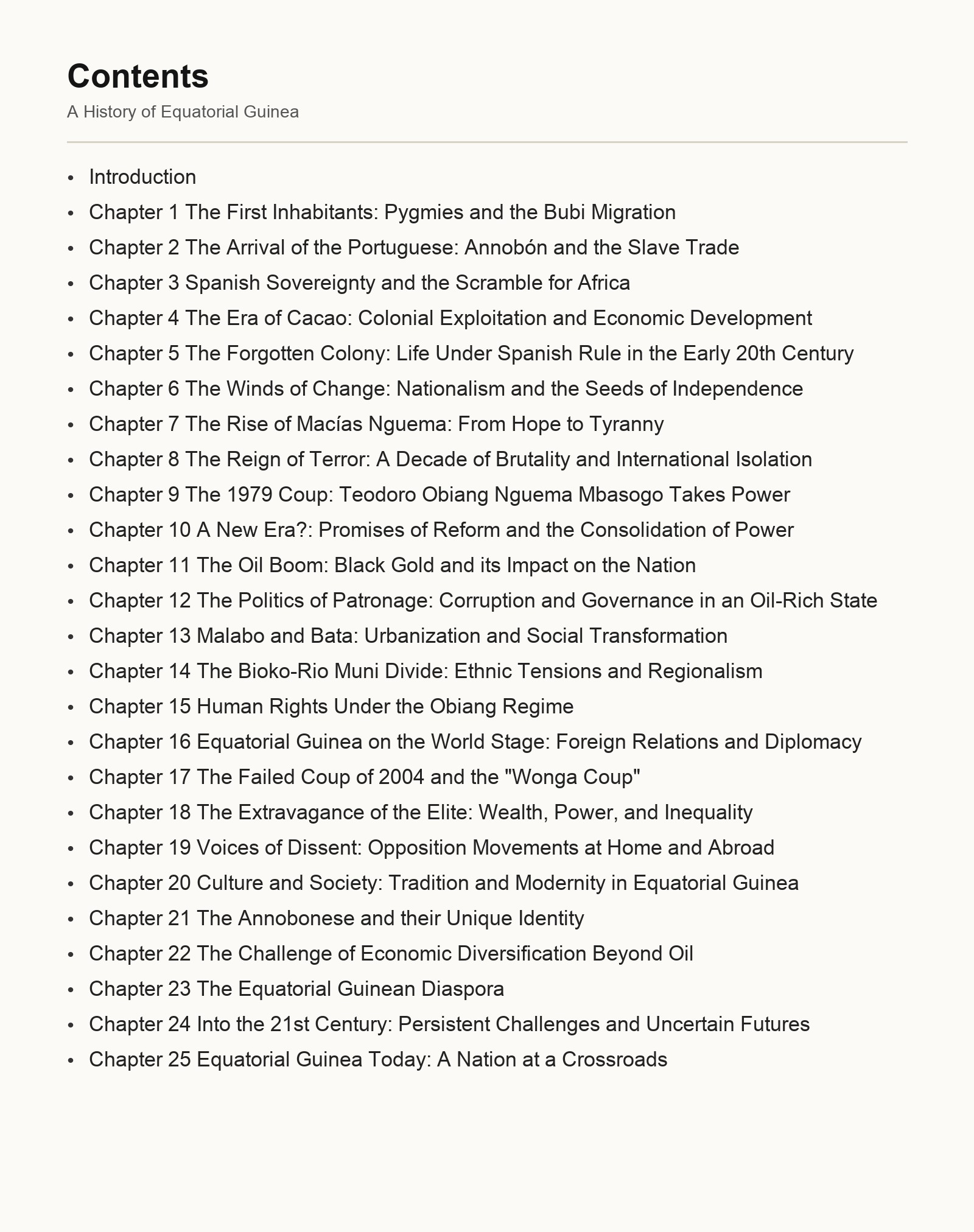
Table of Contents:
- Introduction
- Chapter 1 The First Inhabitants: Pygmies and the Bubi Migration
- Chapter 2 The Arrival of the Portuguese: Annobón and the Slave Trade
- Chapter 3 Spanish Sovereignty and the Scramble for Africa
- Chapter 4 The Era of Cacao: Colonial Exploitation and Economic Development
- Chapter 5 The Forgotten Colony: Life Under Spanish Rule in the Early 20th Century
- Chapter 6 The Winds of Change: Nationalism and the Seeds of Independence
- Chapter 7 The Rise of Macías Nguema: From Hope to Tyranny
- Chapter 8 The Reign of Terror: A Decade of Brutality and International Isolation
- Chapter 9 The 1979 Coup: Teodoro Obiang Nguema Mbasogo Takes Power
- Chapter 10 A New Era?: Promises of Reform and the Consolidation of Power
- Chapter 11 The Oil Boom: Black Gold and its Impact on the Nation
- Chapter 12 The Politics of Patronage: Corruption and Governance in an Oil-Rich State
- Chapter 13 Malabo and Bata: Urbanization and Social Transformation
- Chapter 14 The Bioko-Rio Muni Divide: Ethnic Tensions and Regionalism
- Chapter 15 Human Rights Under the Obiang Regime
- Chapter 16 Equatorial Guinea on the World Stage: Foreign Relations and Diplomacy
- Chapter 17 The Failed Coup of 2004 and the "Wonga Coup"
- Chapter 18 The Extravagance of the Elite: Wealth, Power, and Inequality
- Chapter 19 Voices of Dissent: Opposition Movements at Home and Abroad
- Chapter 20 Culture and Society: Tradition and Modernity in Equatorial Guinea
- Chapter 21 The Annobonese and their Unique Identity
- Chapter 22 The Challenge of Economic Diversification Beyond Oil
- Chapter 23 The Equatorial Guinean Diaspora
- Chapter 24 Into the 21st Century: Persistent Challenges and Uncertain Futures
- Chapter 25 Equatorial Guinea Today: A Nation at a Crossroads
Author:
Published By:
Date Published:
May 23, 2026
Type:
Nonfiction
Language:
English
Also Available In:
Word Count:
35,734 words
Reading Time:
2 hours 30 minutes
Sample:
Order:
Buy the A History of Equatorial Guinea ebook on MixCache.com:
Buy NowThe full ebook will be available immediately to read instantly on any device.
$5 account credit for all new MixCache.com accounts, usable toward any ebook purchase!*



Ratings & Reviews
Ask Questions About This Book
Have a question about the content? Ask our AI assistant!
Start by asking a question about "A History of Equatorial Guinea"
Example: "Does this book mention William Shakespeare?"
Thinking...