
Browse by Category
Fiction
- Action & Adventure
- African American
- Anthologies
- Children's Fiction
- Classics
- Comics & Graphic Novels
- Coming of Age
- Contemporary
- Cultural & Regional
- Drama
- Erotica
- Fantasy
- General
- Historical Fiction
- Horror
- Humor & Satire
- Literary Fiction
- Mystery, Thriller & Suspense
- Poetry
- Religious & Inspirational
- Romance
- Science Fiction
- Short Stories
- War & Military
- Westerns
- Women's Fiction
- Young Adult
Non-Fiction
- Antiques & Collectibles
- Arts & Photography
- Biographies & Memoirs
- Business & Money
- Children's Non-Fiction
-
Computers & Technology
- Artificial Intelligence
- Computer Science
- Cybersecurity & Cryptography
- Data Science & Analytics
- Databases & Big Data
- Game Development & Design
- General
- Hardware & DIY
- Mobile App Development
- Networking & Cloud Computing
- Operating Systems
- Programming
- Robotics
- Software
- Software Engineering
- User Experience (UX) & Design
- Web Development & Design
- Cooking, Food & Wine
- Crafts, Hobbies & Home
- Education & Teaching
- Engineering
- General
- Health, Fitness & Dieting
-
History
- African History
- African History - North Africa
- African History - Sub-Saharan Africa
- American History
- American History - 20th Century
- American History - Civil War
- American History - Colonial Period
- Ancient History
- Asian History
- Asian History - China
- Asian History - India
- Asian History - Japan
- Asian History - Southeast Asia
- European History
- European History - Ancient Greece
- European History - Ancient Rome
- European History - Medieval
- European History - Modern
- European History - Renaissance
- General
- Middle Eastern History
- Military History
- Military History - Aviation
- Military History - Naval
- Social & Cultural History
- World History
- Humor & Entertainment
- Industrial Technology
- Language Learning
- Law
- LGBTQ+ Non-Fiction
- Literary Criticism
- Medical Books
- Parenting & Relationships
- Philosophy
- Politics & Social Sciences
- Reference
- Religion & Spirituality
-
Science & Math
- Agricultural Sciences
- Astronomy & Space Science
- Behavioral Sciences
- Biological Sciences
- Botany & Plant Science
- Chemistry
- Earth Sciences
- Engineering - Chemical
- Engineering - Civil
- Engineering - Electrical
- Engineering - Mechanical
- Environment
- General
- Geology
- Mathematics
- Nature & Ecology
- Oceanography
- Paleontology
- Physics
- Statistics
- Self-Help
- Sports & Outdoors
- Study Aids
- Sustainability & Green Living
- Textbooks
- Transportation
- Travel
- True Crime
- Urban Planning & Development
- Veterinary Medicine
- Writing & Publishing
Jump to Section

Want unlimited access to all books published by MixCache.com (plus their audiobooks)? Try MixCache.com Total Access. Look for the MTA badge on book covers to identify included titles.
Access to infinite ebooks: Don't see the book you want? Suggest it and we'll create it (free!) for you from scratch with our powerful AI book writer. Then read it with MTA - besides profiting from any sales it makes!
A History of the Caucasus
About this book:
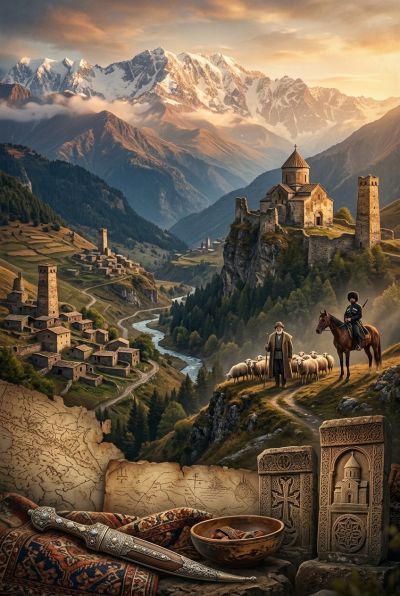
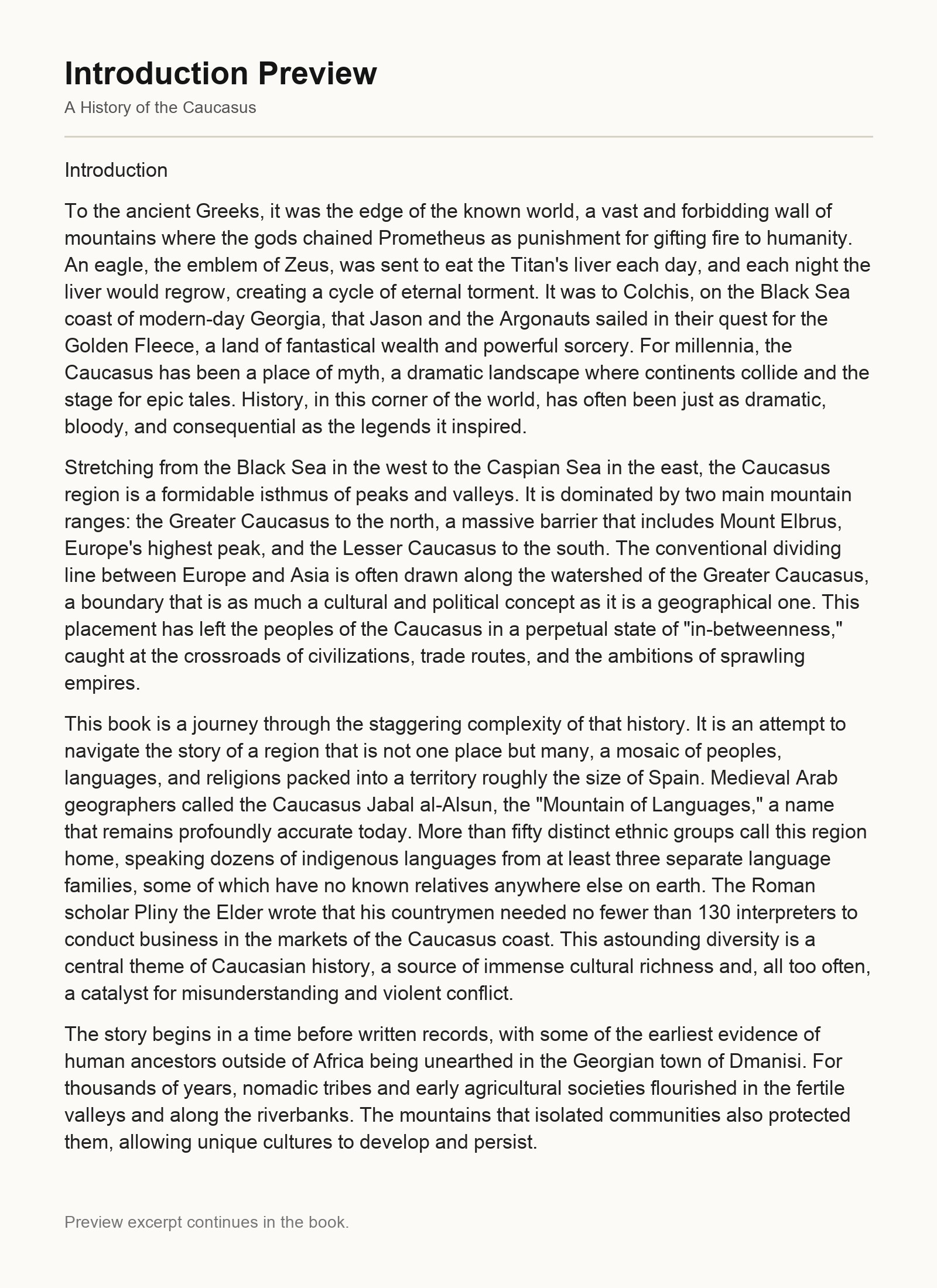
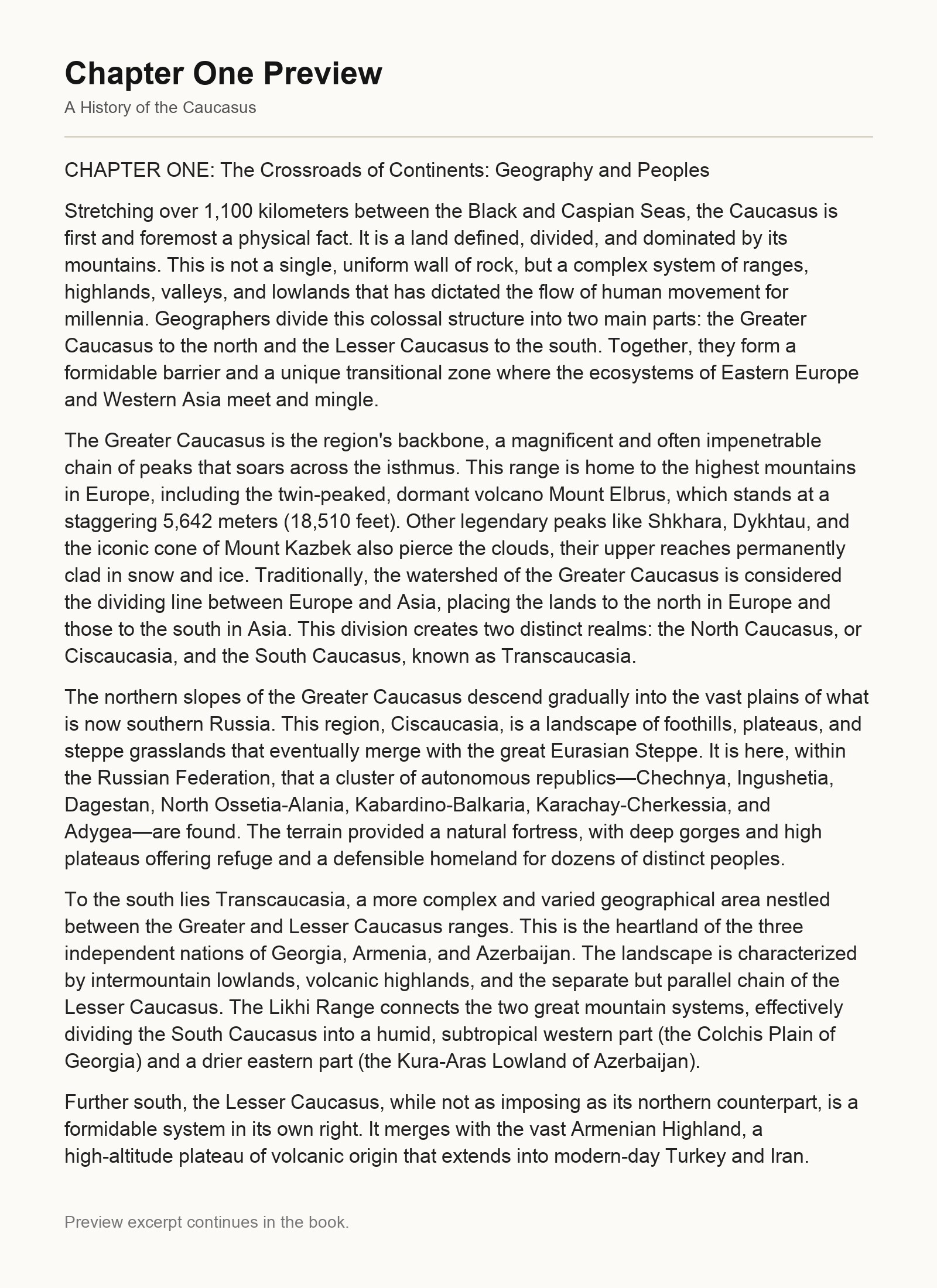
A History of the Caucasus invites readers on a sweeping journey through one of the world’s most complex and storied regions, from the mist‑shrouded valleys where ancient kingdoms first rose to the bustling oil‑filled streets of twenty‑first‑century capitals. Beginning with the geological forces that forged the Greater and Lesser Caucasus ranges, the book explains how these towering mountains have acted as both barrier and bridge, shaping patterns of migration, trade, and conflict for millennia. Readers will discover how the region’s extraordinary linguistic tapestry—more than fifty distinct peoples speaking languages from three unrelated families—emerged from isolated valleys that protected unique cultures while also exposing them to the ambitions of surrounding empires.
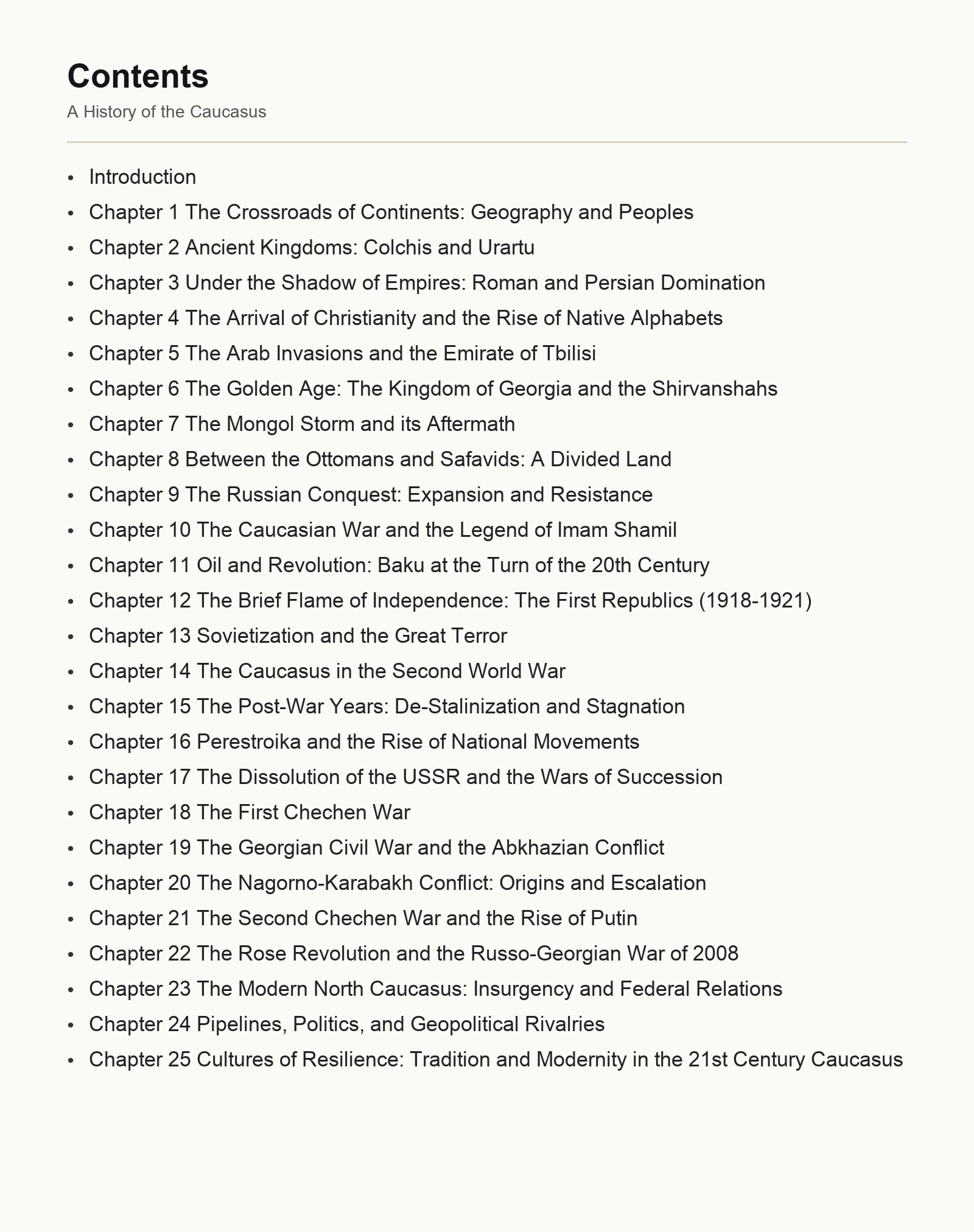
The narrative then moves chronologically through the rise and fall of early powers such as Colchis and Urartu, the tug‑of‑war between Rome and Persia, and the transformative arrival of Christianity that gave Armenia and Georgia their first alphabets and a lasting spiritual identity. Subsequent chapters detail the Arab conquests and the creation of the Emirate of Tbilisi, the medieval golden age of Queen Tamar’s Georgia and the Shirvanshahs, and the devastation wrought by Mongol and Timurid invasions. Each era is illustrated with vivid accounts of battles, treaties, and cultural achievements, showing how local rulers balanced survival with adaptation in a landscape constantly contested by greater powers.
As the story progresses into the modern era, the book examines the Russian conquest, the brutal Caucasian War led by Imam Shamil, and the turbulent twentieth century that saw brief independence, Soviet repression, mass deportations, and the fierce battles of World War II. Readers will gain insight into the origins of the Nagorno‑Karabakh, Abkhazian, and Chechen conflicts, the impact of oil wealth on Baku’s transformation, and the geopolitical rivalries that turned pipelines into new frontiers of influence. The final chapters bring the history into the present, exploring how ancient traditions of kinship, religion, and hospitality coexist with rapid modernization, technological innovation, and enduring struggles for identity in the twenty‑first century Caucasus.
By weaving together political, military, social, and cultural threads, A History of the Caucasus offers a comprehensive yet accessible portrait of a region where myth and history intertwine. Readers will come away with a deeper understanding of how geography has shaped destiny, how diversity has been both a source of strength and a catalyst for strife, and how the peoples of the Caucasus have continually demonstrated resilience in the face of conquest, repression, and change. This book is essential for anyone seeking to grasp the forces that have molded a crossroads of continents and to appreciate the living legacy of its many cultures.
What You'll Find Inside:
- The Caucasus as a historic crossroads where Europe and Asia meet, shaped by competing empires and extraordinary linguistic diversity with over 50 ethnic groups
- The transformation of the region through the adoption of Christianity in Armenia and Georgia (4th century) and later Islam, creating enduring religious and cultural divides
- Centuries of imperial rivalry between Rome/Persia, Ottomans/Safavids, and finally Russia, which conquered the region through prolonged wars of resistance
- The Soviet era's brutal modernization efforts including forced collectivization, industrialization, and the Great Terror, followed by mass deportations during WWII
- The post-Soviet collapse leading to independence, frozen conflicts (Nagorno-Karabakh, Abkhazia, South Ossetia), and the Caucasus becoming a pivotal energy corridor in global geopolitics
Who's It For:
This book is ideal for students, scholars, and general readers interested in Eurasian history who seek to understand the complex historical roots of contemporary Caucasus conflicts. It provides essential context for policymakers, journalists, and professionals working on regional security, energy politics, or international relations, while remaining accessible to educated non-specialists fascinated by the interplay of geography, culture, and power in this strategic crossroads between continents.
Author:
Published By:
Date Published:
May 22, 2026
Type:
Nonfiction
Language:
English
Word Count:
49,085 words
Reading Time:
3 hours 26 minutes
Sample:
Order:
Order A History of the Caucasus (Paperback) on MixCache.com:
Buy NowPrint copy is made to order and ships worldwide. Includes the ebook free, ready to read instantly.
$5 account credit for all new MixCache.com accounts, usable toward any ebook purchase!*


