
Browse by Category
Fiction
- Action & Adventure
- African American
- Anthologies
- Children's Fiction
- Classics
- Comics & Graphic Novels
- Coming of Age
- Contemporary
- Cultural & Regional
- Drama
- Erotica
- Fantasy
- General
- Historical Fiction
- Horror
- Humor & Satire
- Literary Fiction
- Mystery, Thriller & Suspense
- Poetry
- Religious & Inspirational
- Romance
- Science Fiction
- Short Stories
- War & Military
- Westerns
- Women's Fiction
- Young Adult
Non-Fiction
- Antiques & Collectibles
- Arts & Photography
- Biographies & Memoirs
- Business & Money
- Children's Non-Fiction
-
Computers & Technology
- Artificial Intelligence
- Computer Science
- Cybersecurity & Cryptography
- Data Science & Analytics
- Databases & Big Data
- Game Development & Design
- General
- Hardware & DIY
- Mobile App Development
- Networking & Cloud Computing
- Operating Systems
- Programming
- Robotics
- Software
- Software Engineering
- User Experience (UX) & Design
- Web Development & Design
- Cooking, Food & Wine
- Crafts, Hobbies & Home
- Education & Teaching
- Engineering
- General
- Health, Fitness & Dieting
-
History
- African History
- African History - North Africa
- African History - Sub-Saharan Africa
- American History
- American History - 20th Century
- American History - Civil War
- American History - Colonial Period
- Ancient History
- Asian History
- Asian History - China
- Asian History - India
- Asian History - Japan
- Asian History - Southeast Asia
- European History
- European History - Ancient Greece
- European History - Ancient Rome
- European History - Medieval
- European History - Modern
- European History - Renaissance
- General
- Middle Eastern History
- Military History
- Military History - Aviation
- Military History - Naval
- Social & Cultural History
- World History
- Humor & Entertainment
- Industrial Technology
- Language Learning
- Law
- LGBTQ+ Non-Fiction
- Literary Criticism
- Medical Books
- Parenting & Relationships
- Philosophy
- Politics & Social Sciences
- Reference
- Religion & Spirituality
-
Science & Math
- Agricultural Sciences
- Astronomy & Space Science
- Behavioral Sciences
- Biological Sciences
- Botany & Plant Science
- Chemistry
- Earth Sciences
- Engineering - Chemical
- Engineering - Civil
- Engineering - Electrical
- Engineering - Mechanical
- Environment
- General
- Geology
- Mathematics
- Nature & Ecology
- Oceanography
- Paleontology
- Physics
- Statistics
- Self-Help
- Sports & Outdoors
- Study Aids
- Sustainability & Green Living
- Textbooks
- Transportation
- Travel
- True Crime
- Urban Planning & Development
- Veterinary Medicine
- Writing & Publishing
Jump to Section
MixCache.com Total Access
Unlimited reading and audiobooks for every book published by MixCache.com.
Included titles carry the MTA badge.
Learn more →
Violent Revolutions
A History
About this book:
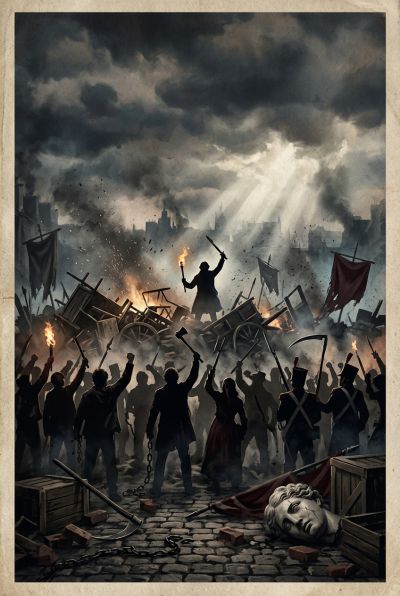


Violent Revolutions: A History invites readers on a sweeping journey through twenty‑five of the most transformative uprisings that have shaken the world, from the slave revolt of Spartacus against Rome to the televised collapse of communism in Romania. Each chapter examines a distinct episode of violent change, revealing how disparate societies across centuries and continents have reached the point where armed struggle seemed the only path to a new order. By presenting these events in a consistent structure—causes, unfolding conflict, and aftermath—the book offers a clear comparative framework that highlights both the unique circumstances and the recurring patterns that drive revolutionary fervor.
Readers will gain a deep understanding of the complex web of factors that ignite these explosions of violence. The work delves into the economic distress, social inequality, political repression, and ideological fervor that push populations to breaking point, showing how famine, taxation, land loss, foreign domination, and inspirational movements—from religious millenarianism to Enlightenment republicanism—combine to create fertile ground for revolt. It also highlights the pivotal role of charismatic leaders, from Toussaint Louverture and Simón Bolívar to Lenin and Khomeini, whose visions and actions shape the direction and intensity of the struggle.
Through vivid, chronological storytelling, the book immerses the reader in the drama of battle and rebellion: the daring night escape from Mount Vesuvius, the horrific siege of Suiyang where desperation led to cannibalism, the tidal wave of the Paris Commune’s Bloody Week, and the guerrilla triumphs in the Sierra Maestra that toppled a dictatorship. These narratives are not merely tales of combat; they illuminate the human cost, the courage and brutality on all sides, and the ways ordinary people become swept up in forces far larger than themselves.
Beyond the immediate clash of arms, the book explores the lasting legacies of each upheaval. It examines how revolutions can dismantle old hierarchies, yet often replace them with new forms of oppression, how they unleash nationalism and ideological movements that reverberate for generations, and how the unintended consequences—such as the indemnity that crippled Haiti or the warlordism that followed the Taiping Rebellion—shape the future trajectory of nations. By confronting both the ideals and the realities of violent change, the work encourages readers to reflect on the perennial question of when, if ever, such upheaval can lead to a more just society.
This comprehensive yet accessible study is ideal for students of history, political science, and global affairs, as well as any reader fascinated by the dynamics of power, resistance, and transformation. It provides not only a catalog of past conflicts but also a lens through which to understand contemporary struggles for change, offering valuable insight into the forces that continue to shape our world. Whether seeking knowledge, context, or a compelling narrative of human defiance, the reader will find a richly rewarding experience in these pages.
What You'll Find Inside:
- Violent revolutions typically emerge from a combination of social, economic, and political pressures when peaceful means of change fail or are perceived as unavailable
- Revolutionary ideals often transform or deteriorate in practice, with many movements replacing one form of oppression with another rather than achieving their original goals
- The human cost of these conflicts is staggering, with some revolutions like the Taiping Rebellion and An Lushan Rebellion causing tens of millions of deaths through warfare, famine, and disease
- Successful revolutions frequently lead to prolonged instability and civil wars as competing factions vie for power, as seen in the aftermath of the Russian and Chinese Revolutions
- The book demonstrates how revolutionary movements have fundamentally reshaped political boundaries, ideologies, and national identities across world history, creating lasting legacies that continue to influence contemporary politics
Who's It For:
This book is ideal for history students, political science enthusiasts, and general readers seeking to understand the patterns, causes, and consequences of violent revolutionary movements throughout world history. It provides valuable context for comprehending current geopolitical conflicts by examining how past upheavals have shaped modern nations, ideologies, and international relations. Readers interested in the interplay between social justice, political power, and historical change will find particular value in this comprehensive survey.
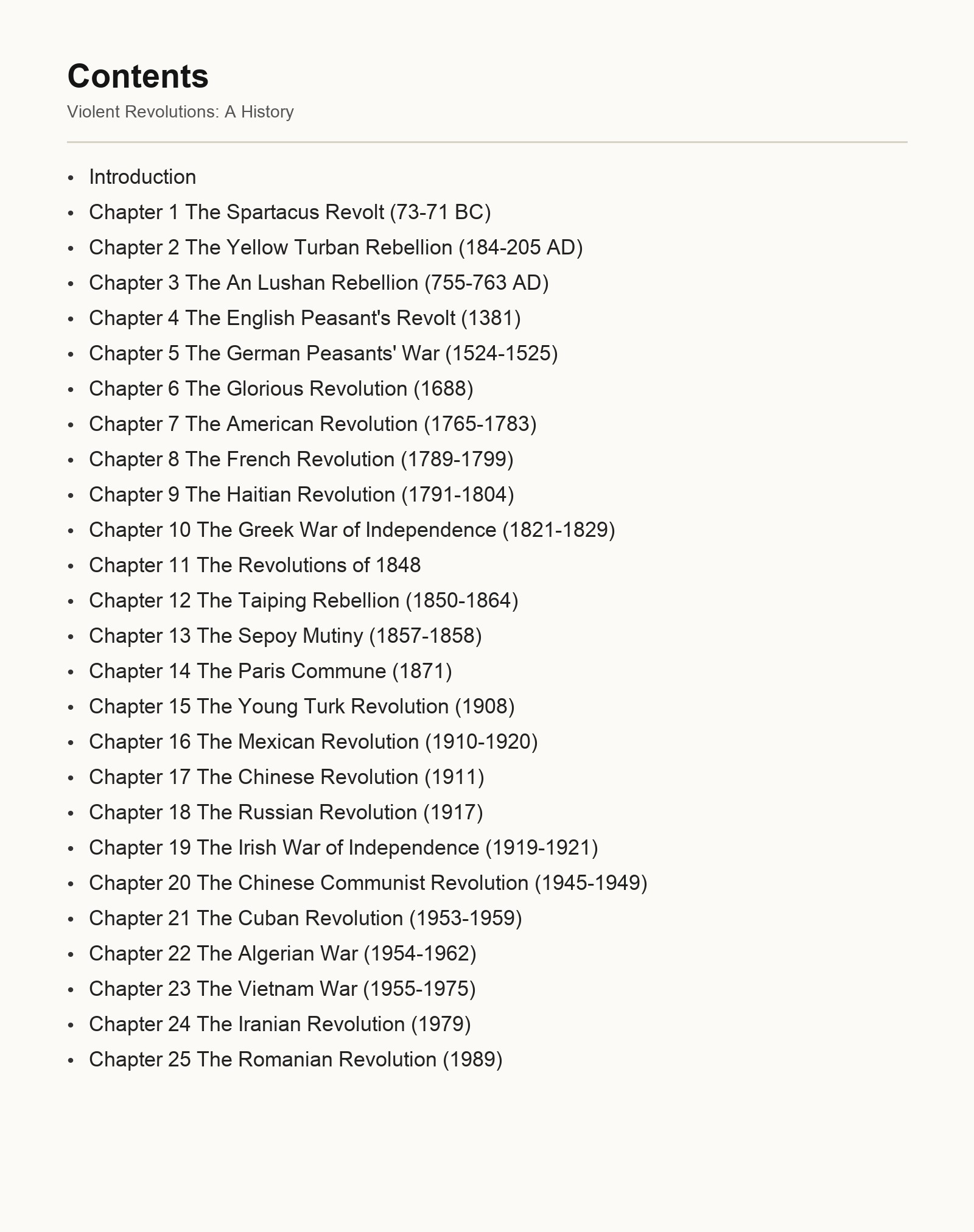
Table of Contents:
- Introduction
- Chapter 1 The Spartacus Revolt (73-71 BC)
- Chapter 2 The Yellow Turban Rebellion (184-205 AD)
- Chapter 3 The An Lushan Rebellion (755-763 AD)
- Chapter 4 The English Peasant's Revolt (1381)
- Chapter 5 The German Peasants' War (1524-1525)
- Chapter 6 The Glorious Revolution (1688)
- Chapter 7 The American Revolution (1765-1783)
- Chapter 8 The French Revolution (1789-1799)
- Chapter 9 The Haitian Revolution (1791-1804)
- Chapter 10 The Greek War of Independence (1821-1829)
- Chapter 11 The Revolutions of 1848
- Chapter 12 The Taiping Rebellion (1850-1864)
- Chapter 13 The Sepoy Mutiny (1857-1858)
- Chapter 14 The Paris Commune (1871)
- Chapter 15 The Young Turk Revolution (1908)
- Chapter 16 The Mexican Revolution (1910-1920)
- Chapter 17 The Chinese Revolution (1911)
- Chapter 18 The Russian Revolution (1917)
- Chapter 19 The Irish War of Independence (1919-1921)
- Chapter 20 The Chinese Communist Revolution (1945-1949)
- Chapter 21 The Cuban Revolution (1953-1959)
- Chapter 22 The Algerian War (1954-1962)
- Chapter 23 The Vietnam War (1955-1975)
- Chapter 24 The Iranian Revolution (1979)
- Chapter 25 The Romanian Revolution (1989)
Author:
Published By:
Date Published:
May 21, 2026
Type:
Nonfiction
Language:
English
Also Available In:
German, Spanish, Italian, Dutch
Word Count:
57,910 words
Reading Time:
4 hours 3 minutes
Sample:
Order:
Order Violent Revolutions (Paperback) on MixCache.com:
Buy NowPrint copy is made to order and ships worldwide. Includes the ebook free, ready to read instantly.
$5 account credit for all new MixCache.com accounts, usable toward any ebook purchase!*


