Browse by Category
Fiction
- Action & Adventure
- African American
- Anthologies
- Children's Fiction
- Classics
- Comics & Graphic Novels
- Coming of Age
- Contemporary
- Cultural & Regional
- Drama
- Erotica
- Fantasy
- General
- Historical Fiction
- Horror
- Humor & Satire
- Literary Fiction
- Mystery, Thriller & Suspense
- Poetry
- Religious & Inspirational
- Romance
- Science Fiction
- Short Stories
- War & Military
- Westerns
- Women's Fiction
- Young Adult
Non-Fiction
- Antiques & Collectibles
- Arts & Photography
- Biographies & Memoirs
- Business & Money
- Children's Non-Fiction
-
Computers & Technology
- Artificial Intelligence
- Computer Science
- Cybersecurity & Cryptography
- Data Science & Analytics
- Databases & Big Data
- Game Development & Design
- General
- Hardware & DIY
- Mobile App Development
- Networking & Cloud Computing
- Operating Systems
- Programming
- Robotics
- Software
- Software Engineering
- User Experience (UX) & Design
- Web Development & Design
- Cooking, Food & Wine
- Crafts, Hobbies & Home
- Education & Teaching
- Engineering
- General
- Health, Fitness & Dieting
-
History
- African History
- African History - North Africa
- African History - Sub-Saharan Africa
- American History
- American History - 20th Century
- American History - Civil War
- American History - Colonial Period
- Ancient History
- Asian History
- Asian History - China
- Asian History - India
- Asian History - Japan
- Asian History - Southeast Asia
- European History
- European History - Ancient Greece
- European History - Ancient Rome
- European History - Medieval
- European History - Modern
- European History - Renaissance
- General
- Middle Eastern History
- Military History
- Military History - Aviation
- Military History - Naval
- Social & Cultural History
- World History
- Humor & Entertainment
- Industrial Technology
- Language Learning
- Law
- LGBTQ+ Non-Fiction
- Literary Criticism
- Medical Books
- Parenting & Relationships
- Philosophy
- Politics & Social Sciences
- Reference
- Religion & Spirituality
-
Science & Math
- Agricultural Sciences
- Astronomy & Space Science
- Behavioral Sciences
- Biological Sciences
- Botany & Plant Science
- Chemistry
- Earth Sciences
- Engineering - Chemical
- Engineering - Civil
- Engineering - Electrical
- Engineering - Mechanical
- Environment
- General
- Geology
- Mathematics
- Nature & Ecology
- Oceanography
- Paleontology
- Physics
- Statistics
- Self-Help
- Sports & Outdoors
- Study Aids
- Sustainability & Green Living
- Textbooks
- Transportation
- Travel
- True Crime
- Urban Planning & Development
- Veterinary Medicine
- Writing & Publishing
Jump to Section

Want unlimited access to all books published by MixCache.com (plus their audiobooks)? Try MixCache.com Total Access. Look for the MTA badge on book covers to identify included titles.
Access to infinite ebooks: Don't see the book you want? Suggest it and we'll create it (free!) for you from scratch with our powerful AI book writer. Then read it with MTA - besides profiting from any sales it makes!
A History of Norway
About this book:

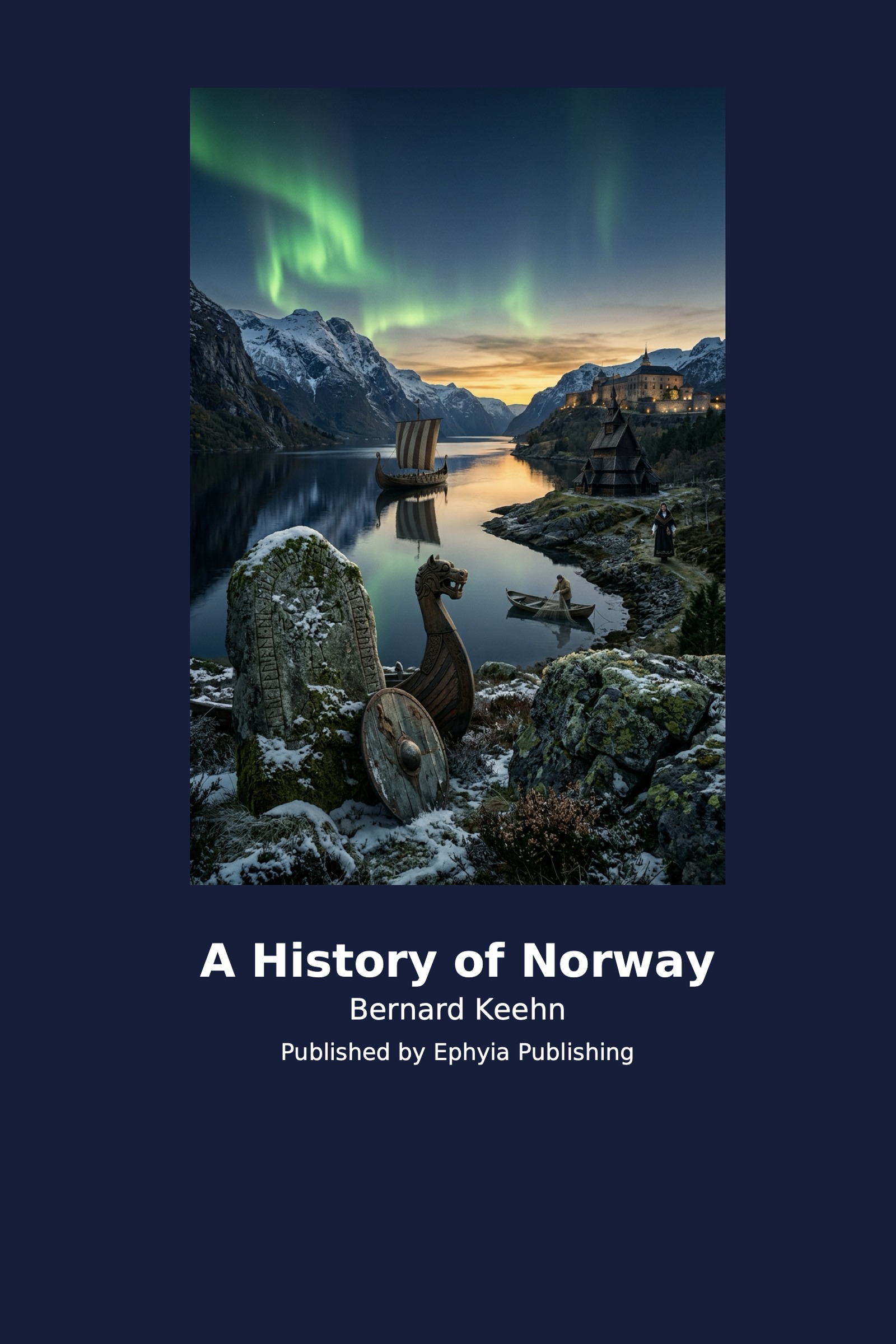

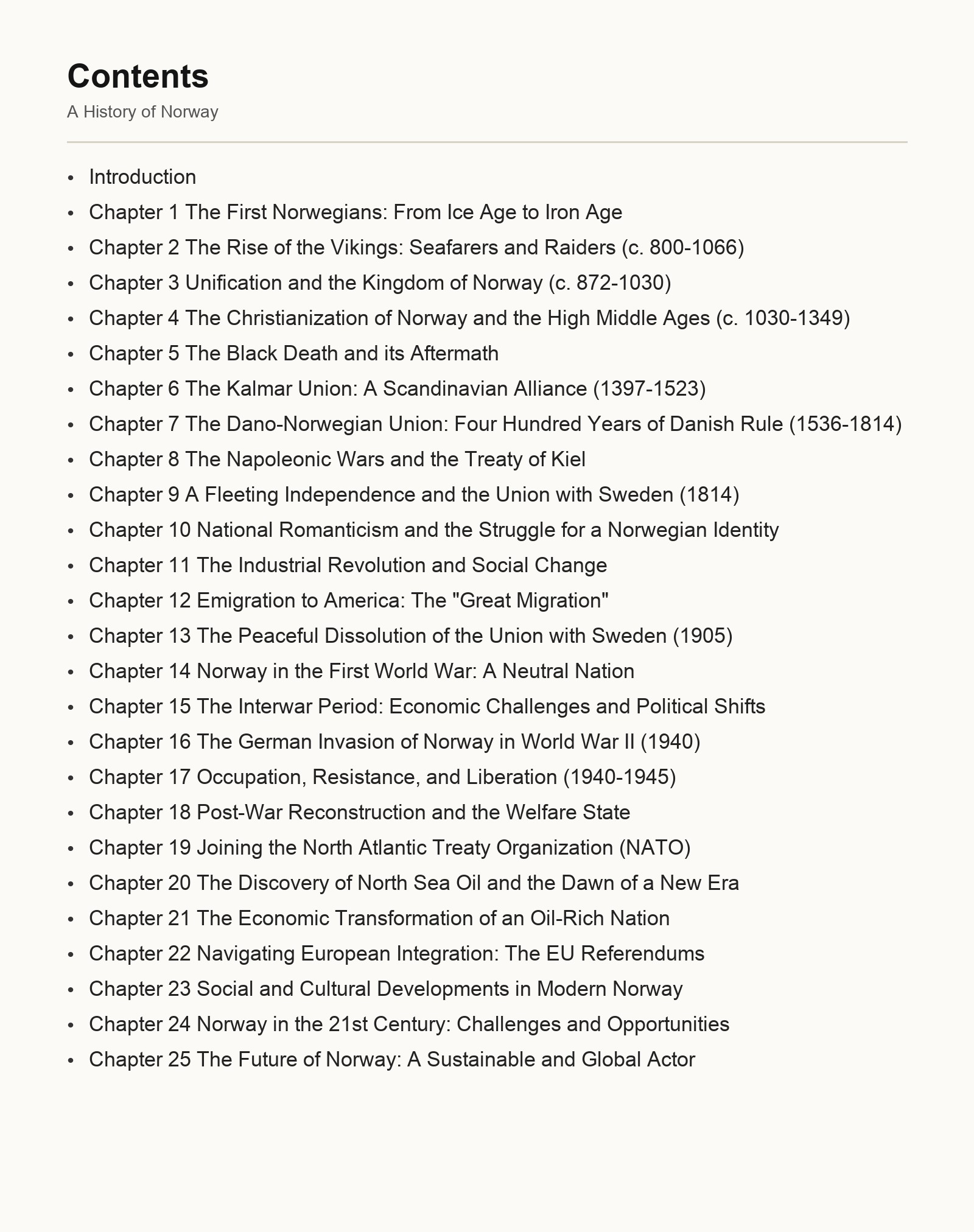
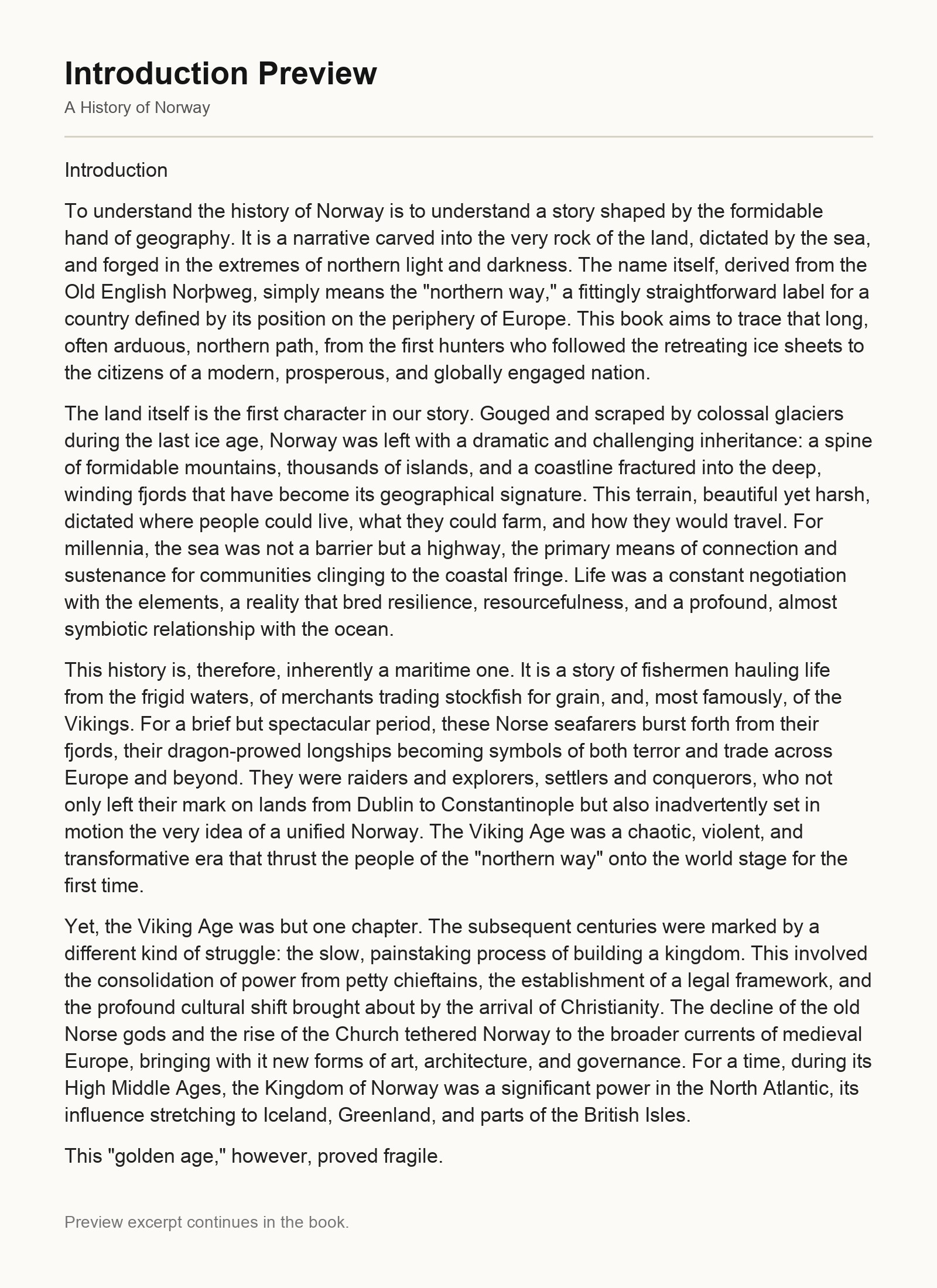
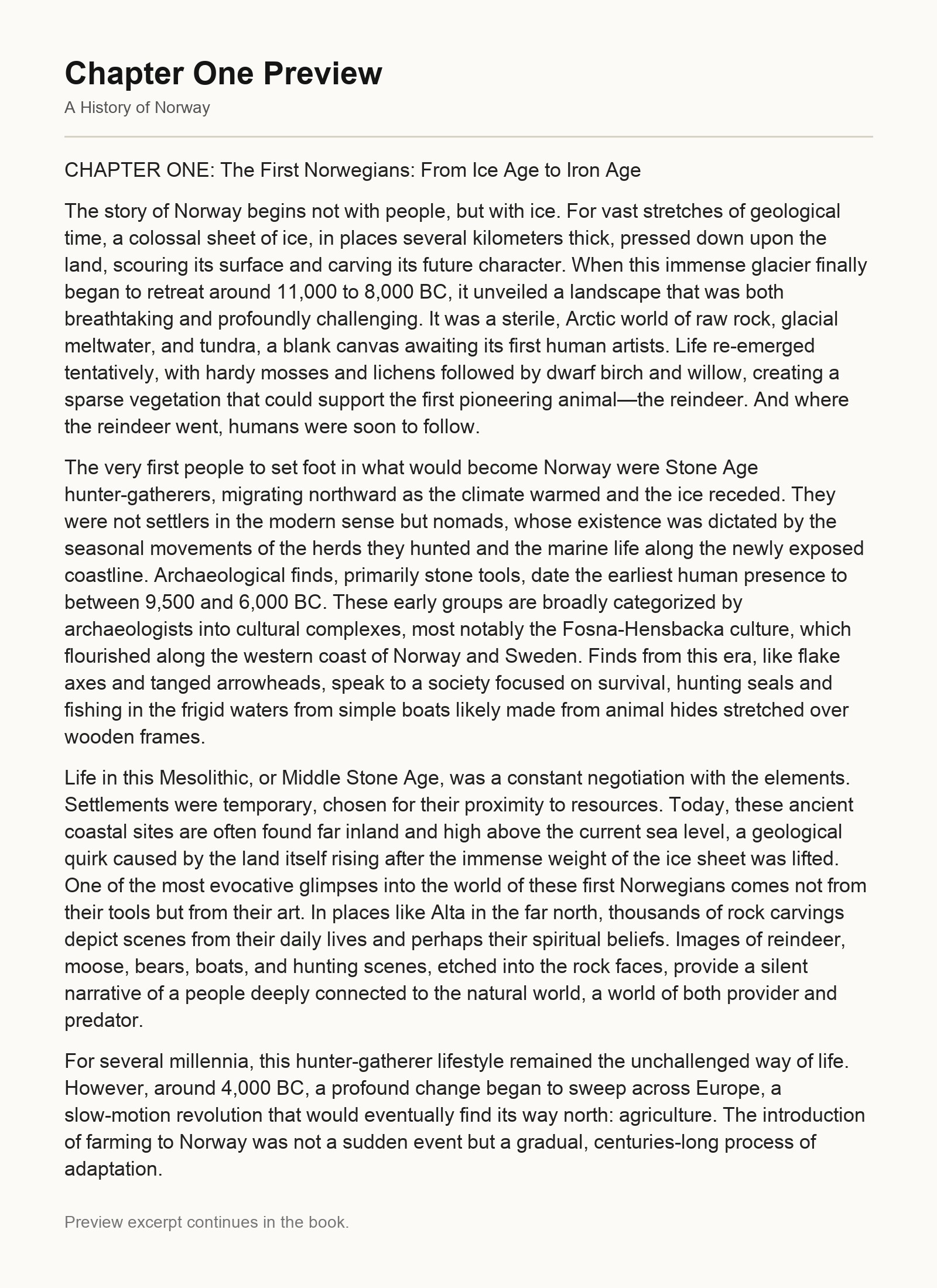
A History of Norway invites readers on a sweeping journey that begins with the retreat of the Ice Age and follows the first hunter‑gatherers who carved out a life along Norway’s rugged fjords and storm‑tossed coasts. From the stone tools of the Fosna‑Hensbacka culture to the bronze‑age chieftains buried with ornate weapons, the book reveals how geography forced a people to become masters of the sea, shaping a culture where fishing, trade, and shipbuilding were inseparable from survival.
The narrative then carries the reader into the legendary Viking Age, detailing the daring raids on Lindisfarne, the settlement of Iceland and Greenland, and the astonishing voyage to Vinland that predated Columbus by centuries. Beyond the swords and longships, the text explores the complex Norse pantheon, the sophisticated trade networks that linked Scandinavia to the Mediterranean, and the profound societal shifts that accompanied the gradual adoption of Christianity and the consolidation of power under Harald Fairhair and his successors.
Readers will witness the long struggle for a unified Norwegian kingdom, from the civil wars of the Bagler and Birkebeiner to the golden age of Haakon Haakonsson, whose North Atlantic empire stretched from the British Isles to Greenland. The book explains how the Black Death devastated the population, how Norway became a province within the Kalmar and later the Dano‑Norwegian unions, and how centuries of Danish rule left a deep imprint on language, law, and national identity before the nineteenth‑century reawakening of national romanticism sparked by figures like Ivar Aasen, Henrik Ibsen, and Edvard Grieg.
The twentieth century unfolds with Norway’s peaceful dissolution of its union with Sweden in 1905, its painful experience of neutrality during two world wars, the German invasion and heroic resistance, and the post‑war construction of one of the world’s most comprehensive welfare states. The discovery of North Sea oil transforms the nation’s fortunes, leading to the creation of the sovereign wealth fund and a bold experiment in managing wealth for future generations, while the book also examines Norway’s ambivalent dance with European integration, its repeated EU referendums, and the ongoing debates over sovereignty, identity, and the country’s role on the global stage.
Finally, A History of Norway looks ahead to the challenges of the twenty‑first century: managing the decline of petroleum wealth, leading the green shift toward offshore wind and carbon capture, preserving the egalitarian welfare model amid an aging population and increasing diversity, and navigating a renewed strategic focus on the High North. By the end, readers will have gained a deep understanding of how a land defined by ice, sea, and long winters forged a resilient, prosperous, and globally engaged nation, and they will appreciate the enduring tension between tradition and change that continues to shape Norway’s future.
What You'll Find Inside:
- The Viking Age exploration and expansion that put Norway on the world map, from raids on Lindisfarne to settlements in Iceland, Greenland, and North America.
- The long struggle for national identity and independence, including the peaceful dissolution of the union with Sweden in 1905 and the cultural renaissance of National Romanticism.
- The devastating impact of the Black Death that killed 60-65% of Norway's population and led to centuries of political decline and foreign domination.
- The transformation from a poor peripheral nation to a wealthy oil-rich country following the North Sea discoveries, and how Norway managed this wealth through its sovereign wealth fund.
- Norway's unique path in the modern world as a NATO member outside the EU, building a comprehensive welfare state while navigating contemporary challenges like climate change and immigration.
Who's It For:
This book is ideal for students, scholars, and general readers interested in Scandinavian history, European development, or the unique journey of a small nation that transformed from Viking raiders to a global peacekeeper and wealthy welfare state. It will particularly benefit those seeking to understand how geography, natural resources, and cultural identity shape a nation's destiny over millennia, from the Ice Age to the challenges of the 21st century.
Author:
Published By:
Date Published:
May 21, 2026
Type:
Nonfiction
Language:
English
Also Available In:
Spanish, French, Italian, Dutch
Word Count:
47,886 words
Reading Time:
3 hours 21 minutes
Sample:
Order:
Order A History of Norway (Paperback) on MixCache.com:
Buy NowPrint copy is made to order and ships worldwide. Includes the ebook free, ready to read instantly.
$5 account credit for all new MixCache.com accounts, usable toward any ebook purchase!*