Browse by Category
Fiction
- Action & Adventure
- African American
- Anthologies
- Children's Fiction
- Classics
- Comics & Graphic Novels
- Coming of Age
- Contemporary
- Cultural & Regional
- Drama
- Erotica
- Fantasy
- General
- Historical Fiction
- Horror
- Humor & Satire
- Literary Fiction
- Mystery, Thriller & Suspense
- Poetry
- Religious & Inspirational
- Romance
- Science Fiction
- Short Stories
- War & Military
- Westerns
- Women's Fiction
- Young Adult
Non-Fiction
- Antiques & Collectibles
- Arts & Photography
- Biographies & Memoirs
- Business & Money
- Children's Non-Fiction
-
Computers & Technology
- Artificial Intelligence
- Computer Science
- Cybersecurity & Cryptography
- Data Science & Analytics
- Databases & Big Data
- Game Development & Design
- General
- Hardware & DIY
- Mobile App Development
- Networking & Cloud Computing
- Operating Systems
- Programming
- Robotics
- Software
- Software Engineering
- User Experience (UX) & Design
- Web Development & Design
- Cooking, Food & Wine
- Crafts, Hobbies & Home
- Education & Teaching
- Engineering
- General
- Health, Fitness & Dieting
-
History
- African History
- African History - North Africa
- African History - Sub-Saharan Africa
- American History
- American History - 20th Century
- American History - Civil War
- American History - Colonial Period
- Ancient History
- Asian History
- Asian History - China
- Asian History - India
- Asian History - Japan
- Asian History - Southeast Asia
- European History
- European History - Ancient Greece
- European History - Ancient Rome
- European History - Medieval
- European History - Modern
- European History - Renaissance
- General
- Middle Eastern History
- Military History
- Military History - Aviation
- Military History - Naval
- Social & Cultural History
- World History
- Humor & Entertainment
- Industrial Technology
- Language Learning
- Law
- LGBTQ+ Non-Fiction
- Literary Criticism
- Medical Books
- Parenting & Relationships
- Philosophy
- Politics & Social Sciences
- Reference
- Religion & Spirituality
-
Science & Math
- Agricultural Sciences
- Astronomy & Space Science
- Behavioral Sciences
- Biological Sciences
- Botany & Plant Science
- Chemistry
- Earth Sciences
- Engineering - Chemical
- Engineering - Civil
- Engineering - Electrical
- Engineering - Mechanical
- Environment
- General
- Geology
- Mathematics
- Nature & Ecology
- Oceanography
- Paleontology
- Physics
- Statistics
- Self-Help
- Sports & Outdoors
- Study Aids
- Sustainability & Green Living
- Textbooks
- Transportation
- Travel
- True Crime
- Urban Planning & Development
- Veterinary Medicine
- Writing & Publishing
Jump to Section
MixCache.com Total Access
Unlimited reading and audiobooks for every book published by MixCache.com.
Included titles carry the MTA badge.
Learn more →A History of Capitalism
About this book:



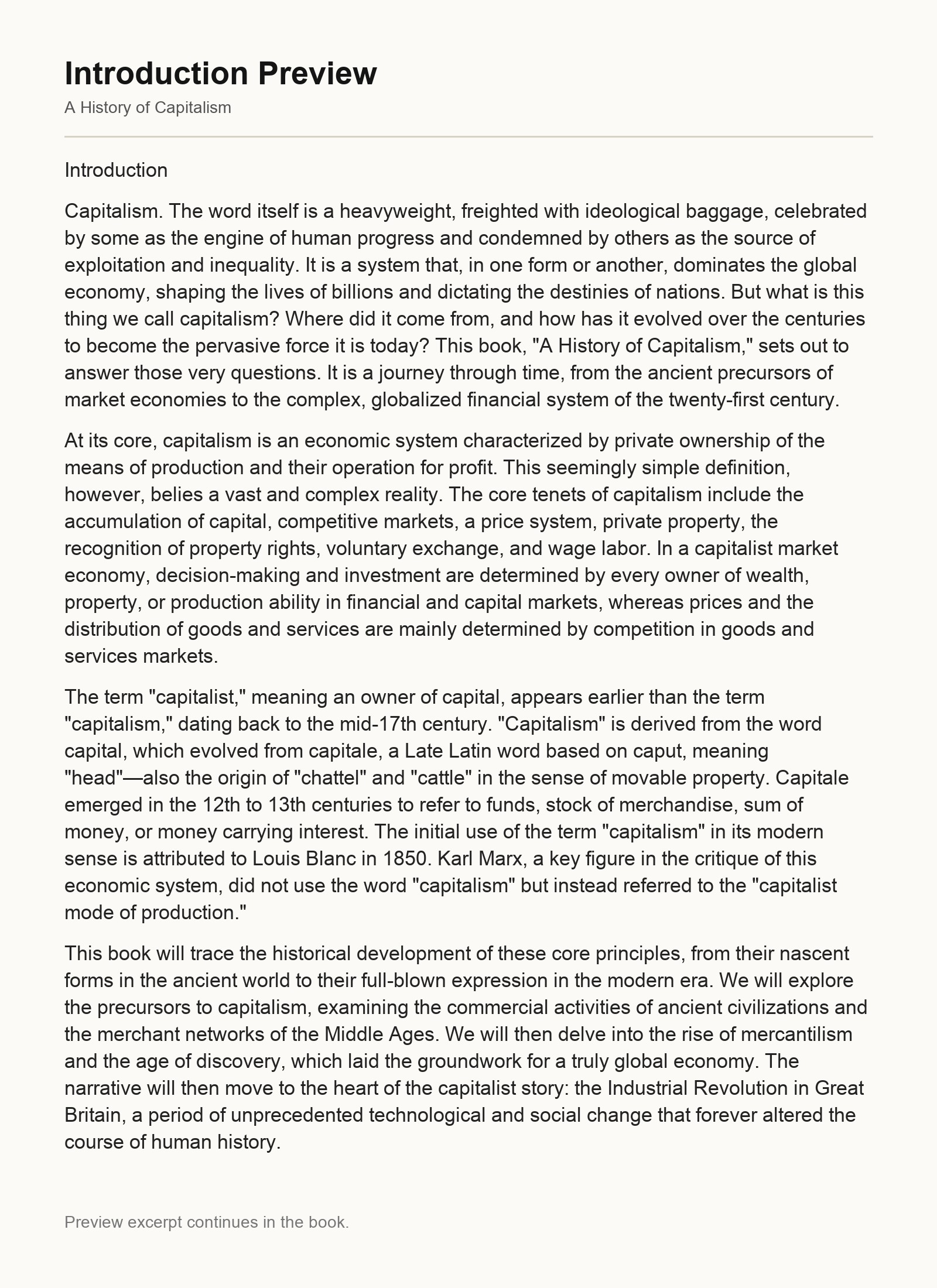
"A History of Capitalism" invites readers on an expansive journey through the evolution of one of the world’s most influential economic systems, tracing its roots from the clay‑tablet markets of Mesopotamia to the algorithm‑driven finance of the twenty‑first century. Each chapter builds a clear narrative that shows how private ownership, profit motive, and market exchange emerged, were tested, and transformed across centuries, allowing readers to see the deep connections between ancient trade practices and today’s globalized economy.
Readers will encounter the pivotal moments that reshaped societies: the Commercial Revolution of the Italian city‑states, the brutal enclosures that created a landless proletariat, the roar of steam and iron that powered the Industrial Revolution, and the ideological clashes between Adam Smith’s invisible hand and Karl Marx’s critique of exploitation. The book also explains how state policies—from mercantilist bullion hoarding to Bretton Woods cooperation and later neoliberal deregulation—have repeatedly redirected the flow of capital and power.
Beyond the milestones of production and trade, the work delves into the human experience of capitalism, examining the rise of the working class, the formation of trade unions, the social upheavals of the Gilded Age, and the postwar welfare state that promised shared prosperity. It brings to life the cultural forces that undergirded economic change, such as the Protestant ethic, the gospel of wealth, and the consumer credit boom of the Roaring Twenties, helping readers understand why capitalism feels both empowering and unsettling at different times.
The narrative continues into the contemporary era, unpacking the financialization of Wall Street, the dot‑com bubble, the rise of state‑led capitalism in China, and the stark realities of inequality highlighted by movements like Occupy Wall Street and thinkers like Thomas Piketty. Readers will gain insight into the challenges that loom ahead—climate limits, artificial intelligence, surveillance capitalism, and renewed debates over universal basic income and stakeholder responsibility—offering a foundation for thinking critically about what capitalism might become.
By the end of the book, readers will have a comprehensive grasp of how capitalism’s core principles have been continually invented, contested, and reinvented, equipping them with the historical perspective needed to engage with today’s economic debates and to imagine possible futures for the system that shapes our world.
What You'll Find Inside:
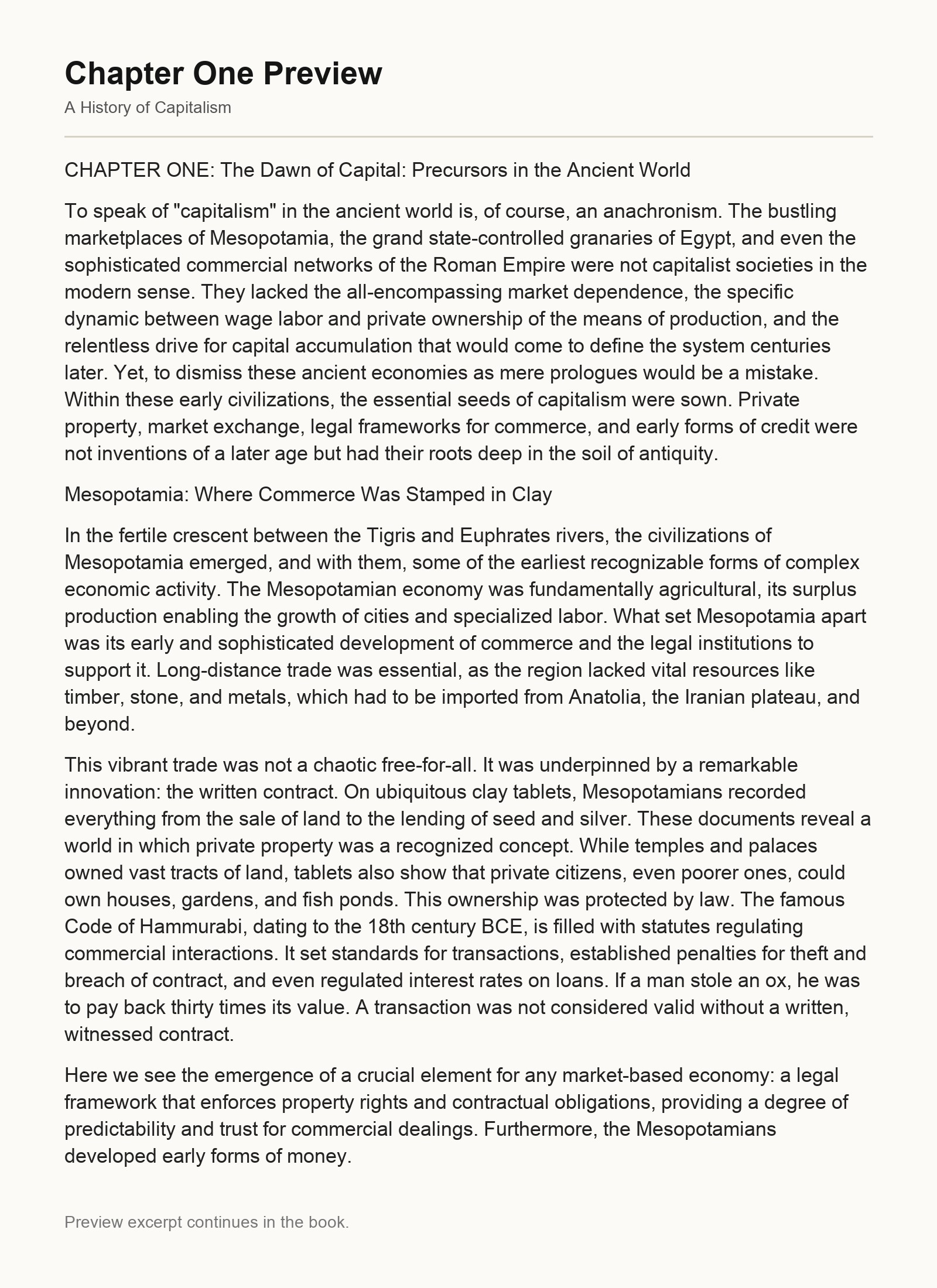
- Traces capitalism's evolution from ancient precursors in Mesopotamia and Rome through mercantilism, the Industrial Revolution, and into today's financialized global system.
- Examines key economic theories including Adam Smith's classical economics, Marx's critique, Keynesian responses to depression, and the neoliberal turn of Hayek and Friedman.
- Analyzes capitalism's social impacts: enclosure movements creating landless laborers, rise of the working class and labor movements, and 21st-century inequality trends.
- Explores capitalism's global dimensions: colonialism and imperialism, Bretton Woods system, fall of communism, and emergence of state-led capitalism in China.
- Addresses contemporary challenges: financialization and the 2008 crisis, technological disruption, ecological limits, and debates about capitalism's future alternatives.
Who's It For:
This book is ideal for students and scholars of history, economics, and political science seeking a comprehensive historical understanding of capitalism's development. It will also appeal to general readers interested in how economic systems shape societies, particularly those wanting to understand current economic inequalities, financial crises, and debates about capitalism's future in light of technological change, globalization, and environmental challenges.
Table of Contents:
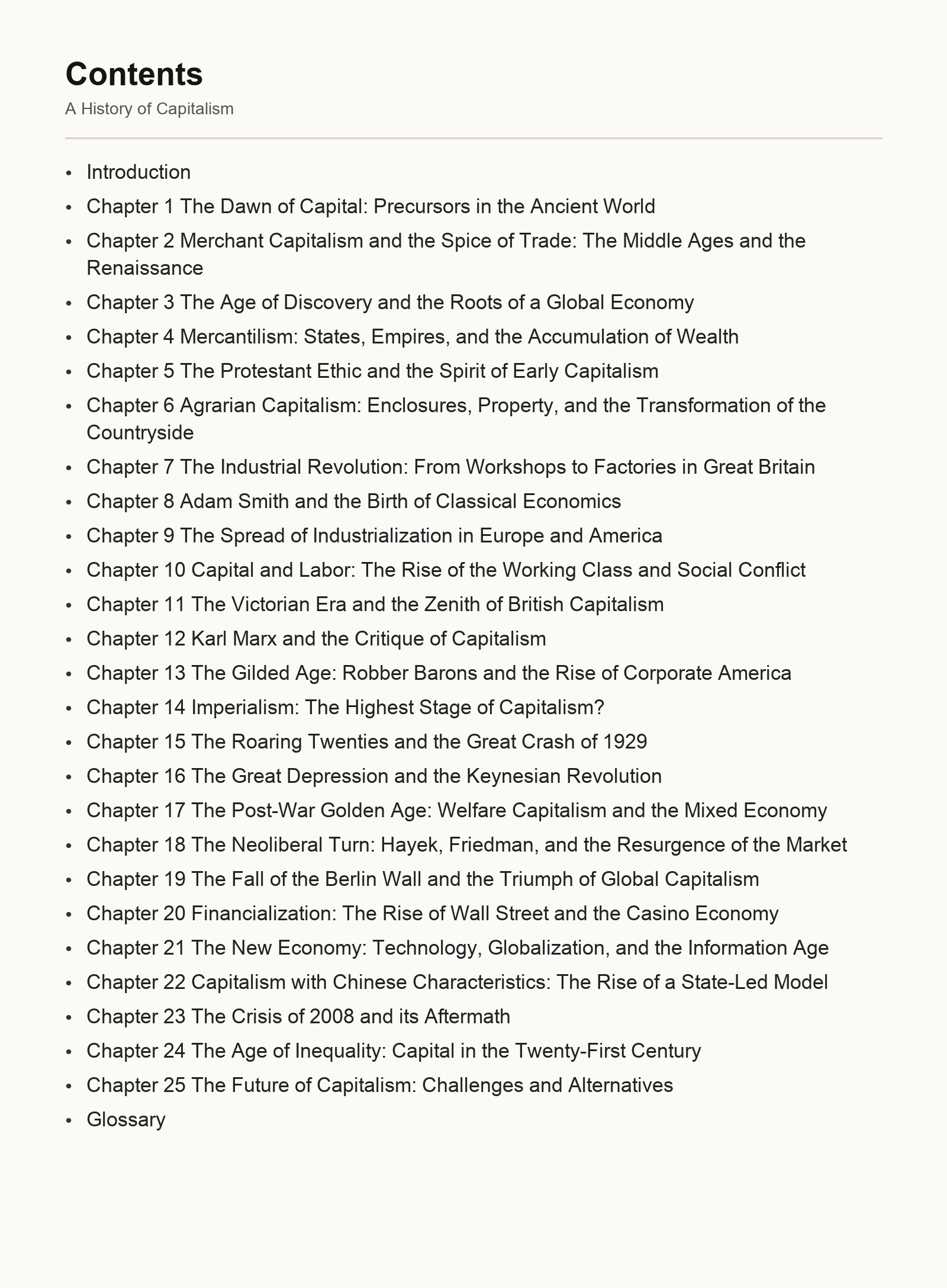
- Introduction
- Chapter 1 The Dawn of Capital: Precursors in the Ancient World
- Chapter 2 Merchant Capitalism and the Spice of Trade: The Middle Ages and the Renaissance
- Chapter 3 The Age of Discovery and the Roots of a Global Economy
- Chapter 4 Mercantilism: States, Empires, and the Accumulation of Wealth
- Chapter 5 The Protestant Ethic and the Spirit of Early Capitalism
- Chapter 6 Agrarian Capitalism: Enclosures, Property, and the Transformation of the Countryside
- Chapter 7 The Industrial Revolution: From Workshops to Factories in Great Britain
- Chapter 8 Adam Smith and the Birth of Classical Economics
- Chapter 9 The Spread of Industrialization in Europe and America
- Chapter 10 Capital and Labor: The Rise of the Working Class and Social Conflict
- Chapter 11 The Victorian Era and the Zenith of British Capitalism
- Chapter 12 Karl Marx and the Critique of Capitalism
- Chapter 13 The Gilded Age: Robber Barons and the Rise of Corporate America
- Chapter 14 Imperialism: The Highest Stage of Capitalism?
- Chapter 15 The Roaring Twenties and the Great Crash of 1929
- Chapter 16 The Great Depression and the Keynesian Revolution
- Chapter 17 The Post-War Golden Age: Welfare Capitalism and the Mixed Economy
- Chapter 18 The Neoliberal Turn: Hayek, Friedman, and the Resurgence of the Market
- Chapter 19 The Fall of the Berlin Wall and the Triumph of Global Capitalism
- Chapter 20 Financialization: The Rise of Wall Street and the Casino Economy
- Chapter 21 The New Economy: Technology, Globalization, and the Information Age
- Chapter 22 Capitalism with Chinese Characteristics: The Rise of a State-Led Model
- Chapter 23 The Crisis of 2008 and its Aftermath
- Chapter 24 The Age of Inequality: Capital in the Twenty-First Century
- Chapter 25 The Future of Capitalism: Challenges and Alternatives
- Glossary
Author:
Published By:
Date Published:
May 20, 2026
Type:
Nonfiction
Language:
English
Also Available In:
Word Count:
54,527 words
Reading Time:
3 hours 49 minutes
Sample:
Order:
Order A History of Capitalism (Paperback) on MixCache.com:
Buy NowPrint copy is made to order and ships worldwide. Includes the ebook free, ready to read instantly.
$5 account credit for all new MixCache.com accounts, usable toward any ebook purchase!*