Browse by Category
Fiction
- Action & Adventure
- African American
- Anthologies
- Children's Fiction
- Classics
- Comics & Graphic Novels
- Coming of Age
- Contemporary
- Cultural & Regional
- Drama
- Erotica
- Fantasy
- General
- Historical Fiction
- Horror
- Humor & Satire
- Literary Fiction
- Mystery, Thriller & Suspense
- Poetry
- Religious & Inspirational
- Romance
- Science Fiction
- Short Stories
- War & Military
- Westerns
- Women's Fiction
- Young Adult
Non-Fiction
- Antiques & Collectibles
- Arts & Photography
- Biographies & Memoirs
- Business & Money
- Children's Non-Fiction
-
Computers & Technology
- Artificial Intelligence
- Computer Science
- Cybersecurity & Cryptography
- Data Science & Analytics
- Databases & Big Data
- Game Development & Design
- General
- Hardware & DIY
- Mobile App Development
- Networking & Cloud Computing
- Operating Systems
- Programming
- Robotics
- Software
- Software Engineering
- User Experience (UX) & Design
- Web Development & Design
- Cooking, Food & Wine
- Crafts, Hobbies & Home
- Education & Teaching
- Engineering
- General
- Health, Fitness & Dieting
-
History
- African History
- African History - North Africa
- African History - Sub-Saharan Africa
- American History
- American History - 20th Century
- American History - Civil War
- American History - Colonial Period
- Ancient History
- Asian History
- Asian History - China
- Asian History - India
- Asian History - Japan
- Asian History - Southeast Asia
- European History
- European History - Ancient Greece
- European History - Ancient Rome
- European History - Medieval
- European History - Modern
- European History - Renaissance
- General
- Middle Eastern History
- Military History
- Military History - Aviation
- Military History - Naval
- Social & Cultural History
- World History
- Humor & Entertainment
- Industrial Technology
- Language Learning
- Law
- LGBTQ+ Non-Fiction
- Literary Criticism
- Medical Books
- Parenting & Relationships
- Philosophy
- Politics & Social Sciences
- Reference
- Religion & Spirituality
-
Science & Math
- Agricultural Sciences
- Astronomy & Space Science
- Behavioral Sciences
- Biological Sciences
- Botany & Plant Science
- Chemistry
- Earth Sciences
- Engineering - Chemical
- Engineering - Civil
- Engineering - Electrical
- Engineering - Mechanical
- Environment
- General
- Geology
- Mathematics
- Nature & Ecology
- Oceanography
- Paleontology
- Physics
- Statistics
- Self-Help
- Sports & Outdoors
- Study Aids
- Sustainability & Green Living
- Textbooks
- Transportation
- Travel
- True Crime
- Urban Planning & Development
- Veterinary Medicine
- Writing & Publishing
Jump to Section
MixCache.com Total Access
Unlimited reading and audiobooks for every book published by MixCache.com.
Included titles carry the MTA badge.
Learn more →A History of Literature
About this book:

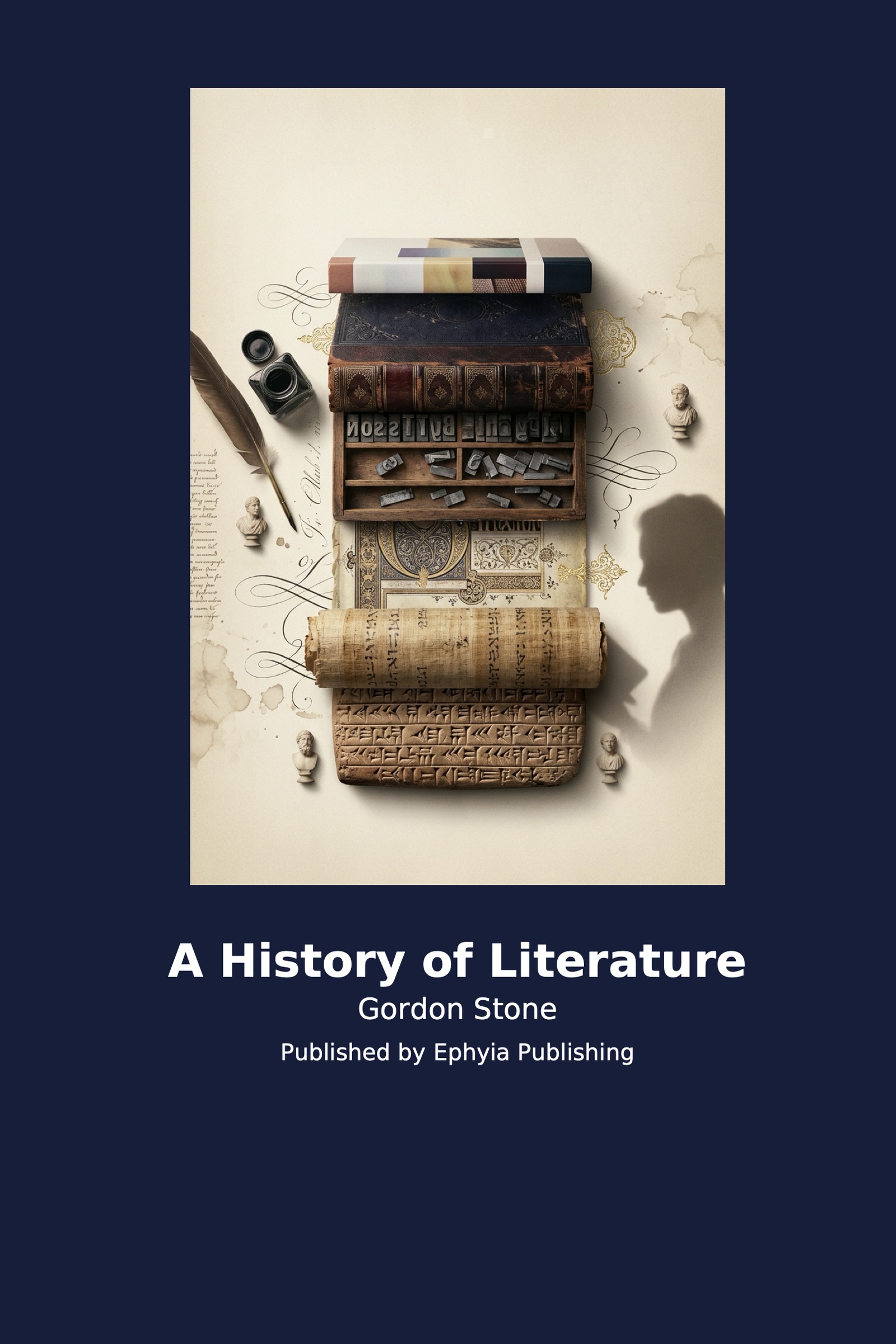
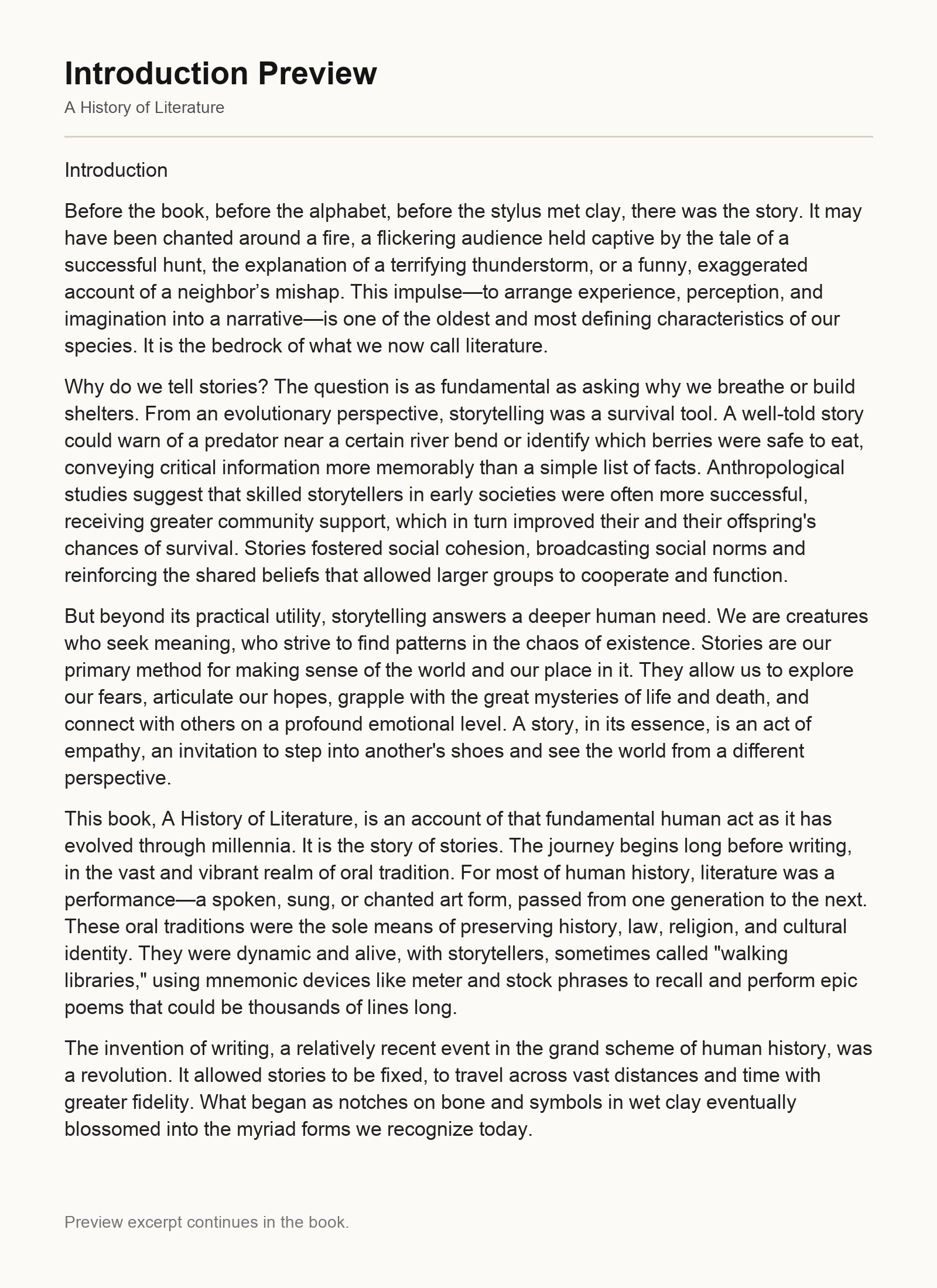
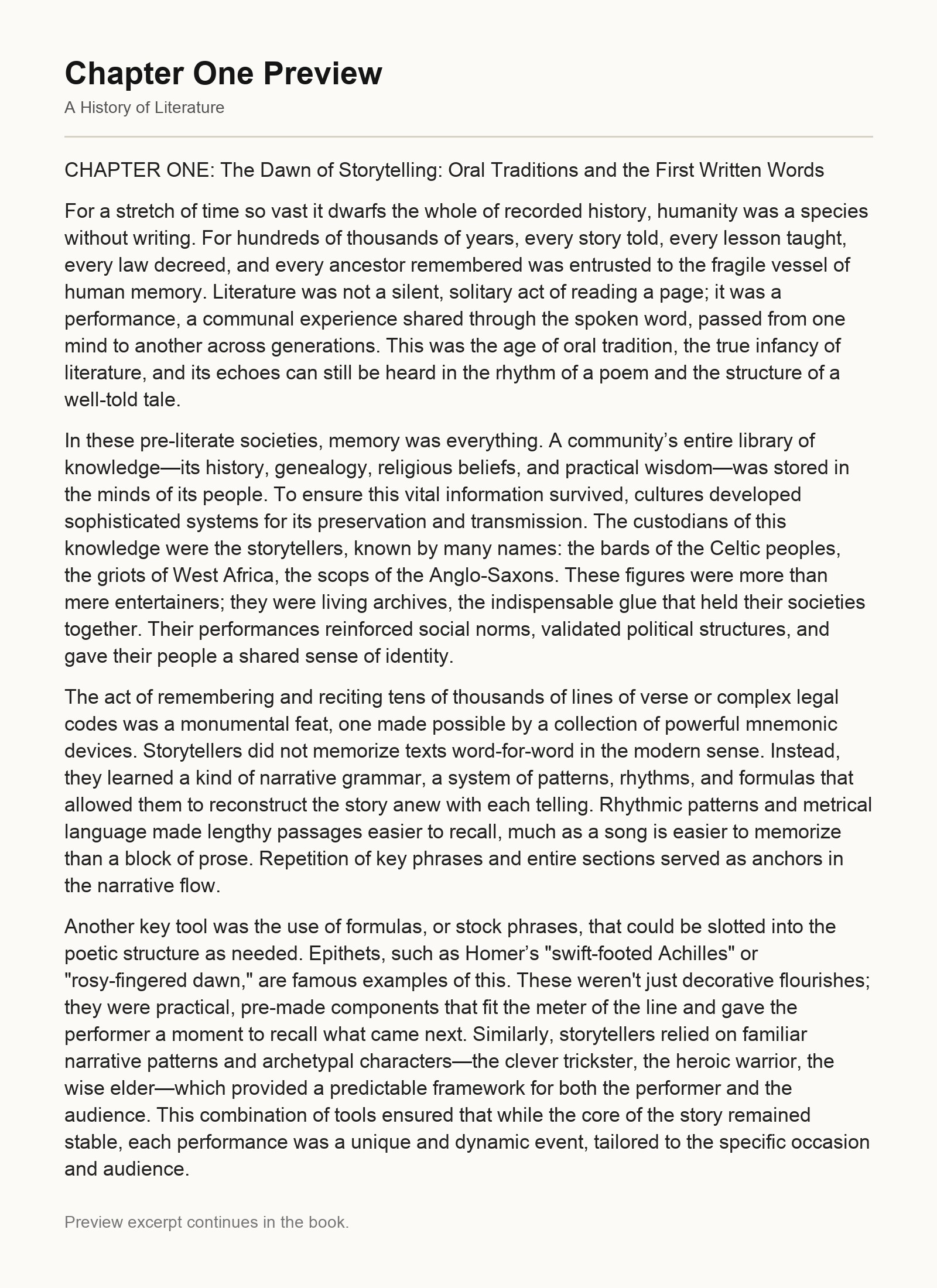
A History of Literature invites readers on an expansive journey through the story of storytelling itself, tracing how humanity has shaped and been shaped by words from the earliest campfire chants to today’s digital narratives. Beginning with oral traditions and the first written marks on clay, the book reveals how mnemonic devices, epic poetry, and sacred scripts emerged as tools for survival, social cohesion, and the search for meaning across Mesopotamia, Egypt, Greece, Rome, China, India, and beyond. Each chapter illuminates the cultural forces—technological advances, religious movements, political shifts—that gave rise to new literary forms and renewed the purpose of narrative.
Readers will walk alongside the great epics of Gilgamesh and the Iliad, engage with the philosophical dialogues of Plato and Aristotle, and witness the Roman synthesis of Greek models into works like the Aeneid and the satires of Juvenal. The narrative then turns to the profound impact of sacred texts—from the Hebrew Bible and the New Testament to the Quran—showing how divine revelation transformed literature into a foundation for law, ethics, and communal identity. The journey continues eastward to explore the lyrical elegance of ancient Chinese poetry, the philosophical depth of the Upanishads and the Mahabharata, and the vibrant oral traditions that kept stories alive across continents.
Moving into the medieval and early modern periods, the book examines how monastic scriptoria preserved classical knowledge while new vernacular voices flourished in troubadour lyrics, Arthurian romance, and Dante’s Divine Comedy. It follows the Islamic Golden Age’s lyrical and prose masterpieces, the humanist revival of the Renaissance, and the Enlightenment’s fierce critique of authority through Voltaire, Rousseau, and the early novel. Readers will experience the emotional intensity of Romanticism, the social realism of Victorian literature, and the bold experiments of American writers who forged a national voice from Transcendentalism to the gritty realism of Twain and James.
The twentieth century unfolds through the ruptures of Modernism, the disillusionment of the Lost Generation, the rise of postcolonial narratives, and the existential confrontations of Sartre and Camus. Readers will encounter the magical realism of the Latin American Boom, the playful deconstructions of Postmodernism, and the polyphonic chorus of contemporary global authors who blend migration, technology, and hybrid identities. Finally, the book considers how genre fiction—from science fiction and fantasy to horror and crime—has expanded the boundaries of storytelling, and how the digital age is once again redefining creation, distribution, and the very nature of the text. By the end, readers will have gained a panoramic understanding of literature as both a mirror and a hammer of human civilization, equipped to appreciate the continuities and ruptures that shape every story we tell.
What You'll Find Inside:
- Traces literature's evolution from oral traditions and ancient writing systems (cuneiform, hieroglyphics) through to contemporary digital formats and AI-generated text.
- Explores how major literary movements - from Epic poetry and Greek tragedy to Modernism and Postmodernism - reflect and shape the philosophical and social contexts of their eras.
- Examines the global diversity of literary traditions, covering seminal works from Mesopotamia, ancient Greece and Rome, China, India, the Islamic world, Africa, and the Americas.
- Analyzes the reciprocal relationship between literature and society, showing how texts both reflect cultural values and actively shape social norms and historical events.
- Investigates how technological innovations - from the printing press to the internet and AI - have continually transformed how literature is created, distributed, and consumed.
Who's It For:
This book is ideal for literature students, educators, and intellectually curious readers seeking a comprehensive understanding of world literary history. It serves both as an academic resource for those studying literature or humanities and as an engaging survey for general readers interested in how storytelling has evolved across cultures and millennia. The accessible yet substantive approach makes it suitable for undergraduate courses while providing sufficient depth for graduate-level study or lifelong learners.
Table of Contents:
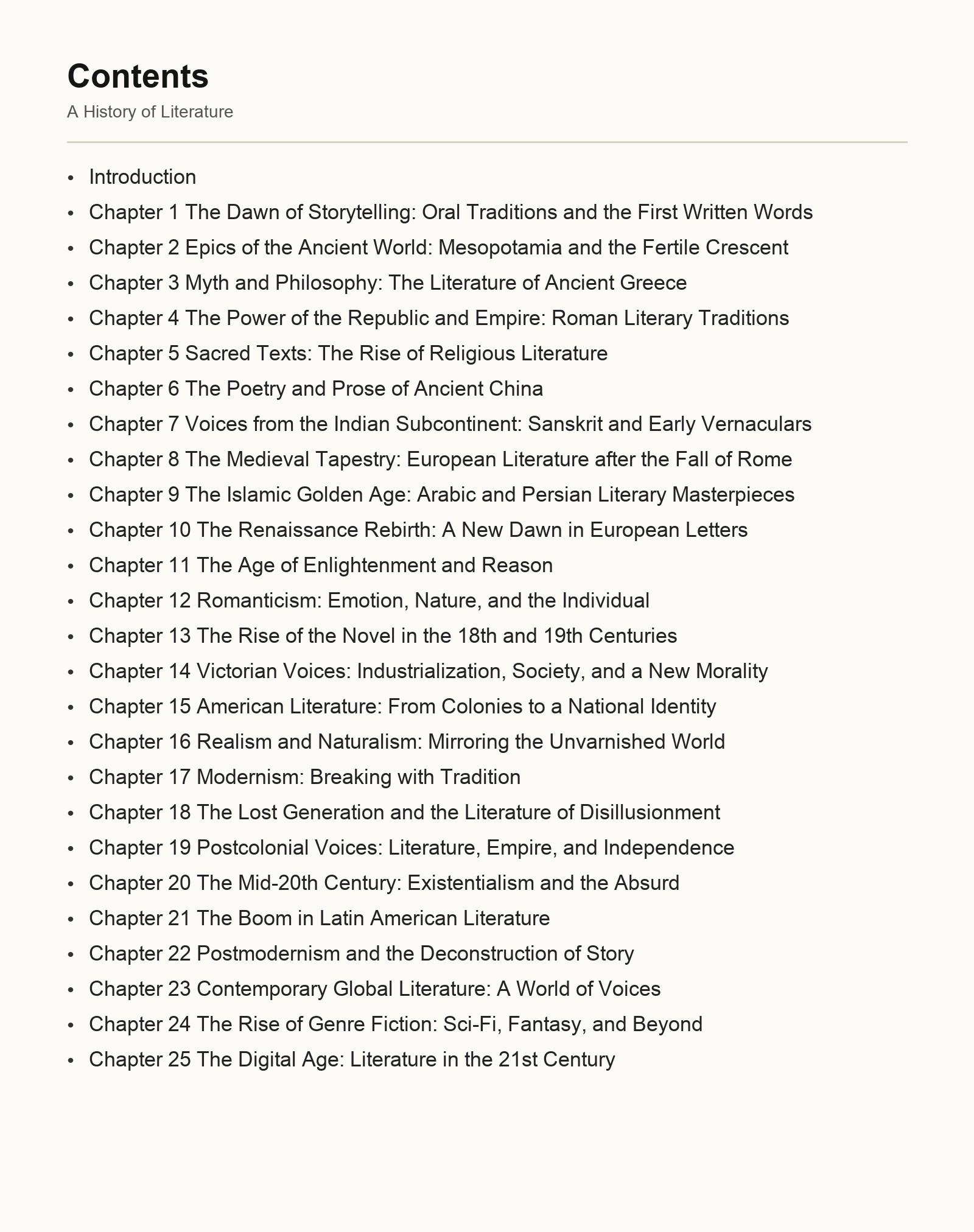
- Introduction
- Chapter 1 The Dawn of Storytelling: Oral Traditions and the First Written Words
- Chapter 2 Epics of the Ancient World: Mesopotamia and the Fertile Crescent
- Chapter 3 Myth and Philosophy: The Literature of Ancient Greece
- Chapter 4 The Power of the Republic and Empire: Roman Literary Traditions
- Chapter 5 Sacred Texts: The Rise of Religious Literature
- Chapter 6 The Poetry and Prose of Ancient China
- Chapter 7 Voices from the Indian Subcontinent: Sanskrit and Early Vernaculars
- Chapter 8 The Medieval Tapestry: European Literature after the Fall of Rome
- Chapter 9 The Islamic Golden Age: Arabic and Persian Literary Masterpieces
- Chapter 10 The Renaissance Rebirth: A New Dawn in European Letters
- Chapter 11 The Age of Enlightenment and Reason
- Chapter 12 Romanticism: Emotion, Nature, and the Individual
- Chapter 13 The Rise of the Novel in the 18th and 19th Centuries
- Chapter 14 Victorian Voices: Industrialization, Society, and a New Morality
- Chapter 15 American Literature: From Colonies to a National Identity
- Chapter 16 Realism and Naturalism: Mirroring the Unvarnished World
- Chapter 17 Modernism: Breaking with Tradition
- Chapter 18 The Lost Generation and the Literature of Disillusionment
- Chapter 19 Postcolonial Voices: Literature, Empire, and Independence
- Chapter 20 The Mid-20th Century: Existentialism and the Absurd
- Chapter 21 The Boom in Latin American Literature
- Chapter 22 Postmodernism and the Deconstruction of Story
- Chapter 23 Contemporary Global Literature: A World of Voices
- Chapter 24 The Rise of Genre Fiction: Sci-Fi, Fantasy, and Beyond
- Chapter 25 The Digital Age: Literature in the 21st Century
Author:
Published By:
Date Published:
May 20, 2026
Type:
Nonfiction
Language:
English
Also Available In:
Word Count:
50,605 words
Reading Time:
3 hours 33 minutes
Sample:
Order:
Order A History of Literature (Hardcover) on MixCache.com:
Buy NowPrint copy is made to order and ships worldwide. Includes the ebook free, ready to read instantly.
$5 account credit for all new MixCache.com accounts, usable toward any ebook purchase!*