Browse by Category
Fiction
- Action & Adventure
- African American
- Anthologies
- Children's Fiction
- Classics
- Comics & Graphic Novels
- Coming of Age
- Contemporary
- Cultural & Regional
- Drama
- Erotica
- Fantasy
- General
- Historical Fiction
- Horror
- Humor & Satire
- Literary Fiction
- Mystery, Thriller & Suspense
- Poetry
- Religious & Inspirational
- Romance
- Science Fiction
- Short Stories
- War & Military
- Westerns
- Women's Fiction
- Young Adult
Non-Fiction
- Antiques & Collectibles
- Arts & Photography
- Biographies & Memoirs
- Business & Money
- Children's Non-Fiction
-
Computers & Technology
- Artificial Intelligence
- Computer Science
- Cybersecurity & Cryptography
- Data Science & Analytics
- Databases & Big Data
- Game Development & Design
- General
- Hardware & DIY
- Mobile App Development
- Networking & Cloud Computing
- Operating Systems
- Programming
- Robotics
- Software
- Software Engineering
- User Experience (UX) & Design
- Web Development & Design
- Cooking, Food & Wine
- Crafts, Hobbies & Home
- Education & Teaching
- Engineering
- General
- Health, Fitness & Dieting
-
History
- African History
- African History - North Africa
- African History - Sub-Saharan Africa
- American History
- American History - 20th Century
- American History - Civil War
- American History - Colonial Period
- Ancient History
- Asian History
- Asian History - China
- Asian History - India
- Asian History - Japan
- Asian History - Southeast Asia
- European History
- European History - Ancient Greece
- European History - Ancient Rome
- European History - Medieval
- European History - Modern
- European History - Renaissance
- General
- Middle Eastern History
- Military History
- Military History - Aviation
- Military History - Naval
- Social & Cultural History
- World History
- Humor & Entertainment
- Industrial Technology
- Language Learning
- Law
- LGBTQ+ Non-Fiction
- Literary Criticism
- Medical Books
- Parenting & Relationships
- Philosophy
- Politics & Social Sciences
- Reference
- Religion & Spirituality
-
Science & Math
- Agricultural Sciences
- Astronomy & Space Science
- Behavioral Sciences
- Biological Sciences
- Botany & Plant Science
- Chemistry
- Earth Sciences
- Engineering - Chemical
- Engineering - Civil
- Engineering - Electrical
- Engineering - Mechanical
- Environment
- General
- Geology
- Mathematics
- Nature & Ecology
- Oceanography
- Paleontology
- Physics
- Statistics
- Self-Help
- Sports & Outdoors
- Study Aids
- Sustainability & Green Living
- Textbooks
- Transportation
- Travel
- True Crime
- Urban Planning & Development
- Veterinary Medicine
- Writing & Publishing
Jump to Section
MixCache.com Total Access
Unlimited reading and audiobooks for every book published by MixCache.com.
Included titles carry the MTA badge.
Learn more →A History of Mathematics
About this book:

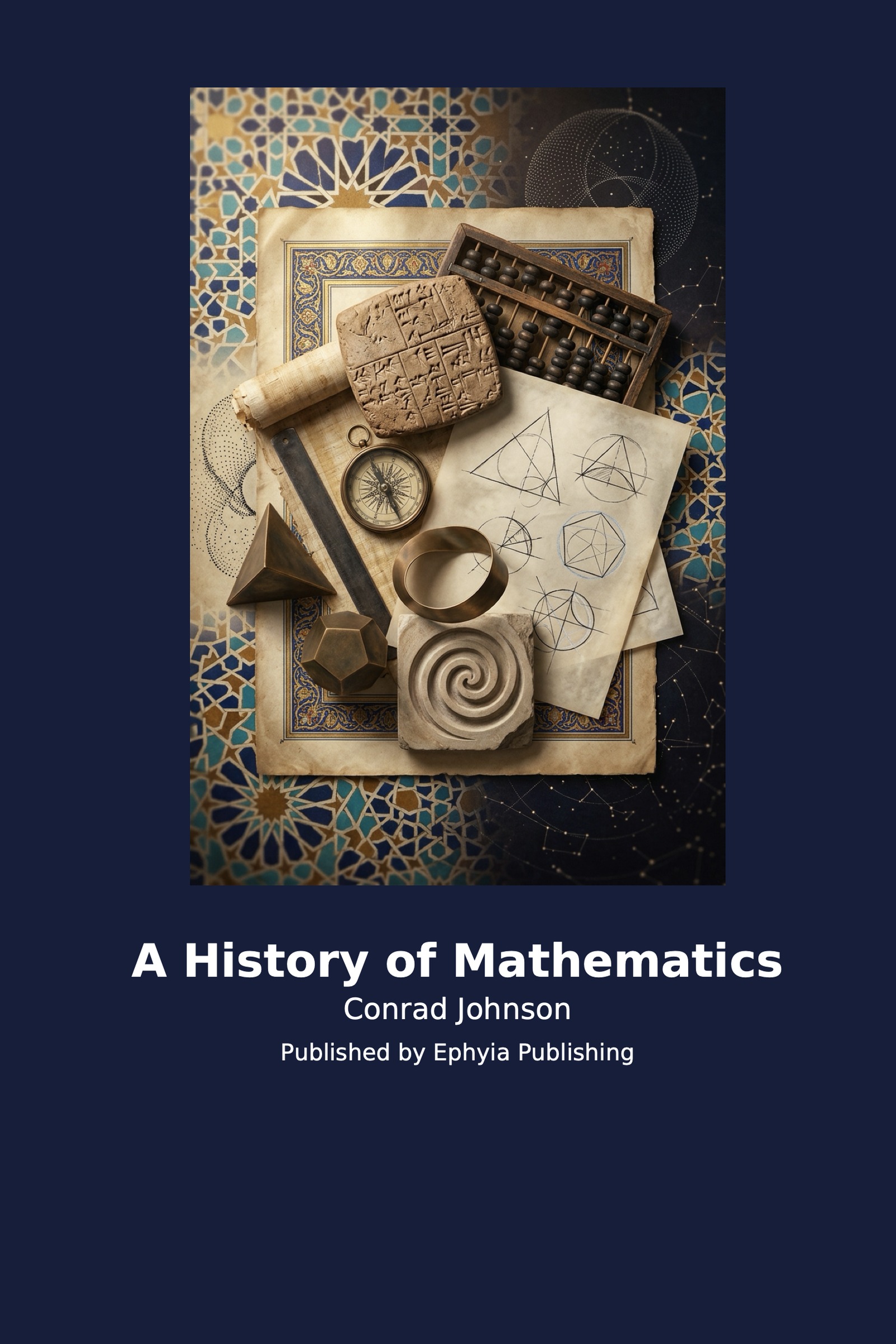

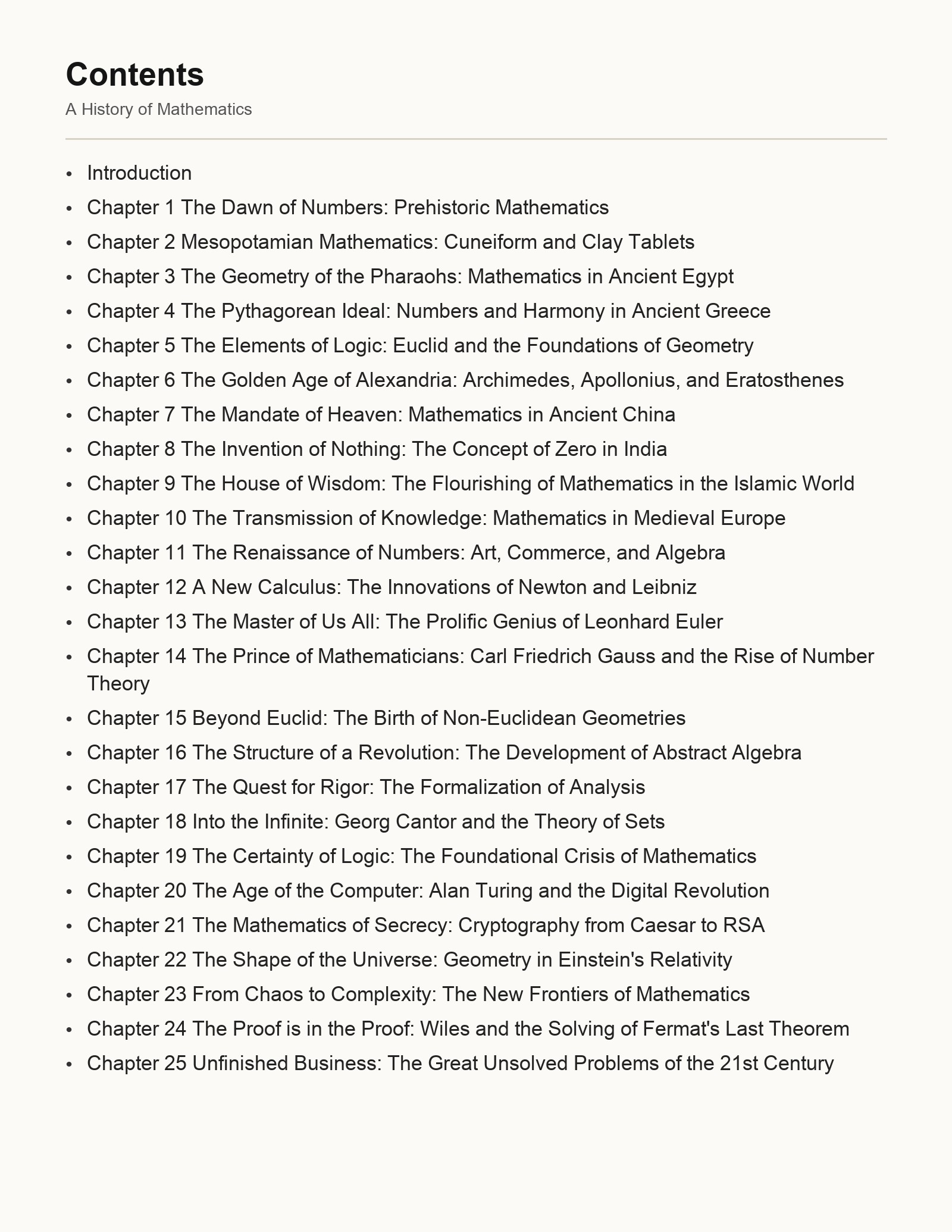
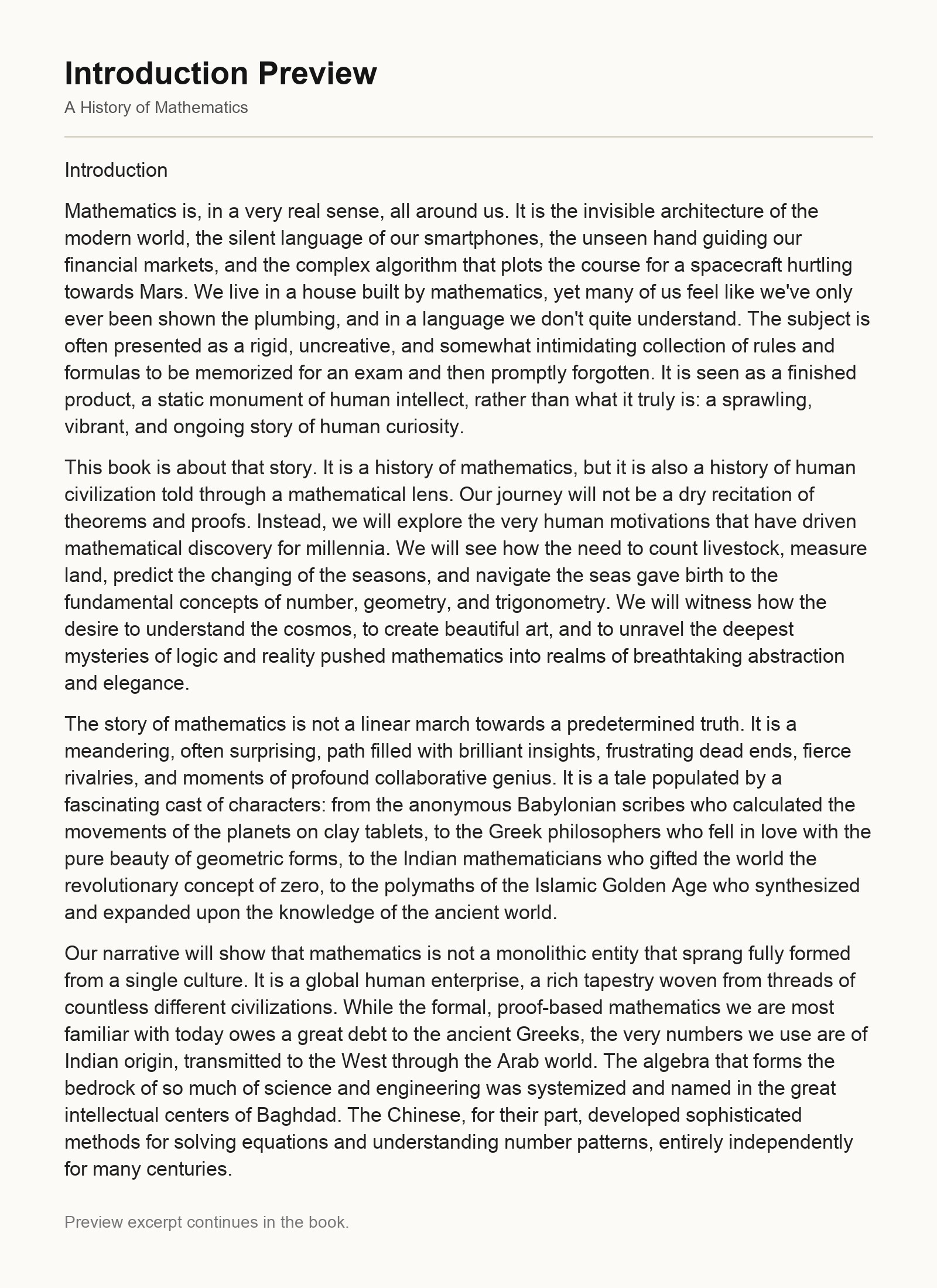
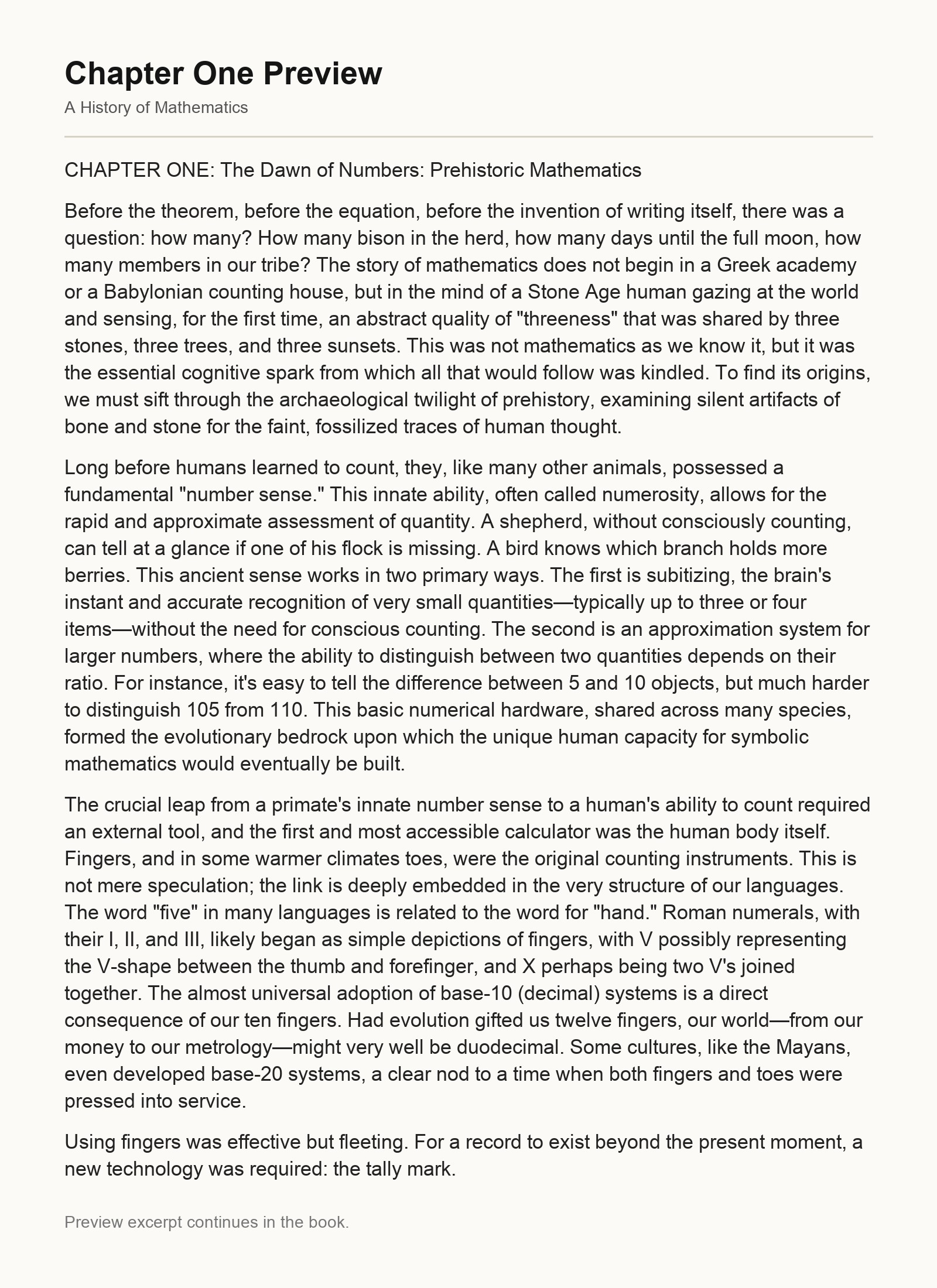
A History of Mathematics invites readers on an epic journey through time, tracing the evolution of mathematical thought from the first notches on prehistoric bones to the cutting‑edge challenges of the twenty‑first century. Each chapter reveals how practical needs—counting livestock, measuring land, predicting celestial events—sparked the earliest ideas of number and shape, and how those humble beginnings blossomed into the abstract theories that now underlie modern technology.
Readers will discover the remarkable contributions of diverse civilizations: the Babylonians’ pioneering positional system and their early grasp of the Pythagorean relationship; the Egyptians’ ingenious methods for area and volume that enabled the construction of the pyramids; the Indian mathematicians who gave the world zero and the decimal system; Islamic scholars who forged algebra and trigonometry from Greek and Indian knowledge; and Chinese thinkers who developed matrix techniques centuries before they reappeared in Europe. The narrative shows how mathematics is a global tapestry, woven from countless threads of human ingenuity.
The book then guides the reader through the transformative moments that reshaped the discipline: the Greek turn toward proof and the crisis of irrational numbers; Euclid’s axiomatic masterpiece that taught the world how to reason; the revolutionary calculus of Newton and Leibniz that unlocked the language of motion; the towering productivity of Euler, who unified analysis, number theory, and topology; and Gauss’s deep insights into number theory and curvature that paved the way for non‑Euclidean geometries and Einstein’s relativity. Each stage is presented not as a dry list of facts but as a story of human curiosity, rivalry, and breakthrough.
Later chapters illuminate the modern era, where abstract logic meets the digital age. Readers will learn how Alan Turing’s theoretical machine laid the foundation for computers, how cryptography evolved from simple ciphers to the RSA algorithm that secures the internet, and how Einstein’s vision of curved spacetime turned differential geometry into the key to understanding the cosmos. The book also explores the vibrant frontiers of chaos, fractals, and complexity, revealing how simple rules can produce astonishingly rich behavior in nature and technology.
Finally, A History of Mathematics confronts the great unsolved problems that continue to inspire mathematicians today—from the Riemann Hypothesis to the P versus NP question—showing that the story is far from finished. By the end, readers will have gained not only a comprehensive overview of mathematical milestones but also a deep appreciation for the subject as a living, evolving adventure of human thought, ready to be explored further by anyone who wonders how we came to understand the universe through numbers and shapes.
What You'll Find Inside:
- The evolution of number systems from prehistoric tally marks and body counting to the Babylonian base-60 positional system, the Indian invention of zero, and the global adoption of Hindu-Arabic numerals.
- The Greek shift from practical calculation to deductive proof, exemplified by Euclid's Elements and its axiomatic method that shaped Western mathematics for two millennia.
- The Islamic Golden Age's synthesis of Greek geometry and Indian arithmetic, giving birth to algebra, advancing trigonometry, and preserving and expanding ancient knowledge that later fueled the European Renaissance.
- The independent invention of calculus by Newton and Leibniz, introducing a powerful language of change and laying the foundation for the Scientific Revolution and modern physics.
- The 19th and 20th century transformations: non-Euclidean geometries, the formalization of analysis, set theory and the concept of different infinities, the foundational crisis, and the rise of computer science and cryptography as modern mathematical frontiers.
Who's It For:
This book is ideal for undergraduate students in mathematics or the sciences, educators seeking a rich narrative to complement technical coursework, and intellectually curious readers who want to understand how mathematical ideas have developed alongside human civilization. It offers a accessible yet thorough overview that requires no specialized background, making it valuable for anyone interested in the story behind the numbers and shapes that shape our world.
Table of Contents:
- Introduction
- Chapter 1 The Dawn of Numbers: Prehistoric Mathematics
- Chapter 2 Mesopotamian Mathematics: Cuneiform and Clay Tablets
- Chapter 3 The Geometry of the Pharaohs: Mathematics in Ancient Egypt
- Chapter 4 The Pythagorean Ideal: Numbers and Harmony in Ancient Greece
- Chapter 5 The Elements of Logic: Euclid and the Foundations of Geometry
- Chapter 6 The Golden Age of Alexandria: Archimedes, Apollonius, and Eratosthenes
- Chapter 7 The Mandate of Heaven: Mathematics in Ancient China
- Chapter 8 The Invention of Nothing: The Concept of Zero in India
- Chapter 9 The House of Wisdom: The Flourishing of Mathematics in the Islamic World
- Chapter 10 The Transmission of Knowledge: Mathematics in Medieval Europe
- Chapter 11 The Renaissance of Numbers: Art, Commerce, and Algebra
- Chapter 12 A New Calculus: The Innovations of Newton and Leibniz
- Chapter 13 The Master of Us All: The Prolific Genius of Leonhard Euler
- Chapter 14 The Prince of Mathematicians: Carl Friedrich Gauss and the Rise of Number Theory
- Chapter 15 Beyond Euclid: The Birth of Non-Euclidean Geometries
- Chapter 16 The Structure of a Revolution: The Development of Abstract Algebra
- Chapter 17 The Quest for Rigor: The Formalization of Analysis
- Chapter 18 Into the Infinite: Georg Cantor and the Theory of Sets
- Chapter 19 The Certainty of Logic: The Foundational Crisis of Mathematics
- Chapter 20 The Age of the Computer: Alan Turing and the Digital Revolution
- Chapter 21 The Mathematics of Secrecy: Cryptography from Caesar to RSA
- Chapter 22 The Shape of the Universe: Geometry in Einstein's Relativity
- Chapter 23 From Chaos to Complexity: The New Frontiers of Mathematics
- Chapter 24 The Proof is in the Proof: Wiles and the Solving of Fermat's Last Theorem
- Chapter 25 Unfinished Business: The Great Unsolved Problems of the 21st Century
Author:
Published By:
Date Published:
May 20, 2026
Type:
Nonfiction
Language:
English
Also Available In:
Word Count:
54,686 words
Reading Time:
3 hours 50 minutes
Sample:
Order:
Order A History of Mathematics (Hardcover) on MixCache.com:
Buy NowPrint copy is made to order and ships worldwide. Includes the ebook free, ready to read instantly.
$5 account credit for all new MixCache.com accounts, usable toward any ebook purchase!*