Browse by Category
Fiction
- Action & Adventure
- African American
- Anthologies
- Children's Fiction
- Classics
- Comics & Graphic Novels
- Coming of Age
- Contemporary
- Cultural & Regional
- Drama
- Erotica
- Fantasy
- General
- Historical Fiction
- Horror
- Humor & Satire
- Literary Fiction
- Mystery, Thriller & Suspense
- Poetry
- Religious & Inspirational
- Romance
- Science Fiction
- Short Stories
- War & Military
- Westerns
- Women's Fiction
- Young Adult
Non-Fiction
- Antiques & Collectibles
- Arts & Photography
- Biographies & Memoirs
- Business & Money
- Children's Non-Fiction
-
Computers & Technology
- Artificial Intelligence
- Computer Science
- Cybersecurity & Cryptography
- Data Science & Analytics
- Databases & Big Data
- Game Development & Design
- General
- Hardware & DIY
- Mobile App Development
- Networking & Cloud Computing
- Operating Systems
- Programming
- Robotics
- Software
- Software Engineering
- User Experience (UX) & Design
- Web Development & Design
- Cooking, Food & Wine
- Crafts, Hobbies & Home
- Education & Teaching
- Engineering
- General
- Health, Fitness & Dieting
-
History
- African History
- African History - North Africa
- African History - Sub-Saharan Africa
- American History
- American History - 20th Century
- American History - Civil War
- American History - Colonial Period
- Ancient History
- Asian History
- Asian History - China
- Asian History - India
- Asian History - Japan
- Asian History - Southeast Asia
- European History
- European History - Ancient Greece
- European History - Ancient Rome
- European History - Medieval
- European History - Modern
- European History - Renaissance
- General
- Middle Eastern History
- Military History
- Military History - Aviation
- Military History - Naval
- Social & Cultural History
- World History
- Humor & Entertainment
- Industrial Technology
- Language Learning
- Law
- LGBTQ+ Non-Fiction
- Literary Criticism
- Medical Books
- Parenting & Relationships
- Philosophy
- Politics & Social Sciences
- Reference
- Religion & Spirituality
-
Science & Math
- Agricultural Sciences
- Astronomy & Space Science
- Behavioral Sciences
- Biological Sciences
- Botany & Plant Science
- Chemistry
- Earth Sciences
- Engineering - Chemical
- Engineering - Civil
- Engineering - Electrical
- Engineering - Mechanical
- Environment
- General
- Geology
- Mathematics
- Nature & Ecology
- Oceanography
- Paleontology
- Physics
- Statistics
- Self-Help
- Sports & Outdoors
- Study Aids
- Sustainability & Green Living
- Textbooks
- Transportation
- Travel
- True Crime
- Urban Planning & Development
- Veterinary Medicine
- Writing & Publishing
Jump to Section
MixCache.com Total Access
Unlimited reading and audiobooks for every book published by MixCache.com.
Included titles carry the MTA badge.
Learn more →A History of New Caledonia
About this book:
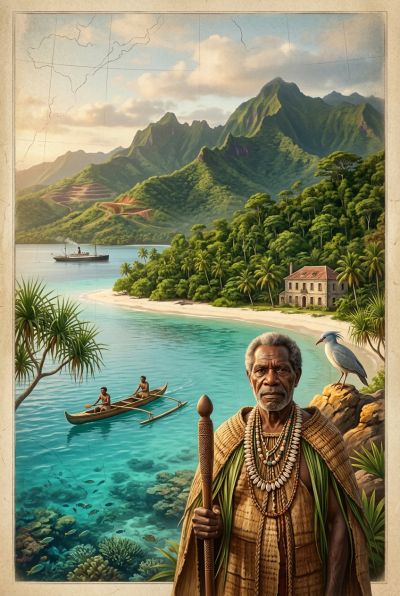
Discover the extraordinary story of New Caledonia, a land forged by ancient geological upheavals and shaped by waves of human settlement that stretch back over three millennia. From the moment the island fractured from Gondwana and drifted into the Pacific, readers will learn how its unique red soils and isolated ecosystems gave rise to a living museum of endemic species, including the ancient flowering plant Amborella trichopoda and the majestic Araucaria pines. The narrative then follows the daring Lapita seafarers who first set foot on Grande Terre, tracing their legacy through the evolution of the Kanak world—its clan‑based society, spiritual customs, yam and taro agriculture, and the profound connection between people and land that endured for centuries.
The book details the seismic shift brought by European contact, beginning with James Cook’s 1774 naming of the island and the subsequent arrival of whalers, sandalwood traders, and missionaries who introduced iron, firearms, new religions, and devastating diseases. Readers will experience the turbulent transition to French annexation in 1853, the establishment of a notorious penal colony that housed communards and common criminals, and the violent dispossession of Kanak lands that seeded long‑standing resentment. The discovery of nickel in 1864 and the rise of Société Le Nickel transformed the colony’s economy, drawing indentured laborers from Asia and the Pacific while scarring the landscape with open‑cast mines that still echo today.
Through the 20th century, the text illuminates New Caledonia’s strategic role in both World Wars, the post‑war reforms that abolished the Indigénat code and granted citizenship, and the rise of Kanak nationalism that culminated in the violent “Events” of the 1980s. It explores the painstaking peace processes—the Matignon Accords, the Nouméa Accord, and the series of independence referendums—showing how political compromise, economic rebalancing, and cultural revival have attempted to forge a shared destiny. Chapters on modern society reveal the multicultural mosaic of Kanak, Caldoche, Wallisian, Vietnamese, Javanese, and other communities, alongside the ongoing struggle to preserve the island’s extraordinary biodiversity amid mining pressures and invasive species.
Readers will finish with a deep understanding of New Caledonia’s place in the Pacific, its complex relationship with France, and the unresolved questions of sovereignty that continue to shape its politics, economy, and identity. This comprehensive history offers not just a chronicle of events, but an invitation to witness a society where ancient traditions, colonial legacies, and aspirations for self‑determination collide and coexist—providing valuable insights into the challenges of building a common destiny in a land of stark contrasts and enduring resilience.
What You'll Find Inside:
- Discover how New Caledonia's ancient Gondwanan origins created its unique biodiversity hotspot and world-class nickel reserves that shaped its ecological and economic destiny.
- Trace the evolution of Kanak society from Lapita settlers 3,000 years ago through traditional customs, colonial resistance, to contemporary cultural renaissance and identity politics.
- Examine the colonial era's profound impacts: French annexation, the penal colony system, the discriminatory Indigénat Code, and nickel mining's transformation of the landscape and society.
- Analyze the 20th century's turning points: World Wars involvement, the rise of Kanak nationalism, the violent 'Events' of the 1980s, and the peacebuilding Matignon and Nouméa Accords.
- Understand modern New Caledonia through its independence referendums, economic struggles with nickel dependence, multicultural dynamics, environmental challenges, and unresolved path toward self-determination.
Who's It For:
This book is essential reading for students and scholars of Pacific history, post-colonial studies, and indigenous rights, as well as policymakers and professionals working in regional development or conflict resolution. It offers valuable insights for anyone seeking to understand the complex interplay of geological heritage, colonialism, cultural resilience, and resource politics in a strategically significant Pacific territory. General readers with an interest in decolonization movements, multicultural societies, or environmental conservation will also find this comprehensive account deeply informative and relevant.
Table of Contents:
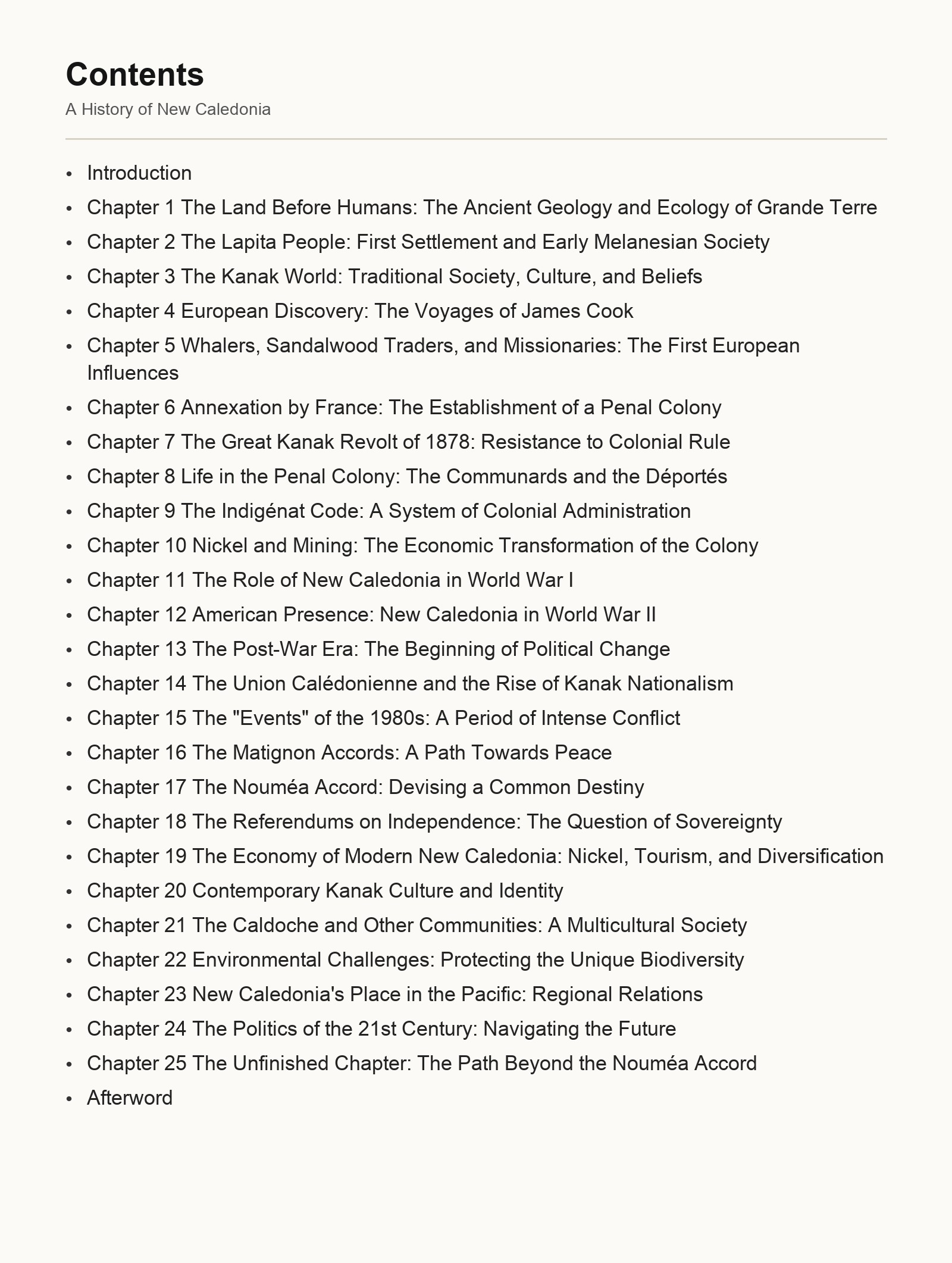
- Introduction
- Chapter 1 The Land Before Humans: The Ancient Geology and Ecology of Grande Terre
- Chapter 2 The Lapita People: First Settlement and Early Melanesian Society
- Chapter 3 The Kanak World: Traditional Society, Culture, and Beliefs
- Chapter 4 European Discovery: The Voyages of James Cook
- Chapter 5 Whalers, Sandalwood Traders, and Missionaries: The First European Influences
- Chapter 6 Annexation by France: The Establishment of a Penal Colony
- Chapter 7 The Great Kanak Revolt of 1878: Resistance to Colonial Rule
- Chapter 8 Life in the Penal Colony: The Communards and the Déportés
- Chapter 9 The Indigénat Code: A System of Colonial Administration
- Chapter 10 Nickel and Mining: The Economic Transformation of the Colony
- Chapter 11 The Role of New Caledonia in World War I
- Chapter 12 American Presence: New Caledonia in World War II
- Chapter 13 The Post-War Era: The Beginning of Political Change
- Chapter 14 The Union Calédonienne and the Rise of Kanak Nationalism
- Chapter 15 The "Events" of the 1980s: A Period of Intense Conflict
- Chapter 16 The Matignon Accords: A Path Towards Peace
- Chapter 17 The Nouméa Accord: Devising a Common Destiny
- Chapter 18 The Referendums on Independence: The Question of Sovereignty
- Chapter 19 The Economy of Modern New Caledonia: Nickel, Tourism, and Diversification
- Chapter 20 Contemporary Kanak Culture and Identity
- Chapter 21 The Caldoche and Other Communities: A Multicultural Society
- Chapter 22 Environmental Challenges: Protecting the Unique Biodiversity
- Chapter 23 New Caledonia's Place in the Pacific: Regional Relations
- Chapter 24 The Politics of the 21st Century: Navigating the Future
- Chapter 25 The Unfinished Chapter: The Path Beyond the Nouméa Accord
- Afterword
Author:
Published By:
Date Published:
May 20, 2026
Type:
Nonfiction
Language:
English
Also Available In:
German, French, Dutch, Portuguese
Word Count:
44,436 words
Reading Time:
3 hours 7 minutes
Sample:
Order:
Order A History of New Caledonia (Hardcover) on MixCache.com:
Buy NowPrint copy is made to order and ships worldwide. Includes the ebook free, ready to read instantly.
$5 account credit for all new MixCache.com accounts, usable toward any ebook purchase!*