
Browse by Category
Fiction
- Action & Adventure
- African American
- Anthologies
- Children's Fiction
- Classics
- Comics & Graphic Novels
- Coming of Age
- Contemporary
- Cultural & Regional
- Drama
- Erotica
- Fantasy
- General
- Historical Fiction
- Horror
- Humor & Satire
- Literary Fiction
- Mystery, Thriller & Suspense
- Poetry
- Religious & Inspirational
- Romance
- Science Fiction
- Short Stories
- War & Military
- Westerns
- Women's Fiction
- Young Adult
Non-Fiction
- Antiques & Collectibles
- Arts & Photography
- Biographies & Memoirs
- Business & Money
- Children's Non-Fiction
-
Computers & Technology
- Artificial Intelligence
- Computer Science
- Cybersecurity & Cryptography
- Data Science & Analytics
- Databases & Big Data
- Game Development & Design
- General
- Hardware & DIY
- Mobile App Development
- Networking & Cloud Computing
- Operating Systems
- Programming
- Robotics
- Software
- Software Engineering
- User Experience (UX) & Design
- Web Development & Design
- Cooking, Food & Wine
- Crafts, Hobbies & Home
- Education & Teaching
- Engineering
- General
- Health, Fitness & Dieting
-
History
- African History
- African History - North Africa
- African History - Sub-Saharan Africa
- American History
- American History - 20th Century
- American History - Civil War
- American History - Colonial Period
- Ancient History
- Asian History
- Asian History - China
- Asian History - India
- Asian History - Japan
- Asian History - Southeast Asia
- European History
- European History - Ancient Greece
- European History - Ancient Rome
- European History - Medieval
- European History - Modern
- European History - Renaissance
- General
- Middle Eastern History
- Military History
- Military History - Aviation
- Military History - Naval
- Social & Cultural History
- World History
- Humor & Entertainment
- Industrial Technology
- Language Learning
- Law
- LGBTQ+ Non-Fiction
- Literary Criticism
- Medical Books
- Parenting & Relationships
- Philosophy
- Politics & Social Sciences
- Reference
- Religion & Spirituality
-
Science & Math
- Agricultural Sciences
- Astronomy & Space Science
- Behavioral Sciences
- Biological Sciences
- Botany & Plant Science
- Chemistry
- Earth Sciences
- Engineering - Chemical
- Engineering - Civil
- Engineering - Electrical
- Engineering - Mechanical
- Environment
- General
- Geology
- Mathematics
- Nature & Ecology
- Oceanography
- Paleontology
- Physics
- Statistics
- Self-Help
- Sports & Outdoors
- Study Aids
- Sustainability & Green Living
- Textbooks
- Transportation
- Travel
- True Crime
- Urban Planning & Development
- Veterinary Medicine
- Writing & Publishing
Jump to Section
MixCache.com Total Access
Unlimited reading and audiobooks for every book published by MixCache.com.
Included titles carry the MTA badge.
Learn more →A History of Bolivia
About this book:
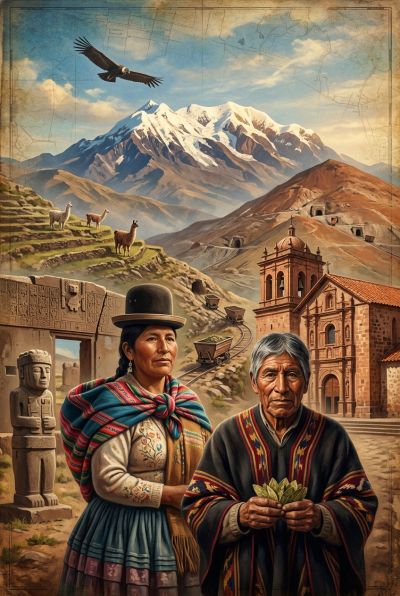
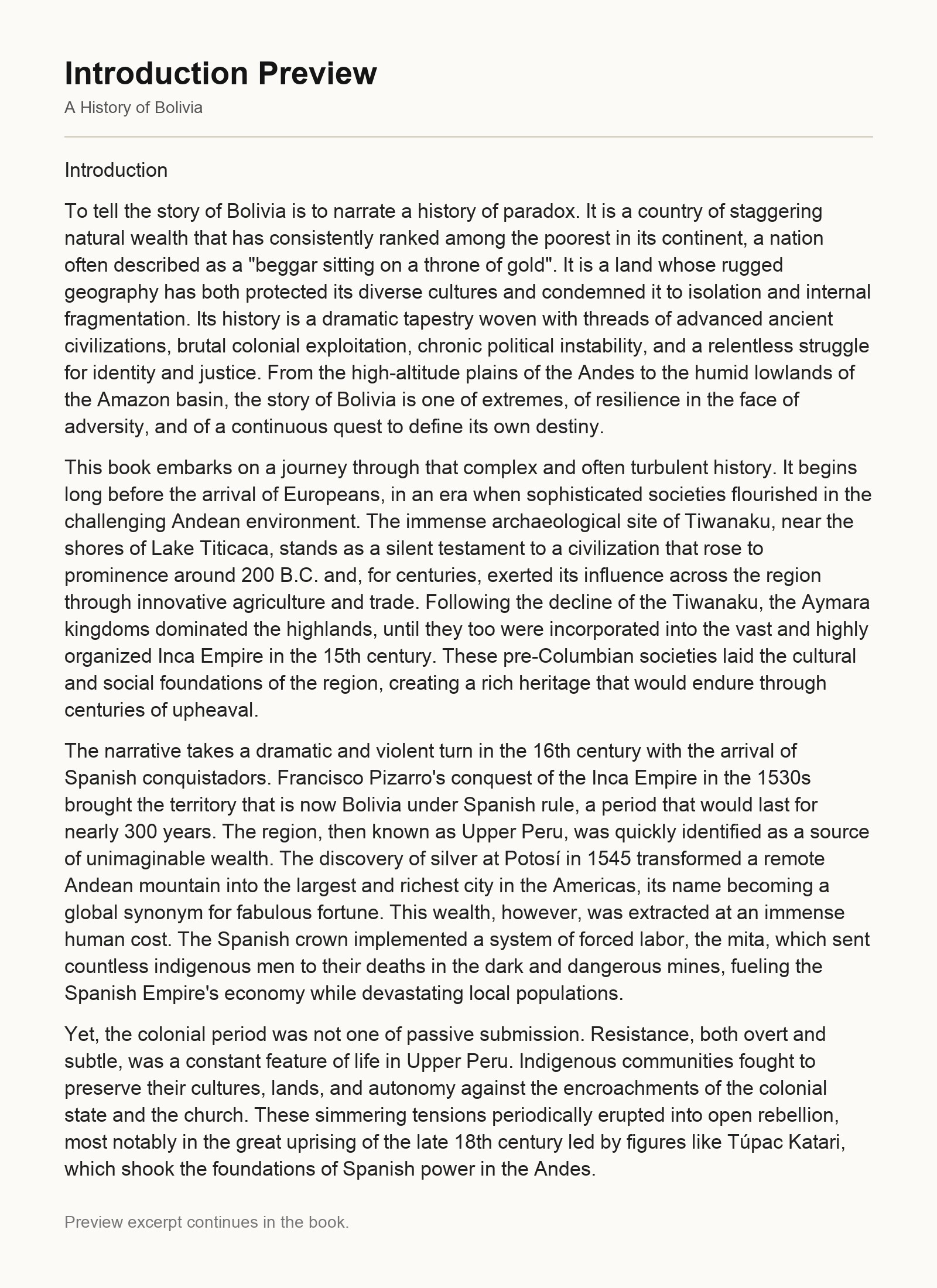
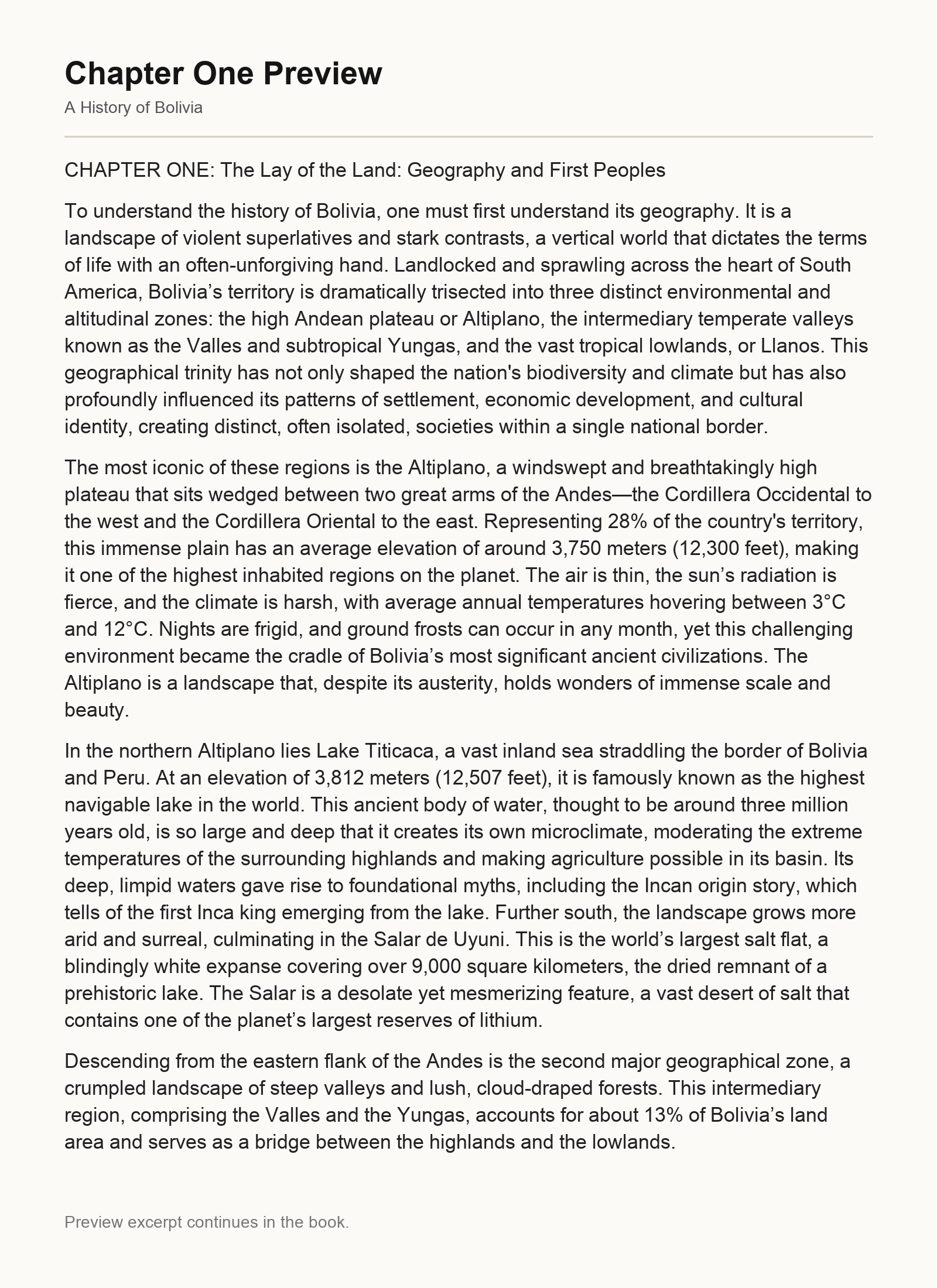
A History of Bolivia takes readers on a sweeping journey from the earliest human footprints on the Andean highlands to the turbulent politics of the twenty‑first century. Beginning with the geography that shaped Bolivia’s distinct zones—the windswept Altiplano, the fertile valleys, and the vast tropical lowlands—the book shows how environment dictated settlement, agriculture, and the rise of ancient societies like Tiwanaku and the Aymara kingdoms. Readers will grasp how these pre‑Columbian cultures mastered potato and quinoa domestication, llama and alpaca herding, and innovative raised‑field farming, laying foundations that endured centuries of change.
The narrative then follows the dramatic encounter with the Inca Empire, the brutal Spanish conquest, and the transformation of Upper Peru into a colonial silver powerhouse centered on Potosí. Through vivid detail, the book reveals the human cost of the mita labor system, the global impact of Potosí’s silver, and the persistent resistance of indigenous peoples—from the rebellions of Túpac Katari and Túpac Amaru II to the subtle everyday acts of cultural survival. Readers will experience the clash of worlds, the exploitation that fueled a European empire, and the enduring spirit of Andean identity.
Moving into the nineteenth and twentieth centuries, the book charts Bolivia’s painful birth as a republic, the instability of caudillo rule, the loss of its coastline in the War of the Pacific, and the rise of tin and silver barons who forged an oligarchic modernization. It explains how the Chaco War devastated a generation, how revolutionary nationalism emerged from military socialism, and how the 1952 National Revolution overturned the old order with mine nationalization, agrarian reform, and universal suffrage. Readers will witness the ensuing tug‑of‑war between populist movements, military coups, and the neoliberal shock therapies of the 1980s that reshaped the nation’s economy and social fabric.
The later chapters bring the story into the contemporary era, exploring the Water War and Gas War that toppled neoliberal governments, the historic election of Evo Morales as Bolivia’s first indigenous president, and the profound social programs that followed. The book does not shy away from recent turmoil, covering the 2019 political crisis, the interim government, and the return of MAS to power, while examining the ongoing tensions between the western highlands and eastern lowlands, the challenges of dwindling gas reserves, and the struggle to balance extractive development with environmental and indigenous rights. By the end, readers will have a comprehensive understanding of how Bolivia’s wealth, geography, and relentless pursuit of justice have intertwined to create a nation of paradoxes, resilience, and continual reinvention.
What You'll Find Inside:
- Bolivia's extreme geographical diversity - from the high Altiplano to the tropical Llanos - has shaped distinct cultural zones and economic patterns throughout its history.
- The nation's paradox of immense natural wealth (silver, tin, gas, lithium) coexisting with persistent poverty has defined its struggle for equitable development.
- The 1952 National Revolution fundamentally transformed Bolivia through mine nationalization, agrarian reform, and universal suffrage, empowering the indigenous majority.
- Colonial exploitation evolved from Potosí's silver mines and the mita system to modern resource conflicts, sparking cycles of resistance and social movements.
- Contemporary Bolivia grapples with indigenous autonomy, resource sovereignty, and political polarization following the Morales era and 2019 crisis.
Who's It For:
This book is ideal for students and scholars of Latin American history, indigenous studies, and post-colonial societies seeking a comprehensive understanding of Bolivia's complex development. It will particularly benefit readers interested in resource economics, revolutionary movements, and the ongoing struggle for social justice in plurinational states. Anyone wishing to grasp Bolivia's unique position as a landlocked Andean nation with vast natural wealth but historical marginalization of its majority population will find this account essential.
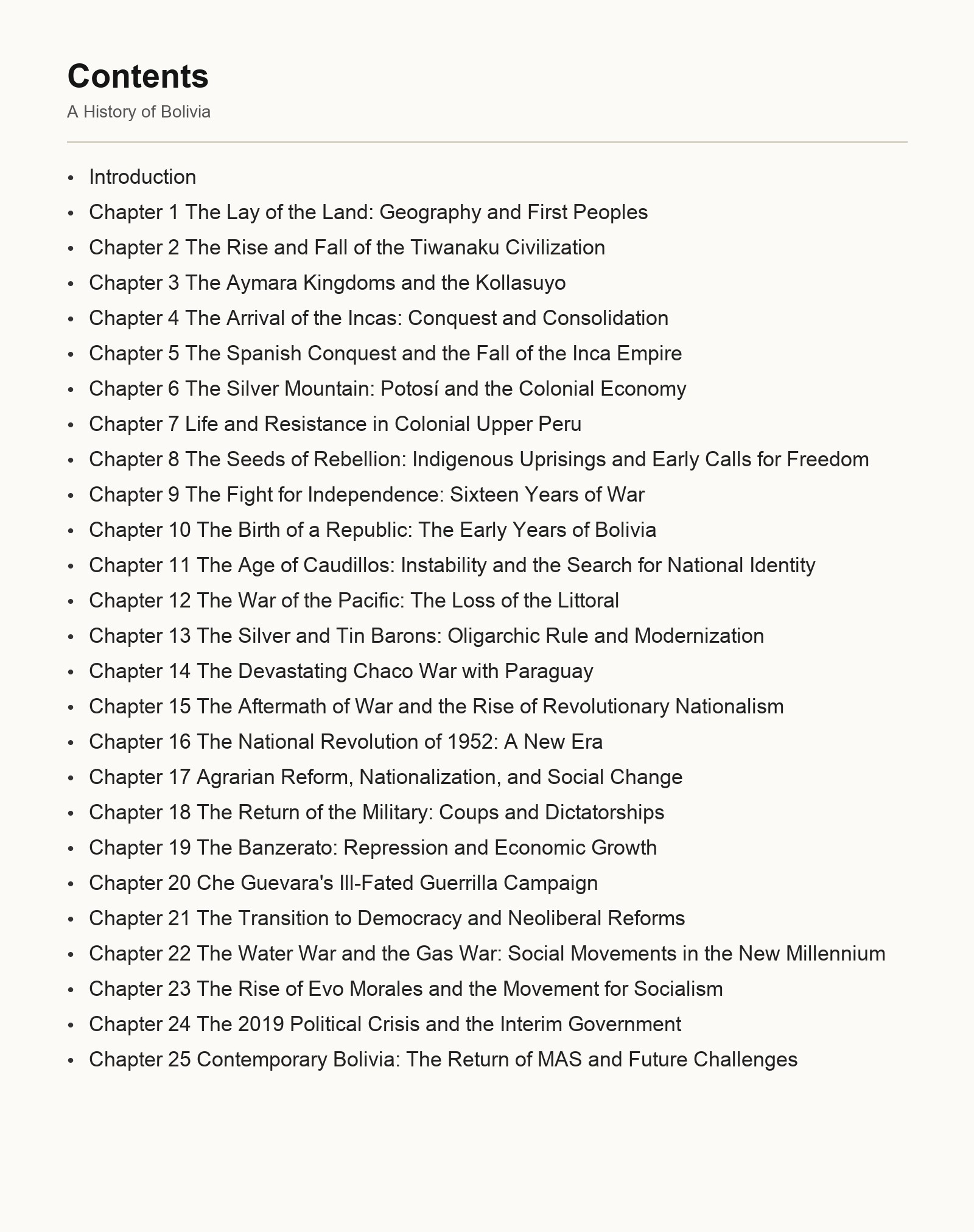
Table of Contents:
- Introduction
- Chapter 1 The Lay of the Land: Geography and First Peoples
- Chapter 2 The Rise and Fall of the Tiwanaku Civilization
- Chapter 3 The Aymara Kingdoms and the Kollasuyo
- Chapter 4 The Arrival of the Incas: Conquest and Consolidation
- Chapter 5 The Spanish Conquest and the Fall of the Inca Empire
- Chapter 6 The Silver Mountain: Potosí and the Colonial Economy
- Chapter 7 Life and Resistance in Colonial Upper Peru
- Chapter 8 The Seeds of Rebellion: Indigenous Uprisings and Early Calls for Freedom
- Chapter 9 The Fight for Independence: Sixteen Years of War
- Chapter 10 The Birth of a Republic: The Early Years of Bolivia
- Chapter 11 The Age of Caudillos: Instability and the Search for National Identity
- Chapter 12 The War of the Pacific: The Loss of the Littoral
- Chapter 13 The Silver and Tin Barons: Oligarchic Rule and Modernization
- Chapter 14 The Devastating Chaco War with Paraguay
- Chapter 15 The Aftermath of War and the Rise of Revolutionary Nationalism
- Chapter 16 The National Revolution of 1952: A New Era
- Chapter 17 Agrarian Reform, Nationalization, and Social Change
- Chapter 18 The Return of the Military: Coups and Dictatorships
- Chapter 19 The Banzerato: Repression and Economic Growth
- Chapter 20 Che Guevara's Ill-Fated Guerrilla Campaign
- Chapter 21 The Transition to Democracy and Neoliberal Reforms
- Chapter 22 The Water War and the Gas War: Social Movements in the New Millennium
- Chapter 23 The Rise of Evo Morales and the Movement for Socialism
- Chapter 24 The 2019 Political Crisis and the Interim Government
- Chapter 25 Contemporary Bolivia: The Return of MAS and Future Challenges
Author:
Published By:
Date Published:
May 18, 2026
Type:
Nonfiction
Language:
English
Also Available In:
Word Count:
46,525 words
Reading Time:
3 hours 15 minutes
Sample:
Order:
Order A History of Bolivia (Paperback) on MixCache.com:
Buy NowPrint copy is made to order and ships worldwide. Includes the ebook free, ready to read instantly.
$5 account credit for all new MixCache.com accounts, usable toward any ebook purchase!*


