
Browse by Category
Fiction
- Action & Adventure
- African American
- Anthologies
- Children's Fiction
- Classics
- Comics & Graphic Novels
- Coming of Age
- Contemporary
- Cultural & Regional
- Drama
- Erotica
- Fantasy
- General
- Historical Fiction
- Horror
- Humor & Satire
- Literary Fiction
- Mystery, Thriller & Suspense
- Poetry
- Religious & Inspirational
- Romance
- Science Fiction
- Short Stories
- War & Military
- Westerns
- Women's Fiction
- Young Adult
Non-Fiction
- Antiques & Collectibles
- Arts & Photography
- Biographies & Memoirs
- Business & Money
- Children's Non-Fiction
-
Computers & Technology
- Artificial Intelligence
- Computer Science
- Cybersecurity & Cryptography
- Data Science & Analytics
- Databases & Big Data
- Game Development & Design
- General
- Hardware & DIY
- Mobile App Development
- Networking & Cloud Computing
- Operating Systems
- Programming
- Robotics
- Software
- Software Engineering
- User Experience (UX) & Design
- Web Development & Design
- Cooking, Food & Wine
- Crafts, Hobbies & Home
- Education & Teaching
- Engineering
- General
- Health, Fitness & Dieting
-
History
- African History
- African History - North Africa
- African History - Sub-Saharan Africa
- American History
- American History - 20th Century
- American History - Civil War
- American History - Colonial Period
- Ancient History
- Asian History
- Asian History - China
- Asian History - India
- Asian History - Japan
- Asian History - Southeast Asia
- European History
- European History - Ancient Greece
- European History - Ancient Rome
- European History - Medieval
- European History - Modern
- European History - Renaissance
- General
- Middle Eastern History
- Military History
- Military History - Aviation
- Military History - Naval
- Social & Cultural History
- World History
- Humor & Entertainment
- Industrial Technology
- Language Learning
- Law
- LGBTQ+ Non-Fiction
- Literary Criticism
- Medical Books
- Parenting & Relationships
- Philosophy
- Politics & Social Sciences
- Reference
- Religion & Spirituality
-
Science & Math
- Agricultural Sciences
- Astronomy & Space Science
- Behavioral Sciences
- Biological Sciences
- Botany & Plant Science
- Chemistry
- Earth Sciences
- Engineering - Chemical
- Engineering - Civil
- Engineering - Electrical
- Engineering - Mechanical
- Environment
- General
- Geology
- Mathematics
- Nature & Ecology
- Oceanography
- Paleontology
- Physics
- Statistics
- Self-Help
- Sports & Outdoors
- Study Aids
- Sustainability & Green Living
- Textbooks
- Transportation
- Travel
- True Crime
- Urban Planning & Development
- Veterinary Medicine
- Writing & Publishing
Jump to Section
MixCache.com Total Access
Unlimited reading and audiobooks for every book published by MixCache.com.
Included titles carry the MTA badge.
Learn more →
Christian Art and Visual Theology
MTA
How Images, Architecture, and Media Shape Belief and Practice
About this book:
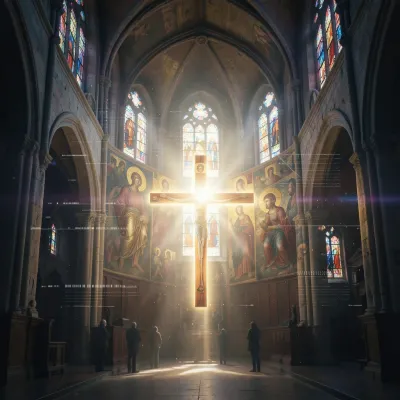
Christian art and visual theology explore how images, architecture, and media shape Christian belief and practice, arguing that the visual dimension is not merely illustrative but formative. Grounded in the biblical witness—from the creation of humanity in God’s image, the tabernacle’s ornate furnishings, and the incarnate Christ as the ultimate visible revelation—the book shows how Scripture provides a dynamic tension between prohibitions against idolatry and divine commands for sacred imagery. Early Christian expressions in the catacombs used symbols like the fish and anchor as covert confessions, while Constantine’s patronage ushered in basilicas and mosaics that made theological truths visible. The theology of icons, defended by John of Damascus and affirmed at the Second Council of Nicaea, rests on the Incarnation: if God became flesh, material images can mediate divine presence without becoming idols, serving as windows that re-present the holy.
Throughout history, visual theology has manifested in diverse media and styles. Medieval stained glass transformed light into doctrinal narratives, Gothic architecture directed the gaze upward as a vertical prayer, and Romanesque sculptural portals taught salvation history to the illiterate. The Protestant Reformation sparked widespread iconoclasm, privileging the preached word and stripping churches of images, yet even austere spaces preached a theology of accessibility and divine immediacy. The Counter‑Reformation embraced Baroque grandeur—illusionistic ceilings, emotive sculpture, and theatrical altarpieces—to re‑engage the senses and reaffirm Catholic doctrine. Global Christian art reveals how African, Asian, and American cultures have indigenized sacred forms, from Ethiopian rock‑hewn churches and Indian saris‑clad Virgins to Latin American retablos and indigenous Mestizo Baroque, asserting that the Incarnation permits the gospel to be expressed in every cultural idiom. Folk art, home altars, and popular piety further democratize visual theology, while modernism, abstraction, photography, film, and digital media continue to reshape how believers encounter the holy.
The book equips readers to read images theologically by examining composition, color, light, context, patronage, representation, and liturgical invitation, and it stresses the ethical responsibilities of beauty, idolatry, and discernment. Practical guidance covers designing worship spaces for participation, integrating art into catechesis and mission, conserving collections, commissioning new works with clear contracts and care, and cultivating a global, inclusive visual imagination. Ultimately, a pastoral rule of art encourages communities to discern whether visual choices deepen love for God and neighbor, balancing authenticity with artifice, tradition with innovation, and sacred beauty with prophetic witness—so that the church’s stones, glass, pixels, and paint continue to preach the gospel in ways that shape belief, practice, and the lived faith of the Body of Christ.
What You'll Find Inside:
- How Christian belief has been expressed through visual forms from catacomb frescoes to digital screens across twenty centuries
- The theological foundations for images in Scripture and how they navigate the tension between incarnation and idolatry
- How architecture, stained glass, icons, and other media function as catechetical tools that shape worship and belief
- Practical methods for interpreting visual theology and integrating art into preaching, catechesis, and mission
- Global perspectives on Christian art addressing issues of race, gender, representation, and power in sacred imagery
Who's It For:
This book is designed for pastors, church leaders, artists, educators, and lay leaders who seek to understand how visual elements shape faith and practice. It provides practical tools for those involved in worship design, art commissioning, religious education, and ministry who want to intentionally integrate visual theology into their congregational life while navigating historical traditions and contemporary challenges.
Table of Contents:
- Introduction
- Chapter 1 Seeing and Believing: What Is Visual Theology?
- Chapter 2 Scripture in Color: Biblical Foundations for Images
- Chapter 3 The Early Church and the Image: From Catacombs to Councils
- Chapter 4 Icons and Incarnation: The Theology of Presence
- Chapter 5 Light Made Manifest: Stained Glass and Sacred Windows
- Chapter 6 Stone Sermons: Architecture as Catechesis
- Chapter 7 The Liturgical Gaze: How Spaces Guide Prayer
- Chapter 8 From Manuscripts to Murals: Medieval Visual Cultures
- Chapter 9 Reform and Resistance: Iconoclasm and the Protestant Imagination
- Chapter 10 Baroque Theaters of Devotion
- Chapter 11 Global Christian Aesthetics: Africa, Asia, and the Americas
- Chapter 12 Folk Art and Popular Piety
- Chapter 13 Modernism, Abstraction, and the Search for the Holy
- Chapter 14 Photography, Film, and the Moving Image in Worship
- Chapter 15 Digital Altars: Screens, Social Media, and Virtual Sanctuaries
- Chapter 16 Race, Gender, and Representation in Christian Art
- Chapter 17 Power, Patronage, and Prophecy: Who Commissions the Sacred?
- Chapter 18 Reading Images: Methods for Interpreting Visual Theology
- Chapter 19 The Ethics of Seeing: Beauty, Idolatry, and Discernment
- Chapter 20 Designing for Participation: Visual Liturgy and Congregational Practice
- Chapter 21 Teaching the Faith Through Art: Catechesis and Formation
- Chapter 22 Art in Mission and Public Witness
- Chapter 23 Curating the Church: Collections, Conservation, and Community
- Chapter 24 Commissioning New Works: Process, Contracts, and Care
- Chapter 25 A Pastoral Rule of Art: Principles, Pitfalls, and Pathways
Author:
Published By:
Date Published:
May 18, 2026
Type:
Nonfiction
Language:
English
Word Count:
54,183 words
Reading Time:
3 hours 48 minutes
Sample:
MixCache.com Total Access
Get unlimited access to this book + all books published by MixCache.com for $11.99/month
Subscribe to MTAOr purchase this book individually below
Order:
Buy the Christian Art and Visual Theology ebook on MixCache.com:
Buy Now
Full ebook will be available immediately
- read online or download as a PDF file.
$5 account credit for all new MixCache.com accounts, usable toward any ebook purchase!*



Ratings & Reviews
Ask Questions About This Book
Have a question about the content? Ask our AI assistant!
Start by asking a question about "Christian Art and Visual Theology"
Example: "Does this book mention William Shakespeare?"
Thinking...