Browse by Category
Fiction
- Action & Adventure
- African American
- Anthologies
- Children's Fiction
- Classics
- Comics & Graphic Novels
- Coming of Age
- Contemporary
- Cultural & Regional
- Drama
- Erotica
- Fantasy
- General
- Historical Fiction
- Horror
- Humor & Satire
- Literary Fiction
- Mystery, Thriller & Suspense
- Poetry
- Religious & Inspirational
- Romance
- Science Fiction
- Short Stories
- War & Military
- Westerns
- Women's Fiction
- Young Adult
Non-Fiction
- Antiques & Collectibles
- Arts & Photography
- Biographies & Memoirs
- Business & Money
- Children's Non-Fiction
-
Computers & Technology
- Artificial Intelligence
- Computer Science
- Cybersecurity & Cryptography
- Data Science & Analytics
- Databases & Big Data
- Game Development & Design
- General
- Hardware & DIY
- Mobile App Development
- Networking & Cloud Computing
- Operating Systems
- Programming
- Robotics
- Software
- Software Engineering
- User Experience (UX) & Design
- Web Development & Design
- Cooking, Food & Wine
- Crafts, Hobbies & Home
- Education & Teaching
- Engineering
- General
- Health, Fitness & Dieting
-
History
- African History
- African History - North Africa
- African History - Sub-Saharan Africa
- American History
- American History - 20th Century
- American History - Civil War
- American History - Colonial Period
- Ancient History
- Asian History
- Asian History - China
- Asian History - India
- Asian History - Japan
- Asian History - Southeast Asia
- European History
- European History - Ancient Greece
- European History - Ancient Rome
- European History - Medieval
- European History - Modern
- European History - Renaissance
- General
- Middle Eastern History
- Military History
- Military History - Aviation
- Military History - Naval
- Social & Cultural History
- World History
- Humor & Entertainment
- Industrial Technology
- Language Learning
- Law
- LGBTQ+ Non-Fiction
- Literary Criticism
- Medical Books
- Parenting & Relationships
- Philosophy
- Politics & Social Sciences
- Reference
- Religion & Spirituality
-
Science & Math
- Agricultural Sciences
- Astronomy & Space Science
- Behavioral Sciences
- Biological Sciences
- Botany & Plant Science
- Chemistry
- Earth Sciences
- Engineering - Chemical
- Engineering - Civil
- Engineering - Electrical
- Engineering - Mechanical
- Environment
- General
- Geology
- Mathematics
- Nature & Ecology
- Oceanography
- Paleontology
- Physics
- Statistics
- Self-Help
- Sports & Outdoors
- Study Aids
- Sustainability & Green Living
- Textbooks
- Transportation
- Travel
- True Crime
- Urban Planning & Development
- Veterinary Medicine
- Writing & Publishing
Jump to Section
MixCache.com Total Access
Unlimited reading and audiobooks for every book published by MixCache.com.
Included titles carry the MTA badge.
Learn more →A History of Manitoba
About this book:

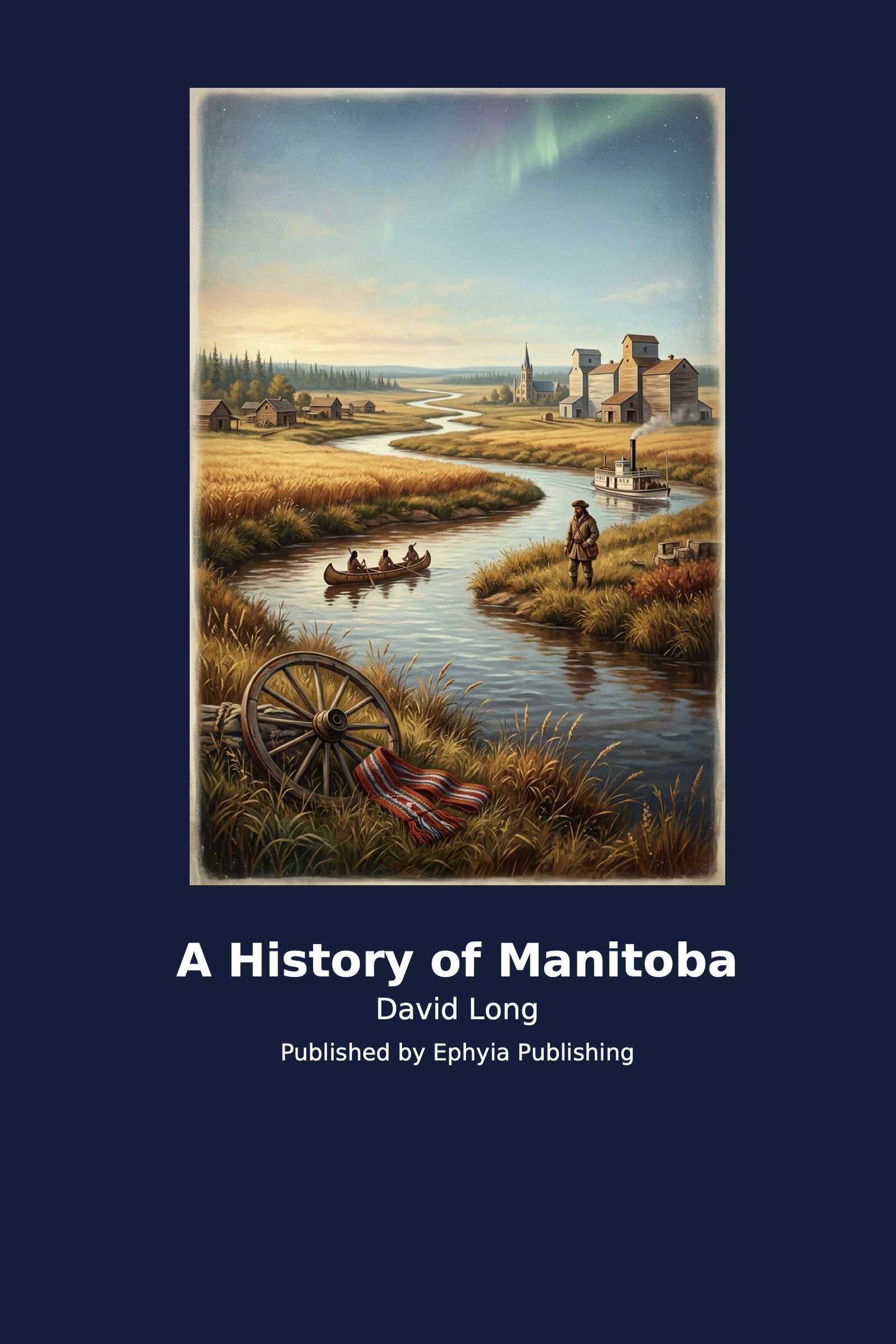
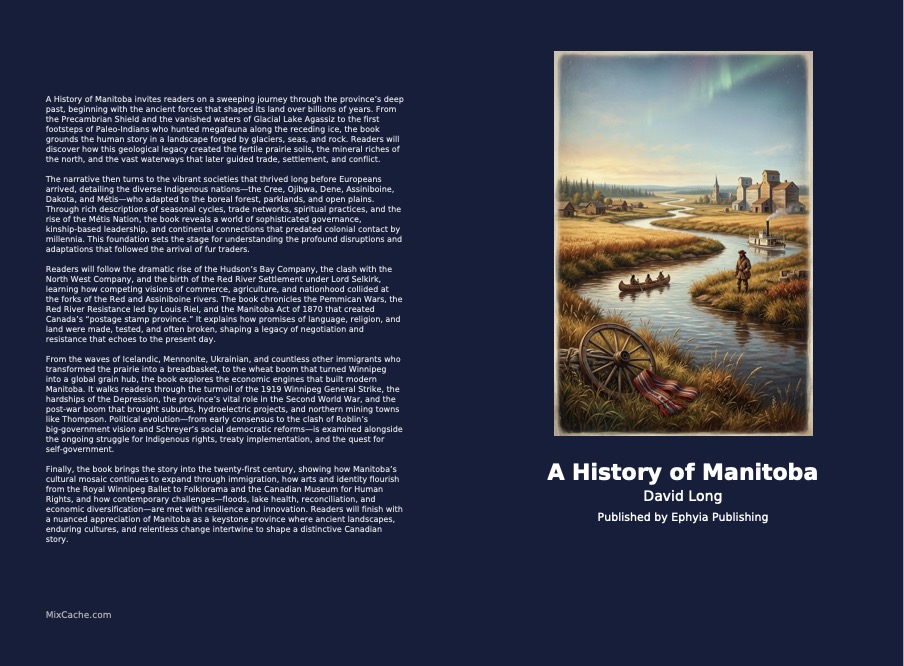
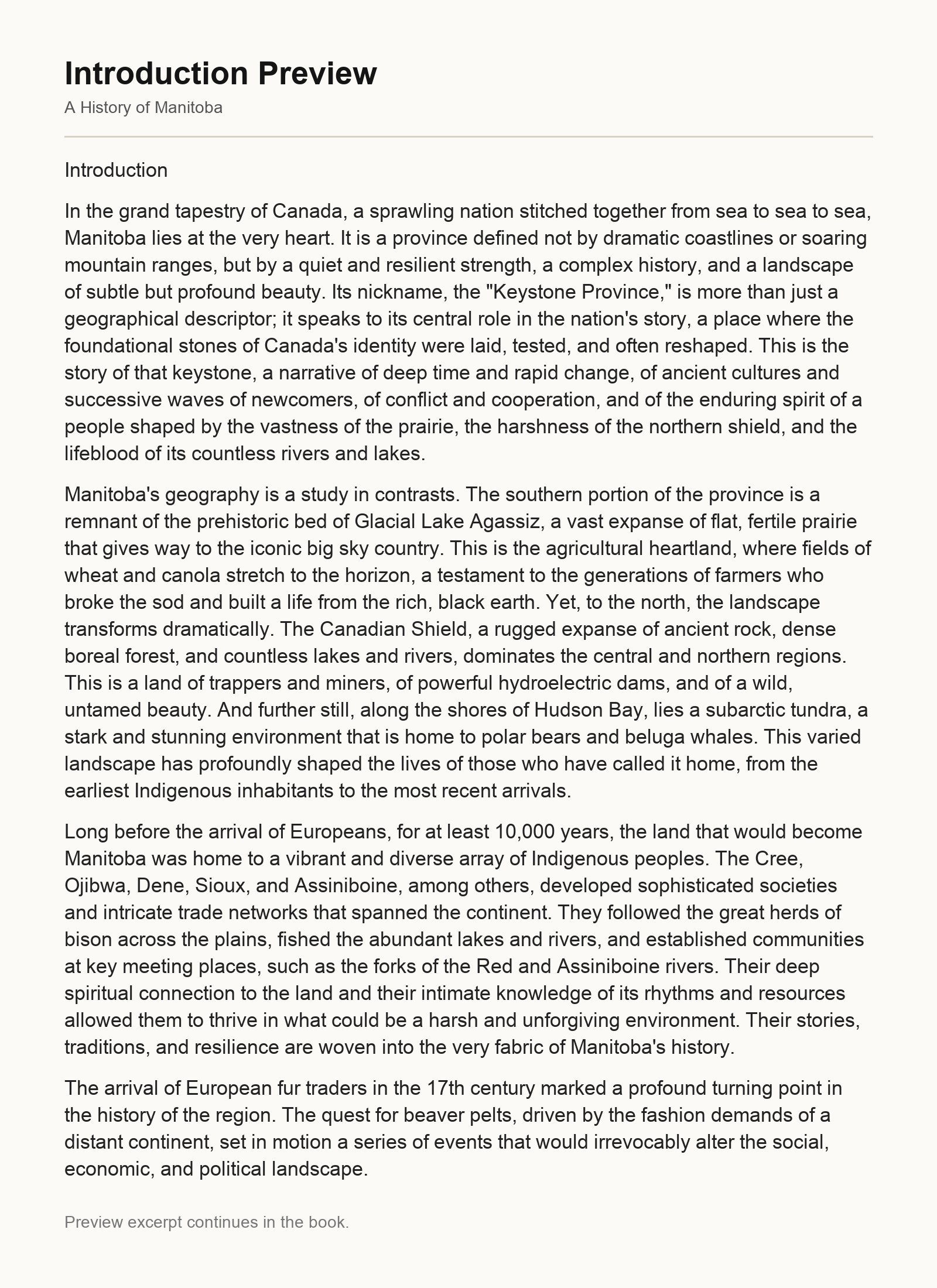
A History of Manitoba invites readers on a sweeping journey through the province’s deep past, beginning with the ancient forces that shaped its land over billions of years. From the Precambrian Shield and the vanished waters of Glacial Lake Agassiz to the first footsteps of Paleo‑Indians who hunted megafauna along the receding ice, the book grounds the human story in a landscape forged by glaciers, seas, and rock. Readers will discover how this geological legacy created the fertile prairie soils, the mineral riches of the north, and the vast waterways that later guided trade, settlement, and conflict.
The narrative then turns to the vibrant societies that thrived long before Europeans arrived, detailing the diverse Indigenous nations—the Cree, Ojibwa, Dene, Assiniboine, Dakota, and Métis—who adapted to the boreal forest, parklands, and open plains. Through rich descriptions of seasonal cycles, trade networks, spiritual practices, and the rise of the Métis Nation, the book reveals a world of sophisticated governance, kinship‑based leadership, and continental connections that predated colonial contact by millennia. This foundation sets the stage for understanding the profound disruptions and adaptations that followed the arrival of fur traders.
Readers will follow the dramatic rise of the Hudson’s Bay Company, the clash with the North West Company, and the birth of the Red River Settlement under Lord Selkirk, learning how competing visions of commerce, agriculture, and nationhood collided at the forks of the Red and Assiniboine rivers. The book chronicles the Pemmican Wars, the Red River Resistance led by Louis Riel, and the Manitoba Act of 1870 that created Canada’s “postage stamp province.” It explains how promises of language, religion, and land were made, tested, and often broken, shaping a legacy of negotiation and resistance that echoes to the present day.
From the waves of Icelandic, Mennonite, Ukrainian, and countless other immigrants who transformed the prairie into a breadbasket, to the wheat boom that turned Winnipeg into a global grain hub, the book explores the economic engines that built modern Manitoba. It walks readers through the turmoil of the 1919 Winnipeg General Strike, the hardships of the Depression, the province’s vital role in the Second World War, and the post‑war boom that brought suburbs, hydroelectric projects, and northern mining towns like Thompson. Political evolution—from early consensus to the clash of Roblin’s big‑government vision and Schreyer’s social democratic reforms—is examined alongside the ongoing struggle for Indigenous rights, treaty implementation, and the quest for self‑government.
Finally, the book brings the story into the twenty‑first century, showing how Manitoba’s cultural mosaic continues to expand through immigration, how arts and identity flourish from the Royal Winnipeg Ballet to Folklorama and the Canadian Museum for Human Rights, and how contemporary challenges—floods, lake health, reconciliation, and economic diversification—are met with resilience and innovation. Readers will finish with a nuanced appreciation of Manitoba as a keystone province where ancient landscapes, enduring cultures, and relentless change intertwine to shape a distinctive Canadian story.
What You'll Find Inside:
- Manitoba's 10,000-year Indigenous foundations, detailing how First Nations thrived through adaptable cultures tied to bison, forests, and waterways long before European arrival.
- The fur trade era's transformative impact, including the Hudson's Bay Company's monopoly, the rise of the Métis as a distinct nation, and conflicts like the Pemmican Wars.
- The Red River Resistance led by Louis Riel, the Manitoba Act of 1870 creating Canada's 'postage stamp province,' and the complex legacy of Métis land promises.
- Waves of immigration from Ontarians, Icelanders, Mennonites, Ukrainians, and others that built Manitoba's multicultural identity and agricultural economy.
- Modern efforts toward reconciliation, including Treaty Land Entitlements, Indigenous self-government models, and addressing historical injustices like residential schools.
Who's It For:
This book is ideal for students, educators, and general readers interested in Canadian history, particularly those seeking to understand Manitoba's pivotal role as a 'keystone province' in national development. It will resonate with readers focused on Indigenous-settler relations, multicultural immigration patterns, and the social-political struggles that shaped Western Canada, offering both scholarly depth and accessible narrative for anyone exploring how geography, culture, and conflict define a province's identity.
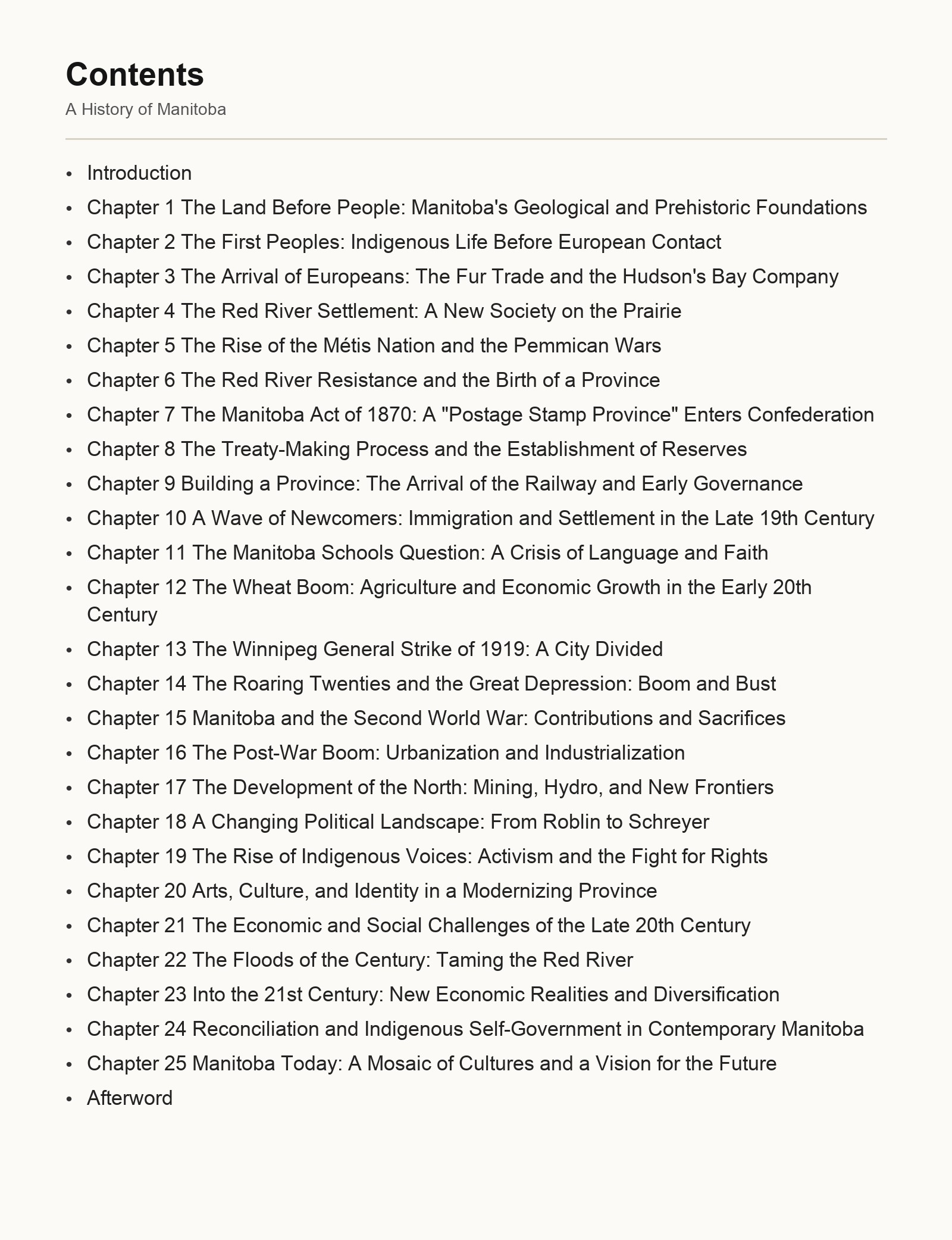
Table of Contents:
- Introduction
- Chapter 1 The Land Before People: Manitoba's Geological and Prehistoric Foundations
- Chapter 2 The First Peoples: Indigenous Life Before European Contact
- Chapter 3 The Arrival of Europeans: The Fur Trade and the Hudson's Bay Company
- Chapter 4 The Red River Settlement: A New Society on the Prairie
- Chapter 5 The Rise of the Métis Nation and the Pemmican Wars
- Chapter 6 The Red River Resistance and the Birth of a Province
- Chapter 7 The Manitoba Act of 1870: A "Postage Stamp Province" Enters Confederation
- Chapter 8 The Treaty-Making Process and the Establishment of Reserves
- Chapter 9 Building a Province: The Arrival of the Railway and Early Governance
- Chapter 10 A Wave of Newcomers: Immigration and Settlement in the Late 19th Century
- Chapter 11 The Manitoba Schools Question: A Crisis of Language and Faith
- Chapter 12 The Wheat Boom: Agriculture and Economic Growth in the Early 20th Century
- Chapter 13 The Winnipeg General Strike of 1919: A City Divided
- Chapter 14 The Roaring Twenties and the Great Depression: Boom and Bust
- Chapter 15 Manitoba and the Second World War: Contributions and Sacrifices
- Chapter 16 The Post-War Boom: Urbanization and Industrialization
- Chapter 17 The Development of the North: Mining, Hydro, and New Frontiers
- Chapter 18 A Changing Political Landscape: From Roblin to Schreyer
- Chapter 19 The Rise of Indigenous Voices: Activism and the Fight for Rights
- Chapter 20 Arts, Culture, and Identity in a Modernizing Province
- Chapter 21 The Economic and Social Challenges of the Late 20th Century
- Chapter 22 The Floods of the Century: Taming the Red River
- Chapter 23 Into the 21st Century: New Economic Realities and Diversification
- Chapter 24 Reconciliation and Indigenous Self-Government in Contemporary Manitoba
- Chapter 25 Manitoba Today: A Mosaic of Cultures and a Vision for the Future
- Afterword
Author:
Published By:
Date Published:
May 18, 2026
Type:
Nonfiction
Language:
English
Also Available In:
German, Spanish, Italian, Dutch, Portuguese
Word Count:
47,612 words
Reading Time:
3 hours 20 minutes
Sample:
Order:
Order A History of Manitoba (Hardcover) on MixCache.com:
Buy NowPrint copy is made to order and ships worldwide. Includes the ebook free, ready to read instantly.
$5 account credit for all new MixCache.com accounts, usable toward any ebook purchase!*