Browse by Category
Fiction
- Action & Adventure
- African American
- Anthologies
- Children's Fiction
- Classics
- Comics & Graphic Novels
- Coming of Age
- Contemporary
- Cultural & Regional
- Drama
- Erotica
- Fantasy
- General
- Historical Fiction
- Horror
- Humor & Satire
- Literary Fiction
- Mystery, Thriller & Suspense
- Poetry
- Religious & Inspirational
- Romance
- Science Fiction
- Short Stories
- War & Military
- Westerns
- Women's Fiction
- Young Adult
Non-Fiction
- Antiques & Collectibles
- Arts & Photography
- Biographies & Memoirs
- Business & Money
- Children's Non-Fiction
-
Computers & Technology
- Artificial Intelligence
- Computer Science
- Cybersecurity & Cryptography
- Data Science & Analytics
- Databases & Big Data
- Game Development & Design
- General
- Hardware & DIY
- Mobile App Development
- Networking & Cloud Computing
- Operating Systems
- Programming
- Robotics
- Software
- Software Engineering
- User Experience (UX) & Design
- Web Development & Design
- Cooking, Food & Wine
- Crafts, Hobbies & Home
- Education & Teaching
- Engineering
- General
- Health, Fitness & Dieting
-
History
- African History
- African History - North Africa
- African History - Sub-Saharan Africa
- American History
- American History - 20th Century
- American History - Civil War
- American History - Colonial Period
- Ancient History
- Asian History
- Asian History - China
- Asian History - India
- Asian History - Japan
- Asian History - Southeast Asia
- European History
- European History - Ancient Greece
- European History - Ancient Rome
- European History - Medieval
- European History - Modern
- European History - Renaissance
- General
- Middle Eastern History
- Military History
- Military History - Aviation
- Military History - Naval
- Social & Cultural History
- World History
- Humor & Entertainment
- Industrial Technology
- Language Learning
- Law
- LGBTQ+ Non-Fiction
- Literary Criticism
- Medical Books
- Parenting & Relationships
- Philosophy
- Politics & Social Sciences
- Reference
- Religion & Spirituality
-
Science & Math
- Agricultural Sciences
- Astronomy & Space Science
- Behavioral Sciences
- Biological Sciences
- Botany & Plant Science
- Chemistry
- Earth Sciences
- Engineering - Chemical
- Engineering - Civil
- Engineering - Electrical
- Engineering - Mechanical
- Environment
- General
- Geology
- Mathematics
- Nature & Ecology
- Oceanography
- Paleontology
- Physics
- Statistics
- Self-Help
- Sports & Outdoors
- Study Aids
- Sustainability & Green Living
- Textbooks
- Transportation
- Travel
- True Crime
- Urban Planning & Development
- Veterinary Medicine
- Writing & Publishing
Jump to Section
MixCache.com Total Access
Unlimited reading and audiobooks for every book published by MixCache.com.
Included titles carry the MTA badge.
Learn more →A History of Mexico City
About this book:
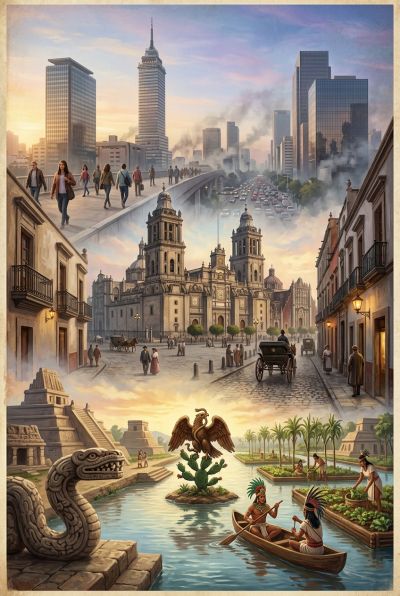
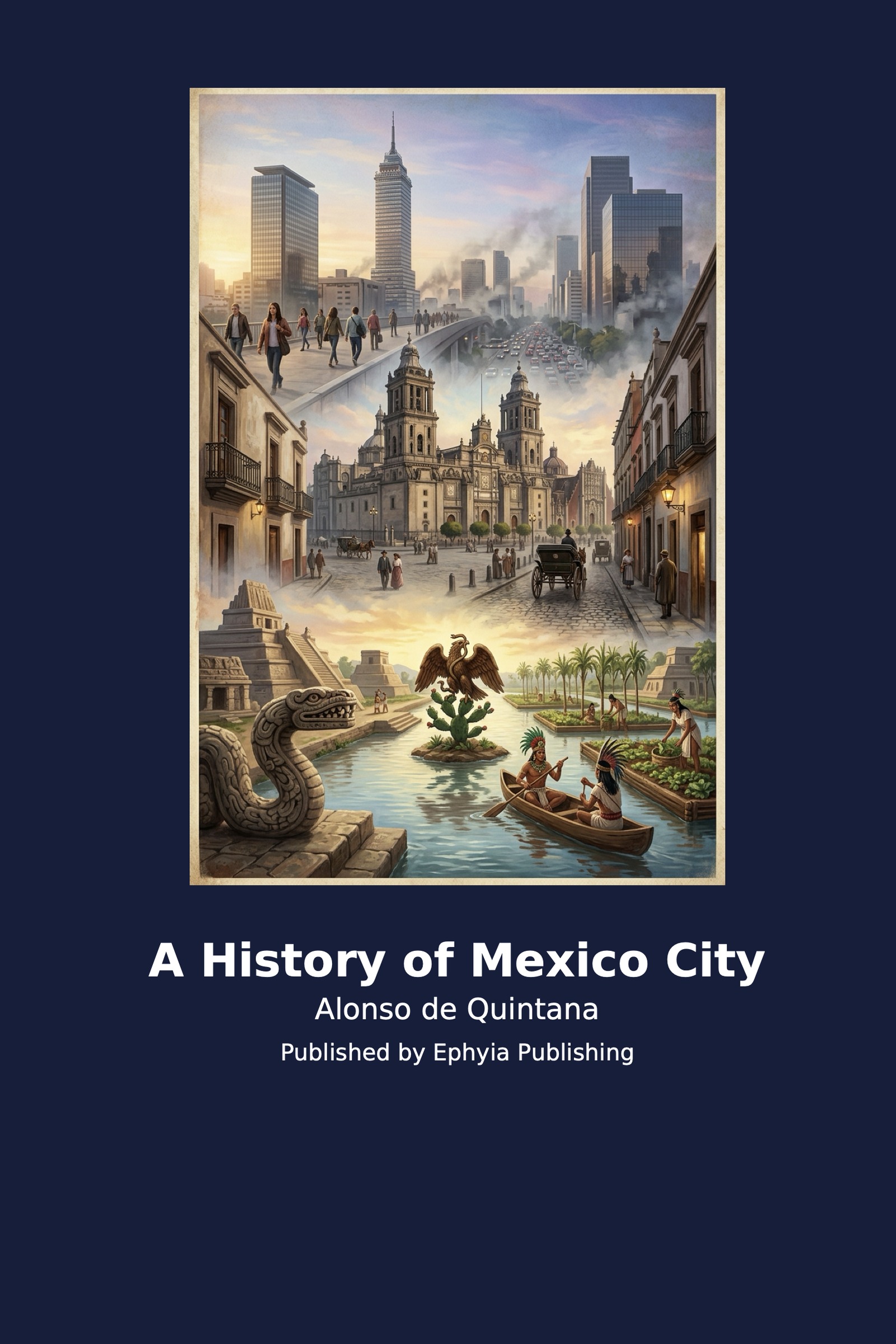
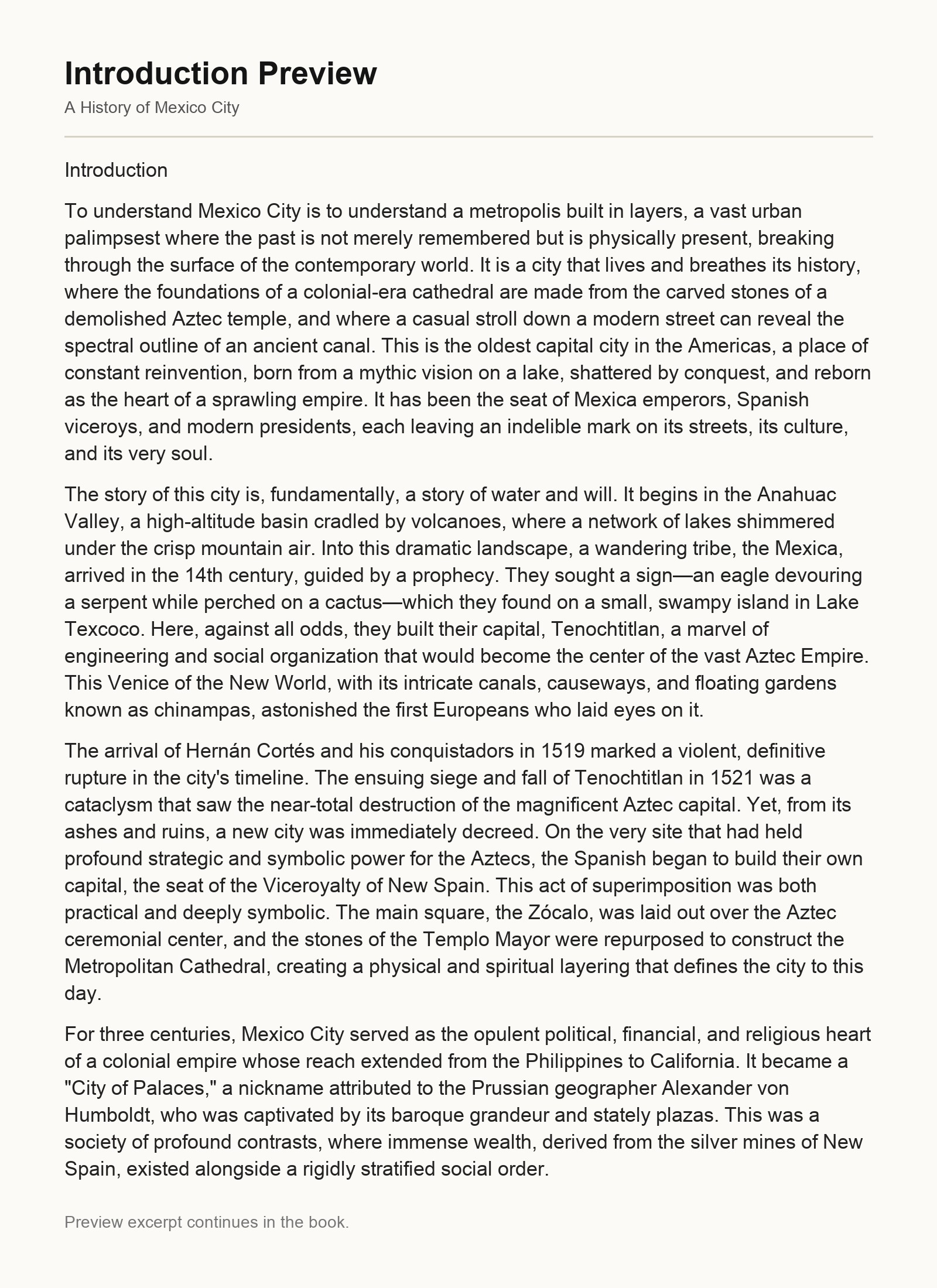
For over seven centuries, Mexico City has been a place of constant transformation—a metropolis built in layers where ancient myths meet modern challenges. In this sweeping history, readers will journey from the volcanic Valley of Mexico, where the Aztecs saw an eagle devouring a serpent on a swampy island and built their extraordinary waterborne capital of Tenochtitlan, through the Spanish conquest that razed the city only to rebuild it upon its ruins, and into the centuries that followed as it evolved from colonial jewel to independent nation's heart.
Readers will discover how this city, quite literally, lives its history—where the stones of demolished Aztec temples form the foundations of colonial cathedrals, where ancient canals lie beneath modern streets, and where every era has left its imprint on the urban landscape. From the ingenious chinampas (floating gardens) that fed an empire to the grand drainage projects that sought to conquer the very lakes on which the city was built, from the Baroque splendor of silver wealth to the revolutionary murals that redefined national identity, this book reveals how Mexico City has continually reinvented itself against formidable odds.
Through vivid storytelling, readers will experience the city's most pivotal moments: the dramatic fall of Tenochtitlan to Cortés, the ideological battles of the Reform era, the Porfiriato's gilded façade masking deep inequality, the explosive cultural awakening after the Revolution that gave us masters like Rivera and Kahlo, the student movements of 1968, and the spontaneous civil society that emerged from the rubble of the 1985 earthquake. Each chapter illuminates not just grand events and famous figures, but the millions of anonymous inhabitants whose daily lives, struggles, and creativity have shaped this unique metropolis.
Beyond politics and architecture, this history delves into the sensory richness of Mexico City—its evolution as a culinary capital from ancient maize-based cuisine to global gastronomic destinations, its emergence as a contemporary art hub where street protests dialogue with world-class museums, and the vibrant urban tribes and social movements that constantly redefine what it means to belong in this sprawling megalopolis. Readers will understand how the city's past informs its present challenges of water scarcity, pollution, and growth, while also revealing its enduring spirit of resilience and reinvention.
Ultimately, this book offers more than a chronological account—it provides a profound understanding of how a city built on a lakebed in a volcanic valley has become one of the most dynamic, complex, and fascinating urban centers in the Americas. Readers will come away with a deep appreciation for Mexico City's ability to honor its layered past while perpetually striving toward its future, making this not just a history of a place, but a story of human ingenuity, adaptation, and the unbreakable bond between a people and their land.
What You'll Find Inside:
- The mythic founding of Tenochtitlan on a swampy island, guided by the eagle-and-serpent prophecy, set the city's divine destiny.
- Aztec engineering marvels—chinampas, causeways, aqueducts, and dikes—turned a lake into a sophisticated metropolis.
- Spanish conquest rebuilt the capital atop Aztec ruins, imposing a grid, colonial institutions, and a layered sacred landscape.
- Post-revolutionary muralism and cultural renaissance forged a modern Mexican identity through public art and education.
- 21st‑century Mexico City grapples with water scarcity, pollution, inequality, and democratic renewal amid massive growth.
Who's It For:
This book is ideal for students, scholars, and general readers interested in Latin American history, urban development, and cultural studies. It offers a deep, chronological exploration of Mexico City’s transformation from an Aztec island capital to a modern megalopolis, highlighting the interplay of geography, politics, and society. Anyone seeking to understand how a city’s layered past shapes its present challenges and identity will find it valuable.
Table of Contents:
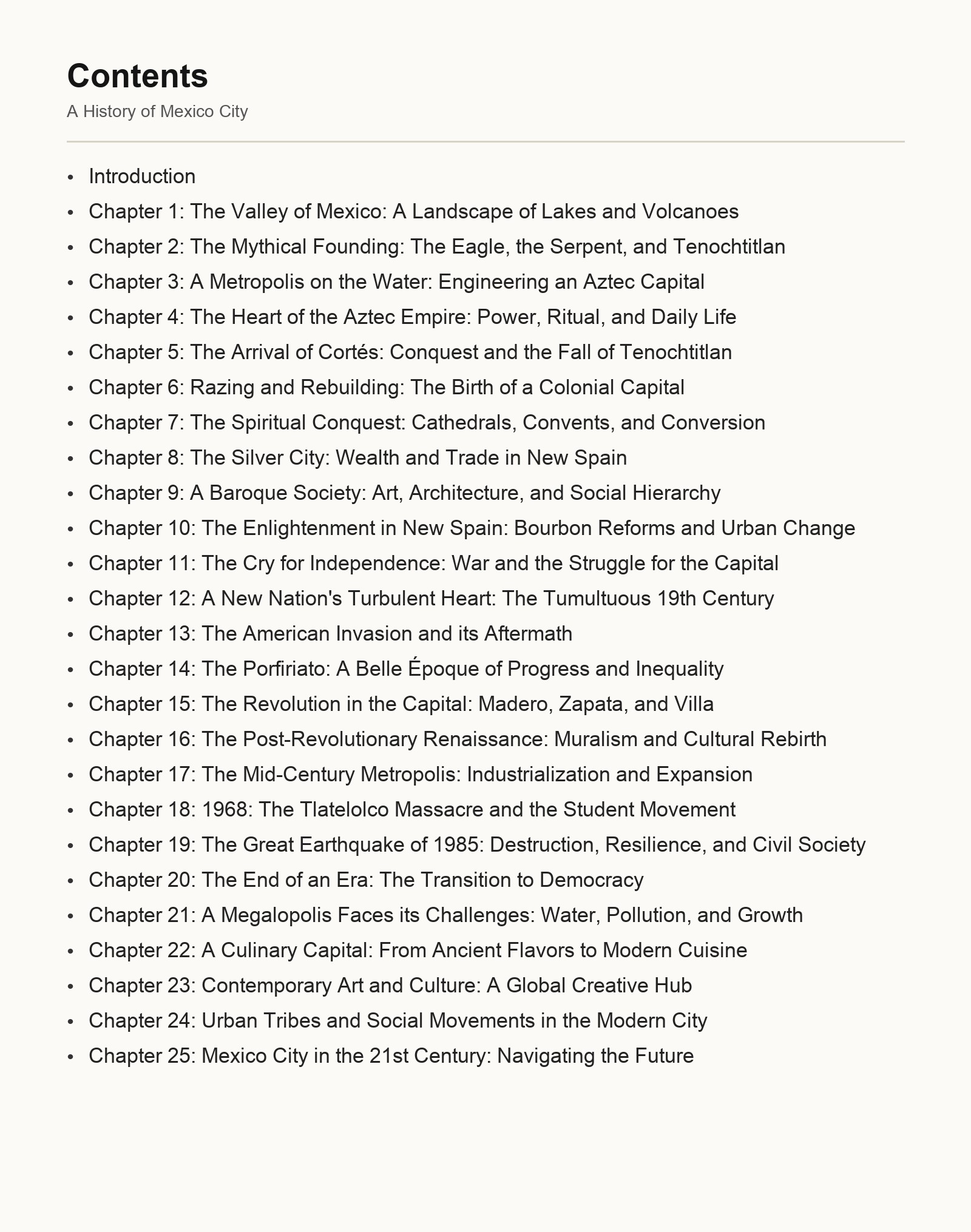
- Introduction
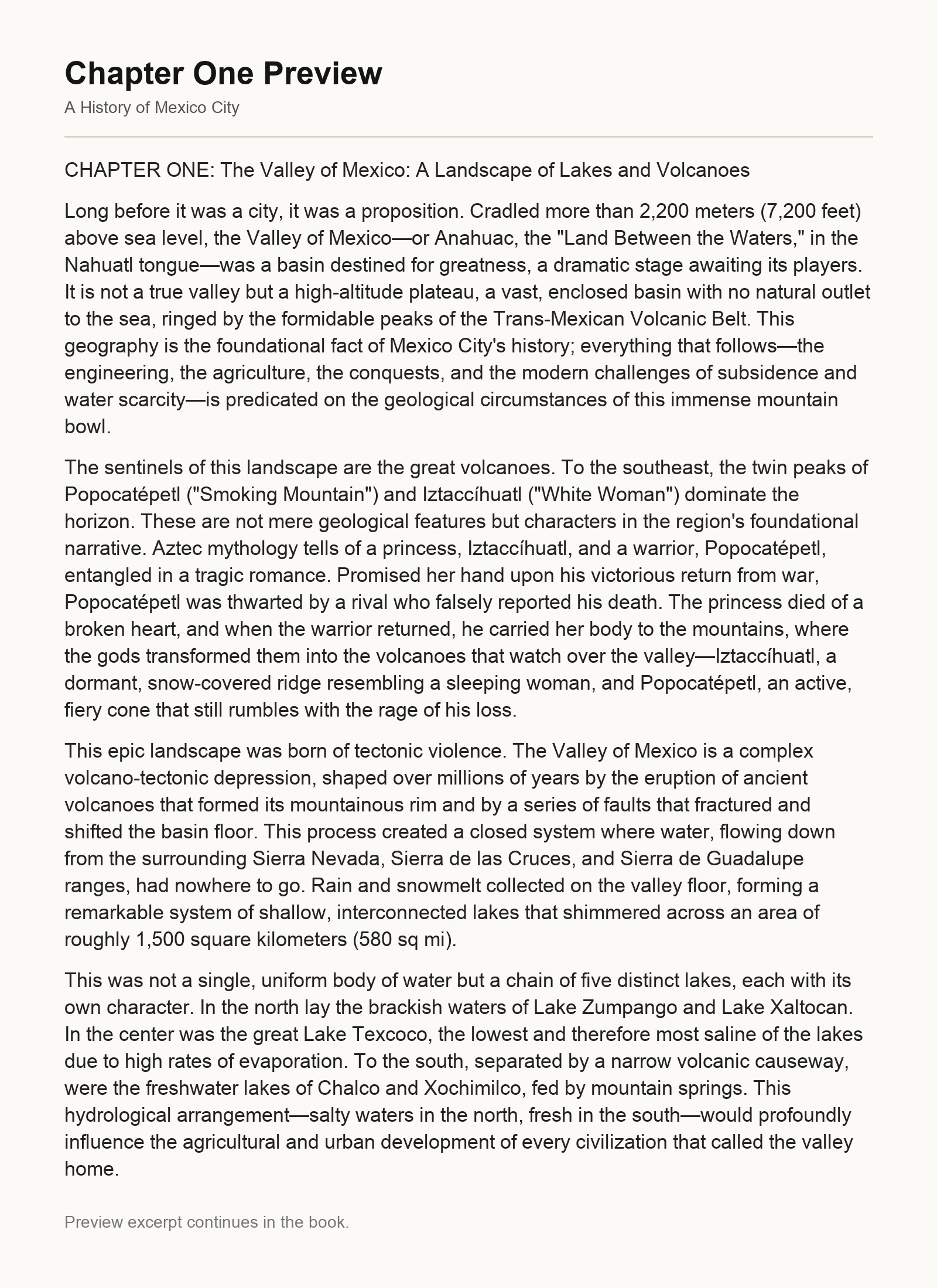
- Chapter 1: The Valley of Mexico: A Landscape of Lakes and Volcanoes
- Chapter 2: The Mythical Founding: The Eagle, the Serpent, and Tenochtitlan
- Chapter 3: A Metropolis on the Water: Engineering an Aztec Capital
- Chapter 4: The Heart of the Aztec Empire: Power, Ritual, and Daily Life
- Chapter 5: The Arrival of Cortés: Conquest and the Fall of Tenochtitlan
- Chapter 6: Razing and Rebuilding: The Birth of a Colonial Capital
- Chapter 7: The Spiritual Conquest: Cathedrals, Convents, and Conversion
- Chapter 8: The Silver City: Wealth and Trade in New Spain
- Chapter 9: A Baroque Society: Art, Architecture, and Social Hierarchy
- Chapter 10: The Enlightenment in New Spain: Bourbon Reforms and Urban Change
- Chapter 11: The Cry for Independence: War and the Struggle for the Capital
- Chapter 12: A New Nation's Turbulent Heart: The Tumultuous 19th Century
- Chapter 13: The American Invasion and its Aftermath
- Chapter 14: The Porfiriato: A Belle Époque of Progress and Inequality
- Chapter 15: The Revolution in the Capital: Madero, Zapata, and Villa
- Chapter 16: The Post-Revolutionary Renaissance: Muralism and Cultural Rebirth
- Chapter 17: The Mid-Century Metropolis: Industrialization and Expansion
- Chapter 18: 1968: The Tlatelolco Massacre and the Student Movement
- Chapter 19: The Great Earthquake of 1985: Destruction, Resilience, and Civil Society
- Chapter 20: The End of an Era: The Transition to Democracy
- Chapter 21: A Megalopolis Faces its Challenges: Water, Pollution, and Growth
- Chapter 22: A Culinary Capital: From Ancient Flavors to Modern Cuisine
- Chapter 23: Contemporary Art and Culture: A Global Creative Hub
- Chapter 24: Urban Tribes and Social Movements in the Modern City
- Chapter 25: Mexico City in the 21st Century: Navigating the Future
Author:
Published By:
Date Published:
May 18, 2026
Type:
Nonfiction
Language:
English
Also Available In:
Word Count:
50,851 words
Reading Time:
3 hours 34 minutes
Sample:
Order:
Order A History of Mexico City (Hardcover) on MixCache.com:
Buy NowPrint copy is made to order and ships worldwide. Includes the ebook free, ready to read instantly.
$5 account credit for all new MixCache.com accounts, usable toward any ebook purchase!*