
Browse by Category
Fiction
- Action & Adventure
- African American
- Anthologies
- Children's Fiction
- Classics
- Comics & Graphic Novels
- Coming of Age
- Contemporary
- Cultural & Regional
- Drama
- Erotica
- Fantasy
- General
- Historical Fiction
- Horror
- Humor & Satire
- Literary Fiction
- Mystery, Thriller & Suspense
- Poetry
- Religious & Inspirational
- Romance
- Science Fiction
- Short Stories
- War & Military
- Westerns
- Women's Fiction
- Young Adult
Non-Fiction
- Antiques & Collectibles
- Arts & Photography
- Biographies & Memoirs
- Business & Money
- Children's Non-Fiction
-
Computers & Technology
- Artificial Intelligence
- Computer Science
- Cybersecurity & Cryptography
- Data Science & Analytics
- Databases & Big Data
- Game Development & Design
- General
- Hardware & DIY
- Mobile App Development
- Networking & Cloud Computing
- Operating Systems
- Programming
- Robotics
- Software
- Software Engineering
- User Experience (UX) & Design
- Web Development & Design
- Cooking, Food & Wine
- Crafts, Hobbies & Home
- Education & Teaching
- Engineering
- General
- Health, Fitness & Dieting
-
History
- African History
- African History - North Africa
- African History - Sub-Saharan Africa
- American History
- American History - 20th Century
- American History - Civil War
- American History - Colonial Period
- Ancient History
- Asian History
- Asian History - China
- Asian History - India
- Asian History - Japan
- Asian History - Southeast Asia
- European History
- European History - Ancient Greece
- European History - Ancient Rome
- European History - Medieval
- European History - Modern
- European History - Renaissance
- General
- Middle Eastern History
- Military History
- Military History - Aviation
- Military History - Naval
- Social & Cultural History
- World History
- Humor & Entertainment
- Industrial Technology
- Language Learning
- Law
- LGBTQ+ Non-Fiction
- Literary Criticism
- Medical Books
- Parenting & Relationships
- Philosophy
- Politics & Social Sciences
- Reference
- Religion & Spirituality
-
Science & Math
- Agricultural Sciences
- Astronomy & Space Science
- Behavioral Sciences
- Biological Sciences
- Botany & Plant Science
- Chemistry
- Earth Sciences
- Engineering - Chemical
- Engineering - Civil
- Engineering - Electrical
- Engineering - Mechanical
- Environment
- General
- Geology
- Mathematics
- Nature & Ecology
- Oceanography
- Paleontology
- Physics
- Statistics
- Self-Help
- Sports & Outdoors
- Study Aids
- Sustainability & Green Living
- Textbooks
- Transportation
- Travel
- True Crime
- Urban Planning & Development
- Veterinary Medicine
- Writing & Publishing
Jump to Section
MixCache.com Total Access
Unlimited reading and audiobooks for every book published by MixCache.com.
Included titles carry the MTA badge.
Learn more →A History of France
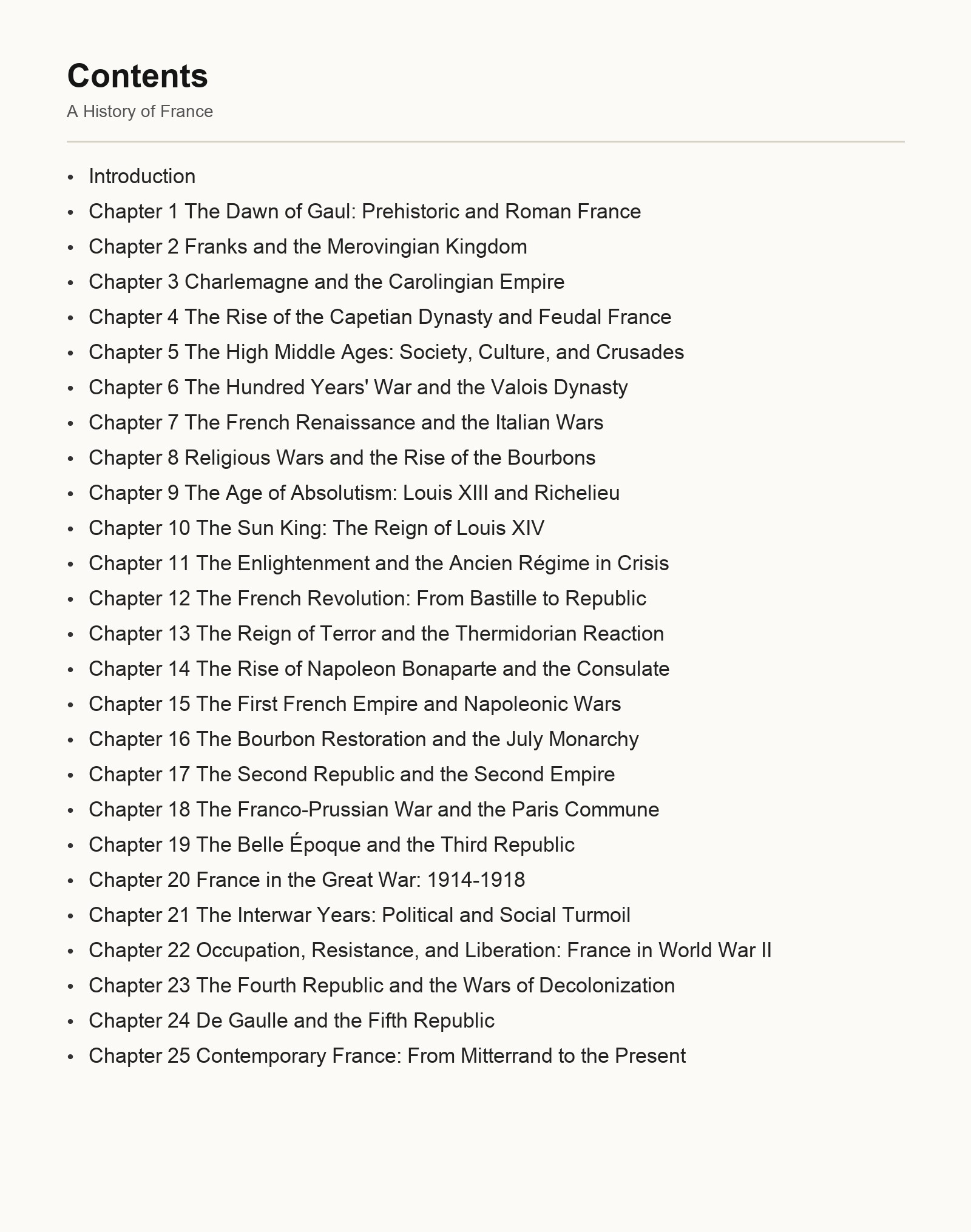
About this book:



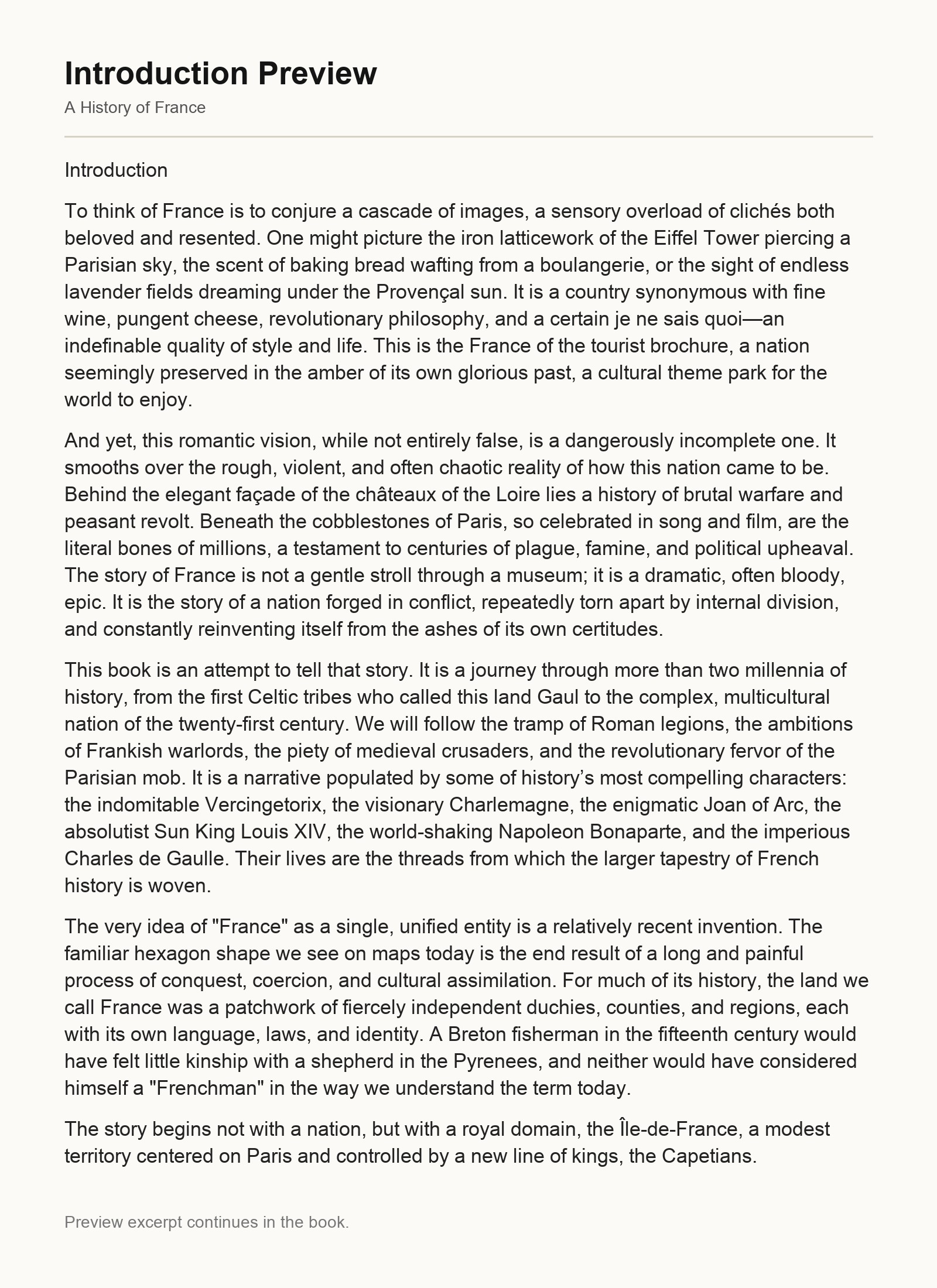
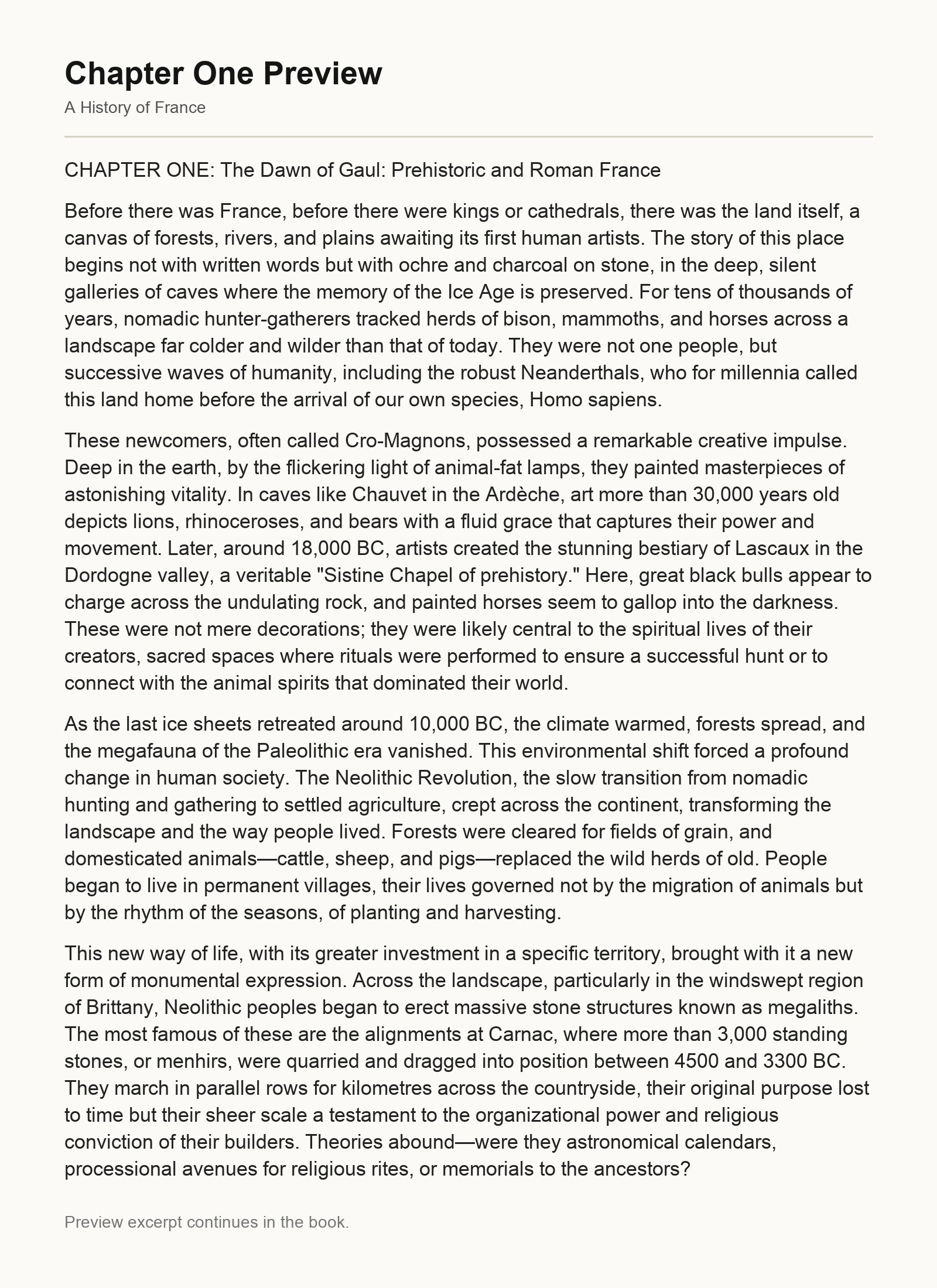
A History of France offers readers a sweeping journey through more than two millennia, from the painted caves of Lascaux to the multicultural nation of the twenty‑first century. By following the rise and fall of dynasties, the clash of cultures, and the relentless drive toward centralization, the book reveals how a fragmented land of Celtic tribes, Roman provinces, and Germanic kingdoms gradually forged the identity we recognize today. Readers will gain a clear sense of the forces—geography, religion, war, and ideas—that repeatedly pulled France apart and then stitched it back together.
Each chapter introduces the pivotal figures whose ambitions and contradictions shaped the nation’s destiny. From Vercingetorix’s defiant stand against Caesar, to Charlemagne’s imperial vision, Joan of Arc’s miraculous leadership, Louis XIV’s absolutist splendor, and Napoleon’s meteoric rise and fall, the narrative brings to life the personalities that turned historical events into personal dramas. The book also highlights the contributions of lesser‑known actors—peasants, artisans, women, and colonial subjects—whose struggles and innovations were essential to France’s evolution.
Beyond recounting battles and treaties, the work explores the social and cultural currents that defined each era. Readers will experience the intellectual ferment of the Enlightenment, the artistic flourishing of the Gothic cathedrals and the Renaissance châteaux, the turbulent religious wars that split the kingdom, and the seismic shifts of the French Revolution, the Reign of Terror, and the Napoleonic Code. The text shows how art, philosophy, law, and everyday life intertwined with political power to produce both sublime achievements and profound tragedies.
The later sections guide the reader through the trials of the twentieth century: the devastation of the World Wars, the painful Vichy collaboration and heroic Resistance, the birth and instability of the Fourth Republic, the Algerian War, and the establishment of de Gaulle’s Fifth Republic. Contemporary challenges—immigration, secularism, European integration, and global terrorism—are examined with the same depth, revealing how France’s past continues to inform its present debates over liberty, equality, and national identity.
By the end of the volume, readers will have acquired not just a chronological account but a nuanced understanding of why France remains a beacon of liberty and a paradox of oppression, a cradle of revolutionary ideals and a stage for authoritarian rule. The book equips anyone interested in European history, culture, or politics with the context needed to appreciate the nation’s enduring influence on the modern world and to grasp the complex tapestry of glory, folly, tragedy, and resilience that defines the French experience.
What You'll Find Inside:
- France's formation through centuries of conquest and cultural assimilation, transforming from a patchwork of tribes and regions into a unified nation centered on Parisian authority.
- The recurring tension between centralizing royal/republican power and regional identities, seen in conflicts from feudal duchies to modern separatist movements.
- France's role as a crucible of Enlightenment ideas that shaped modern concepts of liberty, equality, and secularism (laïcité).
- The nation's revolutionary legacy, from the French Revolution through Napoleonic era to May 1968, which defined modern political discourse globally.
- France's colonial empire and painful decolonization process, particularly in Algeria and Indochina, which continues to influence contemporary French society.
Who's It For:
This book is ideal for students of European history, political science enthusiasts, and general readers seeking to understand how France's turbulent past shapes its present. It will particularly benefit those interested in the origins of modern republican ideals, the evolution of European power dynamics, and the complex relationship between national identity and cultural diversity in Western nations. Readers looking for context on contemporary French society, its global influence, and its ongoing struggles with immigration, secularism, and European integration will find valuable historical perspective.
Table of Contents:
- Introduction
- Chapter 1 The Dawn of Gaul: Prehistoric and Roman France
- Chapter 2 Franks and the Merovingian Kingdom
- Chapter 3 Charlemagne and the Carolingian Empire
- Chapter 4 The Rise of the Capetian Dynasty and Feudal France
- Chapter 5 The High Middle Ages: Society, Culture, and Crusades
- Chapter 6 The Hundred Years' War and the Valois Dynasty
- Chapter 7 The French Renaissance and the Italian Wars
- Chapter 8 Religious Wars and the Rise of the Bourbons
- Chapter 9 The Age of Absolutism: Louis XIII and Richelieu
- Chapter 10 The Sun King: The Reign of Louis XIV
- Chapter 11 The Enlightenment and the Ancien Régime in Crisis
- Chapter 12 The French Revolution: From Bastille to Republic
- Chapter 13 The Reign of Terror and the Thermidorian Reaction
- Chapter 14 The Rise of Napoleon Bonaparte and the Consulate
- Chapter 15 The First French Empire and Napoleonic Wars
- Chapter 16 The Bourbon Restoration and the July Monarchy
- Chapter 17 The Second Republic and the Second Empire
- Chapter 18 The Franco-Prussian War and the Paris Commune
- Chapter 19 The Belle Époque and the Third Republic
- Chapter 20 France in the Great War: 1914-1918
- Chapter 21 The Interwar Years: Political and Social Turmoil
- Chapter 22 Occupation, Resistance, and Liberation: France in World War II
- Chapter 23 The Fourth Republic and the Wars of Decolonization
- Chapter 24 De Gaulle and the Fifth Republic
- Chapter 25 Contemporary France: From Mitterrand to the Present
Author:
Published By:
Date Published:
May 18, 2026
Type:
Nonfiction
Language:
English
Also Available In:
Word Count:
65,324 words
Reading Time:
4 hours 34 minutes
Sample:
Order:
Order A History of France (Hardcover) on MixCache.com:
Buy NowPrint copy is made to order and ships worldwide. Includes the ebook free, ready to read instantly.
$5 account credit for all new MixCache.com accounts, usable toward any ebook purchase!*


