
Browse by Category
Fiction
- Action & Adventure
- African American
- Anthologies
- Children's Fiction
- Classics
- Comics & Graphic Novels
- Coming of Age
- Contemporary
- Cultural & Regional
- Drama
- Erotica
- Fantasy
- General
- Historical Fiction
- Horror
- Humor & Satire
- Literary Fiction
- Mystery, Thriller & Suspense
- Poetry
- Religious & Inspirational
- Romance
- Science Fiction
- Short Stories
- War & Military
- Westerns
- Women's Fiction
- Young Adult
Non-Fiction
- Antiques & Collectibles
- Arts & Photography
- Biographies & Memoirs
- Business & Money
- Children's Non-Fiction
-
Computers & Technology
- Artificial Intelligence
- Computer Science
- Cybersecurity & Cryptography
- Data Science & Analytics
- Databases & Big Data
- Game Development & Design
- General
- Hardware & DIY
- Mobile App Development
- Networking & Cloud Computing
- Operating Systems
- Programming
- Robotics
- Software
- Software Engineering
- User Experience (UX) & Design
- Web Development & Design
- Cooking, Food & Wine
- Crafts, Hobbies & Home
- Education & Teaching
- Engineering
- General
- Health, Fitness & Dieting
-
History
- African History
- African History - North Africa
- African History - Sub-Saharan Africa
- American History
- American History - 20th Century
- American History - Civil War
- American History - Colonial Period
- Ancient History
- Asian History
- Asian History - China
- Asian History - India
- Asian History - Japan
- Asian History - Southeast Asia
- European History
- European History - Ancient Greece
- European History - Ancient Rome
- European History - Medieval
- European History - Modern
- European History - Renaissance
- General
- Middle Eastern History
- Military History
- Military History - Aviation
- Military History - Naval
- Social & Cultural History
- World History
- Humor & Entertainment
- Industrial Technology
- Language Learning
- Law
- LGBTQ+ Non-Fiction
- Literary Criticism
- Medical Books
- Parenting & Relationships
- Philosophy
- Politics & Social Sciences
- Reference
- Religion & Spirituality
-
Science & Math
- Agricultural Sciences
- Astronomy & Space Science
- Behavioral Sciences
- Biological Sciences
- Botany & Plant Science
- Chemistry
- Earth Sciences
- Engineering - Chemical
- Engineering - Civil
- Engineering - Electrical
- Engineering - Mechanical
- Environment
- General
- Geology
- Mathematics
- Nature & Ecology
- Oceanography
- Paleontology
- Physics
- Statistics
- Self-Help
- Sports & Outdoors
- Study Aids
- Sustainability & Green Living
- Textbooks
- Transportation
- Travel
- True Crime
- Urban Planning & Development
- Veterinary Medicine
- Writing & Publishing
Jump to Section
MixCache.com Total Access
Unlimited reading and audiobooks for every book published by MixCache.com.
Included titles carry the MTA badge.
Learn more →A History of Uganda
About this book:

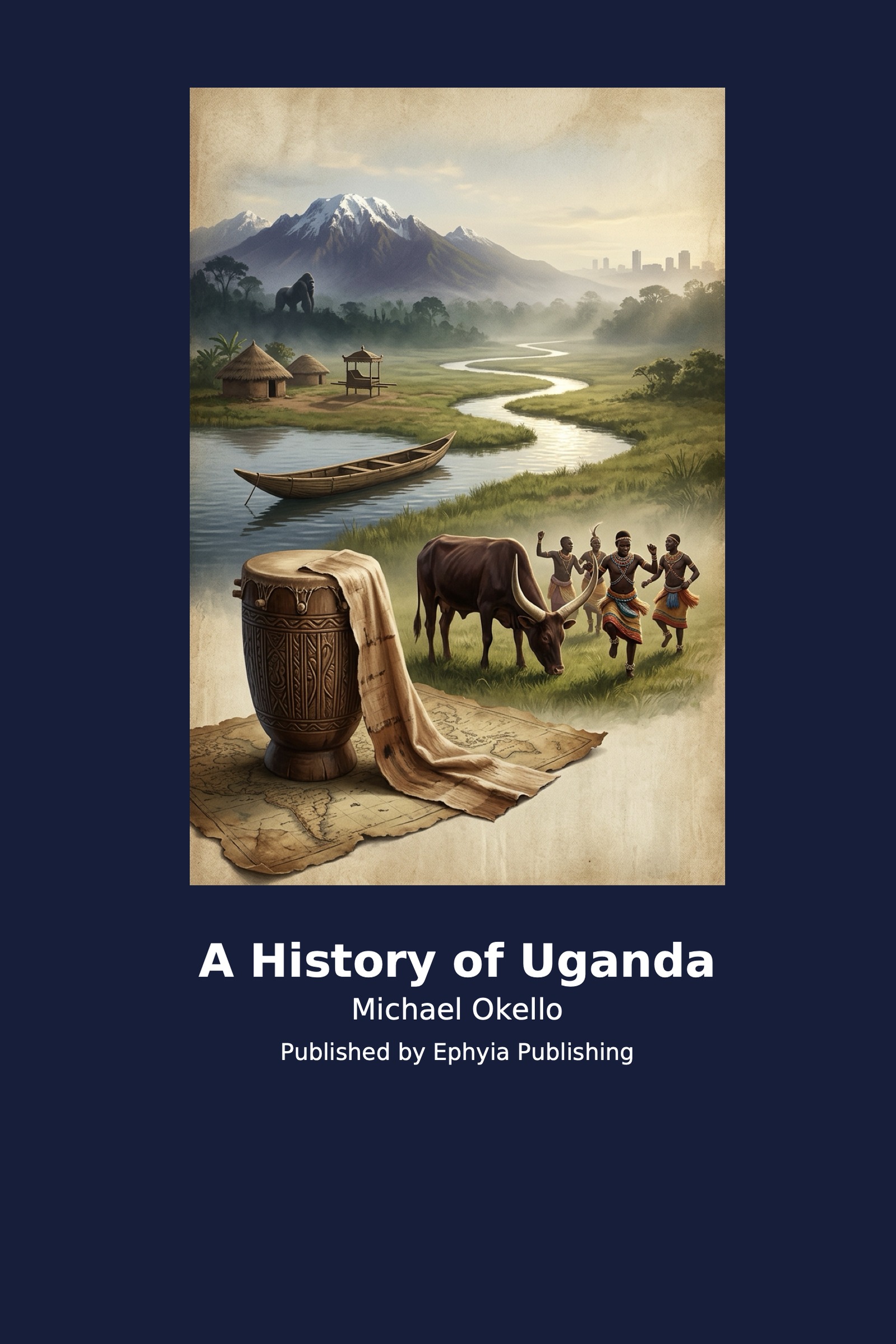
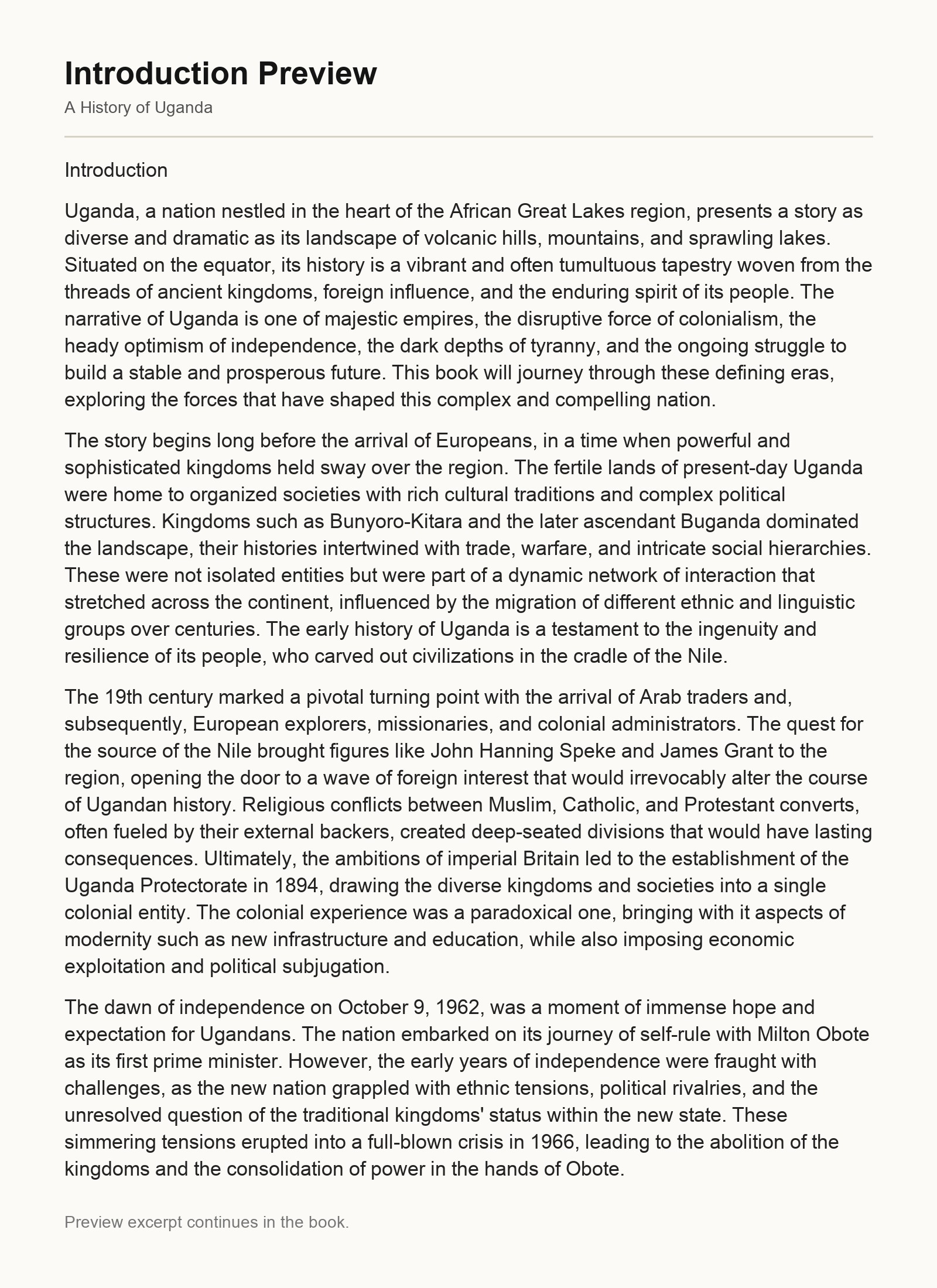
A History of Uganda offers readers a sweeping journey from the dawn of humanity in the Nile’s cradle to the nation’s complex present. Beginning with fossil evidence of early hominins and the stone‑age cultures that shaped the landscape, the book traces how geography, migration, and technological breakthroughs laid the foundations for the great kingdoms of Bunyoro, Buganda, and Nkore. Readers will gain insight into the sophisticated social structures, spiritual beliefs, and economic practices that defined pre‑colonial life, from clan systems and ancestor veneration to the iron‑working prowess that powered regional trade.
The narrative then follows the tumultuous encounter with European explorers, missionaries, and traders, revealing how the quest for the Nile’s source sparked a religious and political rivalry that paved the way for colonial conquest. Chapters detail the establishment of the Uganda Protectorate, the imposition of indirect rule, and the profound consequences of the 1900 Buganda Agreement, which reshaped land tenure, governance, and ethnic relations. Readers will experience the economic transformation driven by cash crops, railway construction, and coercive labor systems, as well as the varied forms of African resistance and collaboration that characterized colonial rule.
Moving into the era of independence, the book examines the hopeful birth of a nation in 1962, the early challenges of ethnic tension and political rivalry, and the dramatic crises that led to the abolition of traditional kingdoms, the rise of Milton Obote, and the shocking ascent of Idi Amin. Readers will witness the brutality of Amin’s regime, the expulsion of the Asian community, the economic collapse, and the eventual liberation war that toppled him. The subsequent return of Obote, the guerrilla war in the Luwero Triangle, and Yoweri Museveni’s seizure of power are presented with careful attention to the human cost and the ideological shifts that followed.
The final sections explore Uganda’s recent decades, covering Museveni’s reconstruction efforts, the insurgency of the Lord’s Resistance Army, the discovery of oil reserves, and the country’s evolving role in regional security. Readers will understand how structural adjustment, political liberalization, and social change have intersected with persistent challenges such as youth unemployment, corruption, and debates over democracy and human rights. By the end, they will have a comprehensive grasp of the forces that have forged Uganda’s identity—a story of resilience, tragedy, and ongoing struggle for a stable, prosperous future.
What You'll Find Inside:
- The book traces Uganda's prehistoric significance as part of the 'cradle of humanity,' highlighting key fossil discoveries like Ugandapithecus major and evidence of early human tool use and symbolic expression.
- It details the rise and fall of the Great Lakes kingdoms, focusing on the legendary Bachwezi, the Kitara Empire, and the centuries-long rivalry between Bunyoro and Buganda that shaped regional politics.
- The colonial era is examined through the establishment of the Uganda Protectorate, the impact of indirect rule, and the economic transformation driven by cash crops like cotton and coffee.
- Post-independence turmoil is chronicled, including Obote's socialist experiments, Amin's brutal dictatorship and expulsion of Asians, and the bush war that brought Museveni to power.
- Contemporary Uganda is analyzed through Museveni's long rule, the northern conflict with the LRA, oil discoveries, and ongoing struggles with democracy, human rights, and economic development.
Who's It For:
This comprehensive history is ideal for students, scholars, and general readers seeking to understand Uganda's complex journey from prehistoric settlements to modern nation-state. It will particularly benefit those studying African colonialism, post-independence politics, and the roots of contemporary conflicts in the Great Lakes region. Researchers interested in ethnic dynamics, state formation, and economic development in Africa will find valuable insights throughout the text.
Table of Contents:
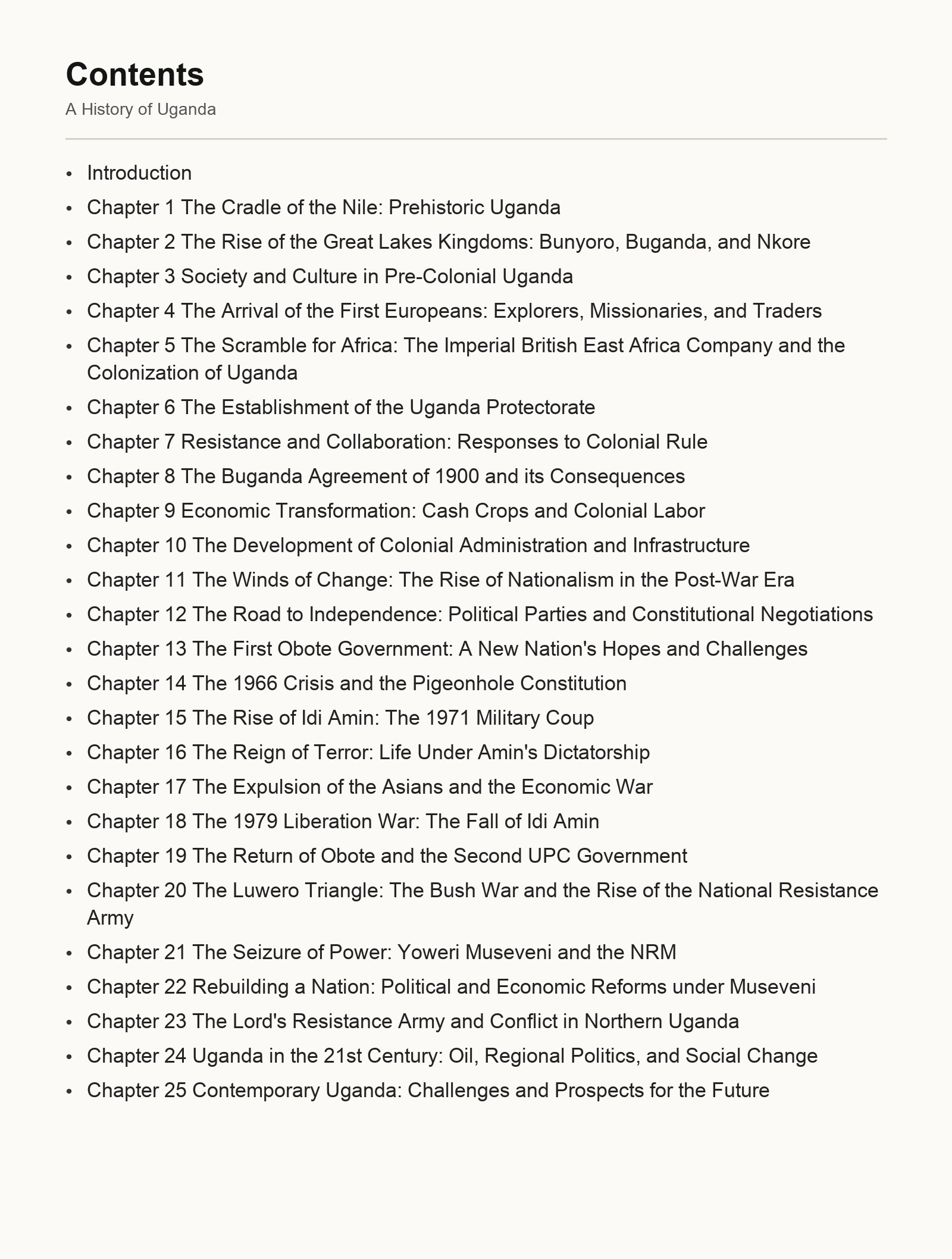
- Introduction
- Chapter 1 The Cradle of the Nile: Prehistoric Uganda
- Chapter 2 The Rise of the Great Lakes Kingdoms: Bunyoro, Buganda, and Nkore
- Chapter 3 Society and Culture in Pre-Colonial Uganda
- Chapter 4 The Arrival of the First Europeans: Explorers, Missionaries, and Traders
- Chapter 5 The Scramble for Africa: The Imperial British East Africa Company and the Colonization of Uganda
- Chapter 6 The Establishment of the Uganda Protectorate
- Chapter 7 Resistance and Collaboration: Responses to Colonial Rule
- Chapter 8 The Buganda Agreement of 1900 and its Consequences
- Chapter 9 Economic Transformation: Cash Crops and Colonial Labor
- Chapter 10 The Development of Colonial Administration and Infrastructure
- Chapter 11 The Winds of Change: The Rise of Nationalism in the Post-War Era
- Chapter 12 The Road to Independence: Political Parties and Constitutional Negotiations
- Chapter 13 The First Obote Government: A New Nation's Hopes and Challenges
- Chapter 14 The 1966 Crisis and the Pigeonhole Constitution
- Chapter 15 The Rise of Idi Amin: The 1971 Military Coup
- Chapter 16 The Reign of Terror: Life Under Amin's Dictatorship
- Chapter 17 The Expulsion of the Asians and the Economic War
- Chapter 18 The 1979 Liberation War: The Fall of Idi Amin
- Chapter 19 The Return of Obote and the Second UPC Government
- Chapter 20 The Luwero Triangle: The Bush War and the Rise of the National Resistance Army
- Chapter 21 The Seizure of Power: Yoweri Museveni and the NRM
- Chapter 22 Rebuilding a Nation: Political and Economic Reforms under Museveni
- Chapter 23 The Lord's Resistance Army and Conflict in Northern Uganda
- Chapter 24 Uganda in the 21st Century: Oil, Regional Politics, and Social Change
- Chapter 25 Contemporary Uganda: Challenges and Prospects for the Future
Author:
Published By:
Date Published:
May 17, 2026
Type:
Nonfiction
Language:
English
Also Available In:
Word Count:
44,782 words
Reading Time:
3 hours 8 minutes
Sample:
Order:
Buy the A History of Uganda ebook on MixCache.com:
Buy NowThe full ebook will be available immediately to read instantly on any device.
$5 account credit for all new MixCache.com accounts, usable toward any ebook purchase!*



Ratings & Reviews
Ask Questions About This Book
Have a question about the content? Ask our AI assistant!
Start by asking a question about "A History of Uganda"
Example: "Does this book mention William Shakespeare?"
Thinking...