
Browse by Category
Fiction
- Action & Adventure
- African American
- Anthologies
- Children's Fiction
- Classics
- Comics & Graphic Novels
- Coming of Age
- Contemporary
- Cultural & Regional
- Drama
- Erotica
- Fantasy
- General
- Historical Fiction
- Horror
- Humor & Satire
- Literary Fiction
- Mystery, Thriller & Suspense
- Poetry
- Religious & Inspirational
- Romance
- Science Fiction
- Short Stories
- War & Military
- Westerns
- Women's Fiction
- Young Adult
Non-Fiction
- Antiques & Collectibles
- Arts & Photography
- Biographies & Memoirs
- Business & Money
- Children's Non-Fiction
-
Computers & Technology
- Artificial Intelligence
- Computer Science
- Cybersecurity & Cryptography
- Data Science & Analytics
- Databases & Big Data
- Game Development & Design
- General
- Hardware & DIY
- Mobile App Development
- Networking & Cloud Computing
- Operating Systems
- Programming
- Robotics
- Software
- Software Engineering
- User Experience (UX) & Design
- Web Development & Design
- Cooking, Food & Wine
- Crafts, Hobbies & Home
- Education & Teaching
- Engineering
- General
- Health, Fitness & Dieting
-
History
- African History
- African History - North Africa
- African History - Sub-Saharan Africa
- American History
- American History - 20th Century
- American History - Civil War
- American History - Colonial Period
- Ancient History
- Asian History
- Asian History - China
- Asian History - India
- Asian History - Japan
- Asian History - Southeast Asia
- European History
- European History - Ancient Greece
- European History - Ancient Rome
- European History - Medieval
- European History - Modern
- European History - Renaissance
- General
- Middle Eastern History
- Military History
- Military History - Aviation
- Military History - Naval
- Social & Cultural History
- World History
- Humor & Entertainment
- Industrial Technology
- Language Learning
- Law
- LGBTQ+ Non-Fiction
- Literary Criticism
- Medical Books
- Parenting & Relationships
- Philosophy
- Politics & Social Sciences
- Reference
- Religion & Spirituality
-
Science & Math
- Agricultural Sciences
- Astronomy & Space Science
- Behavioral Sciences
- Biological Sciences
- Botany & Plant Science
- Chemistry
- Earth Sciences
- Engineering - Chemical
- Engineering - Civil
- Engineering - Electrical
- Engineering - Mechanical
- Environment
- General
- Geology
- Mathematics
- Nature & Ecology
- Oceanography
- Paleontology
- Physics
- Statistics
- Self-Help
- Sports & Outdoors
- Study Aids
- Sustainability & Green Living
- Textbooks
- Transportation
- Travel
- True Crime
- Urban Planning & Development
- Veterinary Medicine
- Writing & Publishing
Jump to Section
MixCache.com Total Access
Unlimited reading and audiobooks for every book published by MixCache.com.
Included titles carry the MTA badge.
Learn more →A History of Anthropology
About this book:
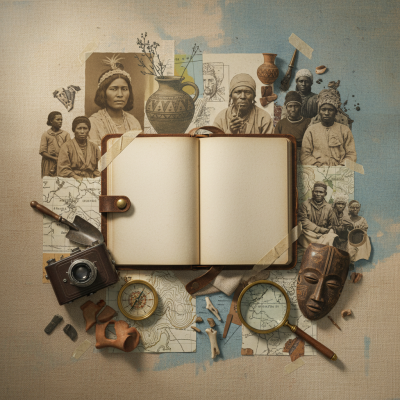


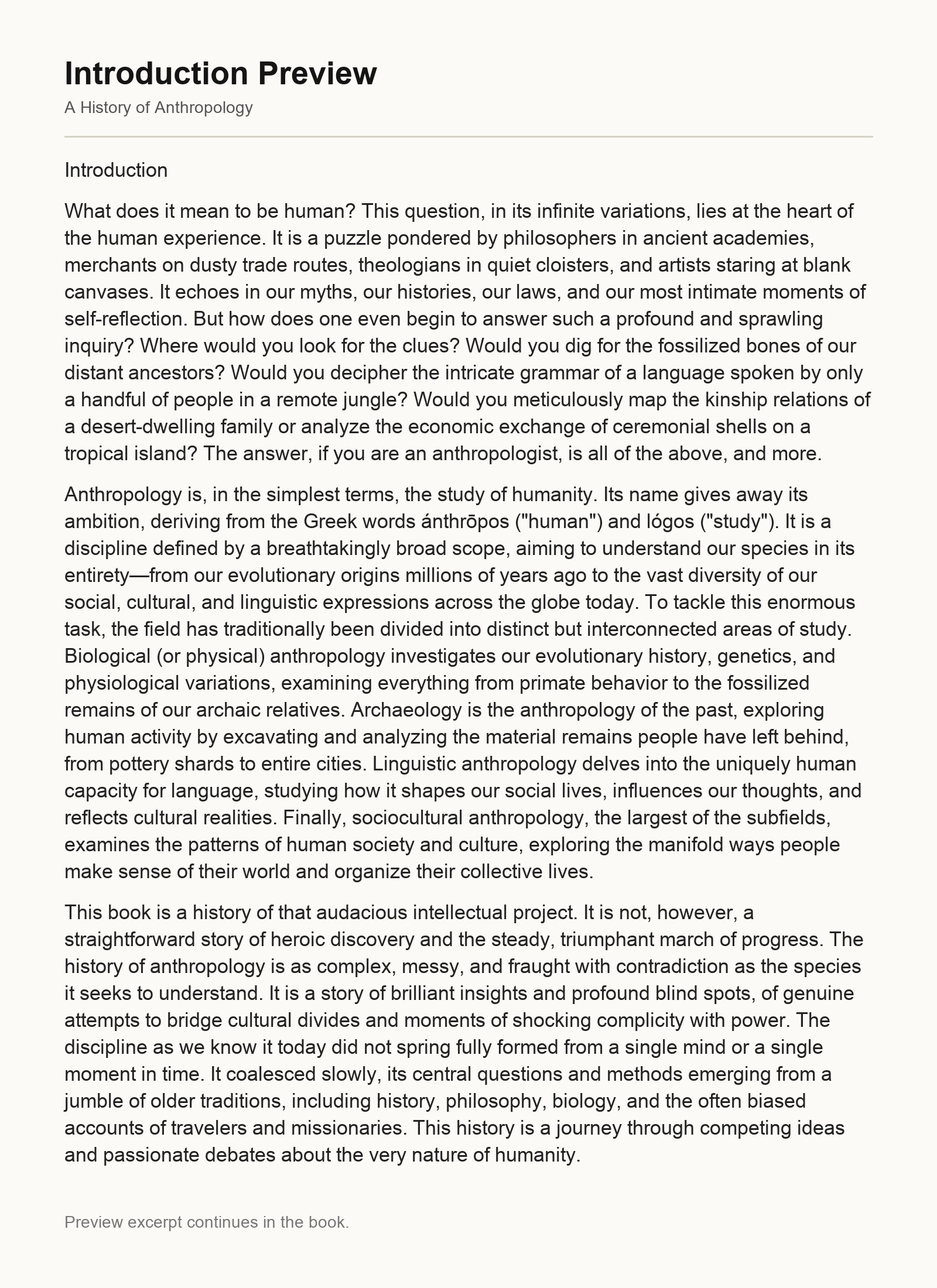
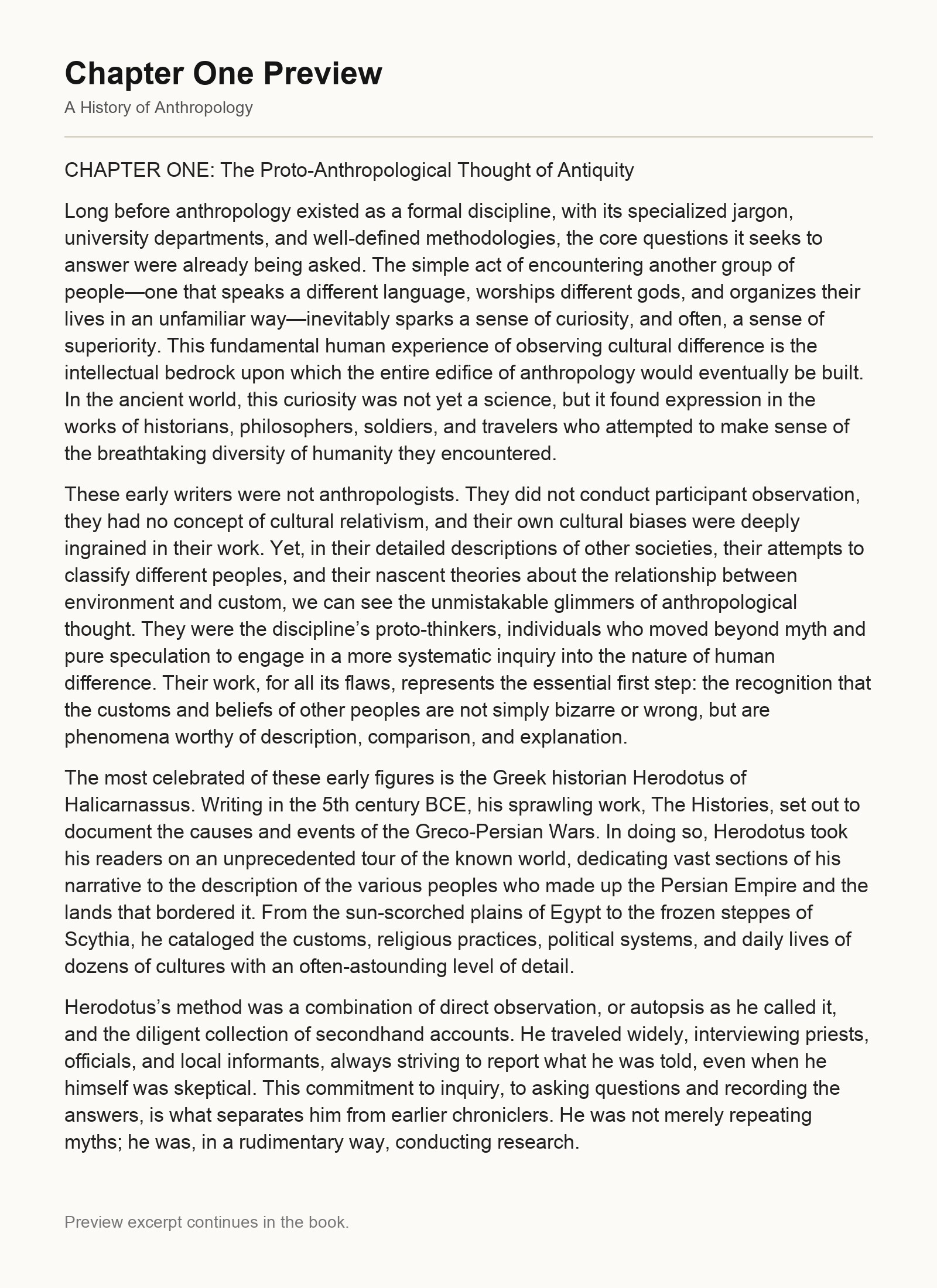
A History of Anthropology offers readers a comprehensive journey through the ideas, people, and events that have shaped the study of humanity from its earliest stirrings to the cutting‑edge debates of today. Beginning with the proto‑anthropological observations of Herodotus, Aristotle, and Ibn Khaldun, the book shows how curiosity about cultural difference laid the groundwork for a discipline that would later grapple with evolution, colonialism, and the very meaning of culture. Each chapter introduces a pivotal thinker or school of thought—from Morgan and Tylor’s unilineal evolutionism to Boas’s historical particularism, Malinowski’s participant observation, Lévi‑Strauss’s structuralism, Geertz’s interpretive turn, and the feminist, Marxist, and postmodern critiques—explaining how their theories emerged, what they sought to explain, and why they mattered.
Readers will learn how anthropology’s methods have evolved over time, moving from armchair speculation to immersive fieldwork, from the collection of curios to thick description and multi‑sited ethnography. The text reveals how concepts such as culture, kinship, religion, and illness have been redefined, and how anthropologists have confronted the discipline’s own biases—ethnocentrism, gender bias, and the legacy of power relations between observer and observed. By tracing these shifts, the book equips readers with a critical toolkit for understanding not only the past of anthropology but also its present applications in areas like medical anthropology, digital anthropology, and the study of globalization.
Beyond theory, the narrative highlights anthropology’s engagement with real‑world issues: the impact of colonialism on knowledge production, the struggle to decolonize the discipline, the rise of intersectional analyses of race and ethnicity, and the ways anthropologists study everything from Balinese cockfights to online communities and global health crises. Readers will see how anthropologists have used their tools to challenge racism, advocate for social justice, and reveal the hidden structures of power that shape everyday life, making the field both intellectually rigorous and socially relevant.
Ultimately, A History of Anthropology invites readers to experience the discipline as a living conversation—one that constantly questions its own assumptions, embraces contradiction, and seeks to understand the spectacular diversity of human meaning‑making. Whether you are a student encountering anthropology for the first time, a scholar looking for a concise yet nuanced overview, or a curious reader interested in how we have come to know ourselves and others, this book provides a clear, engaging roadmap through the triumphs, blind spots, and ongoing debates that define what it means to study humanity.
What You'll Find Inside:
- Traces anthropology's development from ancient proto-anthropological thought (Herodotus, Ibn Khaldun) through Enlightenment 'science of man' to the formal establishment of the discipline as a field of study
- Examines major theoretical paradigms including unilineal evolutionism, Boasian historical particularism and cultural relativism, functionalism (Malinowski), structural functionalism (Radcliffe-Brown), structuralism (Lévi-Strauss), and symbolic/interpretive anthropology (Geertz)
- Details methodological innovations that transformed anthropological practice: participant observation, the four-field approach, multi-sited ethnography, and the rise of decolonizing and collaborative research methodologies
- Explores anthropology's engagement with contemporary issues such as globalization, medical anthropology, digital anthropology, environmental anthropology in the Anthropocene, and engaged/activist approaches to social justice
- Highlights key figures, debates, and conceptual shifts that shaped the discipline: from Morgan and Tylor's evolutionism to feminist and Marxist critiques, postmodernism's crisis of representation, and ongoing ontological and multispecies turns
Who's It For:
This book is ideal for undergraduate and graduate anthropology students seeking a comprehensive historical overview, as well as scholars in sociology, history, and cultural studies interested in the intellectual foundations of social science. It will also benefit researchers and practitioners looking to understand how anthropological theories and methods have evolved to address contemporary global challenges, from colonial legacies to digital cultures and environmental crises.
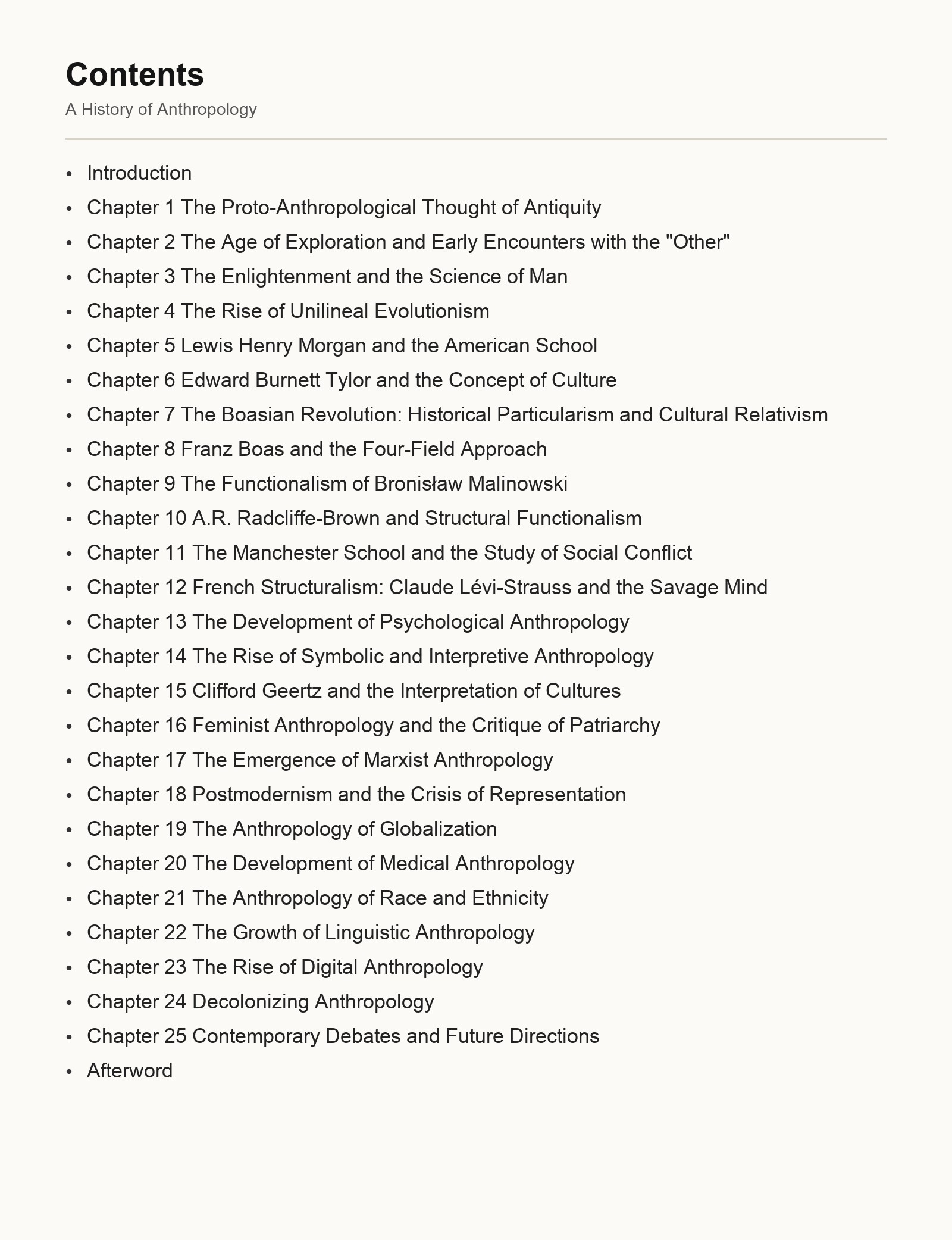
Table of Contents:
- Introduction
- Chapter 1 The Proto-Anthropological Thought of Antiquity
- Chapter 2 The Age of Exploration and Early Encounters with the "Other"
- Chapter 3 The Enlightenment and the Science of Man
- Chapter 4 The Rise of Unilineal Evolutionism
- Chapter 5 Lewis Henry Morgan and the American School
- Chapter 6 Edward Burnett Tylor and the Concept of Culture
- Chapter 7 The Boasian Revolution: Historical Particularism and Cultural Relativism
- Chapter 8 Franz Boas and the Four-Field Approach
- Chapter 9 The Functionalism of Bronisław Malinowski
- Chapter 10 A.R. Radcliffe-Brown and Structural Functionalism
- Chapter 11 The Manchester School and the Study of Social Conflict
- Chapter 12 French Structuralism: Claude Lévi-Strauss and the Savage Mind
- Chapter 13 The Development of Psychological Anthropology
- Chapter 14 The Rise of Symbolic and Interpretive Anthropology
- Chapter 15 Clifford Geertz and the Interpretation of Cultures
- Chapter 16 Feminist Anthropology and the Critique of Patriarchy
- Chapter 17 The Emergence of Marxist Anthropology
- Chapter 18 Postmodernism and the Crisis of Representation
- Chapter 19 The Anthropology of Globalization
- Chapter 20 The Development of Medical Anthropology
- Chapter 21 The Anthropology of Race and Ethnicity
- Chapter 22 The Growth of Linguistic Anthropology
- Chapter 23 The Rise of Digital Anthropology
- Chapter 24 Decolonizing Anthropology
- Chapter 25 Contemporary Debates and Future Directions
- Afterword
Author:
Published By:
Date Published:
May 17, 2026
Type:
Nonfiction
Language:
English
Also Available In:
Word Count:
56,023 words
Reading Time:
3 hours 55 minutes
Sample:
Order:
Buy the A History of Anthropology ebook on MixCache.com:
Buy NowThe full ebook will be available immediately to read instantly on any device.
$5 account credit for all new MixCache.com accounts, usable toward any ebook purchase!*






Ratings & Reviews
Ask Questions About This Book
Have a question about the content? Ask our AI assistant!
Start by asking a question about "A History of Anthropology"
Example: "Does this book mention William Shakespeare?"
Thinking...