
Browse by Category
Fiction
- Action & Adventure
- African American
- Anthologies
- Children's Fiction
- Classics
- Comics & Graphic Novels
- Coming of Age
- Contemporary
- Cultural & Regional
- Drama
- Erotica
- Fantasy
- General
- Historical Fiction
- Horror
- Humor & Satire
- Literary Fiction
- Mystery, Thriller & Suspense
- Poetry
- Religious & Inspirational
- Romance
- Science Fiction
- Short Stories
- War & Military
- Westerns
- Women's Fiction
- Young Adult
Non-Fiction
- Antiques & Collectibles
- Arts & Photography
- Biographies & Memoirs
- Business & Money
- Children's Non-Fiction
-
Computers & Technology
- Artificial Intelligence
- Computer Science
- Cybersecurity & Cryptography
- Data Science & Analytics
- Databases & Big Data
- Game Development & Design
- General
- Hardware & DIY
- Mobile App Development
- Networking & Cloud Computing
- Operating Systems
- Programming
- Robotics
- Software
- Software Engineering
- User Experience (UX) & Design
- Web Development & Design
- Cooking, Food & Wine
- Crafts, Hobbies & Home
- Education & Teaching
- Engineering
- General
- Health, Fitness & Dieting
-
History
- African History
- African History - North Africa
- African History - Sub-Saharan Africa
- American History
- American History - 20th Century
- American History - Civil War
- American History - Colonial Period
- Ancient History
- Asian History
- Asian History - China
- Asian History - India
- Asian History - Japan
- Asian History - Southeast Asia
- European History
- European History - Ancient Greece
- European History - Ancient Rome
- European History - Medieval
- European History - Modern
- European History - Renaissance
- General
- Middle Eastern History
- Military History
- Military History - Aviation
- Military History - Naval
- Social & Cultural History
- World History
- Humor & Entertainment
- Industrial Technology
- Language Learning
- Law
- LGBTQ+ Non-Fiction
- Literary Criticism
- Medical Books
- Parenting & Relationships
- Philosophy
- Politics & Social Sciences
- Reference
- Religion & Spirituality
-
Science & Math
- Agricultural Sciences
- Astronomy & Space Science
- Behavioral Sciences
- Biological Sciences
- Botany & Plant Science
- Chemistry
- Earth Sciences
- Engineering - Chemical
- Engineering - Civil
- Engineering - Electrical
- Engineering - Mechanical
- Environment
- General
- Geology
- Mathematics
- Nature & Ecology
- Oceanography
- Paleontology
- Physics
- Statistics
- Self-Help
- Sports & Outdoors
- Study Aids
- Sustainability & Green Living
- Textbooks
- Transportation
- Travel
- True Crime
- Urban Planning & Development
- Veterinary Medicine
- Writing & Publishing
Jump to Section
MixCache.com Total Access
Unlimited reading and audiobooks for every book published by MixCache.com.
Included titles carry the MTA badge.
Learn more →A History of Sicily
About this book:
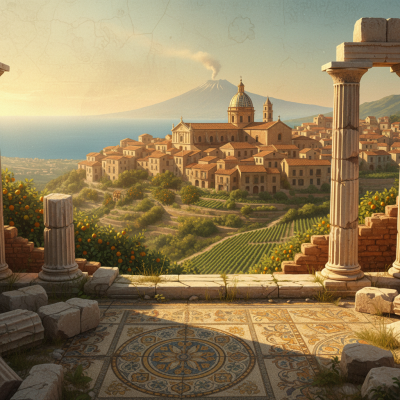
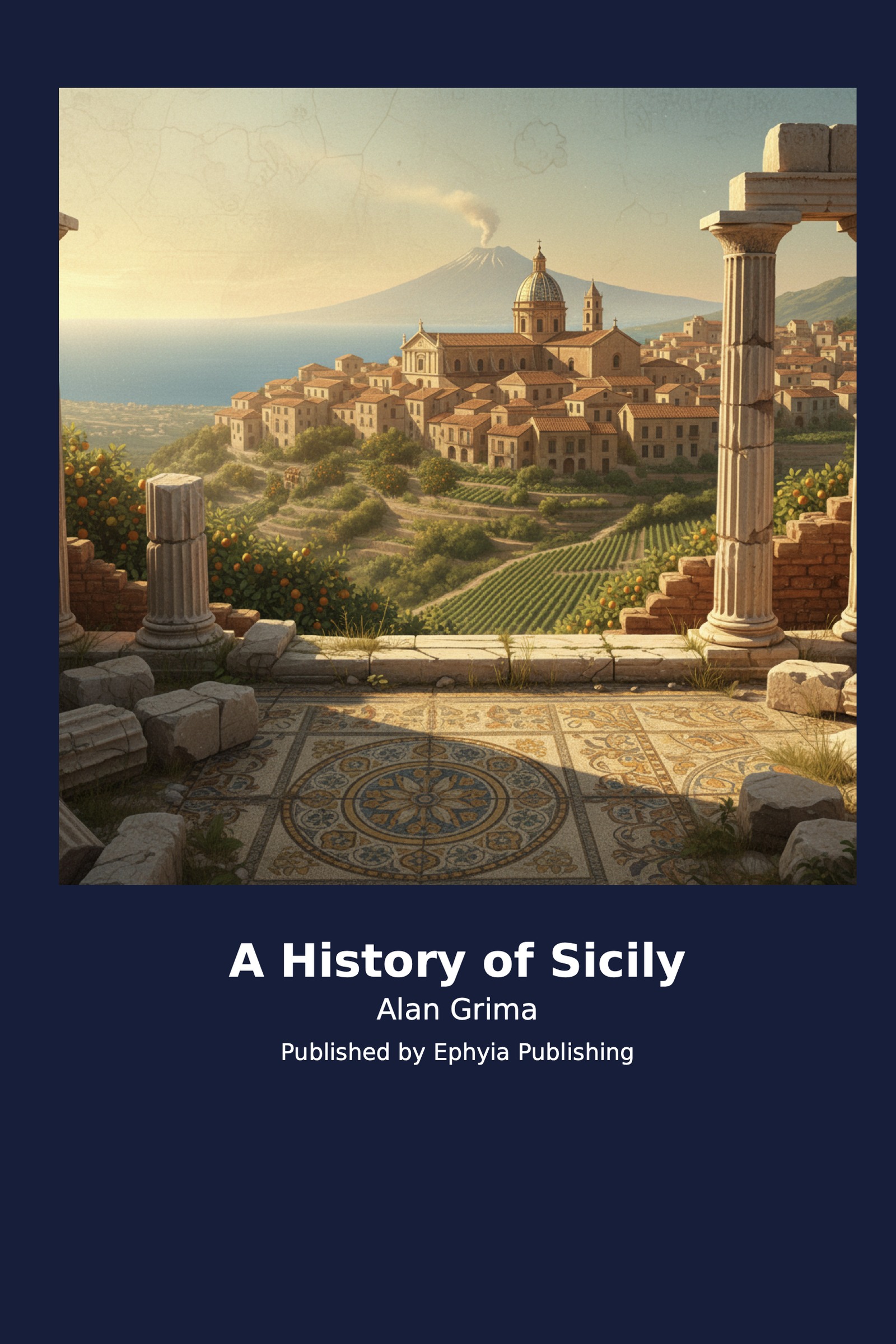
Sicily’s story begins long before recorded history, with its volcanic geology shaping a land that attracted successive waves of peoples. The Sicani, Elymians, and Sicels inhabited the island before Phoenician traders and Greek colonists arrived in the 8th century BCE, establishing prosperous city‑states such as Syracuse, Akragas, and Selinus that formed the heart of Magna Graecia. Rivalry with Carthage turned Sicily into the primary battlefield of the Punic Wars; after Rome’s victory it became the empire’s first province and, for centuries, its “granary,” supplying grain through vast latifundia worked by slave labor. The collapse of Roman authority saw the island pass briefly to Vandals, Ostrogoths, and Byzantines, before Arab conquest in the 9th century introduced new crops, irrigation techniques, and a multi‑confessional society. Arab rule ended when Norman mercenaries, invited by a disaffected emir, conquered the island and created a remarkably tolerant kingdom where Latin, Greek, and Arabic coexisted, leaving a lasting Arab‑Norman artistic legacy in Palermo, Monreale, and Cefalù.
The Norman dynasty gave way to the Hohenstaufen, most notably Frederick II, whose Constitutions of Melfi forged a centralized state and nurtured the Sicilian School of poetry, the first literary use of the vernacular in Italy. Angevin French rule after the Hohenstaufen collapse provoked the 1282 Sicilian Vespers, which expelled the French and placed the island under the Crown of Aragon. For the next several centuries Sicily was governed remotely by Spanish viceroys, first Habsburg then Bourbon, enduring Ottoman raids, the Counter‑Reformation’s Inquisition, and a flurry of Baroque rebuilding after the 1693 earthquake. The War of the Spanish Succession shifted control among Savoy, Austria, and finally the Bourbon‑Spanish line, while the island’s economy remained dominated by grain‑exporting latifundia and its society increasingly stratified.
The 19th century brought the Risorgimento: Garibaldi’s Expedition of the Thousand overthrew Bourbon rule and united Sicily with the new Kingdom of Italy, a change many Sicilians experienced as exchanging one distant master for another. In the power vacuum that followed, the Mafia emerged from rural gabelloti and estate managers, evolving into a shadow state that provided protection and justice through omertà and collusion with officials. The Belle Époque masked deep rural poverty, prompting mass emigration to the Americas and northern Europe. Fascism attempted to eradicate the Mafia but only weakened its rural branches, while World II’s Allied invasion in 1943 toppled the regime and left a power vacuum that the Mafia quickly exploited. Post‑war autonomy and the Cassa per il Mezzogiorno funded reconstruction but also entrenched a corrupt Christian‑Democrat‑Mafia alliance, leading to the “Sack of Palermo” and decades of political stagnation. The 1980s Maxi Trial, powered by informants like Tommaso Buscetta, dealt a severe blow to Cosa Nostra, though the organization adapted to a subtler, economically embedded presence. Contemporary Sicily grapples with high unemployment, a brain drain of educated youth, waste‑management crises, and its role as a front line for Mediterranean migration, yet cultural renewal—evident in UNESCO World Heritage sites, a revived food and wine industry, and grassroots anti‑extortion movements like Addiopizzo—offers hope for a future that acknowledges the island’s layered past while striving for a more equitable and vibrant society.
What You'll Find Inside:
- Sicily's strategic position as a Mediterranean crossroads made it a perpetual prize for empires, shaping its history through successive waves of Greek, Roman, Arab, Norman, and Spanish rule.
- The island's unique cultural identity emerged from centuries of fusion, evident in Arab-Norman architecture, Baroque art, and a enduring spirit of resilience amid constant change.
- A recurring pattern of economic exploitation saw Sicily's wealth—from grain to labor—systematically extracted to enrich distant powers, from Roman latifundia to Spanish viceroys.
- The Mafia originated as a 'shadow state' filling power vacuums during turbulent transitions, evolving from rural protection rackets to a deeply entrenched criminal-political nexus.
- Modern Sicily grapples with the legacy of its past: high unemployment, emigration 'brain drain', Mafia influence, and its role as a frontline in Mediterranean migration crises.
Who's It For:
This book is ideal for history enthusiasts, students of Mediterranean studies, and travelers seeking to understand Sicily's layered past. It will particularly benefit readers interested in how geography influences historical destiny, the processes of cultural synthesis and conflict, and the long-term social and economic consequences of foreign domination. Anyone fascinated by the persistence of local identity amid successive waves of conquest will find this comprehensive chronicle both informative and compelling.
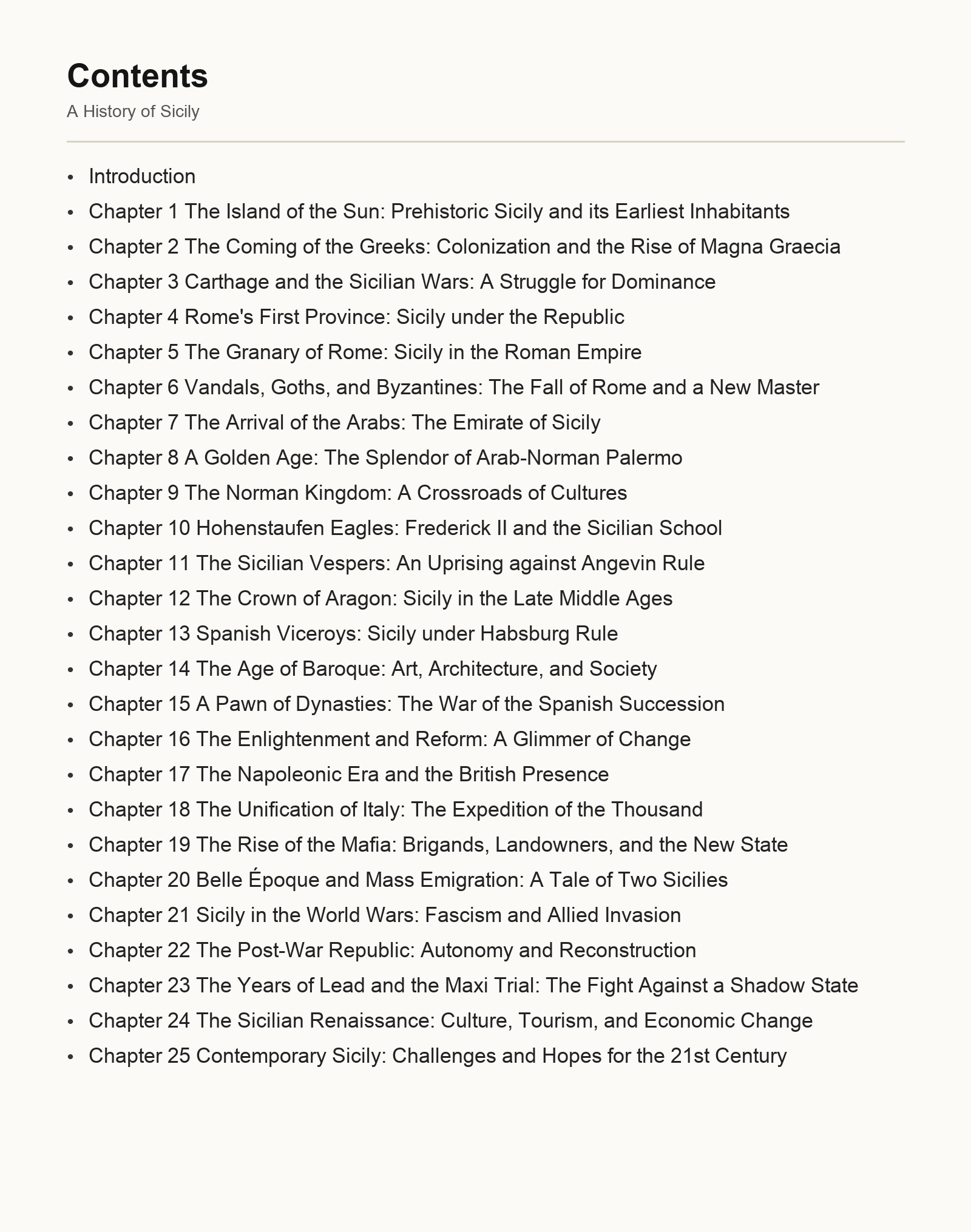
Table of Contents:
- Introduction
- Chapter 1 The Island of the Sun: Prehistoric Sicily and its Earliest Inhabitants
- Chapter 2 The Coming of the Greeks: Colonization and the Rise of Magna Graecia
- Chapter 3 Carthage and the Sicilian Wars: A Struggle for Dominance
- Chapter 4 Rome's First Province: Sicily under the Republic
- Chapter 5 The Granary of Rome: Sicily in the Roman Empire
- Chapter 6 Vandals, Goths, and Byzantines: The Fall of Rome and a New Master
- Chapter 7 The Arrival of the Arabs: The Emirate of Sicily
- Chapter 8 A Golden Age: The Splendor of Arab-Norman Palermo
- Chapter 9 The Norman Kingdom: A Crossroads of Cultures
- Chapter 10 Hohenstaufen Eagles: Frederick II and the Sicilian School
- Chapter 11 The Sicilian Vespers: An Uprising against Angevin Rule
- Chapter 12 The Crown of Aragon: Sicily in the Late Middle Ages
- Chapter 13 Spanish Viceroys: Sicily under Habsburg Rule
- Chapter 14 The Age of Baroque: Art, Architecture, and Society
- Chapter 15 A Pawn of Dynasties: The War of the Spanish Succession
- Chapter 16 The Enlightenment and Reform: A Glimmer of Change
- Chapter 17 The Napoleonic Era and the British Presence
- Chapter 18 The Unification of Italy: The Expedition of the Thousand
- Chapter 19 The Rise of the Mafia: Brigands, Landowners, and the New State
- Chapter 20 Belle Époque and Mass Emigration: A Tale of Two Sicilies
- Chapter 21 Sicily in the World Wars: Fascism and Allied Invasion
- Chapter 22 The Post-War Republic: Autonomy and Reconstruction
- Chapter 23 The Years of Lead and the Maxi Trial: The Fight Against a Shadow State
- Chapter 24 The Sicilian Renaissance: Culture, Tourism, and Economic Change
- Chapter 25 Contemporary Sicily: Challenges and Hopes for the 21st Century
Author:
Published By:
Date Published:
May 16, 2026
Type:
Nonfiction
Language:
English
Also Available In:
Word Count:
47,596 words
Reading Time:
3 hours 20 minutes
Sample:
Order:
Buy the A History of Sicily ebook on MixCache.com:
Buy NowThe full ebook will be available immediately to read instantly on any device.
$5 account credit for all new MixCache.com accounts, usable toward any ebook purchase!*




Ratings & Reviews
Ask Questions About This Book
Have a question about the content? Ask our AI assistant!
Start by asking a question about "A History of Sicily"
Example: "Does this book mention William Shakespeare?"
Thinking...