Browse by Category
Fiction
- Action & Adventure
- African American
- Anthologies
- Children's Fiction
- Classics
- Comics & Graphic Novels
- Coming of Age
- Contemporary
- Cultural & Regional
- Drama
- Erotica
- Fantasy
- General
- Historical Fiction
- Horror
- Humor & Satire
- Literary Fiction
- Mystery, Thriller & Suspense
- Poetry
- Religious & Inspirational
- Romance
- Science Fiction
- Short Stories
- War & Military
- Westerns
- Women's Fiction
- Young Adult
Non-Fiction
- Antiques & Collectibles
- Arts & Photography
- Biographies & Memoirs
- Business & Money
- Children's Non-Fiction
-
Computers & Technology
- Artificial Intelligence
- Computer Science
- Cybersecurity & Cryptography
- Data Science & Analytics
- Databases & Big Data
- Game Development & Design
- General
- Hardware & DIY
- Mobile App Development
- Networking & Cloud Computing
- Operating Systems
- Programming
- Robotics
- Software
- Software Engineering
- User Experience (UX) & Design
- Web Development & Design
- Cooking, Food & Wine
- Crafts, Hobbies & Home
- Education & Teaching
- Engineering
- General
- Health, Fitness & Dieting
-
History
- African History
- African History - North Africa
- African History - Sub-Saharan Africa
- American History
- American History - 20th Century
- American History - Civil War
- American History - Colonial Period
- Ancient History
- Asian History
- Asian History - China
- Asian History - India
- Asian History - Japan
- Asian History - Southeast Asia
- European History
- European History - Ancient Greece
- European History - Ancient Rome
- European History - Medieval
- European History - Modern
- European History - Renaissance
- General
- Middle Eastern History
- Military History
- Military History - Aviation
- Military History - Naval
- Social & Cultural History
- World History
- Humor & Entertainment
- Industrial Technology
- Language Learning
- Law
- LGBTQ+ Non-Fiction
- Literary Criticism
- Medical Books
- Parenting & Relationships
- Philosophy
- Politics & Social Sciences
- Reference
- Religion & Spirituality
-
Science & Math
- Agricultural Sciences
- Astronomy & Space Science
- Behavioral Sciences
- Biological Sciences
- Botany & Plant Science
- Chemistry
- Earth Sciences
- Engineering - Chemical
- Engineering - Civil
- Engineering - Electrical
- Engineering - Mechanical
- Environment
- General
- Geology
- Mathematics
- Nature & Ecology
- Oceanography
- Paleontology
- Physics
- Statistics
- Self-Help
- Sports & Outdoors
- Study Aids
- Sustainability & Green Living
- Textbooks
- Transportation
- Travel
- True Crime
- Urban Planning & Development
- Veterinary Medicine
- Writing & Publishing
Jump to Section
MixCache.com Total Access
Unlimited reading and audiobooks for every book published by MixCache.com.
Included titles carry the MTA badge.
Learn more →
A History of Pain
From Fire and Herbs to Neuroscience and Implants: The Story of Pain’s Past and Future
About this book:


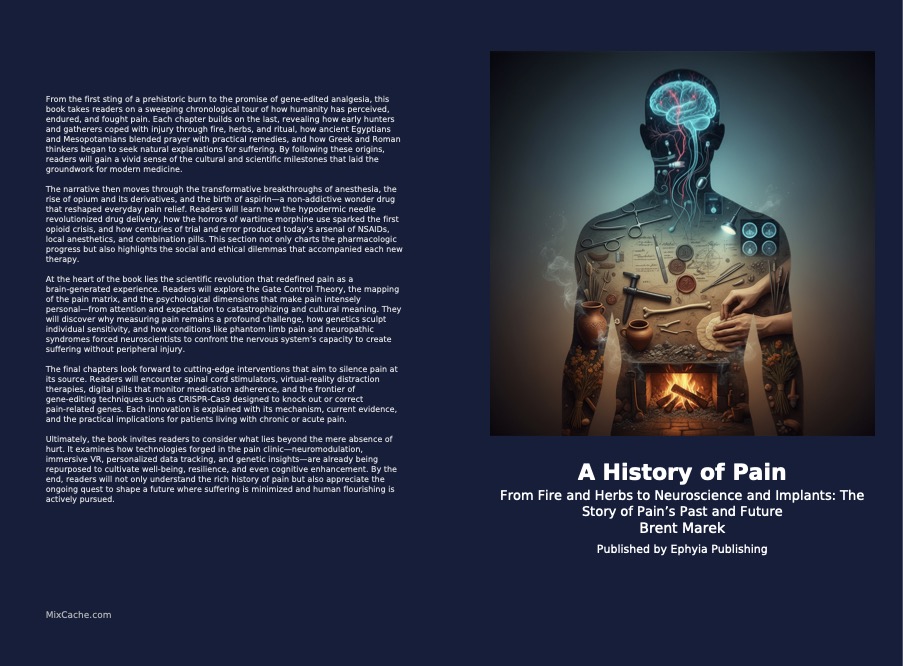
From the first sting of a prehistoric burn to the promise of gene‑edited analgesia, this book takes readers on a sweeping chronological tour of how humanity has perceived, endured, and fought pain. Each chapter builds on the last, revealing how early hunters and gatherers coped with injury through fire, herbs, and ritual, how ancient Egyptians and Mesopotamians blended prayer with practical remedies, and how Greek and Roman thinkers began to seek natural explanations for suffering. By following these origins, readers will gain a vivid sense of the cultural and scientific milestones that laid the groundwork for modern medicine.
The narrative then moves through the transformative breakthroughs of anesthesia, the rise of opium and its derivatives, and the birth of aspirin—a non‑addictive wonder drug that reshaped everyday pain relief. Readers will learn how the hypodermic needle revolutionized drug delivery, how the horrors of wartime morphine use sparked the first opioid crisis, and how centuries of trial and error produced today’s arsenal of NSAIDs, local anesthetics, and combination pills. This section not only charts the pharmacologic progress but also highlights the social and ethical dilemmas that accompanied each new therapy.
At the heart of the book lies the scientific revolution that redefined pain as a brain‑generated experience. Readers will explore the Gate Control Theory, the mapping of the pain matrix, and the psychological dimensions that make pain intensely personal—from attention and expectation to catastrophizing and cultural meaning. They will discover why measuring pain remains a profound challenge, how genetics sculpt individual sensitivity, and how conditions like phantom limb pain and neuropathic syndromes forced neuroscientists to confront the nervous system’s capacity to create suffering without peripheral injury.
The final chapters look forward to cutting‑edge interventions that aim to silence pain at its source. Readers will encounter spinal cord stimulators, virtual‑reality distraction therapies, digital pills that monitor medication adherence, and the frontier of gene‑editing techniques such as CRISPR‑Cas9 designed to knock out or correct pain‑related genes. Each innovation is explained with its mechanism, current evidence, and the practical implications for patients living with chronic or acute pain.
Ultimately, the book invites readers to consider what lies beyond the mere absence of hurt. It examines how technologies forged in the pain clinic—neuromodulation, immersive VR, personalized data tracking, and genetic insights—are already being repurposed to cultivate well‑being, resilience, and even cognitive enhancement. By the end, readers will not only understand the rich history of pain but also appreciate the ongoing quest to shape a future where suffering is minimized and human flourishing is actively pursued.
What You'll Find Inside:
- How pain perception evolved from spiritual punishment and demonic possession to being understood as a complex neurological and psychological phenomenon
- Key historical breakthroughs in pain management including anesthesia (ether/chloroform), opioids, aspirin, and modern pharmacology
- The devastating opioid crisis that emerged from well-intentioned pain treatment and its ongoing impact on society
- Revolutionary neuroscience discoveries like Gate Control Theory and brain pain mapping that transformed our understanding of pain processing
- Cutting-edge future treatments including spinal cord stimulators, virtual reality therapy, digital pills, and gene-editing approaches to pain relief
Who's It For:
This book is ideal for medical students, healthcare professionals, and anyone fascinated by the evolution of medical science. It will particularly resonate with those living with chronic pain seeking historical context for modern treatments, as well as readers interested in neuroscience, pharmacology, and the social impact of medical breakthroughs. The comprehensive yet accessible approach makes it suitable for both professionals looking to deepen their historical understanding and general readers curious about humanity's relationship with pain.
Table of Contents:
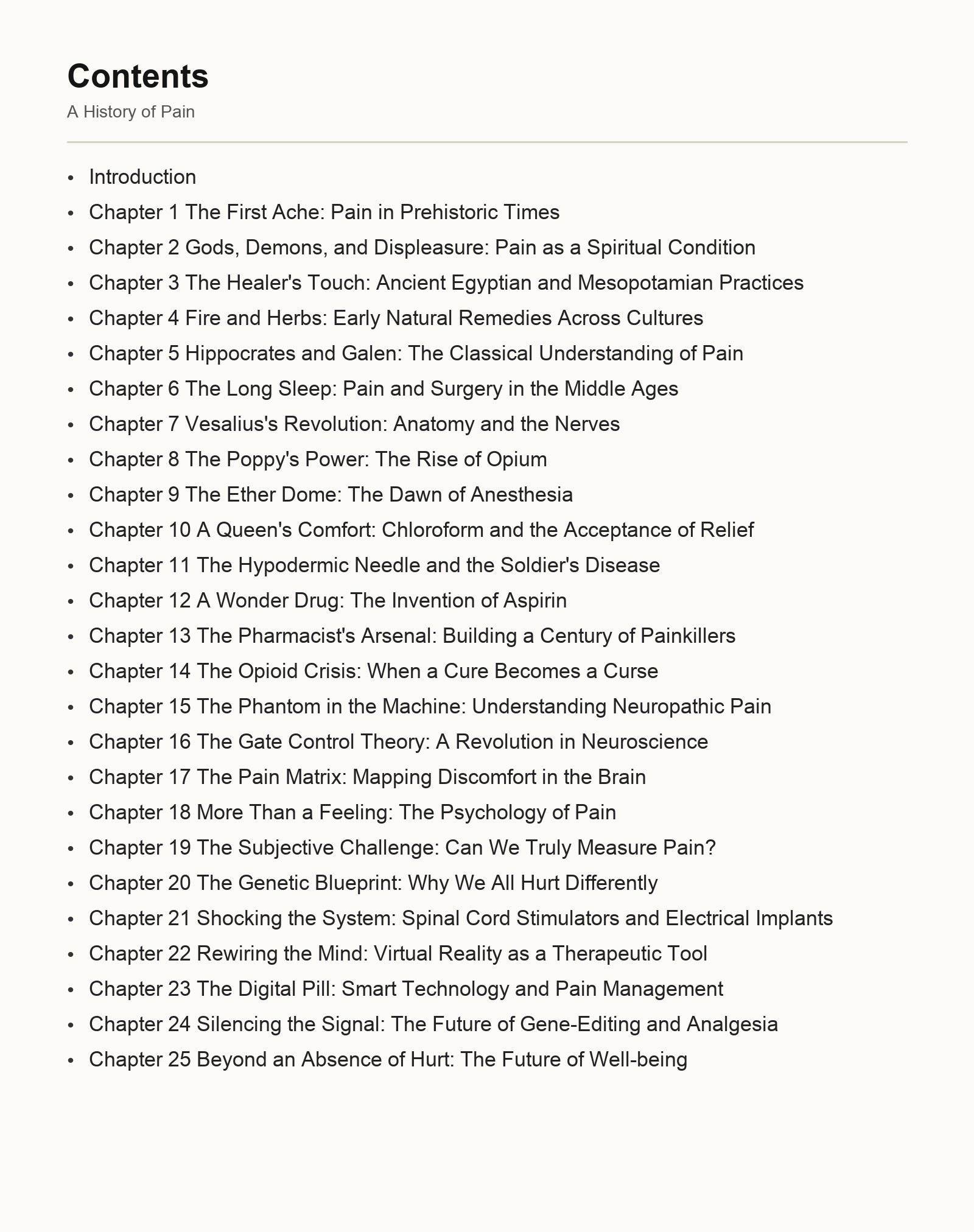
- Introduction
- Chapter 1 The First Ache: Pain in Prehistoric Times
- Chapter 2 Gods, Demons, and Displeasure: Pain as a Spiritual Condition
- Chapter 3 The Healer's Touch: Ancient Egyptian and Mesopotamian Practices
- Chapter 4 Fire and Herbs: Early Natural Remedies Across Cultures
- Chapter 5 Hippocrates and Galen: The Classical Understanding of Pain
- Chapter 6 The Long Sleep: Pain and Surgery in the Middle Ages
- Chapter 7 Vesalius's Revolution: Anatomy and the Nerves
- Chapter 8 The Poppy's Power: The Rise of Opium
- Chapter 9 The Ether Dome: The Dawn of Anesthesia
- Chapter 10 A Queen's Comfort: Chloroform and the Acceptance of Relief
- Chapter 11 The Hypodermic Needle and the Soldier's Disease
- Chapter 12 A Wonder Drug: The Invention of Aspirin
- Chapter 13 The Pharmacist's Arsenal: Building a Century of Painkillers
- Chapter 14 The Opioid Crisis: When a Cure Becomes a Curse
- Chapter 15 The Phantom in the Machine: Understanding Neuropathic Pain
- Chapter 16 The Gate Control Theory: A Revolution in Neuroscience
- Chapter 17 The Pain Matrix: Mapping Discomfort in the Brain
- Chapter 18 More Than a Feeling: The Psychology of Pain
- Chapter 19 The Subjective Challenge: Can We Truly Measure Pain?
- Chapter 20 The Genetic Blueprint: Why We All Hurt Differently
- Chapter 21 Shocking the System: Spinal Cord Stimulators and Electrical Implants
- Chapter 22 Rewiring the Mind: Virtual Reality as a Therapeutic Tool
- Chapter 23 The Digital Pill: Smart Technology and Pain Management
- Chapter 24 Silencing the Signal: The Future of Gene-Editing and Analgesia
- Chapter 25 Beyond an Absence of Hurt: The Future of Well-being
Author:
Published By:
Date Published:
May 16, 2026
Type:
Nonfiction
Language:
English
Also Available In:
Word Count:
46,696 words
Reading Time:
3 hours 16 minutes
Sample:
Order:
Order A History of Pain (Paperback) on MixCache.com:
Buy NowPrint copy is made to order and ships worldwide. Includes the ebook free, ready to read instantly.
$5 account credit for all new MixCache.com accounts, usable toward any ebook purchase!*