
Browse by Category
Fiction
- Action & Adventure
- African American
- Anthologies
- Children's Fiction
- Classics
- Comics & Graphic Novels
- Coming of Age
- Contemporary
- Cultural & Regional
- Drama
- Erotica
- Fantasy
- General
- Historical Fiction
- Horror
- Humor & Satire
- Literary Fiction
- Mystery, Thriller & Suspense
- Poetry
- Religious & Inspirational
- Romance
- Science Fiction
- Short Stories
- War & Military
- Westerns
- Women's Fiction
- Young Adult
Non-Fiction
- Antiques & Collectibles
- Arts & Photography
- Biographies & Memoirs
- Business & Money
- Children's Non-Fiction
-
Computers & Technology
- Artificial Intelligence
- Computer Science
- Cybersecurity & Cryptography
- Data Science & Analytics
- Databases & Big Data
- Game Development & Design
- General
- Hardware & DIY
- Mobile App Development
- Networking & Cloud Computing
- Operating Systems
- Programming
- Robotics
- Software
- Software Engineering
- User Experience (UX) & Design
- Web Development & Design
- Cooking, Food & Wine
- Crafts, Hobbies & Home
- Education & Teaching
- Engineering
- General
- Health, Fitness & Dieting
-
History
- African History
- African History - North Africa
- African History - Sub-Saharan Africa
- American History
- American History - 20th Century
- American History - Civil War
- American History - Colonial Period
- Ancient History
- Asian History
- Asian History - China
- Asian History - India
- Asian History - Japan
- Asian History - Southeast Asia
- European History
- European History - Ancient Greece
- European History - Ancient Rome
- European History - Medieval
- European History - Modern
- European History - Renaissance
- General
- Middle Eastern History
- Military History
- Military History - Aviation
- Military History - Naval
- Social & Cultural History
- World History
- Humor & Entertainment
- Industrial Technology
- Language Learning
- Law
- LGBTQ+ Non-Fiction
- Literary Criticism
- Medical Books
- Parenting & Relationships
- Philosophy
- Politics & Social Sciences
- Reference
- Religion & Spirituality
-
Science & Math
- Agricultural Sciences
- Astronomy & Space Science
- Behavioral Sciences
- Biological Sciences
- Botany & Plant Science
- Chemistry
- Earth Sciences
- Engineering - Chemical
- Engineering - Civil
- Engineering - Electrical
- Engineering - Mechanical
- Environment
- General
- Geology
- Mathematics
- Nature & Ecology
- Oceanography
- Paleontology
- Physics
- Statistics
- Self-Help
- Sports & Outdoors
- Study Aids
- Sustainability & Green Living
- Textbooks
- Transportation
- Travel
- True Crime
- Urban Planning & Development
- Veterinary Medicine
- Writing & Publishing
Jump to Section
MixCache.com Total Access
Unlimited reading and audiobooks for every book published by MixCache.com.
Included titles carry the MTA badge.
Learn more →A History of Botany
About this book:
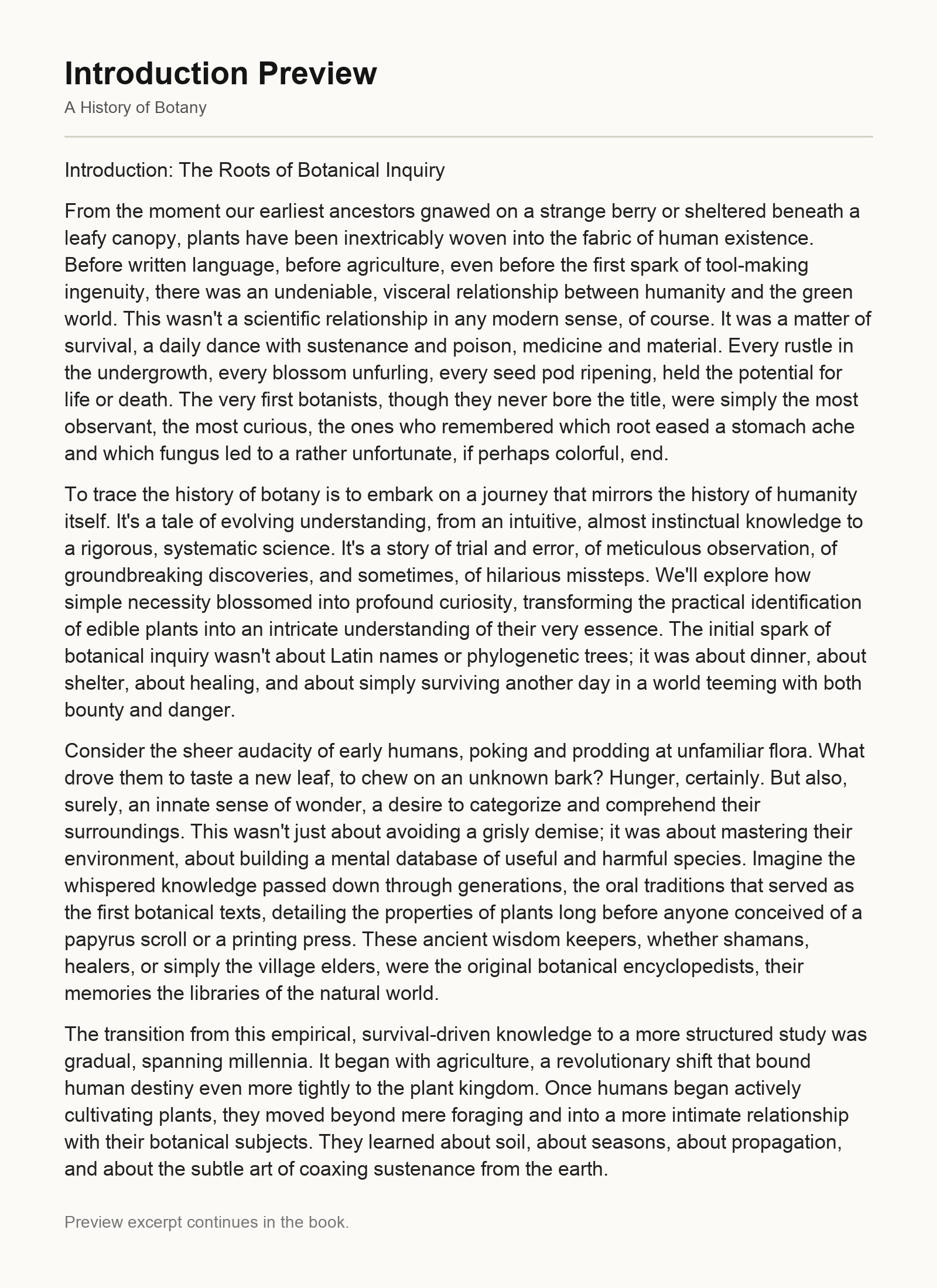
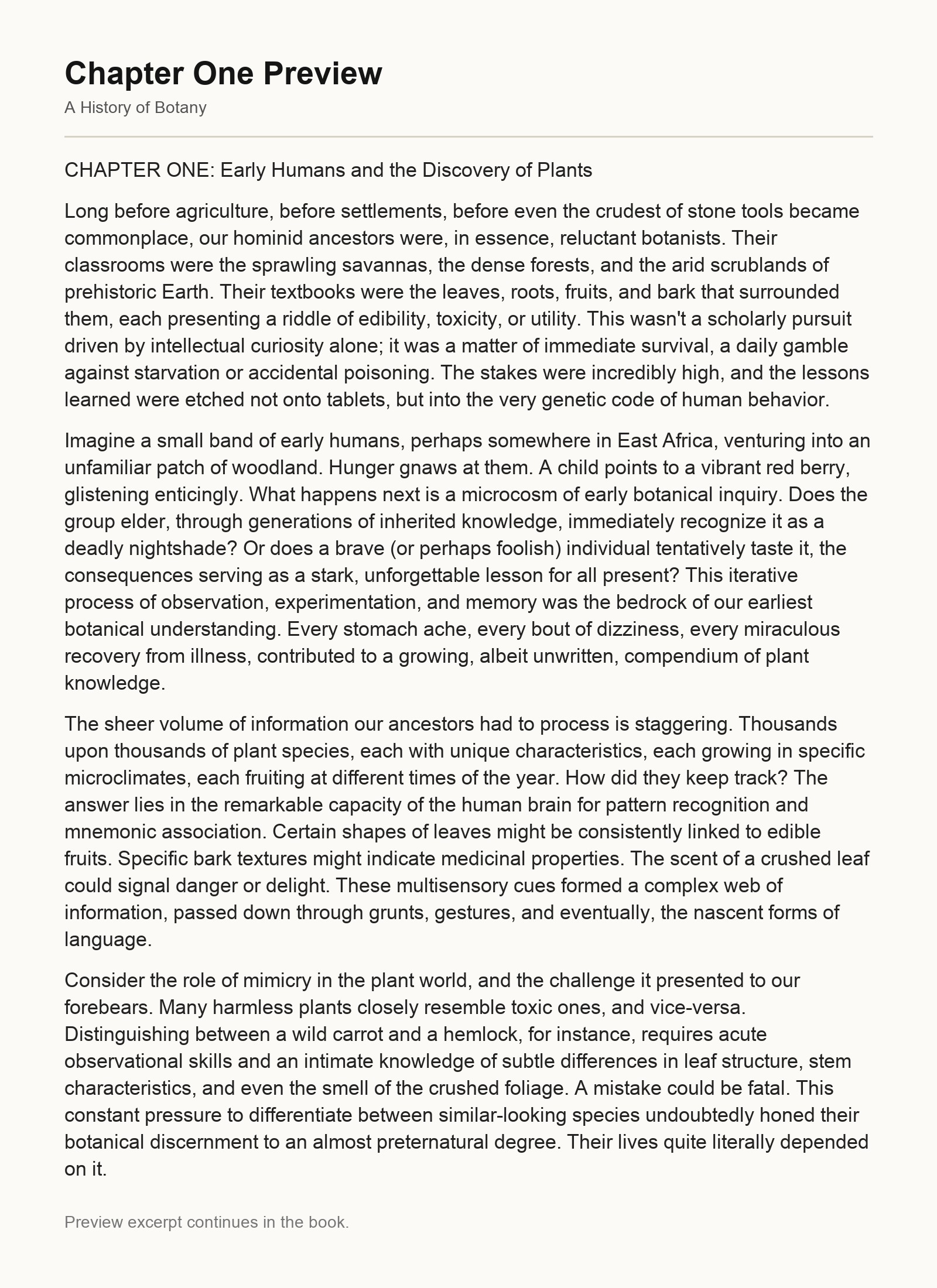
Embark on a sweeping journey through the story of humanity’s relationship with the plant kingdom, beginning with the first curious foragers who tasted wild berries to discern nourishment from poison. You will discover how early survival instincts laid the groundwork for all later botanical science, shaping oral traditions, medicinal practices, and the first attempts to understand which plants could heal, feed, or shelter us. This opening section reveals the deep, visceral connection that has always bound people to the green world, setting the stage for a narrative that moves from instinct to inquiry.
As you turn the pages, you will witness the birth of systematic thought in ancient Greece with Theophrastus, the meticulous preservation of knowledge by Roman scholars, and the flourishing of botany during the Islamic Golden Age. You will explore how medieval monasteries kept ancient texts alive through herbals and gardens, and how the Renaissance sparked a revival driven by the printing press, detailed illustrations, and the flood of new species from the Age of Exploration. Each chapter illustrates a pivotal shift—from practical observation to philosophical classification, from local remedies to global exchange—showing how botany evolved alongside human civilization.
The narrative then guides you through the revolutionary contributions of Carl Linnaeus, whose binomial nomenclature gave plants a universal language, and the subsequent advances in plant anatomy, physiology, and microscopy that unveiled the hidden cellular life within leaves and stems. You will learn how Darwin’s theory of evolution transformed botany from a descriptive craft into an explanatory science, how Mendel’s experiments uncovered the rules of inheritance, and how the rise of plant pathology and genetics equipped humanity to protect crops and understand disease. These sections reveal the growing depth of insight that turned plants from static objects into dynamic, evolving organisms.
Further along, you will experience the emergence of ecology, which shifted focus from single plants to the communities and ecosystems they inhabit, and the modern era of botanical expeditions that combine cutting‑edge technology with urgent conservation work. You will see how molecular botany and genetic engineering now allow scientists to read and rewrite the genetic code of plants, offering solutions for food security, climate resilience, and sustainable medicine. Simultaneously, ethnobotany reminds us of the invaluable wisdom held by indigenous peoples, linking traditional knowledge to contemporary scientific discovery. Together, these perspectives illustrate a discipline that is both deeply rooted in ancient practice and fiercely forward‑looking.
Finally, you will confront the unanswered questions and new frontiers that drive botany today: the mysteries of plant communication, the hidden world of the microbiome, the potential of photosynthetic efficiency, and the ethical challenges of manipulating life at the molecular level. You will finish with a clear sense of how botanists are tackling climate change, biodiversity loss, and food insecurity, and why understanding plants is essential for our shared future. This book equips you not only with a rich historical account but also with an appreciation for the living science that continues to shape our world.
What You'll Find Inside:
- Traces botany's evolution from survival-based plant knowledge in early human societies to today's advanced molecular and genetic sciences.
- Highlights pivotal contributions from key figures including Theophrastus, Linnaeus, and Darwin who transformed botanical understanding.
- Explores how the Age of Exploration revolutionized botany through global plant exchange and the need for new classification systems.
- Details the development of essential botanical institutions from monastic gardens to modern seed banks and molecular laboratories.
- Examines botany's critical role in addressing contemporary challenges like climate change, food security, and biodiversity conservation.
Who's It For:
This book is ideal for undergraduate and graduate students in biology, botany, or history of science seeking a comprehensive foundation in their field's development. It will also benefit professional botanists, horticulturists, and environmental scientists looking to contextualize modern practices within historical traditions. Additionally, environmentally conscious readers interested in the intersection of science, culture, and human-plant relationships will find valuable insights into botany's relevance to current global challenges.
Table of Contents:
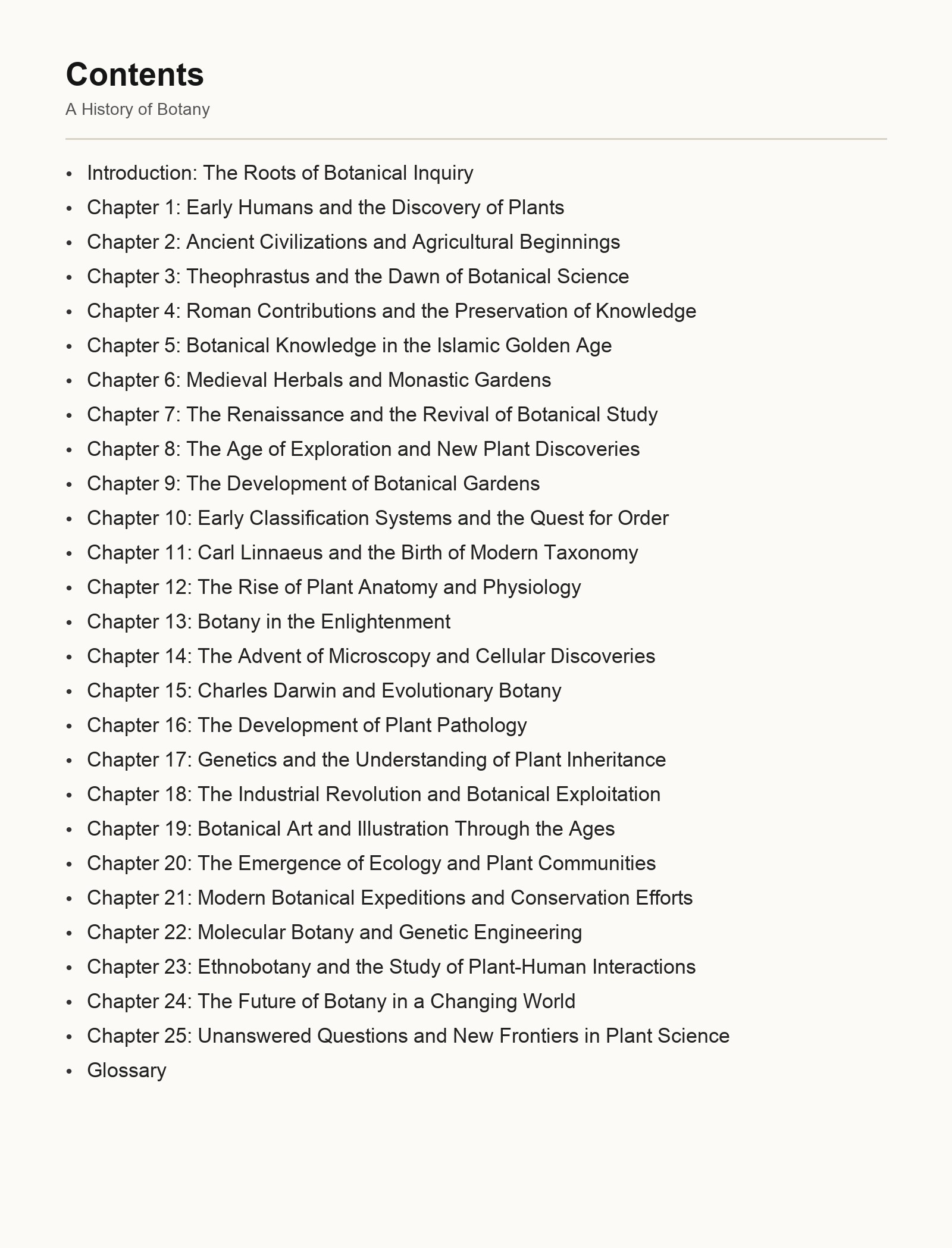
- Introduction: The Roots of Botanical Inquiry
- Chapter 1: Early Humans and the Discovery of Plants
- Chapter 2: Ancient Civilizations and Agricultural Beginnings
- Chapter 3: Theophrastus and the Dawn of Botanical Science
- Chapter 4: Roman Contributions and the Preservation of Knowledge
- Chapter 5: Botanical Knowledge in the Islamic Golden Age
- Chapter 6: Medieval Herbals and Monastic Gardens
- Chapter 7: The Renaissance and the Revival of Botanical Study
- Chapter 8: The Age of Exploration and New Plant Discoveries
- Chapter 9: The Development of Botanical Gardens
- Chapter 10: Early Classification Systems and the Quest for Order
- Chapter 11: Carl Linnaeus and the Birth of Modern Taxonomy
- Chapter 12: The Rise of Plant Anatomy and Physiology
- Chapter 13: Botany in the Enlightenment
- Chapter 14: The Advent of Microscopy and Cellular Discoveries
- Chapter 15: Charles Darwin and Evolutionary Botany
- Chapter 16: The Development of Plant Pathology
- Chapter 17: Genetics and the Understanding of Plant Inheritance
- Chapter 18: The Industrial Revolution and Botanical Exploitation
- Chapter 19: Botanical Art and Illustration Through the Ages
- Chapter 20: The Emergence of Ecology and Plant Communities
- Chapter 21: Modern Botanical Expeditions and Conservation Efforts
- Chapter 22: Molecular Botany and Genetic Engineering
- Chapter 23: Ethnobotany and the Study of Plant-Human Interactions
- Chapter 24: The Future of Botany in a Changing World
- Chapter 25: Unanswered Questions and New Frontiers in Plant Science
- Glossary
Author:
Published By:
Date Published:
May 16, 2026
Type:
Nonfiction
Language:
English
Also Available In:
German, Spanish, French, Italian, Dutch
Word Count:
48,152 words
Reading Time:
3 hours 22 minutes
Sample:
Order:
Buy the A History of Botany ebook on MixCache.com:
Buy NowThe full ebook will be available immediately to read instantly on any device.
$5 account credit for all new MixCache.com accounts, usable toward any ebook purchase!*






Ratings & Reviews
Ask Questions About This Book
Have a question about the content? Ask our AI assistant!
Start by asking a question about "A History of Botany"
Example: "Does this book mention William Shakespeare?"
Thinking...