
Browse by Category
Fiction
- Action & Adventure
- African American
- Anthologies
- Children's Fiction
- Classics
- Comics & Graphic Novels
- Coming of Age
- Contemporary
- Cultural & Regional
- Drama
- Erotica
- Fantasy
- General
- Historical Fiction
- Horror
- Humor & Satire
- Literary Fiction
- Mystery, Thriller & Suspense
- Poetry
- Religious & Inspirational
- Romance
- Science Fiction
- Short Stories
- War & Military
- Westerns
- Women's Fiction
- Young Adult
Non-Fiction
- Antiques & Collectibles
- Arts & Photography
- Biographies & Memoirs
- Business & Money
- Children's Non-Fiction
-
Computers & Technology
- Artificial Intelligence
- Computer Science
- Cybersecurity & Cryptography
- Data Science & Analytics
- Databases & Big Data
- Game Development & Design
- General
- Hardware & DIY
- Mobile App Development
- Networking & Cloud Computing
- Operating Systems
- Programming
- Robotics
- Software
- Software Engineering
- User Experience (UX) & Design
- Web Development & Design
- Cooking, Food & Wine
- Crafts, Hobbies & Home
- Education & Teaching
- Engineering
- General
- Health, Fitness & Dieting
-
History
- African History
- African History - North Africa
- African History - Sub-Saharan Africa
- American History
- American History - 20th Century
- American History - Civil War
- American History - Colonial Period
- Ancient History
- Asian History
- Asian History - China
- Asian History - India
- Asian History - Japan
- Asian History - Southeast Asia
- European History
- European History - Ancient Greece
- European History - Ancient Rome
- European History - Medieval
- European History - Modern
- European History - Renaissance
- General
- Middle Eastern History
- Military History
- Military History - Aviation
- Military History - Naval
- Social & Cultural History
- World History
- Humor & Entertainment
- Industrial Technology
- Language Learning
- Law
- LGBTQ+ Non-Fiction
- Literary Criticism
- Medical Books
- Parenting & Relationships
- Philosophy
- Politics & Social Sciences
- Reference
- Religion & Spirituality
-
Science & Math
- Agricultural Sciences
- Astronomy & Space Science
- Behavioral Sciences
- Biological Sciences
- Botany & Plant Science
- Chemistry
- Earth Sciences
- Engineering - Chemical
- Engineering - Civil
- Engineering - Electrical
- Engineering - Mechanical
- Environment
- General
- Geology
- Mathematics
- Nature & Ecology
- Oceanography
- Paleontology
- Physics
- Statistics
- Self-Help
- Sports & Outdoors
- Study Aids
- Sustainability & Green Living
- Textbooks
- Transportation
- Travel
- True Crime
- Urban Planning & Development
- Veterinary Medicine
- Writing & Publishing
Jump to Section
MixCache.com Total Access
Unlimited reading and audiobooks for every book published by MixCache.com.
Included titles carry the MTA badge.
Learn more →A History of Portugal
About this book:
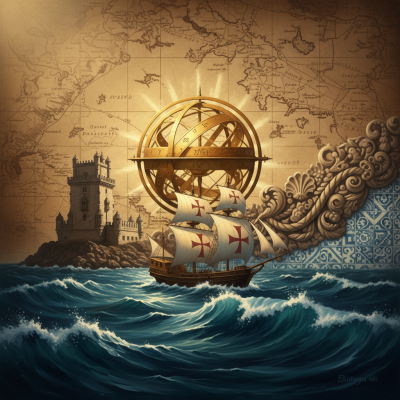
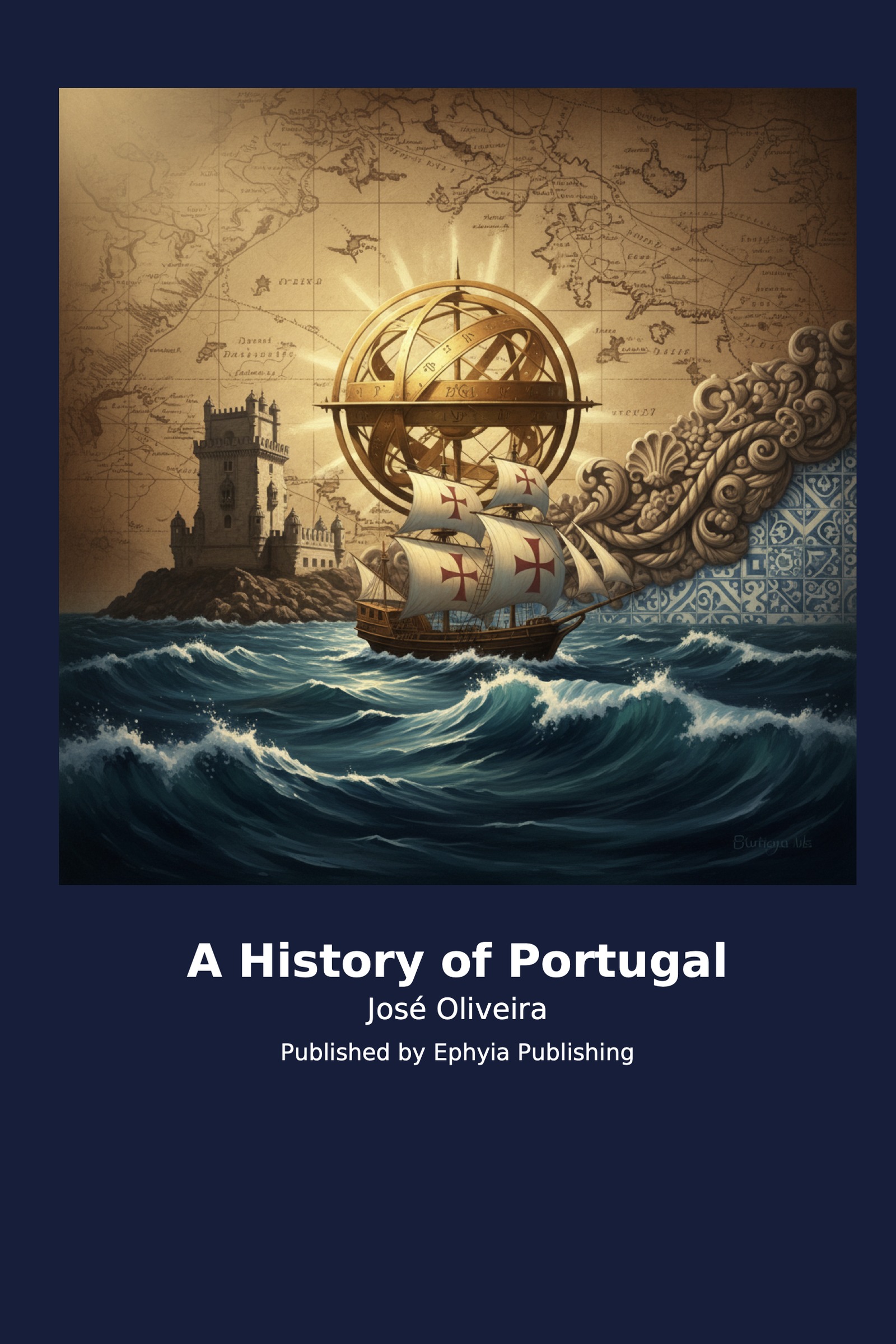
Portugal's history, as chronicled in this book, begins with its ancient roots as a fiercely independent land inhabited by Lusitanian tribes who resisted Roman conquest, exemplified by the legendary Viriathus. Following Romanization and the subsequent Germanic kingdoms of the Suebi and Visigoths, the Iberian Peninsula fell under Moorish rule as Al-Gharb Al-Andalus, leaving a profound cultural imprint on language, agriculture, and architecture. From this crucible emerged the County of Portucale, where Afonso Henriques secured independence through victory at São Mamede and the Battle of Ourique, establishing the Kingdom of Portugal in 1143. The subsequent House of Burgundy consolidated borders, completed the Reconquista by capturing the Algarve, and fostered national identity through institutions like the University of Coimbra and the Order of Christ, setting the stage for global expansion.
Driven by Prince Henry the Navigator's Sagres School, Portuguese explorers shattered maritime barriers, rounding Cape Bojador and the Cape of Good Hope, ultimately enabling Vasco da Gama's pioneering sea route to India in 1498. This inaugurated a Golden Age of empire, with Albuquerque securing key strategic points like Goa, Malacca, and Hormuz to create a thalassocracy dominating the spice trade. Simultaneously, the accidental colonization of Brazil via Pedro Álvares Cabral evolved into a sugar plantation economy reliant on enslaved African labor, becoming Portugal's economic cornerstone. However, dynastic crisis led to the Iberian Union (1580-1640), sixty years of Spanish rule that saw Dutch and English encroachment dismantle much of Portugal's overseas empire. Restoration under the Braganza dynasty, affirmed by victory at Montes Claros, reclaimed independence but shifted focus to Brazil, whose gold and diamond riches in Minas Gerais fueled absolutist grandeur under John V, epitomized by the Palace of Mafra, before economic dependency and stagnation took hold.
The Enlightenment-era reforms of the Marquis of Pombal following the 1755 Lisbon earthquake centralized state power, curtailed noble and ecclesiastical influence, and pursued mercantilist policies, though his fall ushered in a period of religious traditionalism. The Napoleonic invasions precipitated the royal court's historic transfer to Brazil in 1808, elevating Brazil to kingdom status and ultimately triggering its independence in 1822, which plunged Portugal into civil strife during the Liberal Wars between absolutists and constitutionalists. Subsequent decades featured political instability, the Scramble for Africa ambitions embodied by the thwarted "Pink Map," the monarchy's end after the 1908 regicide, and a tumultuous First Republic marked by anti-clericalism and frequent governmental collapses. Salazar's Estado Novo dictatorship (1933-1974) enforced corporatist ideology, neutrality in WWII, and brutal repression while fighting costly colonial wars in Africa until the Carnation Revolution of 1974 peacefully overthrew the regime. The tumultuous transition to democracy involved revolutionary upheaval, decolonization, IMF bailouts, and ultimately integration into the European Economic Community in 1986, anchoring Portugal's democratic future despite enduring 21st-century challenges of economic adjustment, tourism-driven gentrification, and the persistence of saudade as a cultural touchstone.
What You'll Find Inside:
- Portugal's pioneering Age of Discovery that established a global empire through maritime exploration and trade
- The centuries-long struggle for independence from Roman times through the Reconquista to liberation from Spanish rule
- How Brazilian gold and diamonds transformed Portugal's economy and enabled absolutist monarchy in the 18th century
- The peaceful Carnation Revolution of 1974 that ended dictatorship and initiated democratic transition
- Portugal's journey from authoritarian isolation to integration with the European Union and Eurozone
Who's It For:
This book is ideal for students of European or world history, readers interested in the Age of Exploration and colonial empires, those studying the rise and fall of authoritarian regimes, and general readers seeking to understand Portugal's unique cultural identity and historical trajectory as a small nation with outsized global impact.
Table of Contents:
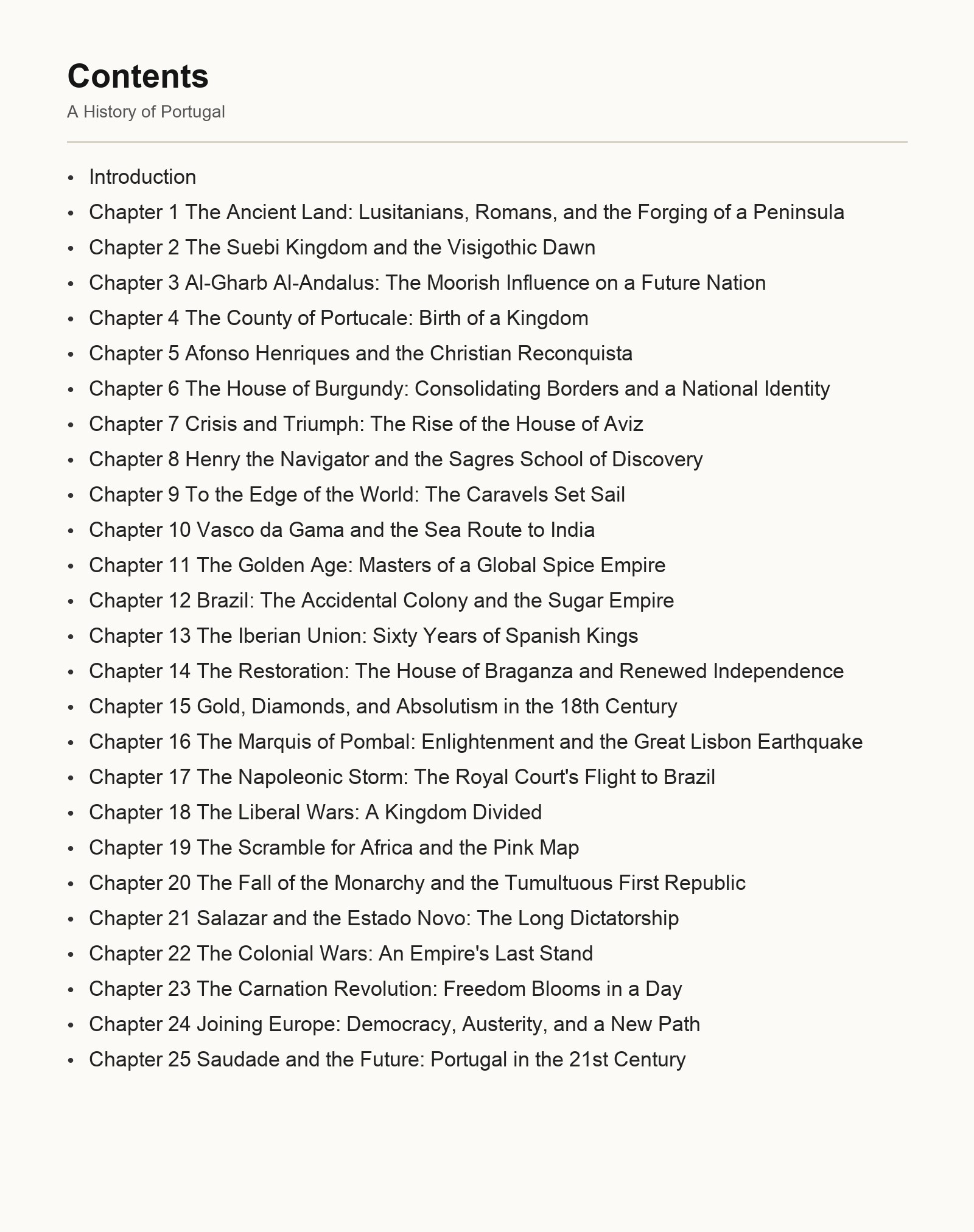
- Introduction
- Chapter 1 The Ancient Land: Lusitanians, Romans, and the Forging of a Peninsula
- Chapter 2 The Suebi Kingdom and the Visigothic Dawn
- Chapter 3 Al-Gharb Al-Andalus: The Moorish Influence on a Future Nation
- Chapter 4 The County of Portucale: Birth of a Kingdom
- Chapter 5 Afonso Henriques and the Christian Reconquista
- Chapter 6 The House of Burgundy: Consolidating Borders and a National Identity
- Chapter 7 Crisis and Triumph: The Rise of the House of Aviz
- Chapter 8 Henry the Navigator and the Sagres School of Discovery
- Chapter 9 To the Edge of the World: The Caravels Set Sail
- Chapter 10 Vasco da Gama and the Sea Route to India
- Chapter 11 The Golden Age: Masters of a Global Spice Empire
- Chapter 12 Brazil: The Accidental Colony and the Sugar Empire
- Chapter 13 The Iberian Union: Sixty Years of Spanish Kings
- Chapter 14 The Restoration: The House of Braganza and Renewed Independence
- Chapter 15 Gold, Diamonds, and Absolutism in the 18th Century
- Chapter 16 The Marquis of Pombal: Enlightenment and the Great Lisbon Earthquake
- Chapter 17 The Napoleonic Storm: The Royal Court's Flight to Brazil
- Chapter 18 The Liberal Wars: A Kingdom Divided
- Chapter 19 The Scramble for Africa and the Pink Map
- Chapter 20 The Fall of the Monarchy and the Tumultuous First Republic
- Chapter 21 Salazar and the Estado Novo: The Long Dictatorship
- Chapter 22 The Colonial Wars: An Empire's Last Stand
- Chapter 23 The Carnation Revolution: Freedom Blooms in a Day
- Chapter 24 Joining Europe: Democracy, Austerity, and a New Path
- Chapter 25 Saudade and the Future: Portugal in the 21st Century
Author:
Published By:
Date Published:
May 16, 2026
Type:
Nonfiction
Language:
English
Also Available In:
Word Count:
52,036 words
Reading Time:
3 hours 39 minutes
Sample:
Order:
Buy the A History of Portugal ebook on MixCache.com:
Buy NowThe full ebook will be available immediately to read instantly on any device.
$5 account credit for all new MixCache.com accounts, usable toward any ebook purchase!*




Ratings & Reviews
Ask Questions About This Book
Have a question about the content? Ask our AI assistant!
Start by asking a question about "A History of Portugal"
Example: "Does this book mention William Shakespeare?"
Thinking...