Browse by Category
Fiction
- Action & Adventure
- African American
- Anthologies
- Children's Fiction
- Classics
- Comics & Graphic Novels
- Coming of Age
- Contemporary
- Cultural & Regional
- Drama
- Erotica
- Fantasy
- General
- Historical Fiction
- Horror
- Humor & Satire
- Literary Fiction
- Mystery, Thriller & Suspense
- Poetry
- Religious & Inspirational
- Romance
- Science Fiction
- Short Stories
- War & Military
- Westerns
- Women's Fiction
- Young Adult
Non-Fiction
- Antiques & Collectibles
- Arts & Photography
- Biographies & Memoirs
- Business & Money
- Children's Non-Fiction
-
Computers & Technology
- Artificial Intelligence
- Computer Science
- Cybersecurity & Cryptography
- Data Science & Analytics
- Databases & Big Data
- Game Development & Design
- General
- Hardware & DIY
- Mobile App Development
- Networking & Cloud Computing
- Operating Systems
- Programming
- Robotics
- Software
- Software Engineering
- User Experience (UX) & Design
- Web Development & Design
- Cooking, Food & Wine
- Crafts, Hobbies & Home
- Education & Teaching
- Engineering
- General
- Health, Fitness & Dieting
-
History
- African History
- African History - North Africa
- African History - Sub-Saharan Africa
- American History
- American History - 20th Century
- American History - Civil War
- American History - Colonial Period
- Ancient History
- Asian History
- Asian History - China
- Asian History - India
- Asian History - Japan
- Asian History - Southeast Asia
- European History
- European History - Ancient Greece
- European History - Ancient Rome
- European History - Medieval
- European History - Modern
- European History - Renaissance
- General
- Middle Eastern History
- Military History
- Military History - Aviation
- Military History - Naval
- Social & Cultural History
- World History
- Humor & Entertainment
- Industrial Technology
- Language Learning
- Law
- LGBTQ+ Non-Fiction
- Literary Criticism
- Medical Books
- Parenting & Relationships
- Philosophy
- Politics & Social Sciences
- Reference
- Religion & Spirituality
-
Science & Math
- Agricultural Sciences
- Astronomy & Space Science
- Behavioral Sciences
- Biological Sciences
- Botany & Plant Science
- Chemistry
- Earth Sciences
- Engineering - Chemical
- Engineering - Civil
- Engineering - Electrical
- Engineering - Mechanical
- Environment
- General
- Geology
- Mathematics
- Nature & Ecology
- Oceanography
- Paleontology
- Physics
- Statistics
- Self-Help
- Sports & Outdoors
- Study Aids
- Sustainability & Green Living
- Textbooks
- Transportation
- Travel
- True Crime
- Urban Planning & Development
- Veterinary Medicine
- Writing & Publishing
Jump to Section

Want unlimited access to all books published by MixCache.com (plus their audiobooks)? Try MixCache.com Total Access. Look for the MTA badge on book covers to identify included titles.
Access to infinite ebooks: Don't see the book you want? Suggest it and we'll create it (free!) for you from scratch with our powerful AI book writer. Then read it with MTA - besides profiting from any sales it makes!
A History of Democracy
About this book:
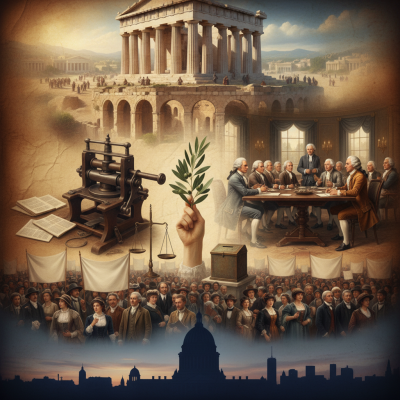


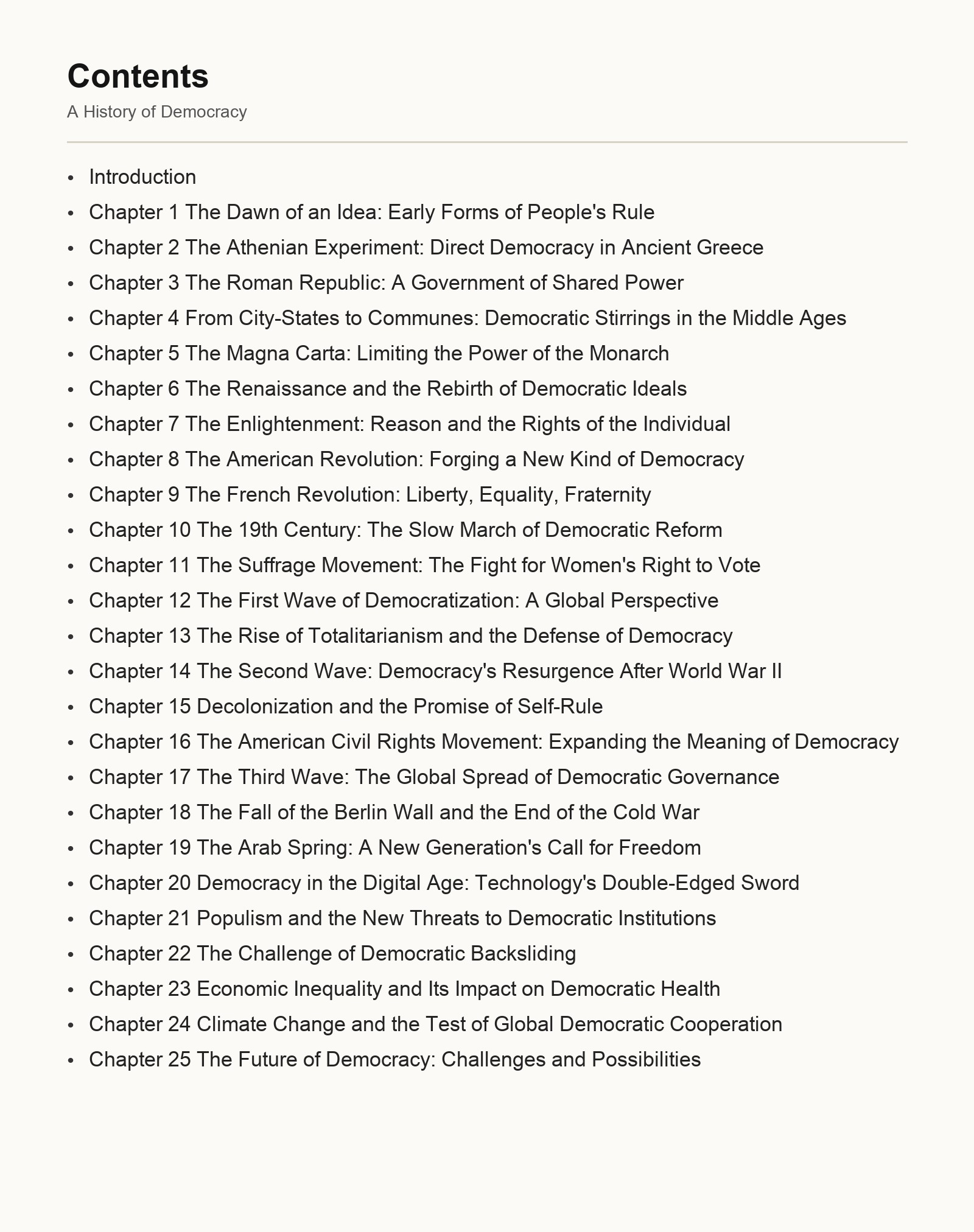
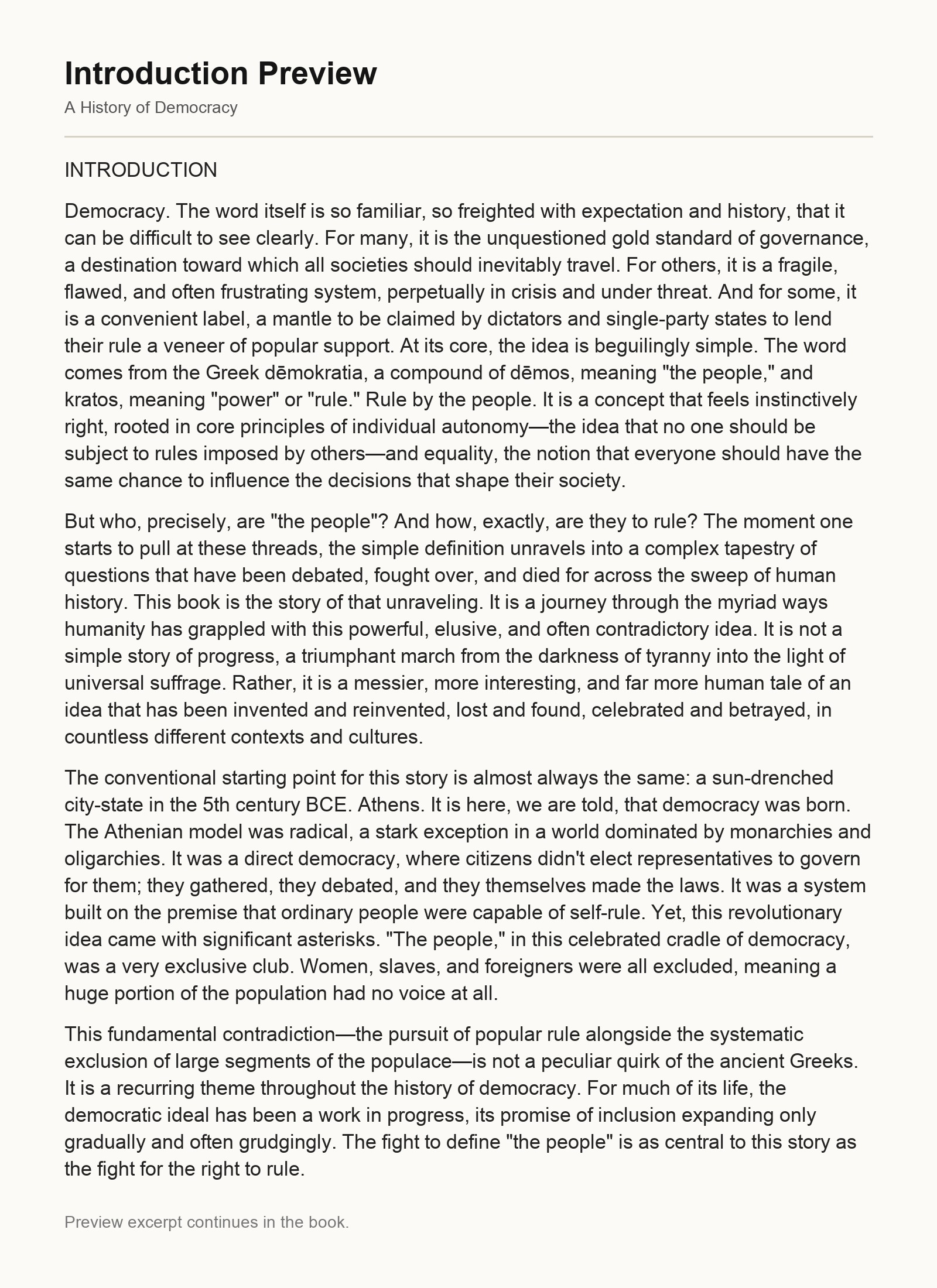
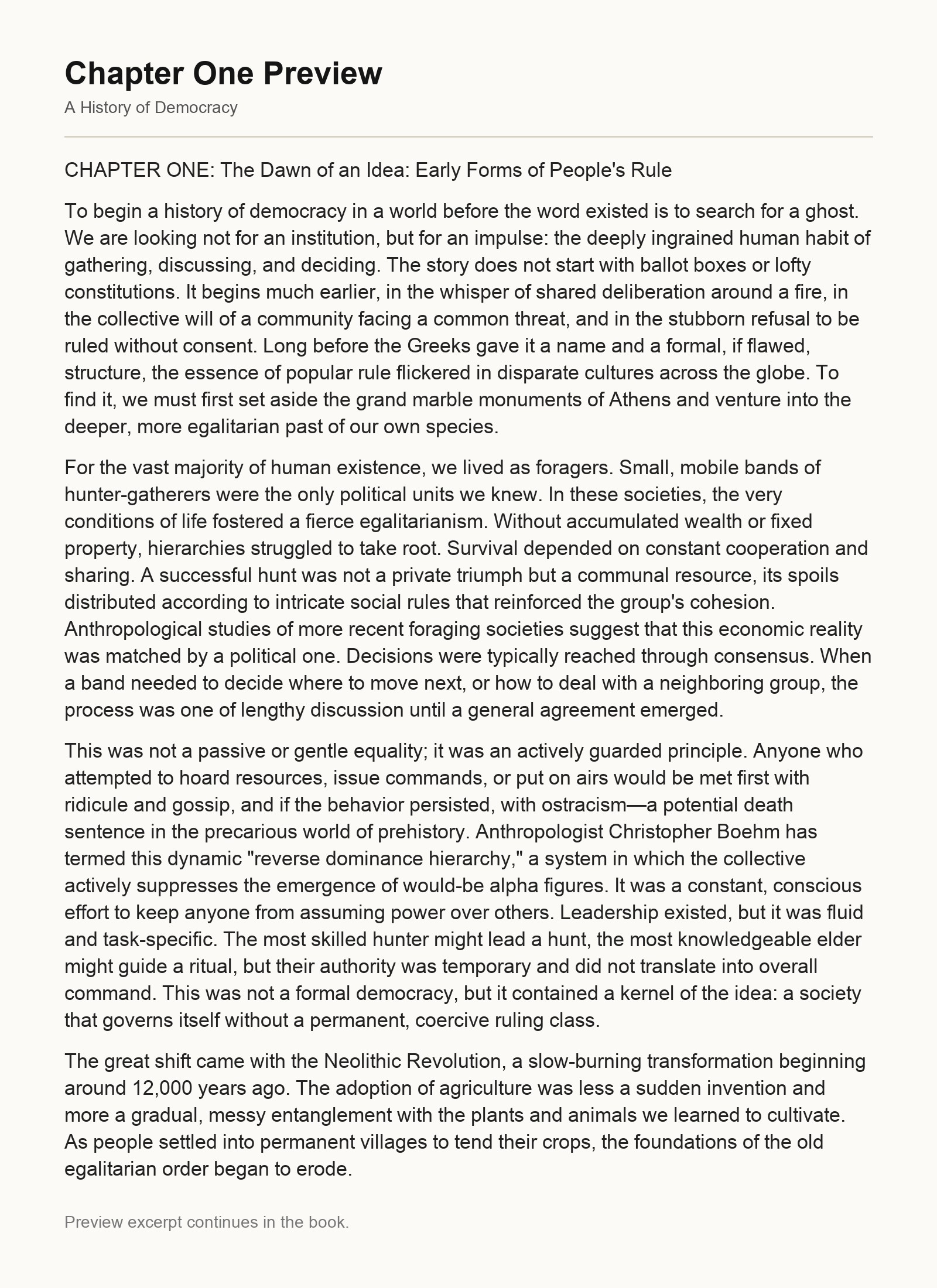
A History of Democracy invites readers on a sweeping journey through the evolution of self‑rule, from the egalitarian impulses of prehistoric hunter‑gatherer bands to the bold experiments of ancient Athens and the Roman Republic. The narrative uncovers how early societies balanced power through councils, assemblies, and consensus‑building, revealing that the desire for a voice in governance is a deep‑seated human trait that appeared long before the word democracy was coined. By tracing these forgotten roots, the book shows that democracy is not a singular Western invention but a recurring response to the challenge of living together.
Moving forward, the work explores the landmark moments that reshaped the concept: the Magna Carta’s early limits on royal authority, the Renaissance revival of republican ideals, and the Enlightenment’s shift toward individual rights and the consent of the governed. Readers will witness how the American and French Revolutions turned abstract philosophy into concrete constitutions, how suffrage movements expanded the franchise to women and marginalized groups, and how waves of democratization swept across Europe, the Americas, Asia, and Africa. Each chapter illuminates the tension between inclusion and exclusion, highlighting the struggles of enslaved peoples, colonized nations, laborers, and minorities who fought to be counted among “the people.”
The latter half of the book confronts the modern pressures that test democratic resilience. It examines the rise of totalitarian regimes in the twentieth century, the post‑World War II democratic resurgence, and the complex legacies of decolonization and the Cold Ray. Contemporary challenges—digital misinformation, economic inequality, climate change, populist backsliding, and the authoritarian allure of state‑guided capitalism—are dissected with clarity, showing how they strain institutions while also sparking innovative responses such as citizens’ assemblies, participatory budgeting, and transnational democratic experiments. The narrative does not shy away from the uncomfortable truths about democracy’s fragility, yet it also underscores its capacity for reinvention.
Ultimately, A History of Democracy equips readers with a nuanced understanding of where the idea of rule by the people has come from, what it has endured, and what possibilities lie ahead. By presenting democracy as a dynamic, imperfect, and continually contested experiment, the book encourages readers to see themselves as participants in an ongoing story—one that demands vigilance, empathy, and a willingness to imagine new forms of collective self‑governance for a interconnected world.
What You'll Find Inside:
- Explores democracy's deep roots in diverse global traditions - from prehistoric foraging bands to ancient Mesopotamian councils and Indian republics - long before Athenian experiments.
- Traces the recurring tension between democratic ideals and exclusion, showing how suffrage expanded gradually from propertied men to include women, minorities, and marginalized groups.
- Examines pivotal democratic turning points: Magna Carta's limits on power, American/French Revolutions' popular sovereignty claims, and three historical waves of global democratization.
- Analyzes contemporary threats to democracy including digital misinformation, populist movements, economic inequality, and democratic backsliding in established systems.
- Investigates democracy's future through challenges like climate change and innovations such as citizens' assemblies, deliberative forums, and transnational governance models.
Who's It For:
This comprehensive historical analysis will benefit political science and history students, civics educators, journalists, and engaged citizens seeking to understand democracy's evolution, its recurring challenges, and potential pathways forward in our complex era.
Author:
Published By:
Date Published:
May 16, 2026
Type:
Nonfiction
Language:
English
Also Available In:
Word Count:
59,682 words
Reading Time:
4 hours 11 minutes
Sample:
Order:
Order A History of Democracy (Paperback) on MixCache.com:
Buy NowPrint copy is made to order and ships worldwide. Includes the ebook free, ready to read instantly.
$5 account credit for all new MixCache.com accounts, usable toward any ebook purchase!*