Browse by Category
Fiction
- Action & Adventure
- African American
- Anthologies
- Children's Fiction
- Classics
- Comics & Graphic Novels
- Coming of Age
- Contemporary
- Cultural & Regional
- Drama
- Erotica
- Fantasy
- General
- Historical Fiction
- Horror
- Humor & Satire
- Literary Fiction
- Mystery, Thriller & Suspense
- Poetry
- Religious & Inspirational
- Romance
- Science Fiction
- Short Stories
- War & Military
- Westerns
- Women's Fiction
- Young Adult
Non-Fiction
- Antiques & Collectibles
- Arts & Photography
- Biographies & Memoirs
- Business & Money
- Children's Non-Fiction
-
Computers & Technology
- Artificial Intelligence
- Computer Science
- Cybersecurity & Cryptography
- Data Science & Analytics
- Databases & Big Data
- Game Development & Design
- General
- Hardware & DIY
- Mobile App Development
- Networking & Cloud Computing
- Operating Systems
- Programming
- Robotics
- Software
- Software Engineering
- User Experience (UX) & Design
- Web Development & Design
- Cooking, Food & Wine
- Crafts, Hobbies & Home
- Education & Teaching
- Engineering
- General
- Health, Fitness & Dieting
-
History
- African History
- African History - North Africa
- African History - Sub-Saharan Africa
- American History
- American History - 20th Century
- American History - Civil War
- American History - Colonial Period
- Ancient History
- Asian History
- Asian History - China
- Asian History - India
- Asian History - Japan
- Asian History - Southeast Asia
- European History
- European History - Ancient Greece
- European History - Ancient Rome
- European History - Medieval
- European History - Modern
- European History - Renaissance
- General
- Middle Eastern History
- Military History
- Military History - Aviation
- Military History - Naval
- Social & Cultural History
- World History
- Humor & Entertainment
- Industrial Technology
- Language Learning
- Law
- LGBTQ+ Non-Fiction
- Literary Criticism
- Medical Books
- Parenting & Relationships
- Philosophy
- Politics & Social Sciences
- Reference
- Religion & Spirituality
-
Science & Math
- Agricultural Sciences
- Astronomy & Space Science
- Behavioral Sciences
- Biological Sciences
- Botany & Plant Science
- Chemistry
- Earth Sciences
- Engineering - Chemical
- Engineering - Civil
- Engineering - Electrical
- Engineering - Mechanical
- Environment
- General
- Geology
- Mathematics
- Nature & Ecology
- Oceanography
- Paleontology
- Physics
- Statistics
- Self-Help
- Sports & Outdoors
- Study Aids
- Sustainability & Green Living
- Textbooks
- Transportation
- Travel
- True Crime
- Urban Planning & Development
- Veterinary Medicine
- Writing & Publishing
Jump to Section

Want unlimited access to all books published by MixCache.com (plus their audiobooks)? Try MixCache.com Total Access. Look for the MTA badge on book covers to identify included titles.
Access to infinite ebooks: Don't see the book you want? Suggest it and we'll create it (free!) for you from scratch with our powerful AI book writer. Then read it with MTA - besides profiting from any sales it makes!
Minorities and the Middle Kingdom: Ethnic Policies and Frontier Societies in Chinese History
MTA
A historical study of ethnic diversity, assimilation, and minority-state relations from imperial to modern times
About this book:
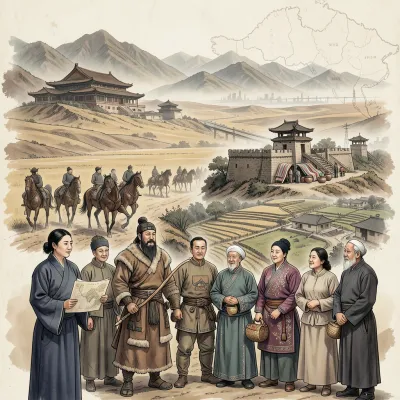
"Minorities and the Middle Kingdom" comprehensively examines the historical evolution of ethnic policies and frontier societies within the Chinese imperial and modern states. The book argues that "frontier" is not merely a geographic boundary but a dynamic social process of exchange, translation, and occasional coercion, where diverse institutions and identities are shaped. From the Qin-Han expansion, which established foundational strategies of indirect rule and military farming, through the cosmopolitan Tang with its Turkic-Tibetan entanglements and the multi-polar Song-Liao-Xi Xia-Jin period marked by sophisticated diplomatic and dual administrative systems, the narrative traces how different dynasties engaged with their non-Han neighbors.
The study highlights the Qing dynasty's sophisticated approach to multiethnic governance, utilizing the Eight Banners, the Lifan Yuan, and a layered system of patronage and direct rule across Inner Asia, including the systematic conquest and resettlement of Xinjiang after the Dzungar wars and a unique spiritual-political bond with Tibet's Dalai Lamas. Religious institutions, such as Jesuit missions at court, Sufi networks in Central Asia, and Tibetan Buddhist monasteries, are presented as crucial intermediaries that bridged cultural divides, often operating with a degree of autonomy that challenged central state control. The book also details how economic interactions—from tribute and border markets to state-led resource extraction—played a vital role in integrating frontier regions, often leading to Han migration and the ecological transformation of diverse landscapes.
The Republican era is portrayed as a period of profound disjuncture, as the collapse of the Qing left a vacuum filled by warlords, fragmented ethnic movements, and the nascent Nationalist government's struggle to define a multiethnic nation. Following 1949, the People's Republic of China embarked on ambitious projects of *minzu* classification and regional autonomy, aiming to integrate minorities into a socialist state. However, the subsequent decades, particularly the Great Leap Forward and the Cultural Revolution, brought widespread cultural destruction, religious suppression, and ecological devastation to frontier regions, shattering the promise of autonomy.
The post-Mao reform era introduced a new paradox: economic development, fueled by infrastructure projects and resource extraction, brought material improvements but also accelerated Han migration, environmental degradation, and new forms of inequality. In recent decades, especially in Xinjiang and Tibet, this has evolved into intense security-centered governance, digital surveillance, and targeted campaigns aimed at controlling ethnic and religious expression. The book concludes by exploring contemporary challenges like ecological migration, the pervasive influence of digital governance, and complex cross-border flows, demonstrating how the interplay of these forces continues to shape the contested identities and uncertain futures of China's diverse frontier societies in the 21st century.
What You'll Find Inside:
- The book demonstrates how Chinese frontier governance employed adaptive strategies like indirect rule (tusi system), tribute networks, and legal pluralism rather than uniform assimilation policies across different geographical and cultural frontiers.
- It examines frontier societies as active participants who strategically engaged state power through negotiation, resistance, and the use of institutions like markets, religion, and law to secure autonomy and resources.
- It traces historical continuity of key governance tools from Qin-Han expansion through Qing dynasties into modern PRC policies, showing how imperial approaches informed contemporary ethnic classification and autonomy experiments.
- It provides detailed comparative case studies of specific frontier regions—Xinjiang, Tibet, and the Southwest (Zhuang, Yi)—revealing distinct historical trajectories and governance challenges.
- It analyzes twenty-first century transformations including ecological migration, digital governance, and cross-border flows that are reshaping frontier societies and state-minority relations.
Who's It For:
This book is intended for scholars, graduate students, and advanced undergraduates in Chinese history, ethnic studies, and Asian studies seeking a comprehensive historical analysis of China's frontier governance. It will also be valuable for policymakers, researchers, and practitioners working on contemporary ethnic minority issues in China who need historical context for current policies in Xinjiang, Tibet, and other frontier regions. The book's methodological approach using case studies and diverse source materials makes it suitable for readers interested in comparative empire studies and the historical dynamics of state-minority relations.
Author:
Published By:
Date Published:
May 15, 2026
Type:
Nonfiction
Language:
English
Word Count:
73,819 words
Reading Time:
5 hours 10 minutes
Sample:
Order:
Order Minorities and the Middle Kingdom: Ethnic Policies and Frontier Societies in Chinese History (Hardcover) on MixCache.com:
Buy NowPrint copy is made to order and ships worldwide. Includes the ebook free, ready to read instantly.
$5 account credit for all new MixCache.com accounts, usable toward any ebook purchase!*