
Browse by Category
Fiction
- Action & Adventure
- African American
- Anthologies
- Children's Fiction
- Classics
- Comics & Graphic Novels
- Coming of Age
- Contemporary
- Cultural & Regional
- Drama
- Erotica
- Fantasy
- General
- Historical Fiction
- Horror
- Humor & Satire
- Literary Fiction
- Mystery, Thriller & Suspense
- Poetry
- Religious & Inspirational
- Romance
- Science Fiction
- Short Stories
- War & Military
- Westerns
- Women's Fiction
- Young Adult
Non-Fiction
- Antiques & Collectibles
- Arts & Photography
- Biographies & Memoirs
- Business & Money
- Children's Non-Fiction
-
Computers & Technology
- Artificial Intelligence
- Computer Science
- Cybersecurity & Cryptography
- Data Science & Analytics
- Databases & Big Data
- Game Development & Design
- General
- Hardware & DIY
- Mobile App Development
- Networking & Cloud Computing
- Operating Systems
- Programming
- Robotics
- Software
- Software Engineering
- User Experience (UX) & Design
- Web Development & Design
- Cooking, Food & Wine
- Crafts, Hobbies & Home
- Education & Teaching
- Engineering
- General
- Health, Fitness & Dieting
-
History
- African History
- African History - North Africa
- African History - Sub-Saharan Africa
- American History
- American History - 20th Century
- American History - Civil War
- American History - Colonial Period
- Ancient History
- Asian History
- Asian History - China
- Asian History - India
- Asian History - Japan
- Asian History - Southeast Asia
- European History
- European History - Ancient Greece
- European History - Ancient Rome
- European History - Medieval
- European History - Modern
- European History - Renaissance
- General
- Middle Eastern History
- Military History
- Military History - Aviation
- Military History - Naval
- Social & Cultural History
- World History
- Humor & Entertainment
- Industrial Technology
- Language Learning
- Law
- LGBTQ+ Non-Fiction
- Literary Criticism
- Medical Books
- Parenting & Relationships
- Philosophy
- Politics & Social Sciences
- Reference
- Religion & Spirituality
-
Science & Math
- Agricultural Sciences
- Astronomy & Space Science
- Behavioral Sciences
- Biological Sciences
- Botany & Plant Science
- Chemistry
- Earth Sciences
- Engineering - Chemical
- Engineering - Civil
- Engineering - Electrical
- Engineering - Mechanical
- Environment
- General
- Geology
- Mathematics
- Nature & Ecology
- Oceanography
- Paleontology
- Physics
- Statistics
- Self-Help
- Sports & Outdoors
- Study Aids
- Sustainability & Green Living
- Textbooks
- Transportation
- Travel
- True Crime
- Urban Planning & Development
- Veterinary Medicine
- Writing & Publishing
Jump to Section
MixCache.com Total Access
Unlimited reading and audiobooks for every book published by MixCache.com.
Included titles carry the MTA badge.
Learn more →
From Canton to the Treaty Ports: Maritime Trade and Foreign Encounters in China
MTA
A maritime history of Sino-foreign trade, diplomacy, and cultural exchange from the Song to the 20th century
About this book:
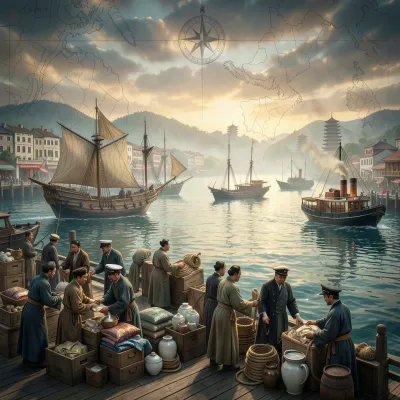
"From Canton to the Treaty Ports" offers a comprehensive maritime history of China, tracing its engagement with the wider world from the Song Dynasty to the mid-20th century. The book argues that China's development was profoundly shaped by its seas and shorelines, which served as conduits for trade, diplomacy, and cultural exchange. It begins by establishing the Song Dynasty's transformation into a significant maritime power, driven by economic dynamism and military pressures on land. Chapters detail the emergence of key ports like Quanzhou, Guangzhou, and Ningbo as cosmopolitan centers within a monsoon-driven trading system, alongside advancements in shipbuilding (like watertight bulkheads and battened sails) and navigation (such as the magnetic compass).
The narrative progresses through the Yuan Dynasty's cosmopolitan maritime empire, exemplified by Quanzhou (Zaytun), and the ambitious but ultimately unsustainable voyages of Zheng He during the early Ming. A significant portion of the book focuses on the Ming's "sea ban" (haijin), which led to increased smuggling and the "wokou" pirate raids, fundamentally reshaping coastal society and the relationship between the state and maritime communities. The arrival of Europeans, notably the Portuguese establishment of Macao and the Spanish galleon trade via Manila, introduces early modern globalization, illustrating how American silver flowed into China, profoundly monetizing its economy and establishing complex multi-centric trade networks across the South China Sea.
The latter half of the book explores the Canton System, which concentrated all foreign trade in Guangzhou under strict Qing regulations, and the destabilizing role of the opium trade, which reversed China's trade surplus and precipitated the Opium Wars. These conflicts heralded the era of "gunboat diplomacy," forcing China to open numerous "treaty ports" and accept extraterritoriality, fundamentally altering its legal and territorial sovereignty. Shanghai's meteoric rise as a global financial and commercial hub, and Hong Kong's development as an entrepôt, exemplify this new order. The book also delves into the lives of ordinary coastal communities—fisherfolk, salt workers, and coolie migrants—highlighting the social and economic dimensions of China's extensive diaspora and its "Nanyang" connections, which profoundly influenced homeland politics.
Finally, the book examines the turbulent early 20th century, from the 1911 Revolution and the establishment of the Republic to the cataclysm of the Sino-Japanese War (1937-1945) and the subsequent Chinese Civil War. These conflicts violently dismantled the treaty port system, as foreign concessions were occupied and China's coastline became a battleground. The conclusion reflects on the enduring legacies of this maritime history, including China's efforts to modernize its navy ("Self-Strengthening"), the pervasive influence of foreign legal and economic frameworks, and the reordering of China's relationship with the sea under the Communist regime, which sought to reclaim sovereignty and rebuild a devastated coastal economy.
What You'll Find Inside:
- How Chinese maritime trade evolved from Song dynasty ports like Quanzhou and Guangzhou to the treaty port system of the 19th-20th centuries
- The technological innovations in Chinese shipbuilding (junks), navigation (compass), and naval warfare that enabled long-distance trade
- The role of diasporic merchant networks (Hokkien, Cantonese) in connecting China to Indian Ocean and Southeast Asian trade circuits
- How the Canton System, Opium Wars, and treaty ports reshaped China's foreign relations and coastal economies
- The social history of coastal communities including fisherfolk, salt workers, pirates, and migrant laborers who formed the backbone of maritime exchange
Who's It For:
This book is essential for students and scholars of Chinese history, maritime studies, and global trade who seek to understand how seafaring shaped China's economic, diplomatic, and cultural development over a millennium. It will particularly benefit readers interested in the intersection of technology, commerce, and cultural exchange in premodern and modern contexts. Those studying diaspora communities, port cities, or the historical roots of China's contemporary maritime ambitions will find valuable insights into the longue durée of Sino-foreign encounters.
Table of Contents:
- Introduction
- Chapter 1 Shores of the Middle Kingdom: The Maritime Frontier in the Song
- Chapter 2 Ports of Exchange: Quanzhou, Guangzhou, and Ningbo in a Monsoon World
- Chapter 3 Junks and Compasses: Navigation, Shipbuilding, and Ocean Science
- Chapter 4 Diasporic Traders: Hokkien, Cantonese, and the Indian Ocean Networks
- Chapter 5 Empire at Sea: Yuan Cosmopolitanism and Zaytun’s Zenith
- Chapter 6 Sea Bans and Smugglers: Ming Regulation, Wokou Raids, and Coastal Society
- Chapter 7 Voyages of Zheng He: Tribute, Diplomacy, and Maritime Statecraft
- Chapter 8 Macao Emerges: Portuguese Brokers, Missions, and Early Modern Commerce
- Chapter 9 Silver Currents: Manila Galleons, Global Bullion Flows, and South China Seas
- Chapter 10 Taiwan and the Zheng Maritime Realm: Koxinga, the Dutch, and Qing Consolidation
- Chapter 11 The Great Clearance and After: Qing Policies and Littoral Recovery
- Chapter 12 The Canton System: Hong Merchants, Compradors, and the Old China Trade
- Chapter 13 Tea, Opium, and Imbalance: Commodities That Changed an Empire
- Chapter 14 1839 and Aftermath: Lin Zexu, War, and the Making of the Treaty of Nanjing
- Chapter 15 Steam and Shock: Gunboat Diplomacy, Technology, and Coastal Fortifications
- Chapter 16 Mapping Empire: Treaty Ports, Extraterritoriality, and New Legal Geographies
- Chapter 17 Shanghai Rising: Customs, Settlements, and Capital Accumulation
- Chapter 18 Hong Kong as Entrepôt: Finance, Shipping, and Colonial Urbanism
- Chapter 19 Missions, Consuls, and Courts: Faith, Law, and Everyday Encounters
- Chapter 20 Self-Strengthening Afloat: Arsenals, Telegraphs, and National Steamship Lines
- Chapter 21 Wars at the Water’s Edge: Sino-French, Sino-Japanese, and Naval Lessons
- Chapter 22 Lives of the Littoral: Fisherfolk, Salt, Piracy, and Coastal Communities
- Chapter 23 Mobility and Diaspora: Emigration, Coolie Trades, and Nanyang Connections
- Chapter 24 Revolution and Republic: Maritime Politics from 1911 to the Nanjing Decade
- Chapter 25 War, Blockade, and Reordering: 1937–1949 and the Legacies of the Treaty Port World
Author:
Published By:
Date Published:
May 15, 2026
Type:
Nonfiction
Language:
English
Word Count:
75,279 words
Reading Time:
5 hours 16 minutes
Sample:
Order:
Order From Canton to the Treaty Ports: Maritime Trade and Foreign Encounters in China (Hardcover) on MixCache.com:
Buy NowPrint copy is made to order and ships worldwide. Includes the ebook free, ready to read instantly.
$5 account credit for all new MixCache.com accounts, usable toward any ebook purchase!*


