
Browse by Category
Fiction
- Action & Adventure
- African American
- Anthologies
- Children's Fiction
- Classics
- Comics & Graphic Novels
- Coming of Age
- Contemporary
- Cultural & Regional
- Drama
- Erotica
- Fantasy
- General
- Historical Fiction
- Horror
- Humor & Satire
- Literary Fiction
- Mystery, Thriller & Suspense
- Poetry
- Religious & Inspirational
- Romance
- Science Fiction
- Short Stories
- War & Military
- Westerns
- Women's Fiction
- Young Adult
Non-Fiction
- Antiques & Collectibles
- Arts & Photography
- Biographies & Memoirs
- Business & Money
- Children's Non-Fiction
-
Computers & Technology
- Artificial Intelligence
- Computer Science
- Cybersecurity & Cryptography
- Data Science & Analytics
- Databases & Big Data
- Game Development & Design
- General
- Hardware & DIY
- Mobile App Development
- Networking & Cloud Computing
- Operating Systems
- Programming
- Robotics
- Software
- Software Engineering
- User Experience (UX) & Design
- Web Development & Design
- Cooking, Food & Wine
- Crafts, Hobbies & Home
- Education & Teaching
- Engineering
- General
- Health, Fitness & Dieting
-
History
- African History
- African History - North Africa
- African History - Sub-Saharan Africa
- American History
- American History - 20th Century
- American History - Civil War
- American History - Colonial Period
- Ancient History
- Asian History
- Asian History - China
- Asian History - India
- Asian History - Japan
- Asian History - Southeast Asia
- European History
- European History - Ancient Greece
- European History - Ancient Rome
- European History - Medieval
- European History - Modern
- European History - Renaissance
- General
- Middle Eastern History
- Military History
- Military History - Aviation
- Military History - Naval
- Social & Cultural History
- World History
- Humor & Entertainment
- Industrial Technology
- Language Learning
- Law
- LGBTQ+ Non-Fiction
- Literary Criticism
- Medical Books
- Parenting & Relationships
- Philosophy
- Politics & Social Sciences
- Reference
- Religion & Spirituality
-
Science & Math
- Agricultural Sciences
- Astronomy & Space Science
- Behavioral Sciences
- Biological Sciences
- Botany & Plant Science
- Chemistry
- Earth Sciences
- Engineering - Chemical
- Engineering - Civil
- Engineering - Electrical
- Engineering - Mechanical
- Environment
- General
- Geology
- Mathematics
- Nature & Ecology
- Oceanography
- Paleontology
- Physics
- Statistics
- Self-Help
- Sports & Outdoors
- Study Aids
- Sustainability & Green Living
- Textbooks
- Transportation
- Travel
- True Crime
- Urban Planning & Development
- Veterinary Medicine
- Writing & Publishing
Jump to Section
MixCache.com Total Access
Unlimited reading and audiobooks for every book published by MixCache.com.
Included titles carry the MTA badge.
Learn more →
Under the Red Flag: Rural Collectivization and Village Life during the Mao Years
MTA
A microhistorical study of collectivization, commune culture, and peasant responses 1949–1978
About this book:
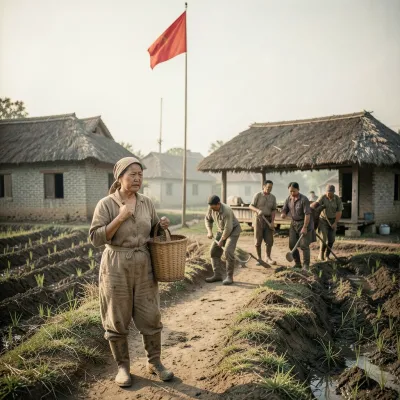
"Under the Red Flag" offers a microhistorical examination of rural collectivization in China from 1949 to 1978, moving beyond national policy narratives to explore the lived experiences of peasants in specific villages. The book details the profound transformations that swept through the countryside, beginning with the radical land reform (1949-1952) that dismantled the landlord class and redistributed land, briefly establishing the household farm as the new norm. This was quickly followed by the formation of mutual aid teams and then lower-stage agricultural producers' cooperatives (APCs), which introduced collective labor and shared resources while retaining some private ownership.
The study then delves into the dramatic shift to high-stage APCs, marking the end of household farming and the full collectivization of land and resources. It examines the crucial role of village cadres as the interface between state directives and local realities, highlighting their power, accountability, and the complex negotiations inherent in their positions. The introduction of work points as the primary currency for labor remuneration is explored, revealing how this system reshaped daily labor, generated disputes, and often codified gendered inequalities. The narrative also uncovers the radical experiment of communal kitchens during the Great Leap Forward, which promised liberation but often led to severe food shortages and transformed the intimate act of eating into a political and public performance.
Furthermore, the book investigates the state's "war on nature" through massive water conservancy projects and land reclamation efforts, often with disastrous ecological consequences. It documents the establishment of the barefoot doctor program as a unique attempt to bring healthcare to the rural masses, showcasing its strengths and limitations. The omnipresent hukou system is revealed as a critical mechanism for population control, binding peasants to their villages and restricting mobility, even during times of famine. The intricate relationship between official "commune culture" (songs, slogans, model operas) and the persistent, often underground, traditional rituals and folk religions is also explored, demonstrating the resilience of local customs against ideological suppression.
Finally, "Under the Red Flag" chronicles the escalating tensions between state quotas and peasant survival strategies through "hidden negotiations" and the emergence of black markets, revealing the persistent pursuit of individual economic autonomy. The devastating impact of the Cultural Revolution on rural life, particularly its disruption of social order, education, and cultural norms, is detailed. The book concludes with the slow unraveling of the commune system in the 1970s, as quiet experiments and open evasions of collective rules paved the way for the post-Mao reforms, leaving a complex legacy of both suffering and resilience etched into the memories and landscapes of China's villages.
What You'll Find Inside:
- Microhistorical examination of how collectivization transformed daily village life from 1949-1978, focusing on lived experience rather than national policy narratives.
- Analysis of the work point system as both labor remuneration and moral currency that revealed gender inequalities, local power dynamics, and villagers' adaptations to collective demands.
- Detailed study of the 1959-1961 famine as a man-made catastrophe resulting from Great Leap Forward policies, including villagers' coping mechanisms and long-term memory of the trauma.
- Exploration of how traditional rituals, religious practices, and kinship networks persisted underground despite official campaigns against 'feudal superstition,' forming a spiritual palimpsest beneath socialist ceremonies.
- Investigation of the tension between state control and local adaptation, including hidden economies, clandestine markets, and quiet resistance that shaped the unraveling of the commune system.
Who's It For:
This book is essential for scholars of modern Chinese history, particularly those studying rural society, collectivization, and the Mao era. It will also benefit researchers in development studies, state-society relations, and the politics of agriculture who seek to understand how high-modernist ambitions interact with local realities. Additionally, readers interested in gender studies, famine history, or microhistorical approaches will find valuable insights into villagers' lived experiences, adaptations, and resistance under collective rule.
Table of Contents:
- Introduction
- Chapter 1 Revolution Comes to the Village: Land Reform, 1949–1952
- Chapter 2 Mutual Aid Teams and the Early Cooperatives
- Chapter 3 High-Stage APCs and the End of Household Farming
- Chapter 4 Cadres at the Gate: Mediation, Power, and Accountability
- Chapter 5 Work Points and the Moral Economy of Labor
- Chapter 6 Communal Kitchens and the Politics of Grain
- Chapter 7 Rituals Remade: Temples, Ancestors, and Socialist Ceremonies
- Chapter 8 Women in the Collective: Labor, Care, and Authority
- Chapter 9 Children, Youth, and Political Schooling
- Chapter 10 Watchful Eyes: Surveillance, Struggle, and Everyday Compliance
- Chapter 11 Leaping Ahead: Steel, Yields, and Campaign Governance
- Chapter 12 Famine on the Commune: Scarcity, Coping, and Memory
- Chapter 13 Water, Soil, and the War on Nature
- Chapter 14 Health on the Brigade: Barefoot Doctors and Epidemics
- Chapter 15 Boundaries of Belonging: Hukou, Migration, and Mobility
- Chapter 16 Calendars of Socialism: Time, Festivals, and Work Rhythms
- Chapter 17 Sidelines and Small Trades: Markets Under Constraint
- Chapter 18 Quotas, Procurement, and Hidden Negotiations with the State
- Chapter 19 Commune Culture: Songs, Slogans, and Theatrical Politics
- Chapter 20 Rules without Courts: Law, Petitioning, and Dispute Resolution
- Chapter 21 Faith under Socialism: Lineages, Folk Religion, and New Taboos
- Chapter 22 The Cultural Revolution in the Countryside
- Chapter 23 Sent-Down Youth and Urban–Rural Encounters
- Chapter 24 From Quiet Experiments to Open Evasions: The 1970s
- Chapter 25 Endings and Afterlives: 1977–1978 and the Unraveling of the Commune
Author:
Published By:
Date Published:
May 15, 2026
Type:
Nonfiction
Language:
English
Word Count:
77,332 words
Reading Time:
5 hours 25 minutes
Sample:
MixCache.com Total Access
Get unlimited access to this book + all books published by MixCache.com for $11.99/month
Subscribe to MTAOr purchase this book individually below
Order:
Buy the Under the Red Flag: Rural Collectivization and Village Life during the Mao Years ebook on MixCache.com:
Buy Now
Full ebook will be available immediately
- read online or download as a PDF file.
$5 account credit for all new MixCache.com accounts, usable toward any ebook purchase!*





Ratings & Reviews
Ask Questions About This Book
Have a question about the content? Ask our AI assistant!
Start by asking a question about "Under the Red Flag: Rural Collectivization and Village Life during the Mao Years"
Example: "Does this book mention William Shakespeare?"
Thinking...